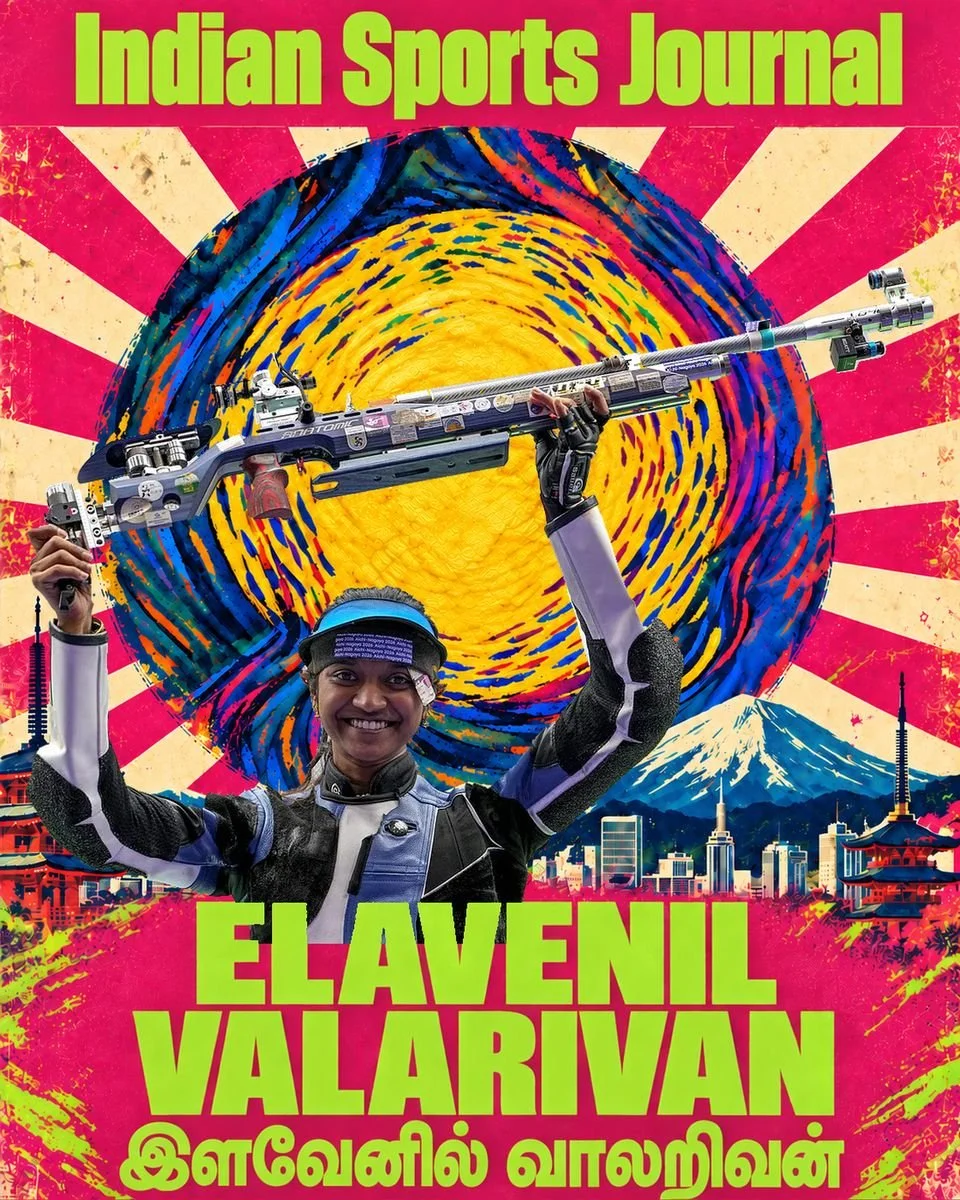
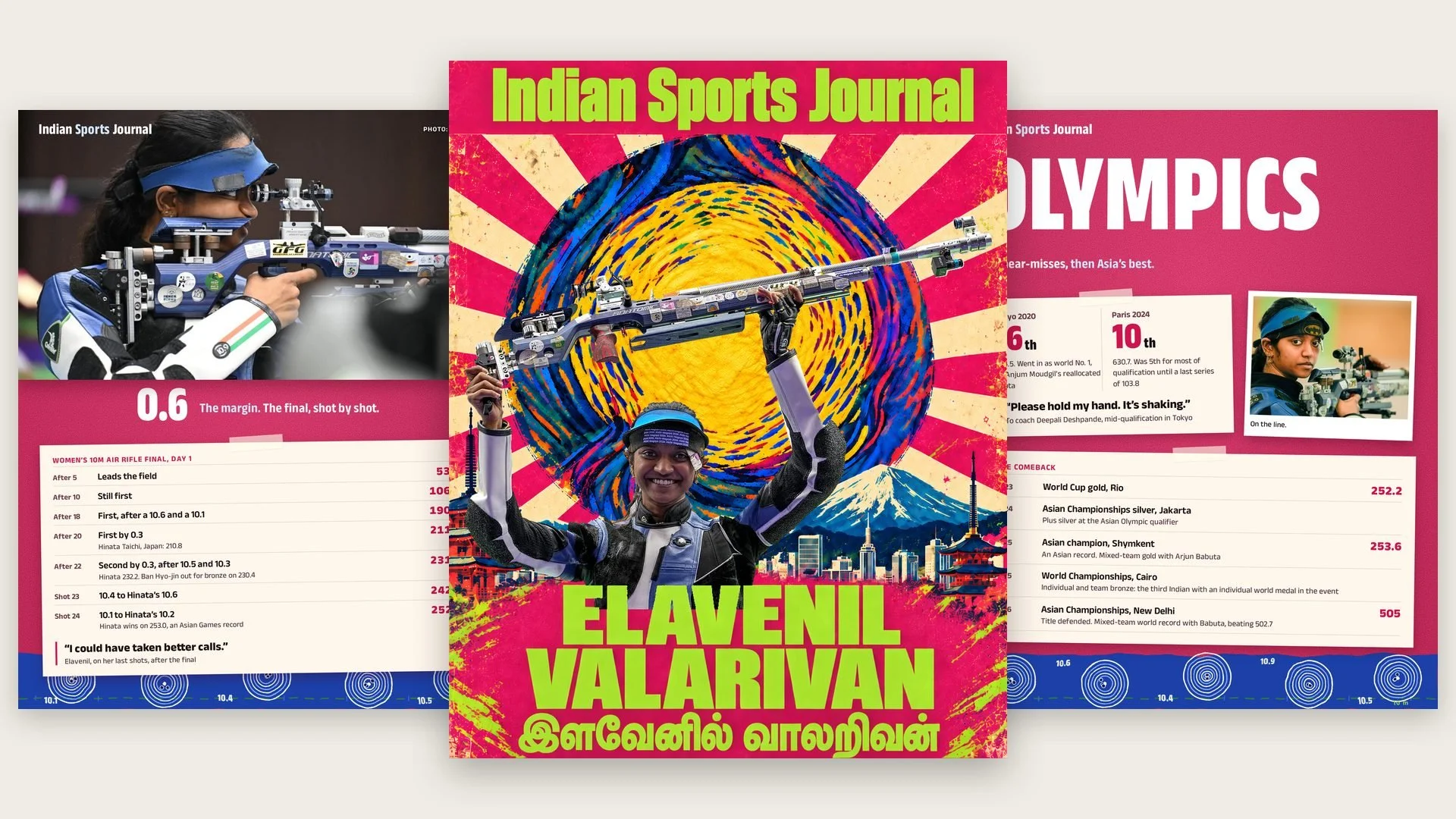
Elavenil Valarivan and the 0.6
India’s first medallist at Aichi–Nagoya won two silvers on Sunday and led the individual final from the first series until the 22nd of its 24 shots. She lost it by the same margin that kept her out of the Paris final, and she has said where it went.
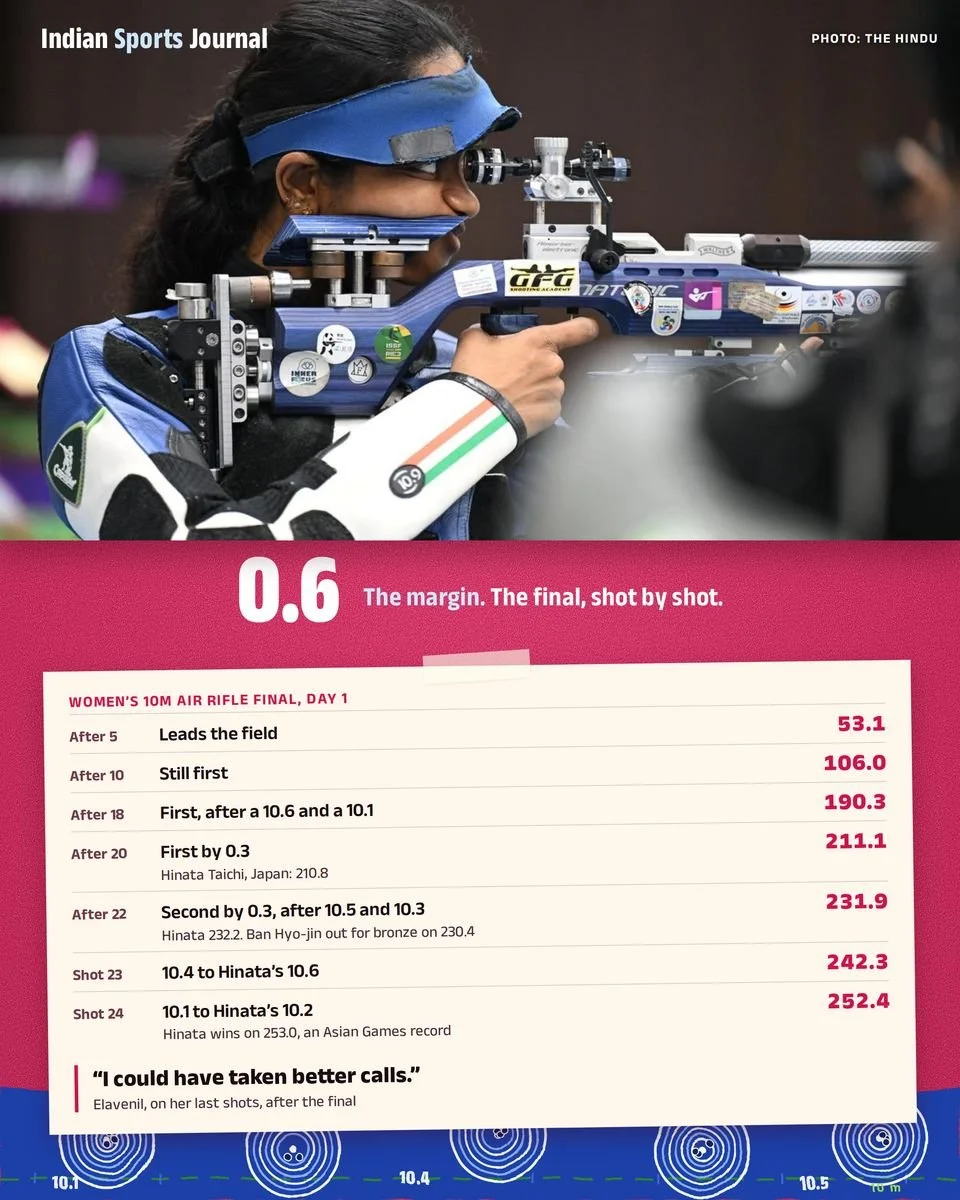
Elavenil Valarivan was in front of the women’s 10m air rifle final at the Aichi–Nagoya Asian Games after the first five shots, after 10, after 17 and after 21. She was not in front after 24. Japan’s Hinata Taichi, 0.2 behind with three shots left, finished 10.8, 10.6, 10.2. Elavenil finished 10.3, 10.4, 10.1. Taichi won on 253.0, an Asian Games record, and Elavenil took silver on 252.4.
It was her second silver of Sunday. Her 633.5 in qualification had already been added to Sonam Maskar’s 634.1 and Vidarsa K Vinod’s 630.4 for a team total of 1898.0. At the Asian Games the team medals are decided on those three qualification scores, with no separate final, and India’s total was worth silver behind China’s world-record 1904.2, nine-tenths of a point clear of the hosts. It was India’s first medal of the Games.
The two silvers are also Elavenil’s first Asian Games medals, eight years after she went to Jakarta as a teenager and left without reaching a final. She was not in the team that won air rifle silver in Hangzhou in 2023. They come at the end of her best run of results since 2019, when she was world No. 1 at 20: Asian champion in 2025 with a score of 253.6, a first individual world championship medal that November, and the continental title retained in New Delhi in February.
That is why the final matters more than the colour of the medal. It is the clearest view yet of where Elavenil, 27, now stands: good enough to lead an Asian Games final with the Olympic champion in it until the 22nd shot, and still working out how to finish one. “Of course, I could have taken better calls, which I didn’t,” she told ANI afterwards.
In front until the 22nd shot
The team medal was settled before the final began. Sonam’s 634.1 was the third-best score of the qualification round, Elavenil’s the seventh and Vidarsa’s the 12th, which put two Indians among the eight finalists.
| Place | Team | Total |
|---|---|---|
| Gold | ChinaWang Zifei 636.8, Han Jiayu 633.8, Du Yuchen 633.6. A world record | 1904.2 |
| Silver | IndiaSonam Maskar 634.1 (3rd), Elavenil Valarivan 633.5 (7th), Vidarsa K Vinod 630.4 (12th) | 1898.0 |
| Bronze | Japan0.9 behind India | 1897.1 |
| 4th | KoreaBan Hyo-jin, Kwon Yu-na, Cho Eun-byeol | 1895.8 |
The final runs to two series of five shots and then 14 single shots, with the last-placed shooter eliminated after the 12th shot and after every second shot from then on. Elavenil led after the first series with 53.1 and was on 106.0 after 10, 0.7 ahead of Japan’s Misaki Nobata, with Ban Hyo-jin, Korea’s Paris Olympic champion, third. Her single shots held the lead: 10.6, 10.3, 10.8, 10.7, 10.7, 10.5. After 17 she was 1.4 clear of Ban, with Taichi third. Sonam, joint fifth after 10, went out in sixth place on 167.0.
The lead narrowed from there. A 10.1 on the 18th shot left Elavenil on 190.3, and when the fourth-placed shooter went out after 20 the three left were close together: Elavenil 211.1, Taichi 210.8, Ban 210.0. On the 21st shot Ban hit 10.8, Taichi 10.6 and Elavenil 10.5, which left Elavenil 0.2 in front. On the 22nd Taichi hit 10.8, Elavenil 10.3 and Ban 9.6. Ban went out with bronze on 230.4, and Taichi went ahead, 232.2 to 231.9. Over the last three shots she outscored Elavenil 31.6 to 30.8.
Elavenil’s account of the last three shots was specific. “I did get a bit relaxed,” she said, according to PTI. “I really need to work on my finals some more.” To ANI she said she could have been “a little more patient in taking my shots and possibly worked a little more on my breathing.” She told myKhel she had felt herself drifting: “I think I kind of knew that I was getting a bit distracted from my technique going on to the medals.”
She did not reach for the conditions either. Indian athletes had reported problems with their accommodation in Nagoya, and she acknowledged them, “a lot of issues with the arrangements here when we arrived,” and set them aside: “I think as shooters, we generally live on one lane.”
Born in Tamil Nadu, made in Gujarat
Elavenil was born in Cuddalore on 2 August 1999, and the family moved to Ahmedabad when she was three. Both her parents have PhDs, and her father is a scientist. “Both my parents are into academics and I had no idea about shooting or rifles,” she told SheThePeople in 2018. Before rifles, she ran: “I used to run 100m and 5 km earlier at the state level.”
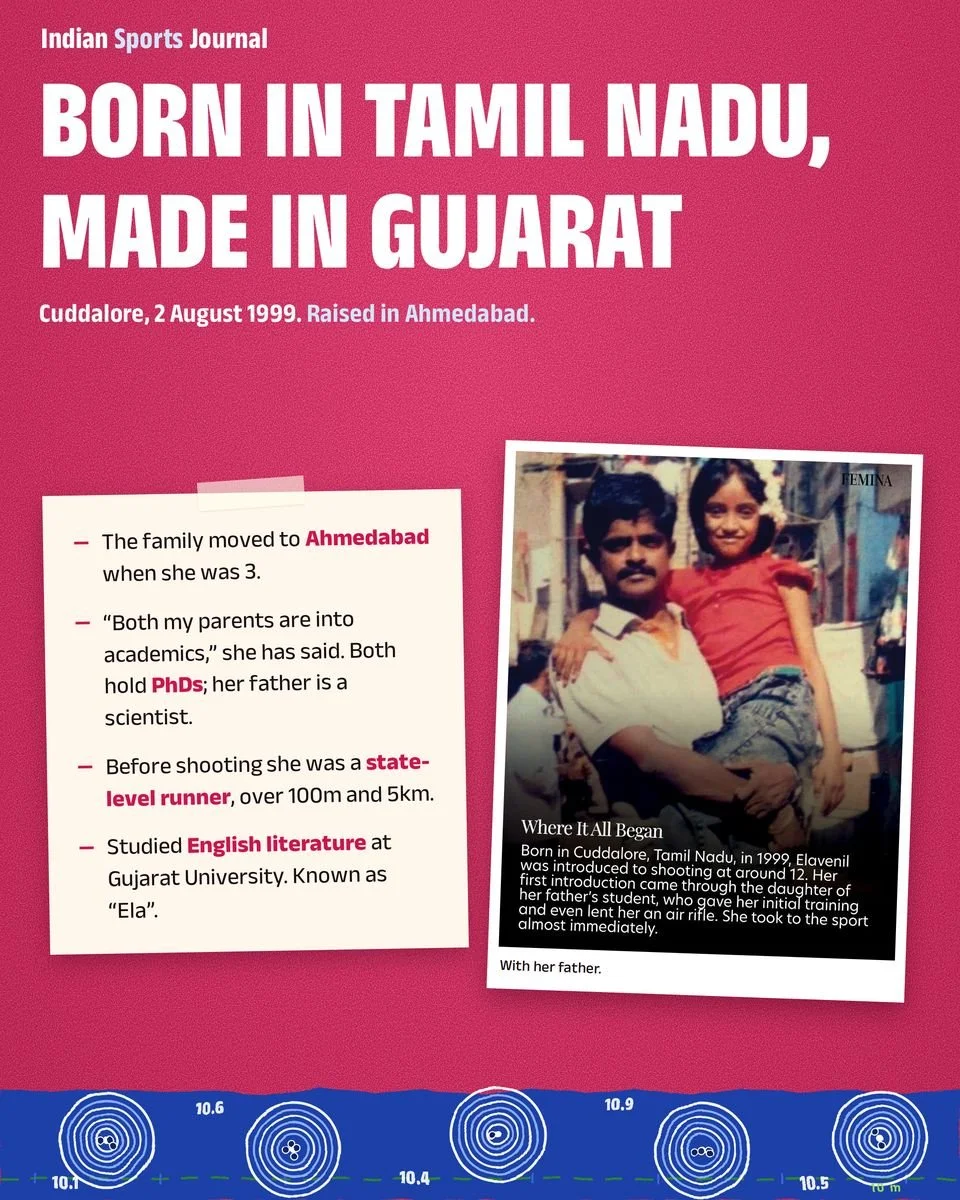
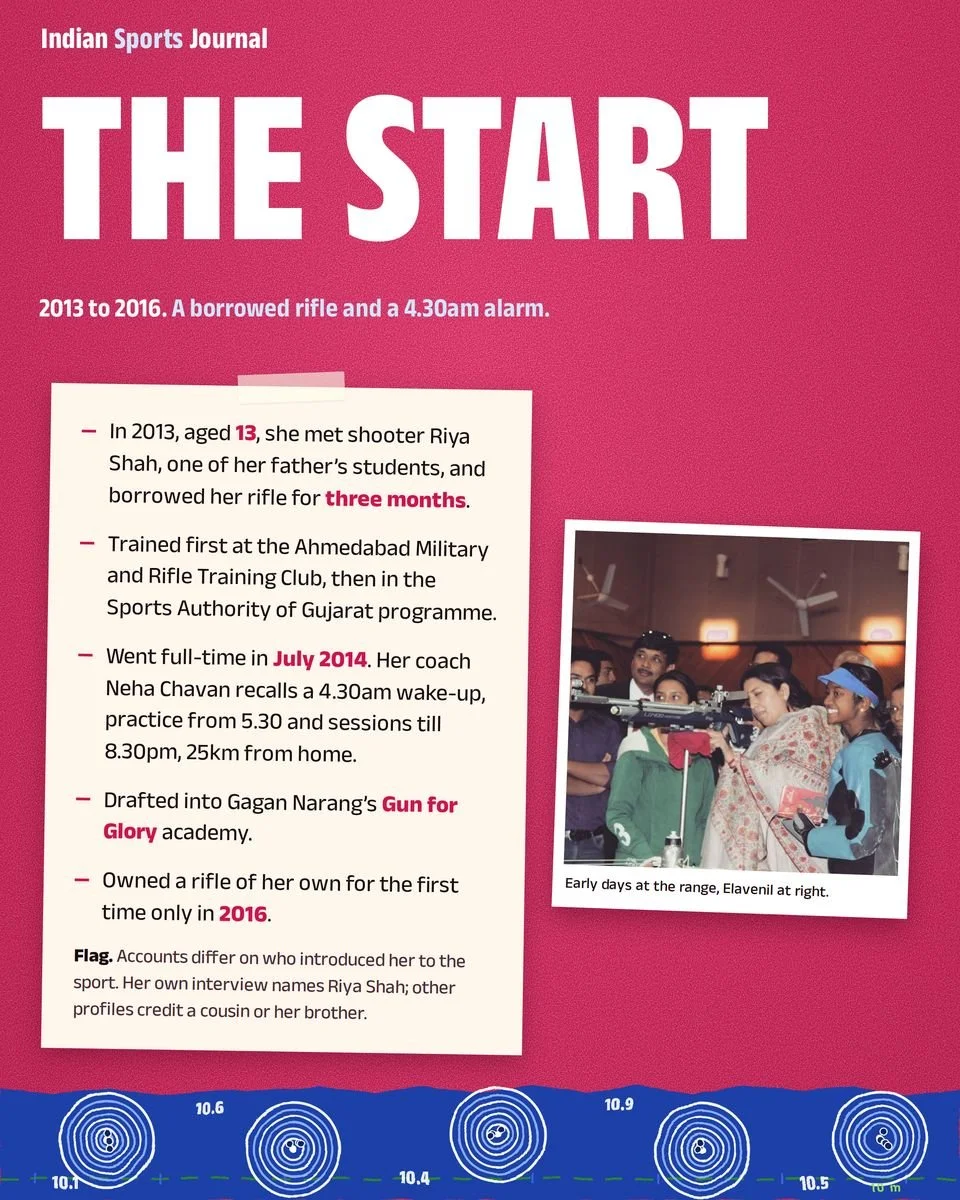
In her own telling, the start came in 2013, when she was 13. Her father took her to the Ahmedabad Military and Rifle Training Club to meet one of his students, the shooter Riya Shah, who introduced her to the sport, and Elavenil borrowed Shah’s rifle for three months. Other profiles from the same year differ. The News Minute wrote that a cousin had introduced her; The Quint described the rifle as a spare lent by a friend of her father’s student. ISJ’s carousel kept that conflict on the slide, and so does this page.
She went full-time in July 2014, trained in the Sports Authority of Gujarat’s programme and at Gun for Glory, Gagan Narang’s academy in Ahmedabad. Narang found her name hard to pronounce. “He tried pronouncing my name a few times but he just found it easier to call me Ela instead,” she told ESPN in 2019, and the name stuck. Her coach, Neha Chavan, who is still her personal coach, described the routine to The News Minute in 2018: up at 4.30, on the range by about 5.30, training until 8.30 at night. She did not own a rifle until 2016. She studied English literature at Gujarat University.
World No. 1 at 20
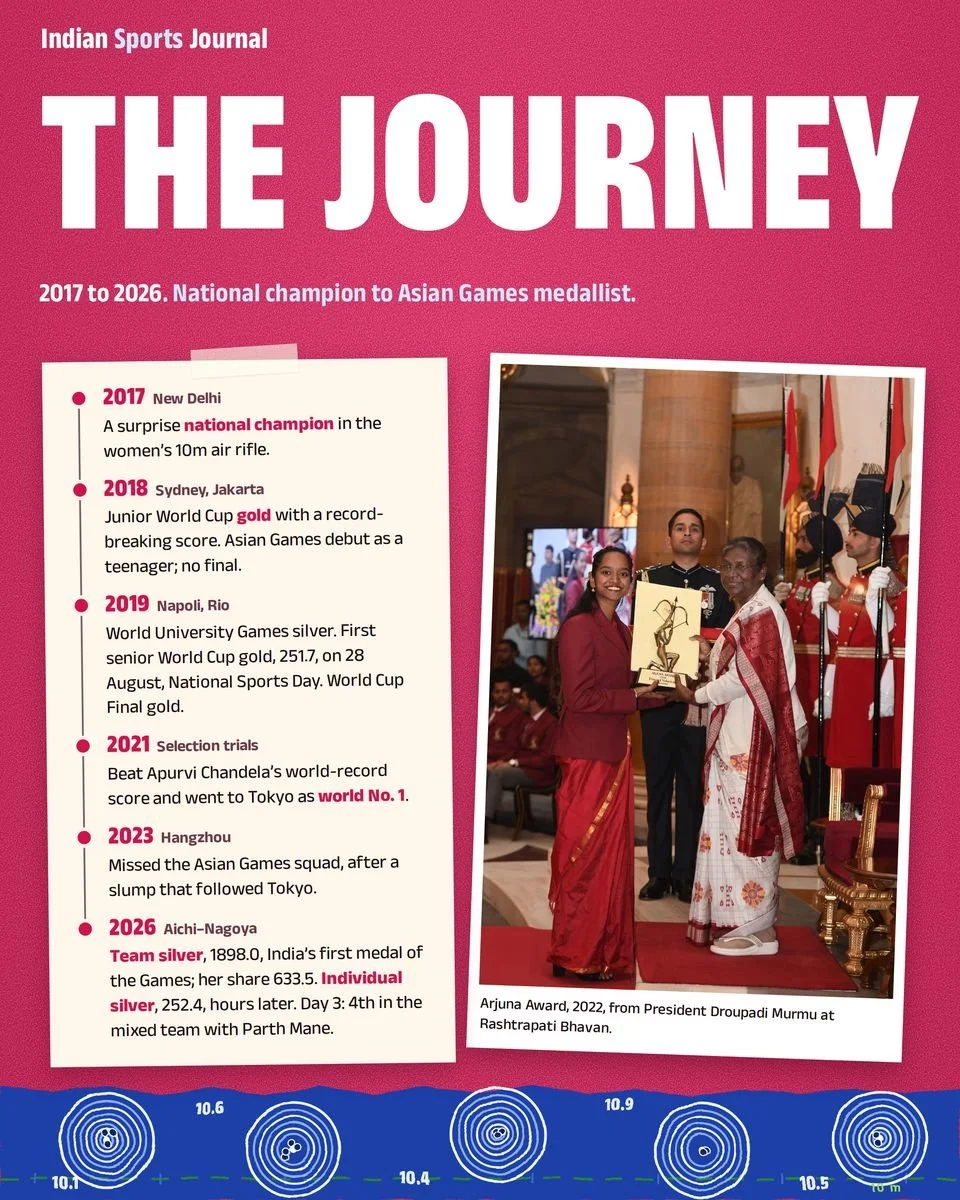
The rise, when it came, was quick. She won gold at the 2017 national championships. In March 2018, having finished fourth in the trials for that year’s Commonwealth Games (“I was not upset, but it pinched me,” she told The Quint), she went to the Junior World Cup in Sydney, shot 631.4 in qualification, above both the junior world record of 629.1 and the senior mark of 629.5, and won gold. By August she was at the Asian Games at 19, and finished 14th in qualification.
In 2019 she won silver at the World University Games in Napoli, the Asian airgun title in Taoyuan and, on 28 August in Rio de Janeiro, her first senior World Cup gold, with 251.7 to Britain’s Seonaid McIntosh’s 250.6. She also won the World Cup Final in Putian.
By the time India picked its Tokyo team she was ranked No. 1 in the world. The National Rifle Association of India ranked its shooters on the average of their five best international scores, and before the New Delhi World Cup in March 2021 hers, 631.09, led Apurvi Chandela’s 629.65, ESPN reported. At the national trials in February 2021 she shot 253.0 in a final, a tenth more than the world record Chandela had set in 2019, though in a domestic trial rather than an ISSF competition. She took the individual place for which Anjum Moudgil had won India’s quota at the 2018 World Championships.
| Year | Event | Result |
|---|---|---|
| 2018 | Junior World Cup, SydneyGold, after a qualification score above the junior world record | 631.4 |
| 2018 | Asian Games, Jakarta–PalembangDebut at 19; no final | 14th |
| 2019 | World Cup, Rio de JaneiroFirst senior World Cup gold, 28 August | 251.7 |
| 2019 | World Cup Final, PutianGold, in the year she reached world No. 1 | Gold |
| 2021 | Olympic Games, TokyoWent as world No. 1; 16th in qualification | 626.5 |
| 2023 | World Cup, Rio de JaneiroGold from the last qualifying place; not in the Hangzhou team | 252.2 |
| 2024 | Olympic Games, Paris10th, 0.6 below the last place in the final | 630.7 |
| 2025 | Asian Championships, ShymkentGold in an Asian record; mixed-team gold with Arjun Babuta | 253.6 |
| 2025 | World Championships, CairoBronze, her first individual world medal; team bronze | 232.0 |
| 2026 | Asian Championships, New DelhiIndividual, team and mixed-team golds; a mixed-team world record of 505.0 | 3 golds |
| 2026 | Asian Games, Aichi–NagoyaTeam silver on 1898.0, then the individual silver; fourth in the mixed team | 252.4 |
The decimals
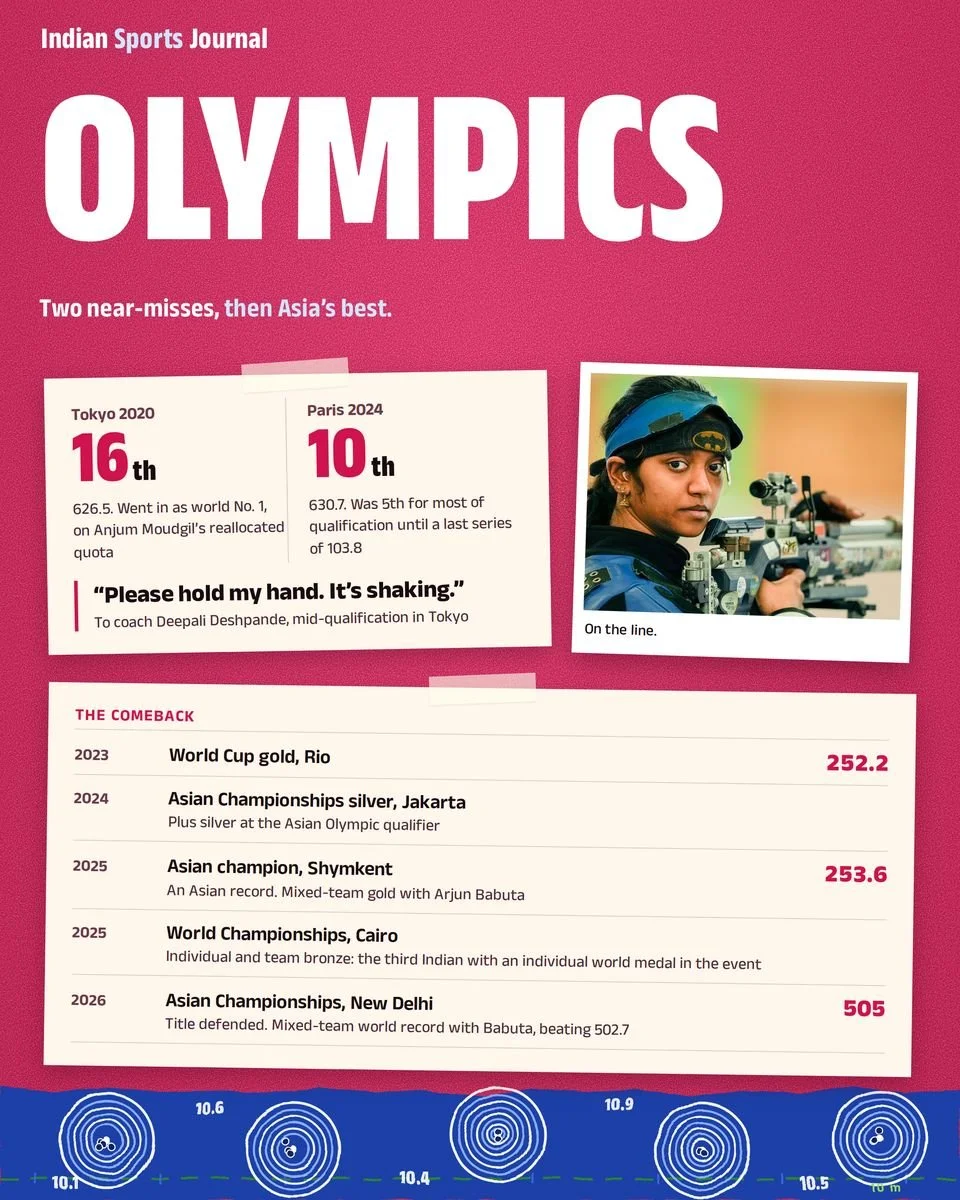
Tokyo did not go to plan. After her second qualification series she turned to the national coach, Deepali Deshpande: “Please hold my hand. It’s shaking.” She finished 16th on 626.5. Deshpande told ESPN that Elavenil had stayed too cautious once she settled, “a tactically wrong move,” and called it what it was, a first Games: “the Olympic final is not a galaxy far away.”
For a while it was further away than that. Between the World Cup Final in 2019 and the Rio World Cup in September 2023, Elavenil did not win an individual medal at a World Cup, a World Championship or an Asian Championship; her medals at those events in those years, by her Wikipedia record, came in team and mixed competitions. When India’s women won air rifle team silver in Hangzhou on 24 September 2023, the team was Mehuli Ghosh, Ramita Jindal and Ashi Chouksey. Eight days earlier, Elavenil had won the World Cup in Rio from the last of the eight qualifying places, 630.5 in qualification and 252.2 in the final, 0.3 ahead of France’s Océanne Muller.
Paris was closer, and in its way harder. Her six qualification series read 105.8, 106.1, 104.4, 105.3, 105.3 and then 103.8, with a 9.8 on the 59th shot. She had been fifth for much of the round, by The Free Press Journal’s account. She finished 10th on 630.7. Muller, the shooter she had edged in Rio, took the last place in the final with 631.3. The gap was 0.6.
The comeback
What has changed since is mostly in the finals. At the Asian Championships in Shymkent on 22 August 2025 she won with 253.6, the women’s final record on the Asian Shooting Confederation’s list, and took the mixed-team title with Arjun Babuta. At the World Championships in Cairo in November she qualified fifth on 633.4 and took bronze on 232.0, behind Ban and China’s Wang Zifei. It was her first individual world medal, and only the third by an Indian woman in the event, after Anjum Moudgil in 2018 and Mehuli Ghosh in 2023. “Definitely one of the most intense finals that I have ever been a part of,” she said. The team took bronze too, with Meghana Sajjanar and Shreya Agrawal.
In February, at home in New Delhi, she kept the Asian title, won the team gold, and with Babuta won the mixed final on 505.0, a world record that beat the 502.7 set by Germany’s Hanna Buehlmeyer and Maximilian Ulbrich the previous month. “I am happy my learnings are working,” she said. Her 2026 World Cup season was uneven: sixth in Hangzhou and 19th in Munich, by the ISSF’s record.
The set-up around her has been stable. Chavan remains her personal coach, with Deshpande and Deepak Dubey as national coaches, according to her ISSF profile. The NRAI now picks its Asian Games teams through ranking trials, a system that left the defending 50m rifle three-positions champion, Sift Kaur Samra, at home. Elavenil came through it, and she was clear about whose medal the team silver was. “I think I’m very grateful to have got such a team with Sonam and with Vidarsa,” she told myKhel. “Without them, I think the silver wouldn’t have been possible.” Vidarsa, whose main event, the 50m rifle three positions, is on Saturday, said the silver had “given us a good start.”
On Tuesday, Elavenil and Parth Mane qualified second for the mixed-team final on 634.6, behind China’s Wang Zifei and Sheng Lihao, and finished fourth. The Chinese pair won with a world record of 507.1.
What comes next
Her programme in Aichi–Nagoya is finished. The work she named afterwards is on the last shots of a final, and the numbers suggest that is the right place to look. Her best final, the 253.6 in Shymkent, is 0.6 more than the score that beat her on Sunday.
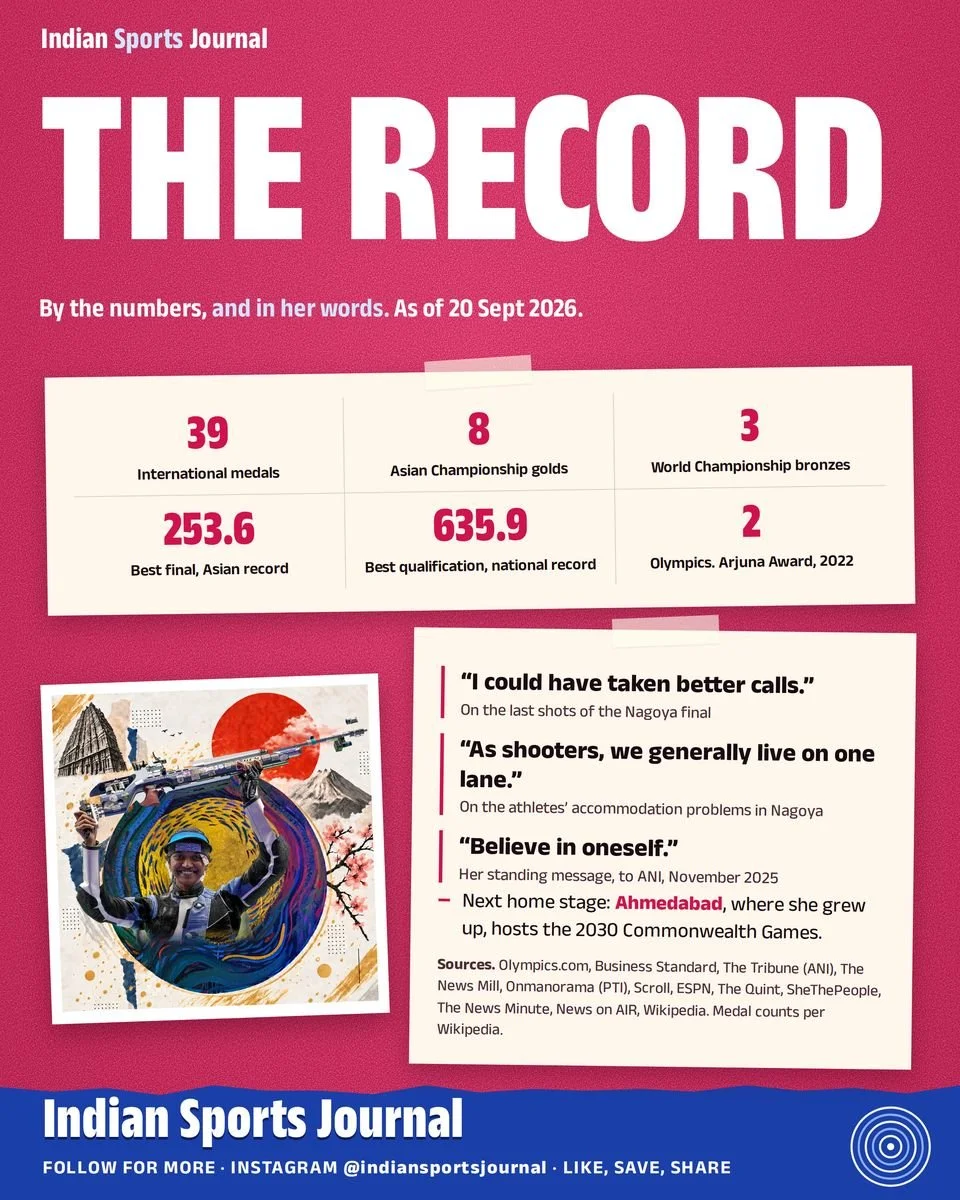
The next fixed points are further off. A third Olympics would come in Los Angeles in 2028. Ahmedabad, where she grew up and learned the sport, hosts the 2030 Commonwealth Games, though shooting was not among the sports Commonwealth Sport had confirmed for that programme when ISJ last reported on it, in July.
She has spent a decade showing she can shoot the scores. On Sunday the gold went in the last three shots, and that, by her own account, is the part still to fix.
India finished the Games on 4 October with 85 medals, 21 of them gold, fourth on the table; Elavenil’s two silvers on the first day were the start of it. Her ISSF athlete profile, viewed on 28 October, ranks her sixth in the world in the women’s 10m air rifle and lists no competition after the Games.
Sourcing. ISJ’s Day 1 recap (20 September) and the research behind its air rifle carousels; for the final, ANI (via ThePrint and Asianet Newsable), PTI (via DT Next), IANS (via Telangana Today), The Korea Times and myKhel; the Asian Shooting Confederation’s official records list of 14 February 2026; the ISSF athlete profile and news pages; Wikipedia (her medal record, and the 2019 Universiade shooting page); ESPN (2019, 2021); The News Minute, SheThePeople and The Quint (2018); Scroll (2021); The Bridge (2019, 2023, 2026); The Free Press Journal and Sportskeeda (2024); The Tribune, IndiaSportsHub and RevSportz (2025). Final tally from ISJ’s postscript to The Nagoya Brief.
Corrections to the carousel. Slide 4: “25km from home” — not found in any source reviewed; dropped. Slide 5: the 2017 national title is placed in New Delhi — The News Minute (2018) says that championship was held in Kerala; “surprise” is not sourced and is dropped. Slide 5: the first senior World Cup gold is dated “28 August, National Sports Day” — the Rio final was on 28 August 2019 per the ISSF; National Sports Day is 29 August, the date the result was reported in India (PTI, The Tribune). Slide 5: the individual silver came “hours later” — IANS put the two silvers “inside just over an hour”; this page says later the same day. Slide 6: “plus silver at the Asian Olympic qualifier” (2024) — no second Jakarta silver found; Wikipedia’s record lists one, individual. Slide 7: “Believe in oneself” (to ANI, November 2025) — not found; not quoted. Slide 7: 39 international medals is Wikipedia’s tally, which omits her 2019 Universiade silver (and team bronze) in Napoli; treat it as a floor. Slide 7: “Next home stage: Ahmedabad” — Ahmedabad hosts the 2030 Commonwealth Games, but shooting was not on the confirmed programme in ISJ’s July reporting. Slide 3 (inset, Femina): introduced to shooting “at around 12” — her own account says 13, in 2013.
Flag — the peak lead. ISJ’s air rifle carousel of 25 September carried a Times of India report of a lead near 1.5 against the official flow’s 0.3 after 20 shots. The fullest sequence ISJ has found shows 0.7 after 10 shots (The Korea Times), 1.4 after 17 (PTI via DT Next), 0.3 after 20 and 0.2 after 21. Margins between those checkpoints were not published, so the peak cannot be confirmed.
Flag — who introduced her. Riya Shah, her father’s student (her account to SheThePeople, 2018); a cousin (The News Minute, 2018); a friend of her father’s student (The Quint, 2018); the daughter of her father’s student (Femina, quoted on slide 3). The News Minute also dates her first shots to 2012. Slide 4’s mention of a brother was not found in any source reviewed.
Flag — conflicting reports. DT Next’s PTI report of 20 September says she competed at Hangzhou 2022 and won silver, not gold, at the 2025 and 2026 Asian Championships; the Hangzhou team list (ESPN), the Asian Shooting Confederation records and Wikipedia contradict both, and this page follows them. PTI (via DT Next and The Pioneer) gave Wang Zifei’s qualification score as 638.8; Chinese reporting (Tide News) gives 636.8, an Asian record, which with Han Jiayu’s 633.8 and Du Yuchen’s 633.6 makes China’s 1904.2, and this page uses it. Khel Now named the gold medallist “Taichi Hashimoto” and the bronze medallist “Ban Hyeon”; other reports give Hinata Taichi and Ban Hyo-jin. ISJ’s slide refers to the winner as Hinata on second reference; agency reports use Taichi, as this page does. On Paris, The Free Press Journal has her fifth for much of qualification and Sportskeeda has her dominating until the last series; this page follows the former, as the slide does.
Flag — “Asian record”. The 253.6 is the record on the Asian Shooting Confederation’s list, which counts its own championships and the Asian Games. Asian shooters have scored higher elsewhere, including Ban’s 255.0 at the 2025 World Championships.
Dropped for lack of verification. Her father’s full name (spelled Rudrapati and Ruthrapathy in different sources); the exact gap in hours between the two silvers.