The Golden Double — India's Juniors in Moqi
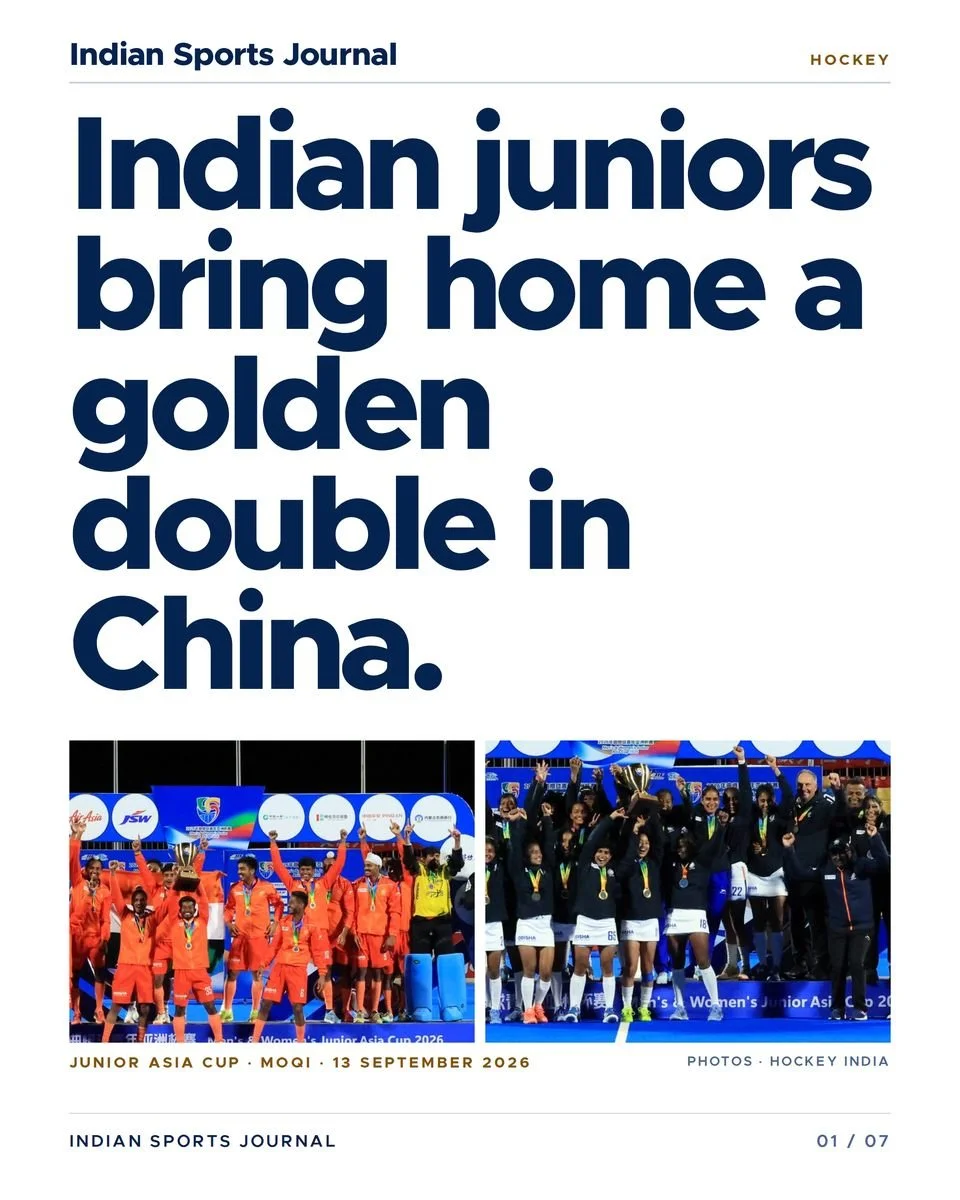
On the same Sunday in Inner Mongolia, India's junior men beat Korea 4–1 and the junior women beat the hosts 1–0. Both Junior Asia Cups defended, 13 matches without a defeat, and a women's side that let in three goals all tournament.
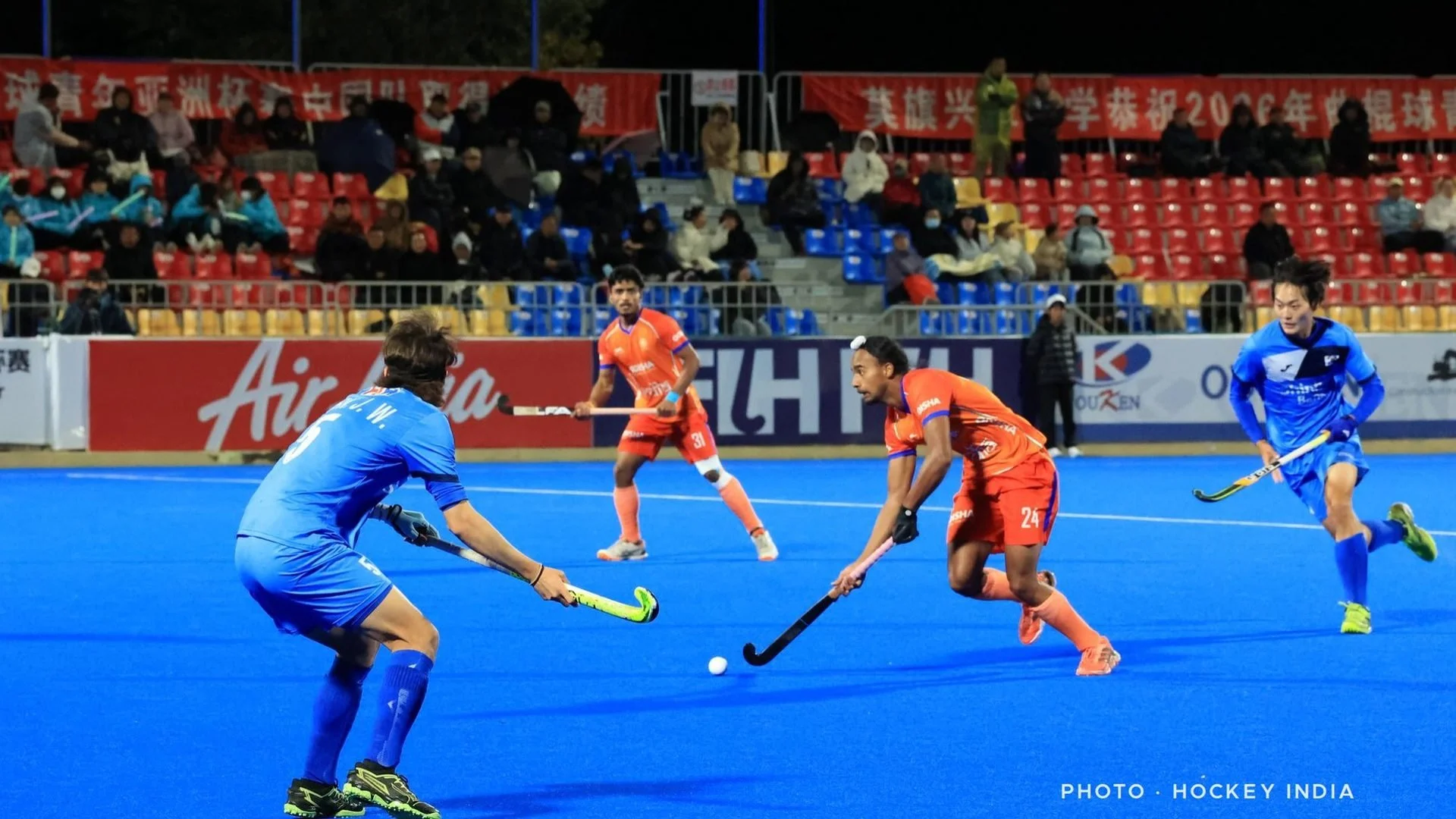
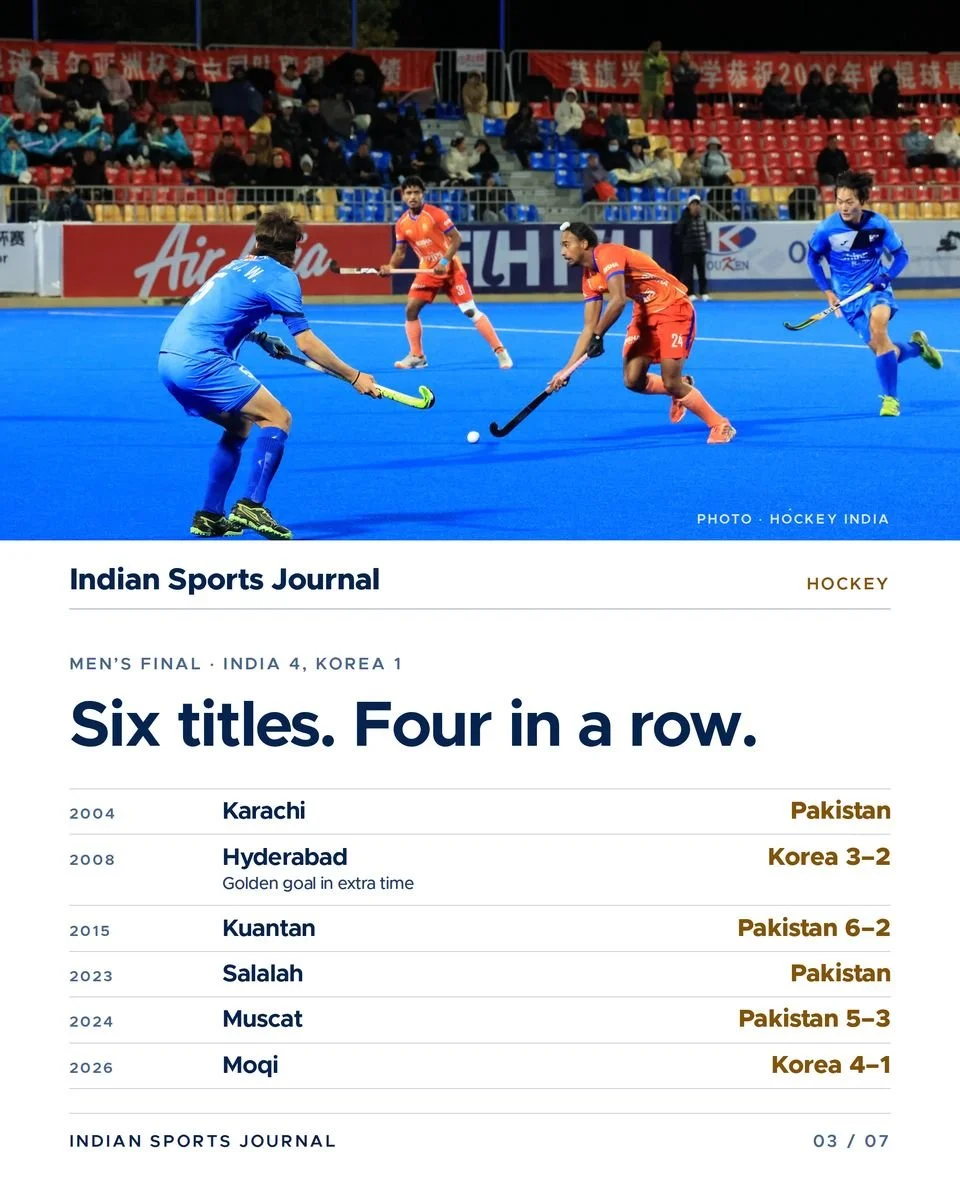
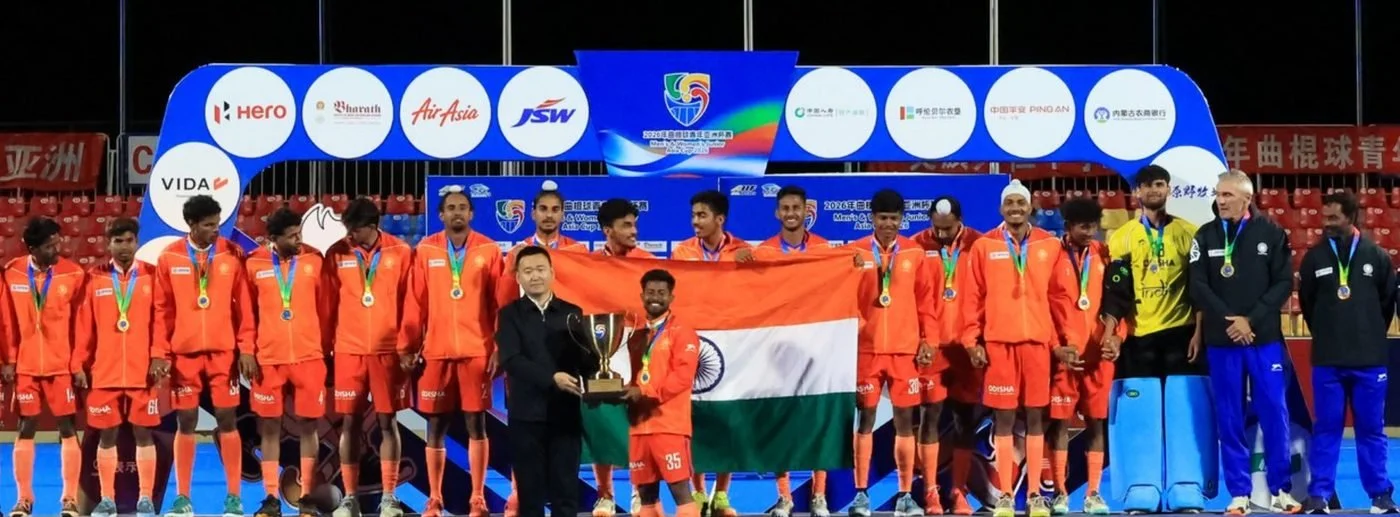
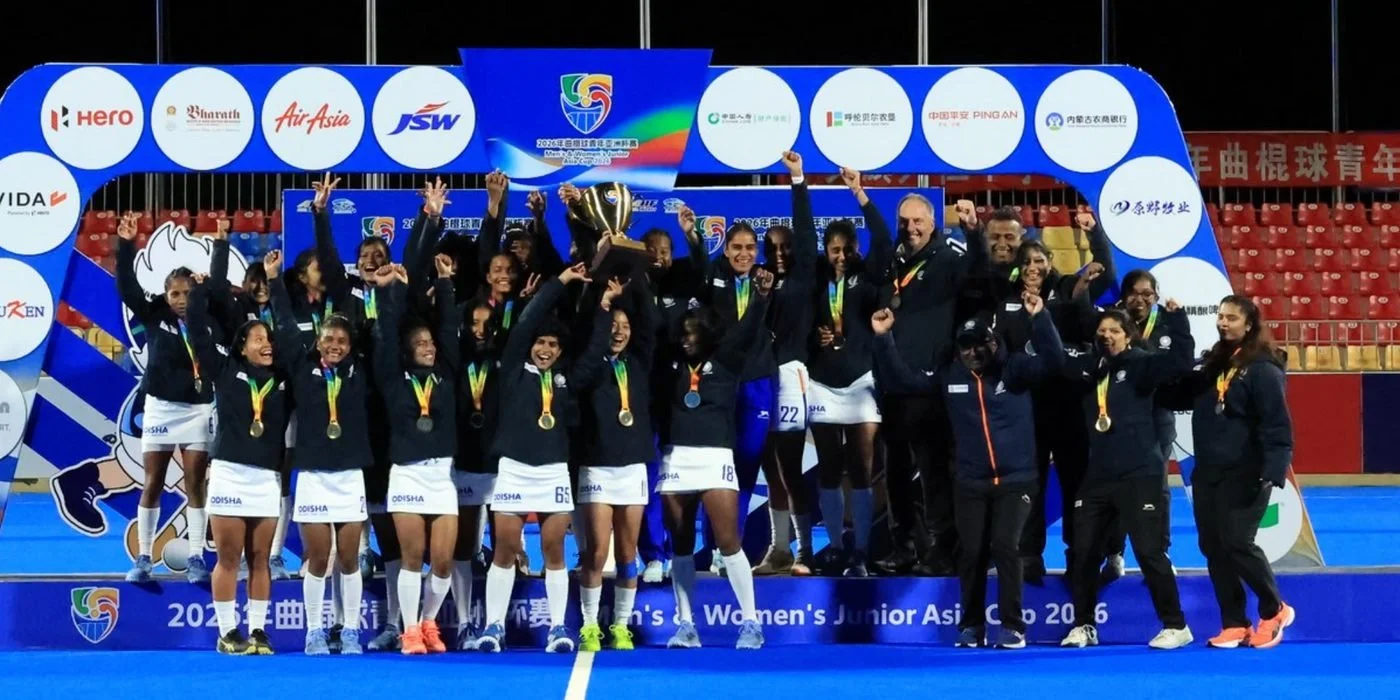
India's junior hockey teams left Moqi, in China's Inner Mongolia, with both continental titles. On Sunday the men beat Korea 4–1 to win the Men's Junior Asia Cup for a sixth time, a record, and a fourth time in a row. The women beat China, the hosts, 1–0 for their third straight Women's Junior Asia Cup. Neither side lost a match. Between them they played 13, won 11 and drew two.
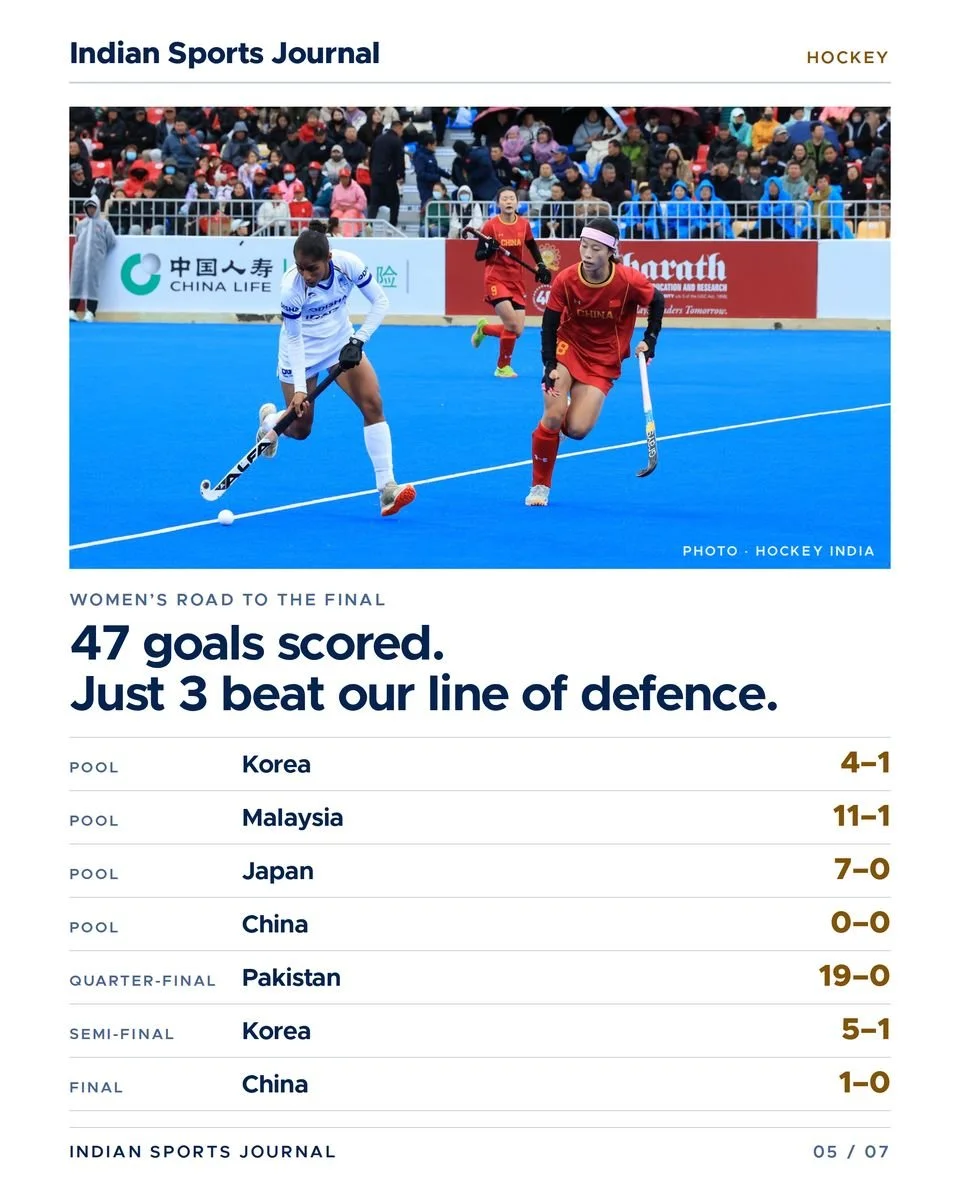
The number that defines the week belongs to the women. In seven matches they scored 47 goals and conceded three — the tally ISJ's carousel put as "47 goals scored. Just 3 beat our line of defence." It covers the women's tournament alone. The men finished on 46 for and eight against, across six matches.
Junior titles are easy to file and forget. These deserve a closer look for two reasons. They arrive two weeks after a mixed senior World Cup: the men finished eighth after losing a classification shoot-out to Belgium, and the women beat Germany 3–1 for fifth, their best finish since 1974. That puts the under-21 pipeline under closer scrutiny than usual. And the Junior Asia Cup doubled as Asia's qualifying event for the 2027 FIH Junior World Cups, where India's record — the women's especially — is far less commanding than it is in Asia.
The men: a record, and one scare
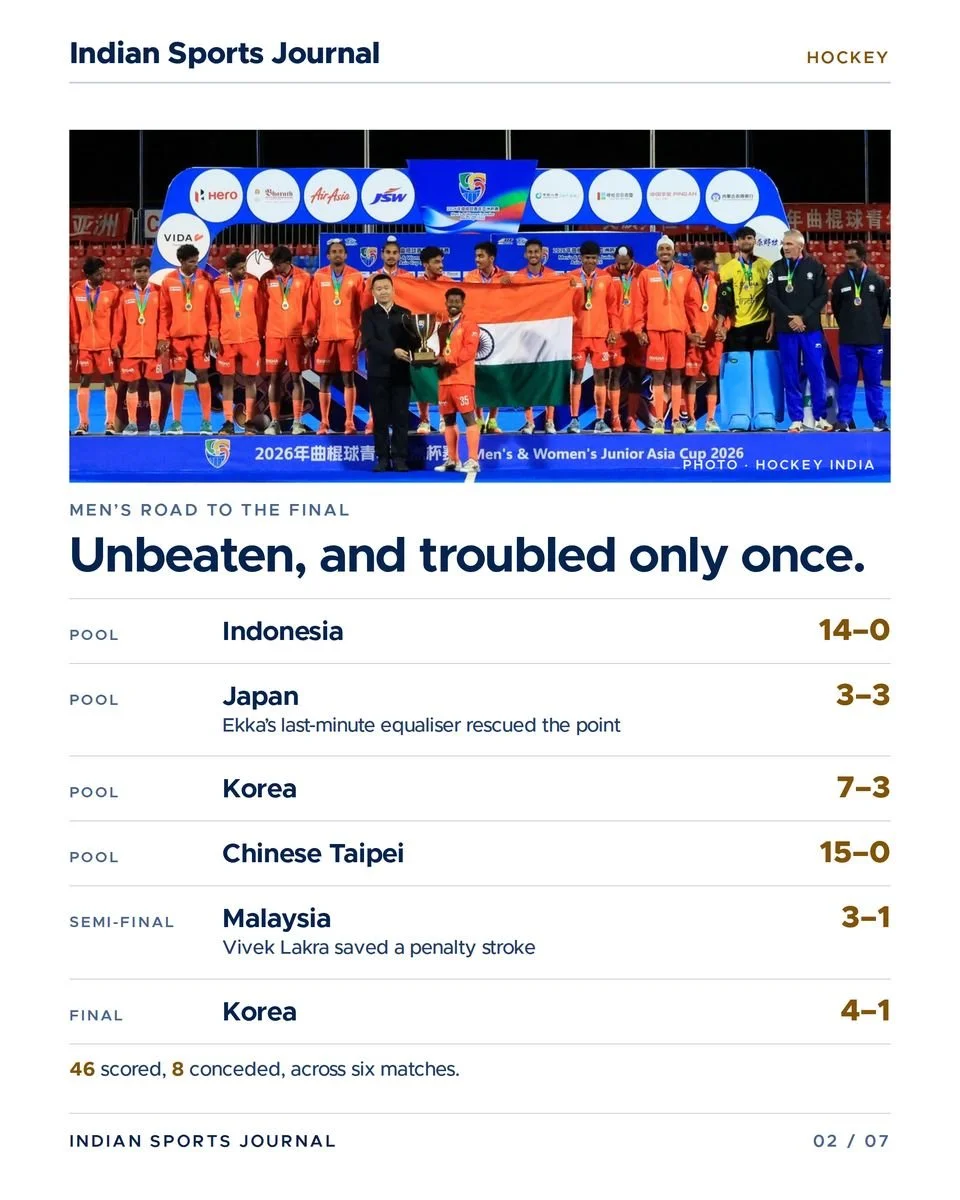
India's men were drawn in Pool A with Korea, Japan, Chinese Taipei and Indonesia, and opened on 5 September with a 14–0 win over Indonesia: five goals for Prabhdeep Singh, named player of the match, four for the captain, Anmol Ekka, and three for Ajeet Yadav.
The next day nearly cost them. India led 2–1 at half-time through Ekka's fourth-minute penalty stroke and Ashu Maurya's corner in the tenth, but Japan's Kazuki Nakanishi scored twice in the last 12 minutes, the second in the 59th, to put Japan 3–2 ahead. India withdrew their goalkeeper, won a penalty corner with 59 seconds left, and Ekka converted it for 3–3. It was one of only two matches across both tournaments that India did not win.
Korea, India's eventual opponents in the final, met them in the pool on 8 September and drew level three times before India pulled away. Ekka's fifth-minute corner was answered within a minute by Choi Dohyeon; Lovenoor Singh's goal was cancelled almost at once by Yoo Hyoguk; and after Ajeet Yadav had put India 3–2 up at half-time, Yoo levelled again early in the third quarter. From 3–3, Prabhdeep Singh scored in the 42nd minute, and Gursewak Singh, Ekka and Aryan Xess added three more in the last six minutes for 7–3. A 15–0 win over Chinese Taipei the next day, with Ekka scoring six from penalty corners, put India top of Pool A on 10 points, one ahead of Korea.
The semi-final against Malaysia on 11 September was tighter than 3–1 suggests. Ekka's 16th-minute penalty corner was the only goal for 35 minutes. Sukhvinder made it 2–0 in the 51st, and when Malaysia were awarded a penalty stroke two minutes later, goalkeeper Vivek Lakra dived to his left and kept it out with his glove. Ekka's second corner, a minute after that, settled it; Malaysia's goal came with 24 seconds left. In the other semi-final Korea beat Pakistan 4–1, Pakistan's first defeat of the tournament.
| Date | Opponent | India |
|---|---|---|
| 5 Sep | IndonesiaPool A · Prabhdeep Singh 5, Anmol Ekka 4, Ajeet Yadav 3 | 14–0 |
| 6 Sep | JapanPool A · Japan led 3–2 in the 59th minute; Ekka levelled from a corner with 59 seconds left, goalkeeper withdrawn | 3–3 |
| 8 Sep | KoreaPool A · Korea drew level three times; Prabhdeep Singh’s 42nd-minute goal began a run of four | 7–3 |
| 9 Sep | Chinese TaipeiPool A · Ekka six, all from penalty corners | 15–0 |
| 11 Sep | MalaysiaSemi-final · Ekka 16′ and 54′, Sukhvinder 51′; Vivek Lakra saved a 53rd-minute penalty stroke | 3–1 |
| 13 Sep | KoreaFinal · Ajeet Yadav 9′, Ekka 13′, Prabhdeep Singh 21′, Ashu Maurya 50′; Lee Minhyeok 54′ (stroke) | 4–1 |
| Total | Five wins, one drawTop of Pool A on 10 points; sixth title, fourth in a row | 46–8 |
Ekka's seventeen
The final on 13 September went the way the pool match had threatened to. India won two penalty corners in the first quarter and converted the second, Ajeet Yadav deflecting in the ninth minute. Ekka flicked in another corner in the 13th, Prabhdeep Singh made it 3–0 in the 21st, and India led by three at half-time. A corner struck the crossbar in the third quarter. In the fourth, a corner India kept after a referral — Korea's own challenge failed — produced Ashu Maurya's goal in the 50th minute. Korea's captain, Lee Minhyeok, scored a penalty stroke in the 54th, and their final-minute corner hit the post.
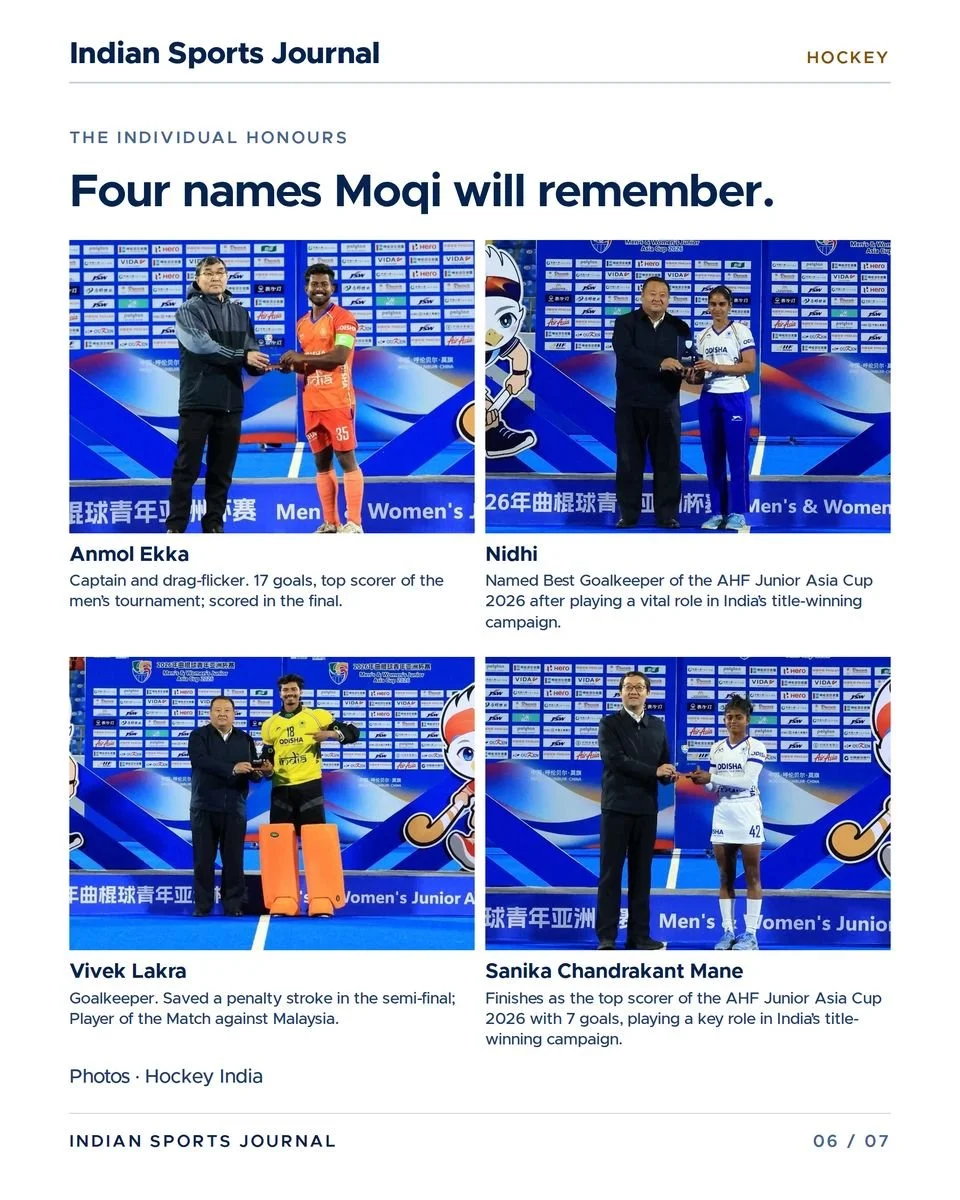
Ekka's goal in the final was his 17th of the tournament: four against Indonesia, two each against Japan, Korea and Malaysia, six against Chinese Taipei and one in the final. He is 20, a defender from Odisha, and both the side's captain and its drag-flicker. Of India's 46 goals in Moqi, 17 were his. It is a familiar shape for Indian hockey: at the senior World Cup in August, by ISJ's count, Harmanpreet Singh scored eight of India's 17 goals, every one from a penalty corner. The difference in Moqi was the support around Ekka — Prabhdeep Singh, Ajeet Yadav, Ashu Maurya and Aryan Xess all scored more than once.
The men's defence was the less convincing half of the campaign. Six of the eight goals India conceded came in the two pool matches against Japan and Korea; in the knockouts they conceded twice, a consolation in the final seconds against Malaysia and a penalty stroke in the final.
The title is India's sixth, after 2004, 2008, 2015, 2023 and 2024, and no team has won more. The current run began in 2015; in Muscat in 2024 India beat Pakistan 5–3 in the final for a third successive title, and Moqi makes it four. Hockey India announced ₹3 lakh for each player and ₹1.5 lakh for each member of the support staff, the same reward it gave the women. The side is coached by Frederic Soyez.
Forty-seven and three
Hockey India named the women's squad on 6 August: 18 players and two alternates, with Khaidem Shileima Chanu as captain and Nidhi and Engil Harsha Rani Minz in goal. "I am confident this group has the talent and character to make the country proud," said Tim White, the coach, when it was announced.
The women's tournament ran on a different structure: an Elite Pool, a Challenger Pool, then quarter-finals. India opened their defence on 5 September by beating Korea 4–1, then beat Malaysia 11–1 and Japan 7–0. The pool decider against China on 9 September finished 0–0, with goalkeeper Nidhi saving a Chinese penalty stroke in the first quarter. India and China both finished on 10 points; India topped the pool on goal difference.
The quarter-final on 10 September, against Pakistan, who had finished third in the Challenger Pool, became a 19–0 rout: 10–0 at half-time, 13 different scorers and a hat-trick for Pooja Malik. In the semi-final two days later, against a Korea side that had come through its own quarter-final against Malaysia, Supriya scored a hat-trick and Madhu Sidar and Sukhveer Kaur one each in a 5–1 win over Korea, whose goal came from Yuri Jeong.
| Date | Opponent | India |
|---|---|---|
| 5 Sep | KoreaElite Pool · Title defence opens; Sanika Chandrakant Mane on the scoresheet | 4–1 |
| 6 Sep | MalaysiaElite Pool · Mane twice | 11–1 |
| 8 Sep | JapanElite Pool · A place in the quarter-finals sealed | 7–0 |
| 9 Sep | ChinaElite Pool · Nidhi saved a first-quarter penalty stroke; India top the pool on goal difference | 0–0 |
| 10 Sep | PakistanQuarter-final · Thirteen different scorers; Pooja Malik hat-trick; 10–0 at half-time | 19–0 |
| 12 Sep | KoreaSemi-final · Supriya hat-trick; Madhu Sidar and Sukhveer Kaur | 5–1 |
| 13 Sep | ChinaFinal · Sanika Chandrakant Mane 17′ | 1–0 |
| Total | Six wins, one drawUnbeaten; third title in a row | 47–3 |
The three goals India conceded came in the 4–1 against Korea, the 11–1 against Malaysia and the semi-final against Korea. India kept clean sheets against Japan, Pakistan and, twice, China — the only team to take a point off them. White's side conceded in three of its seven matches and never more than once in any of them.
A final won at the back
The final on 13 September was decided by one moment of anticipation and 43 minutes of defending. China had more of the ball in a goalless first quarter. Two minutes into the second, Sanika Chandrakant Mane slipped in behind a defender five metres from goal and got her stick to a long slap-push into the circle; the deflection beat goalkeeper Xu Mengjiao. China's only penalty corner of the match went in, but was ruled out because the ball entered the goal above the permitted height of the backboard. The captain, Khaidem Shileima Chanu, had a shot saved two minutes before half-time. Early in the third quarter India's defence read and cut out a minus pass from the baseline. After that, by Hockey India's account, the final quarter was a test of India's organisation around their own circle, and they passed it.
Mane, named player of the match, finished with seven goals: one against Korea, two against Malaysia, one against Japan, two against Pakistan and the winner in the final. She comes from Nool, a village in Kolhapur district in Maharashtra. According to Punekar News, her mother, Jyoti, played hockey at national level, her elder sister, Krishna, has also played nationally, and her father, Chandrakant, is a farmer. Athletics came first; the coach Aniket More spotted her early, and training with the Sports Authority of India made her a stronger technical player, the site reports.
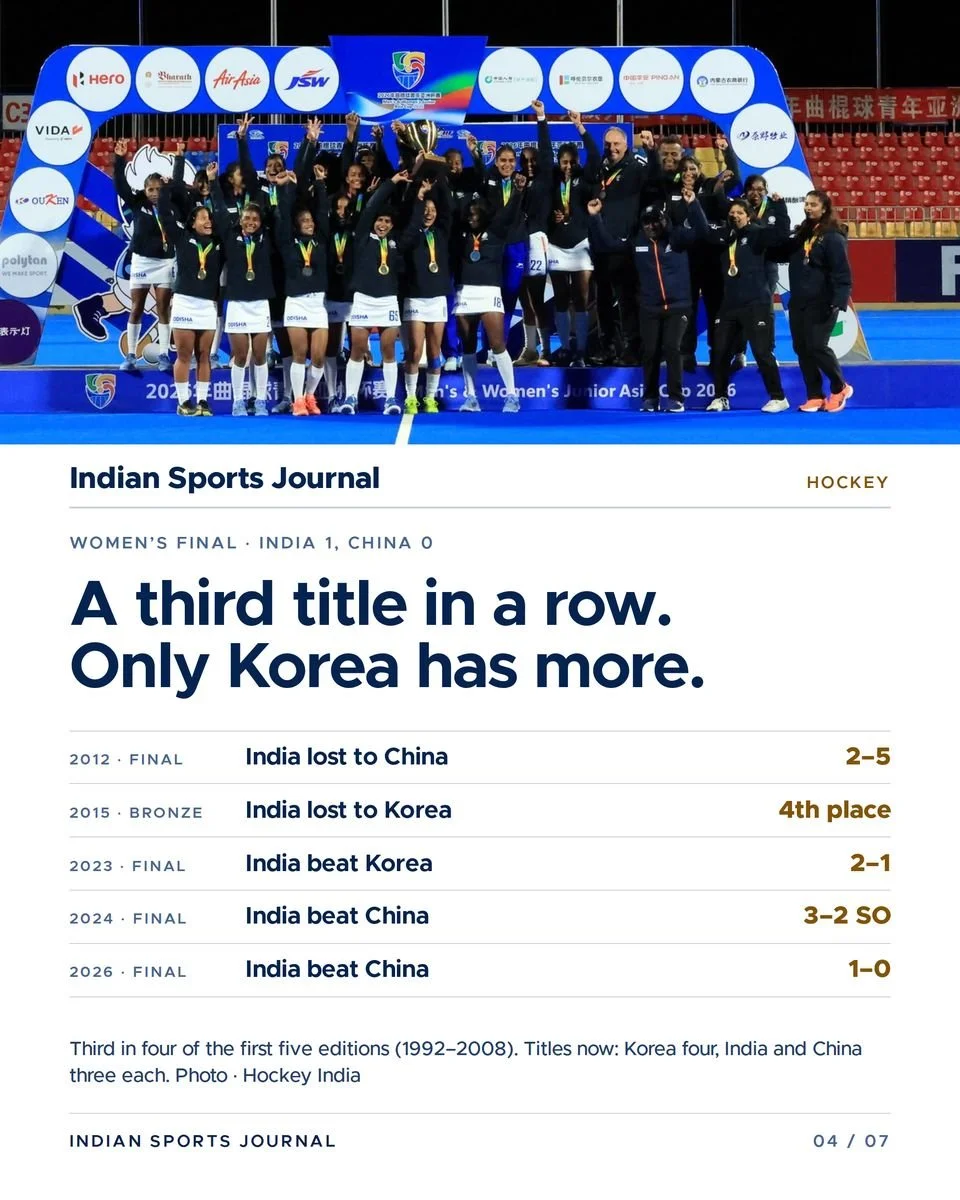
The title is the women's third in a row and their third in all. Before 2023 India had never won it; they beat Korea in that year's final, then retained the title in Muscat in 2024 by beating China in a shoot-out after a 1–1 draw, Nidhi making three saves. Tim White, who took charge of the team earlier this year, has won the event at his first attempt.
What the titles buy
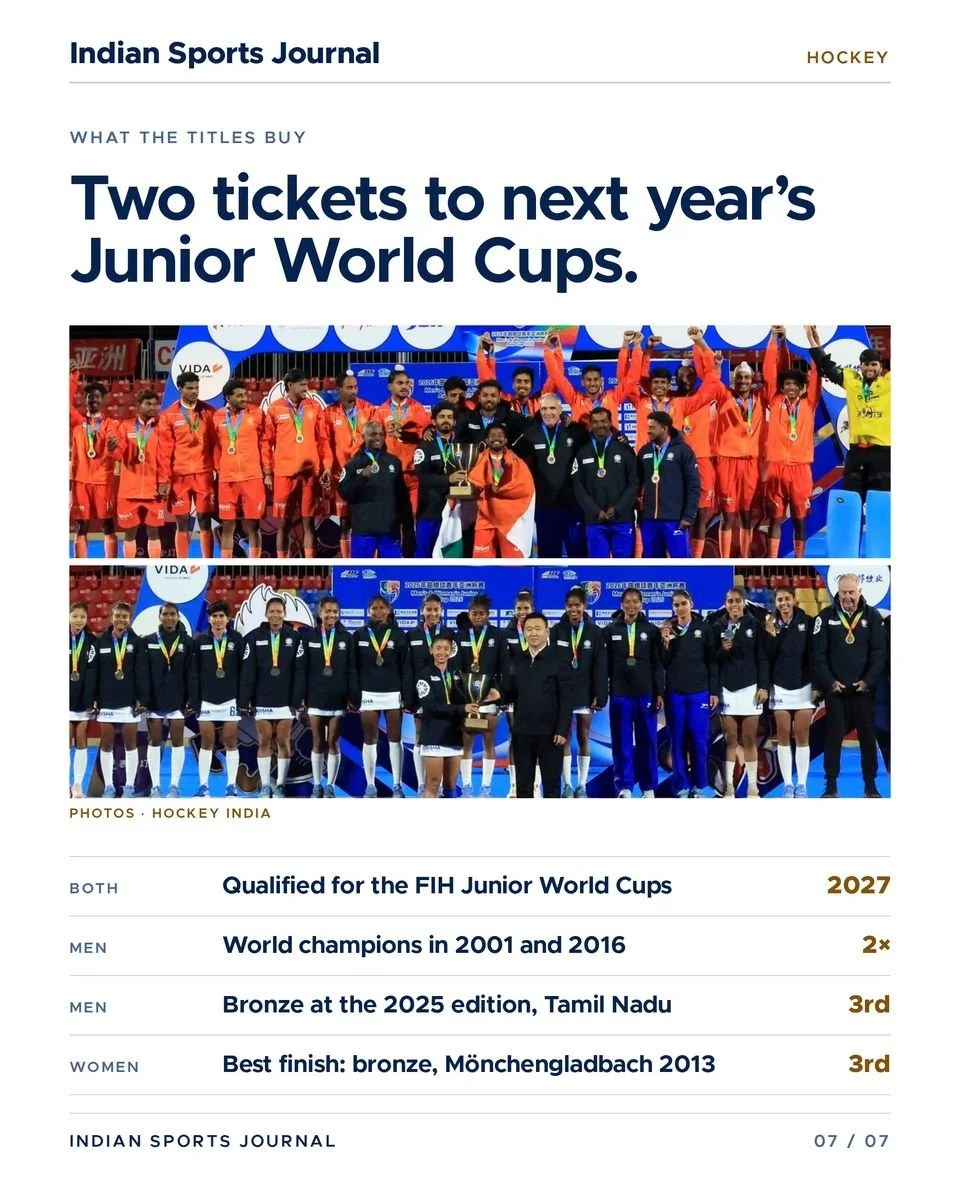
The titles themselves were not the World Cup ticket. Under FIH's qualification system for 2027, each 24-team Junior World Cup takes the top three from the Junior Asia Cup. Asia also earned further places through the junior world rankings, to be filled by the next-best finishers in Moqi: three for the men, one for the women. Both Indian teams had qualified once they won their semi-finals. On the men's side the direct places went to India, Korea and Pakistan, who beat Malaysia 4–2 for bronze. The women's picture is tighter: four Asian places in all, three of them direct. Unless a host from the continent changes the count, that is the whole of Asia's representation at the women's event. FIH's document lists both 2027 hosts as still to be confirmed; players must be born on or after 1 January 2006.
What the titles confirm is the gap between India's standing in Asia and its standing in the world, and it is widest for the women. The men's record holds at both levels: Junior World Cup champions in 2001 and 2016, fourth in 2021 and 2023, and bronze in Chennai last December, when they came from 0–2 down to beat Argentina 4–2. They went into FIH's 2027 allocation fourth in the junior world rankings, behind Germany, Spain and Argentina.
The women have now won three straight Asian titles, but their Junior World Cup results have gone the other way: bronze in Mönchengladbach in 2013, fourth in 2022, ninth in 2023, tenth in 2025. FIH ranked them eighth for the 2027 allocation, behind the Netherlands, Argentina, Germany, the United States, Belgium, England and Australia. None of the seven plays in Asia.
Men
Junior Asia Cup titles: 2004, 2008, 2015, 2023, 2024, 2026 — six, the most of any team, and four in a row.
Junior World Cup: champions in 2001 and 2016 (Lucknow); fourth in 2021 and 2023; bronze in 2025 in Chennai.
FIH junior ranking used for 2027 places: 4th.
Coach: Frederic Soyez. Captain: Anmol Ekka.
Women
Junior Asia Cup titles: 2023, 2024, 2026 — three in a row, the first in 2023.
Junior World Cup: bronze in 2013 (Mönchengladbach); fourth in 2022; ninth in 2023; tenth in 2025.
FIH junior ranking used for 2027 places: 8th.
Coach: Tim White. Captain: Khaidem Shileima Chanu.
That is the honest reading of Moqi. India's men are a junior side that wins in Asia and contends in the world. India's women are a junior side that now wins in Asia almost without conceding, and has not yet carried that defence into a Junior World Cup. Three goals against in a week is the best evidence yet that it can.
Asia is settled. The world is not.
Sourcing. Built from ISJ's "Junior Week" reporting of 13–15 September, the Hockey India match reports for both finals, and match reports from IANS, Khel Now, The Bridge, Outlook, DT Next, Odisha Bytes, The Star (Malaysia), The Express Tribune, Minute Mirror, Telangana Today, The Sentinel, News On Air and Punekar News; FIH's qualification system for the 2027 Junior World Cups; Olympics.com, The Bridge, Outlook and Zee News for earlier editions. The senior World Cup finishes are from ISJ's August 2026 recap, and Harmanpreet Singh's World Cup scoring from ISJ's World Cup analysis.
Flag — the "47 and 3" line. ISJ's carousel headline ("47 goals scored. Just 3 beat our line of defence.") describes the women's seven matches only; the men scored 46 and conceded 8 in six. It was also the only first-person line in the carousel.
Flag — awards. Hockey India's wording has Sanika Chandrakant Mane as top scorer; adda247 lists her as joint top scorer on seven, and the other player could not be confirmed. Tournament awards (best goalkeeper, best player) could not be verified and are not carried. Adda247's claim that Ekka's 17 is a tournament record is single-sourced and not carried.
Flag — single sources and dates. Mane's family background rests on Punekar News alone. Hockey India's squad release gave the women's tournament as 30 August–13 September while its fixtures listed play from 4 September; this page uses per-match dates. One IANS headline styled the women's side "U-19"; Junior World Cup eligibility is under-21. A claim on an earlier slide that Korea reached their first men's final in 18 years was not verified and is not carried. The women's other semi-final and bronze-medal match are not shown.