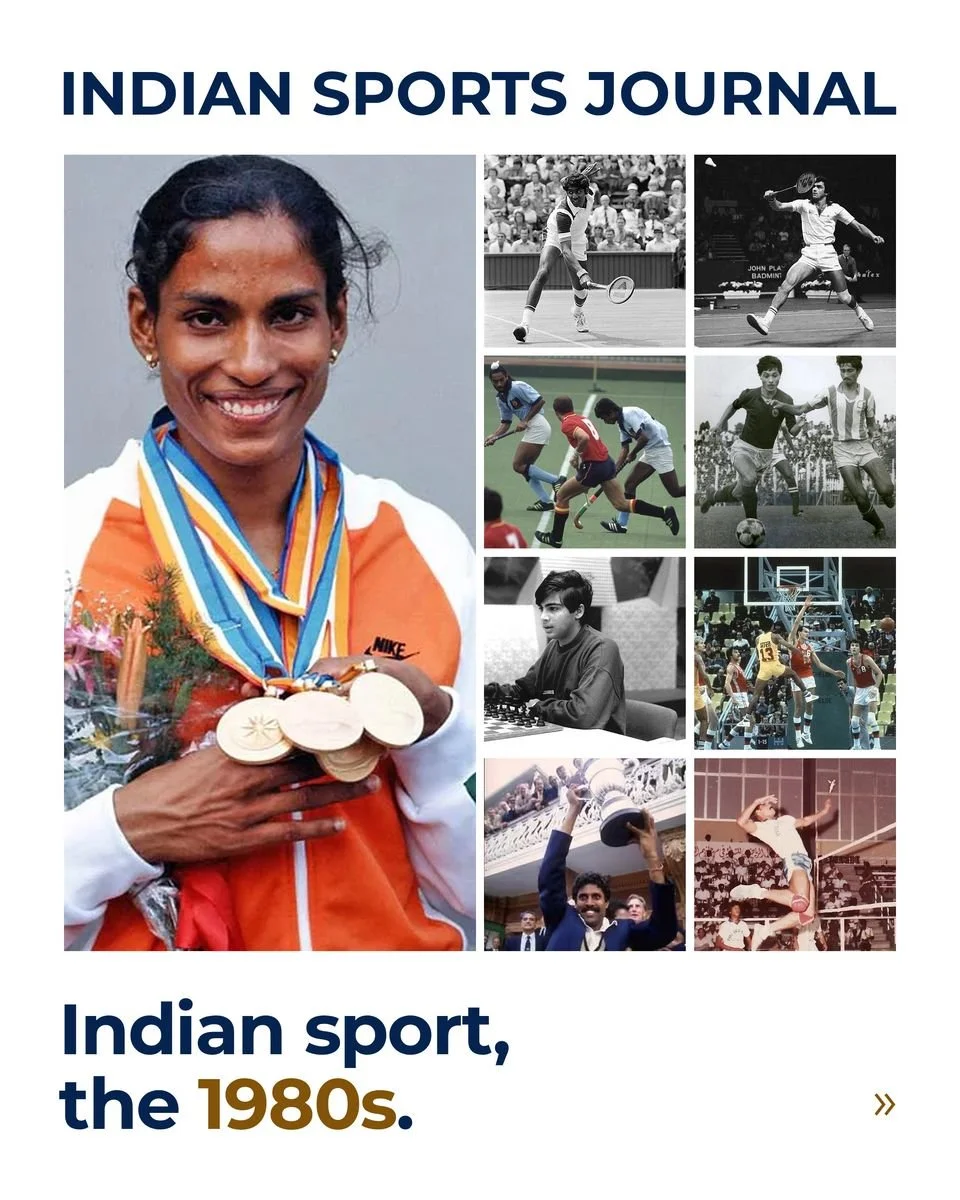
Indian Sport, the 1980s — The Decade That Came in Colour
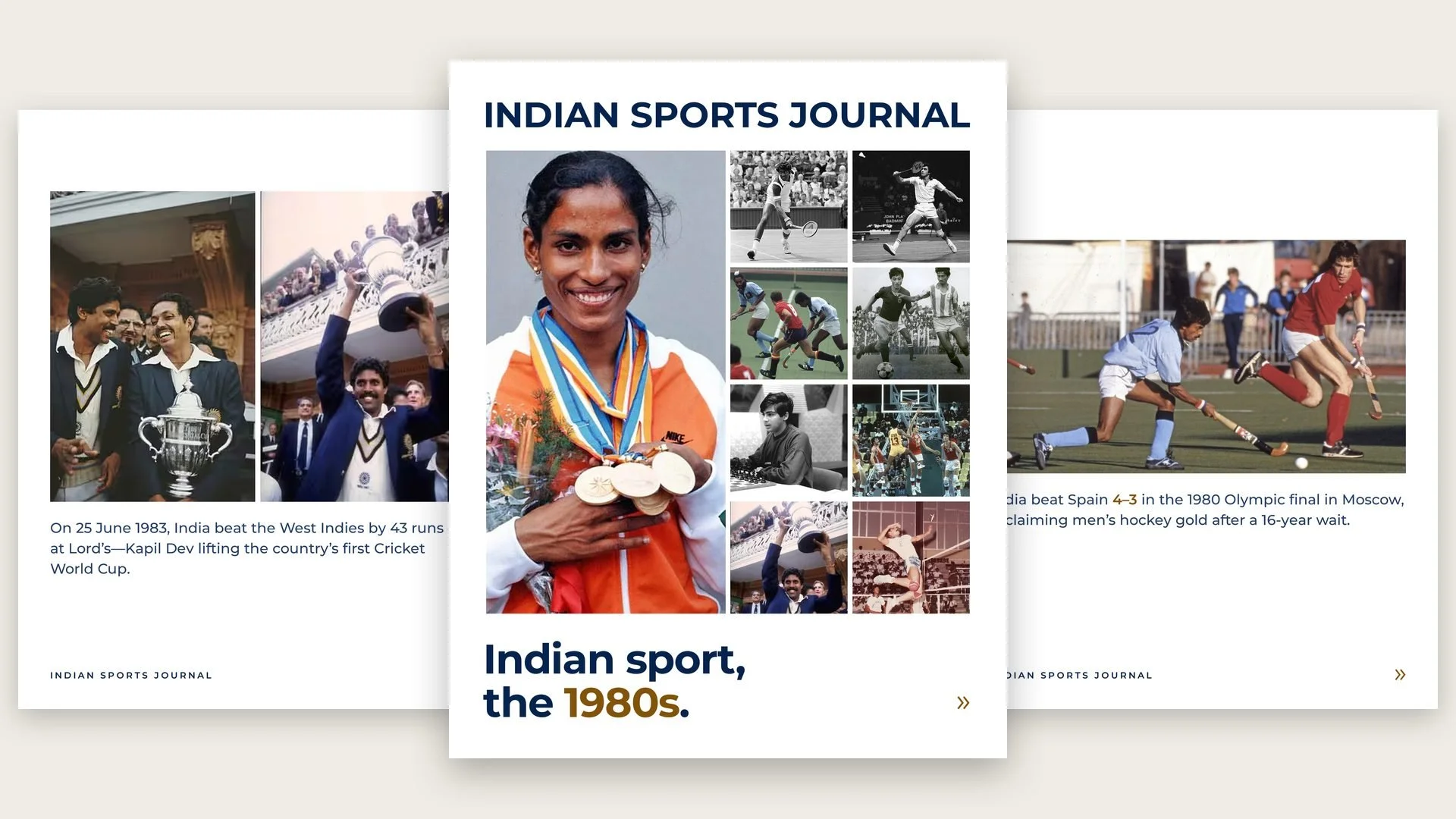
Eighteen archive slides, from Wembley to Lord’s to the Jawaharlal Nehru Stadium, follow the ten years in which India got colour television and a cricket world title, found a new generation of world-class individuals outside cricket, and watched hockey win its last Olympic gold.
India won its last Olympic hockey gold on 29 July 1980, beating Spain 4–3 in Moscow in a tournament the boycott had cut to six teams. Two years and seventeen days later, on 15 August 1982, Doordarshan carried Indira Gandhi’s Independence Day speech live in colour, the broadcast that introduced colour television to the country. In November the Asian Games in Delhi followed it onto the new screens. Most of what the decade did to Indian sport sits between those two dates: an old certainty going out, and a new way of watching coming in.
By 1989 the shape had changed. Cricket had a world title. Hockey had gone from Olympic gold to last place at a World Cup in six years. And India had a new generation of individuals outside cricket who could beat the best in the world at their own events: a badminton player who won the All England without dropping a game, a hurdler who missed an Olympic medal by one-hundredth of a second, a teenager who became the country’s first chess grandmaster.
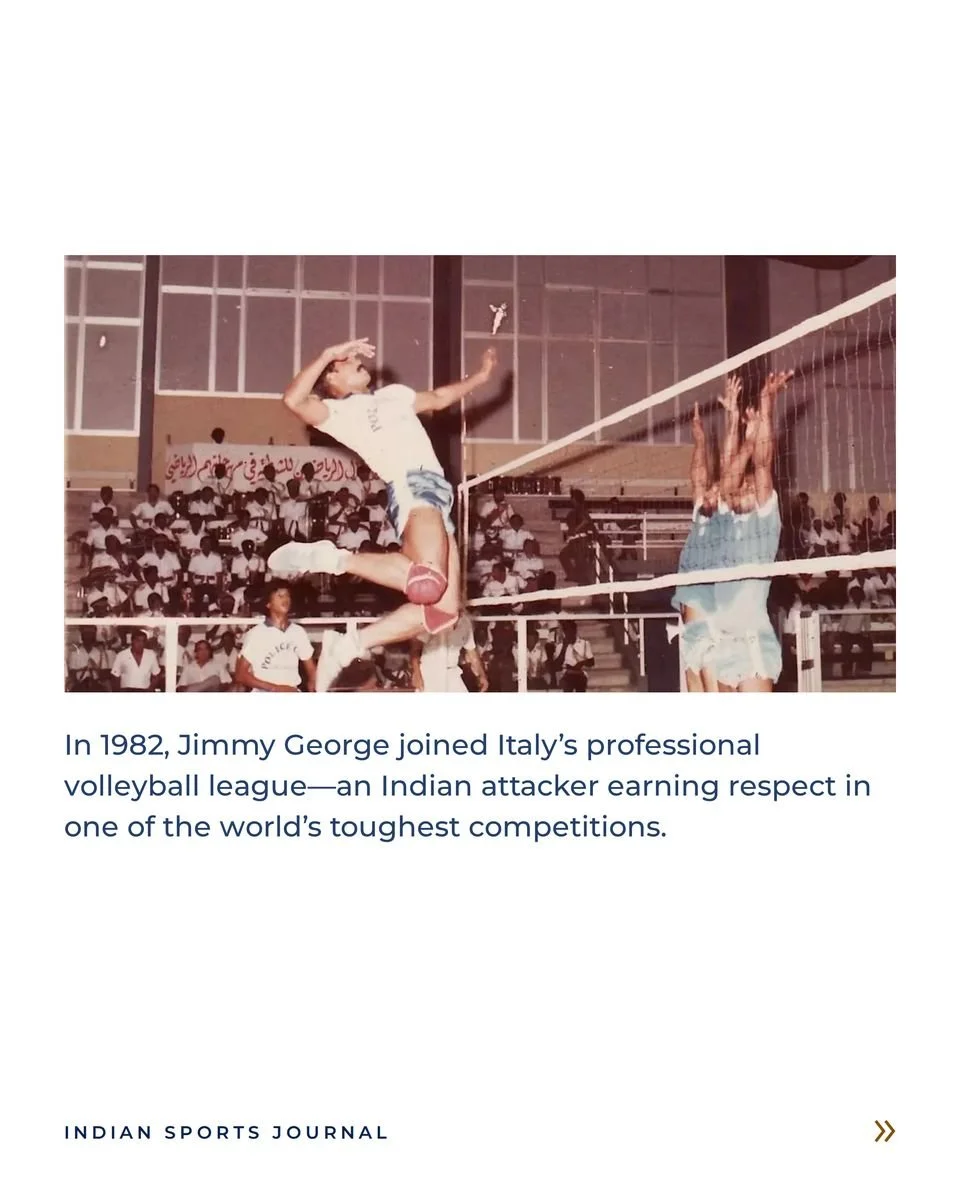
ISJ’s archive carousel for the decade runs to 18 slides, a cover and 17 captioned pictures, across nine sports. This piece uses them as the stations of that argument and checks them on the way. Most hold up. Some do not. The slide captioned as the Moscow final probably shows an England–India match five years later; the volleyball photograph appears to have been taken in the Gulf, not in Italy; the Maidan photograph cannot be placed at all. Where a picture’s identification is in doubt, this page says so.
Two golds in 1980
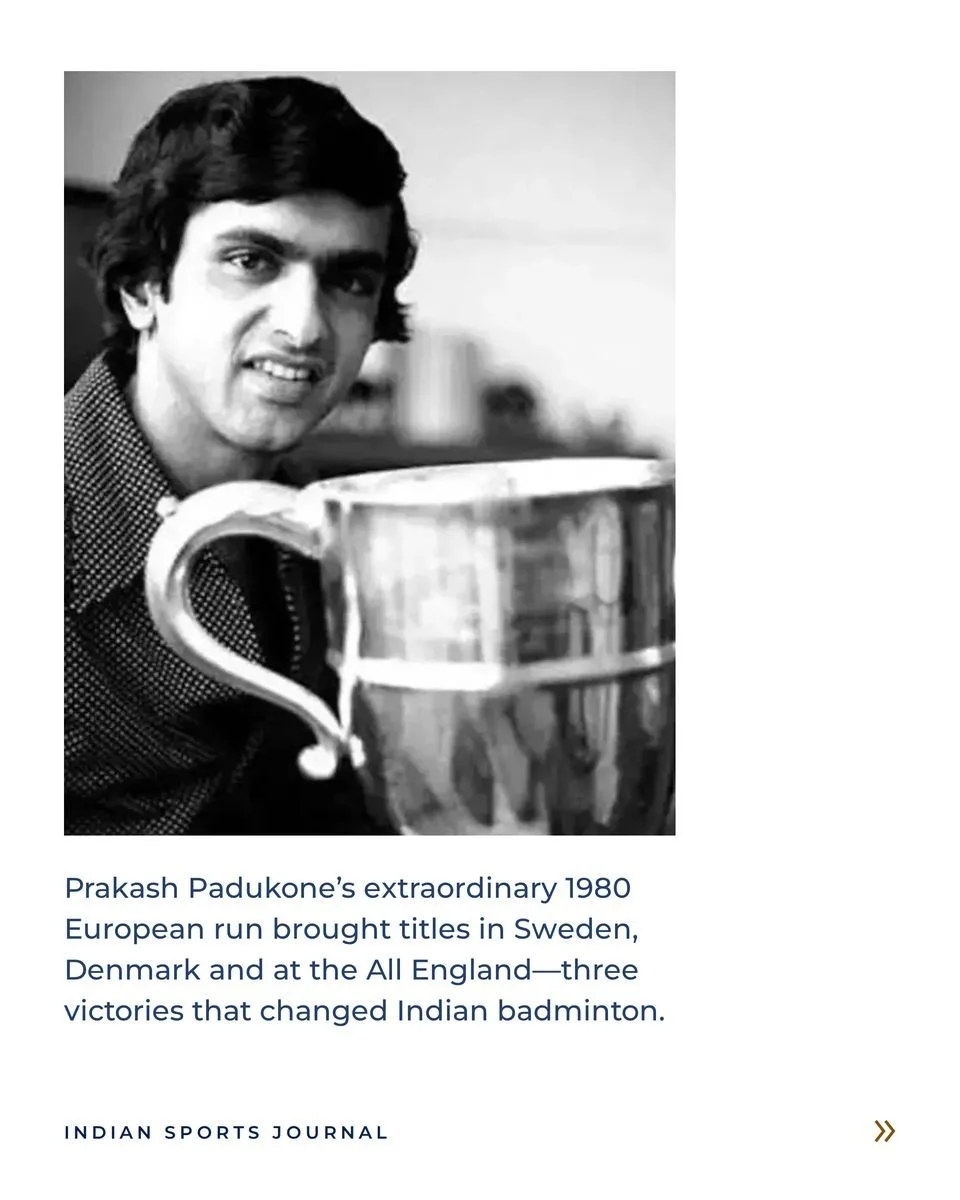
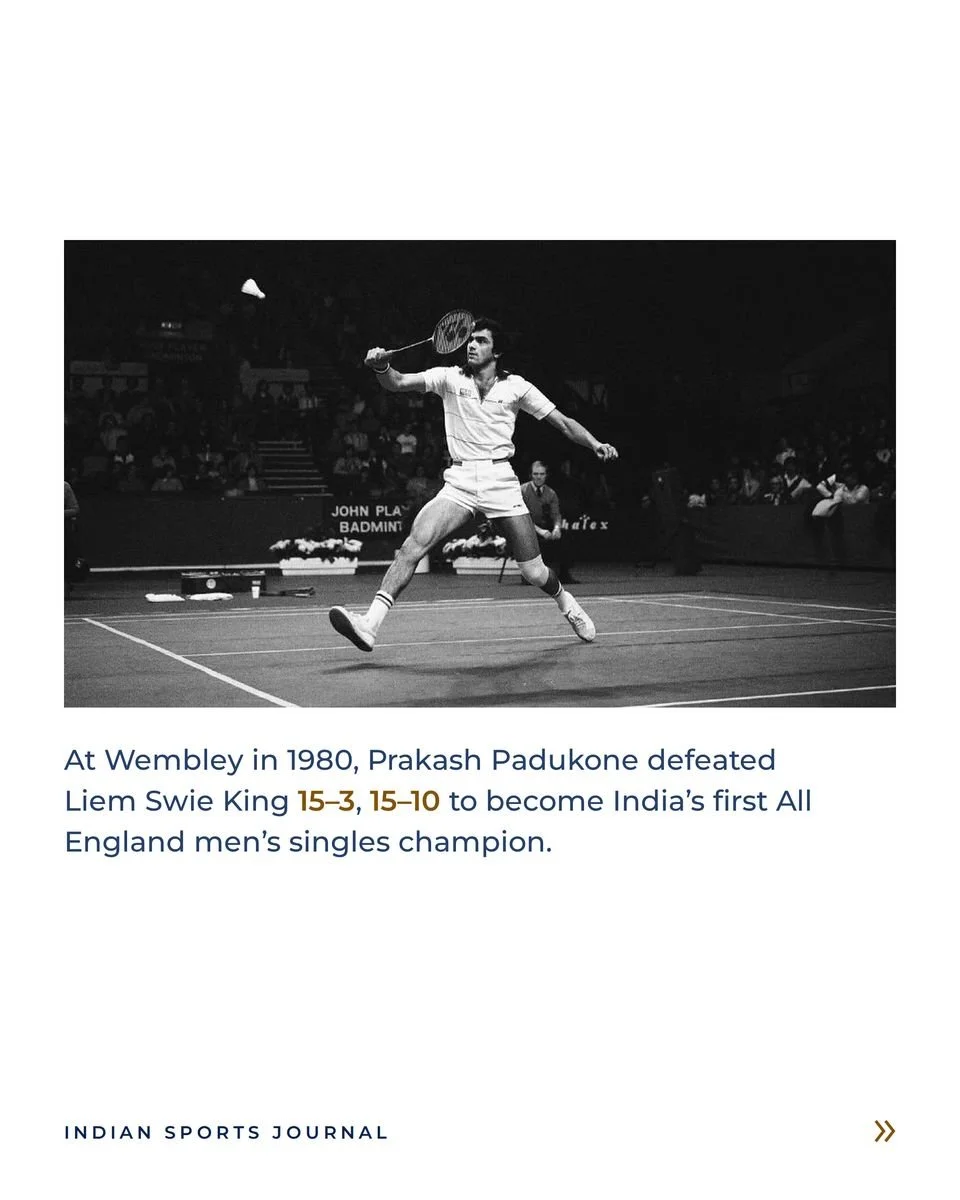
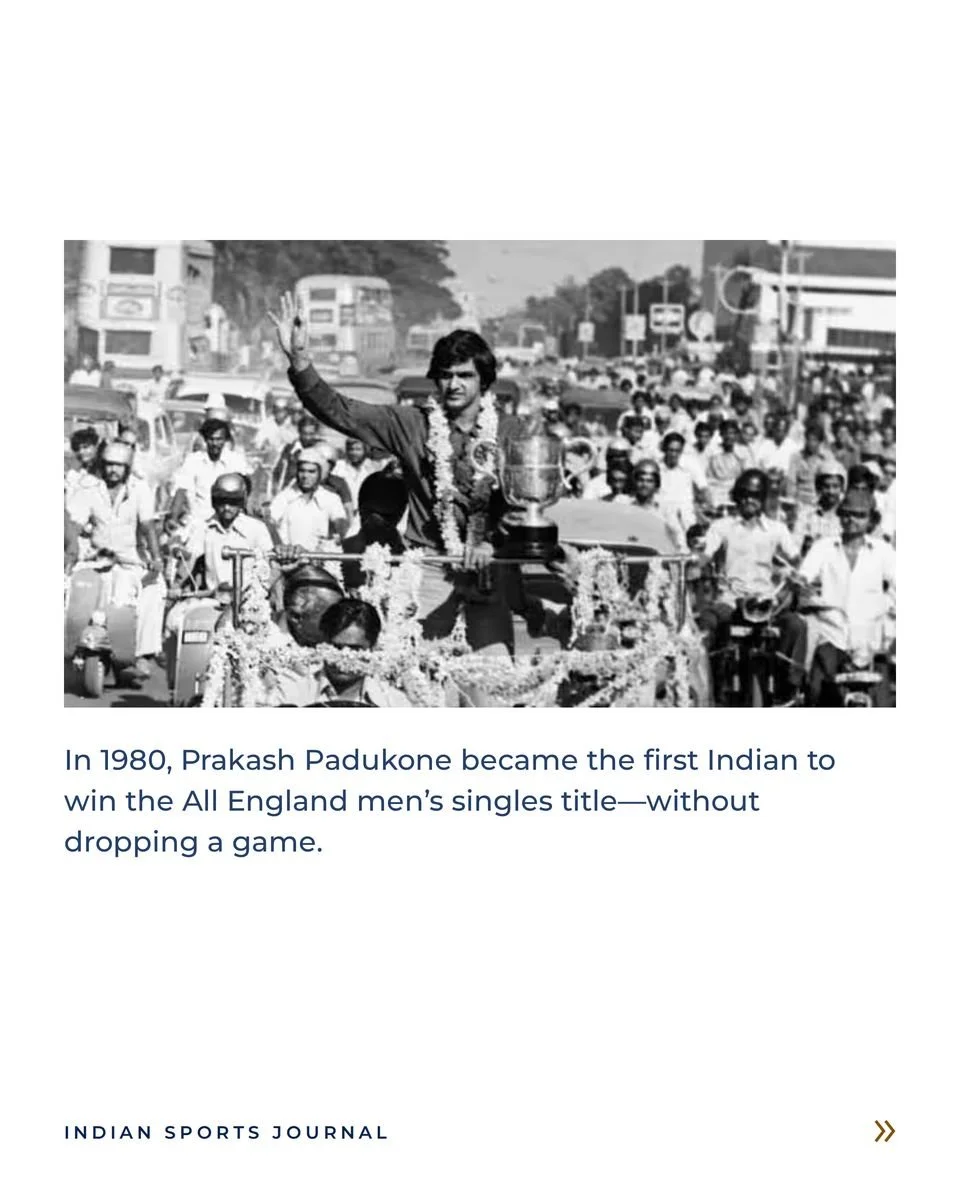
The decade opened at Wembley Arena. On 23 March 1980 Padukone beat Indonesia’s Liem Swie King 15–3, 15–10 to become the first Indian to win the All England men’s singles. He did not drop a game in five matches, ESPN has recorded, and in the semi-final he beat the top seed, Denmark’s Morten Frost, 15–8, 15–10. The title sat inside a run of three in Europe that year: the Danish Open, where he beat Frost again in the final, and the Swedish Open, where he came from a game down to beat Rudy Hartono 9–15, 15–12, 15–1. In 1983 he added a bronze at the World Championships in Copenhagen.
Bangalore put him in an open jeep when he came home. ISJ’s photo check matched the picture to that 1980 homecoming.
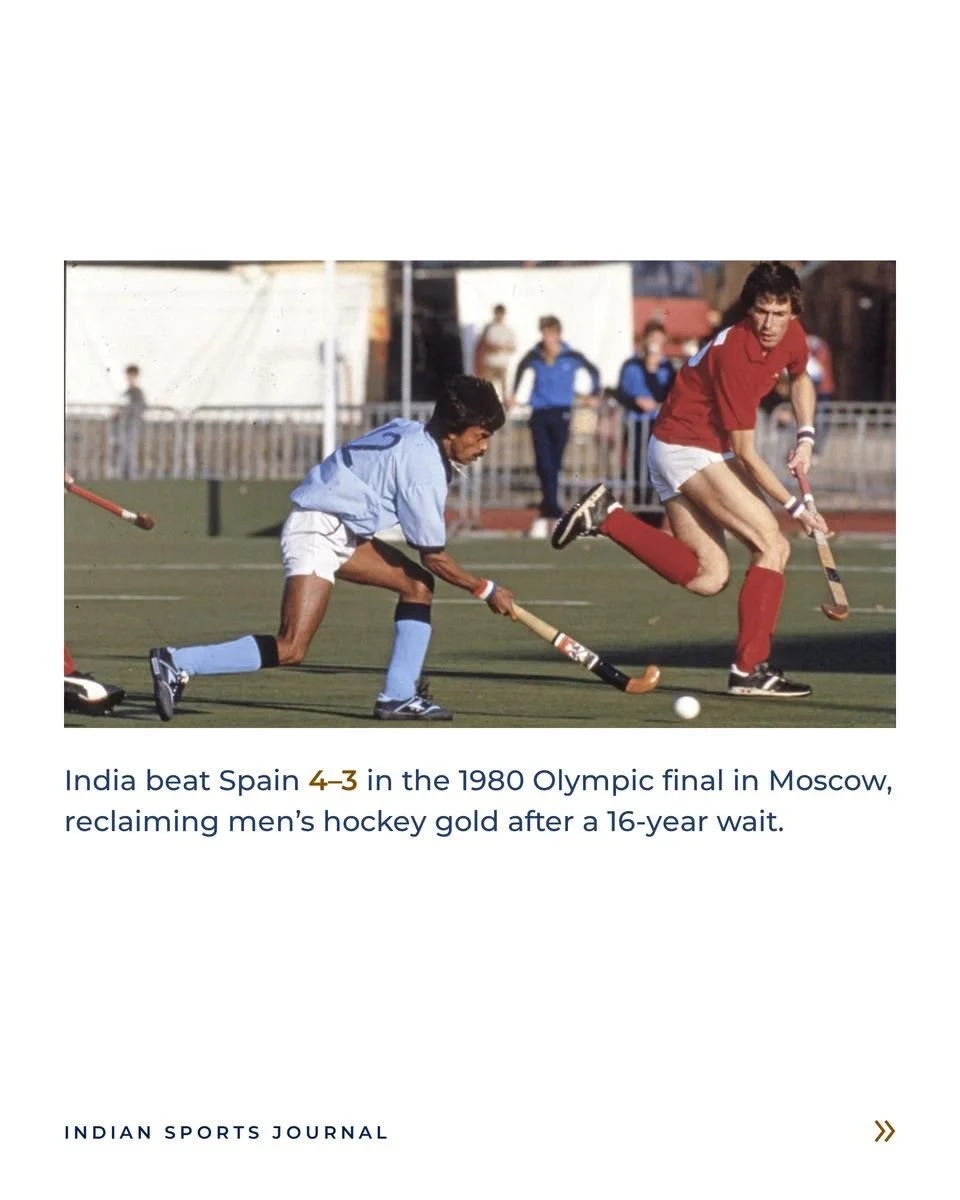
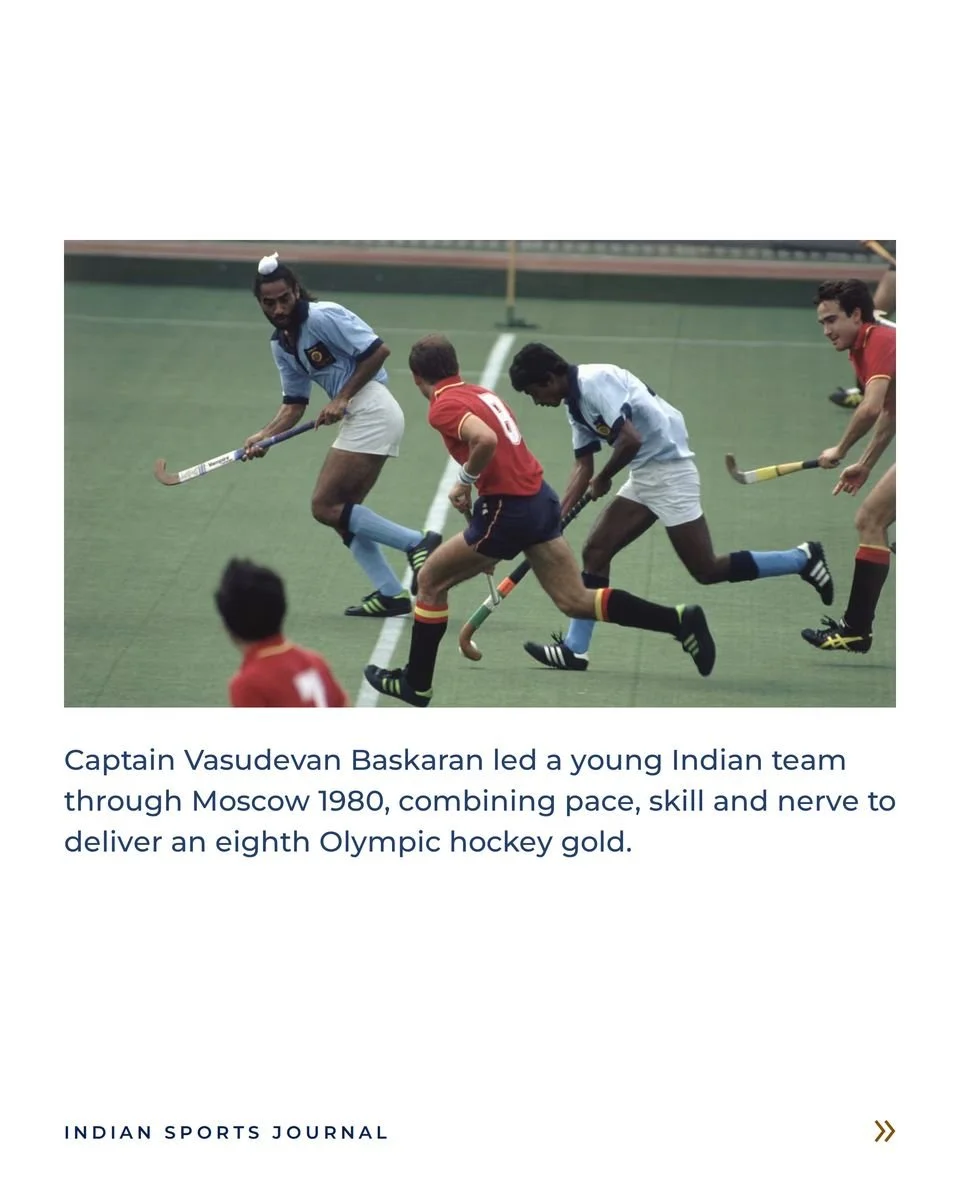
Four months later the hockey team won India’s eighth Olympic gold, and its first since Tokyo in 1964. Moscow was the boycott Games: a planned 12-team men’s tournament went ahead with six after nine countries pulled out, by Olympedia’s account. India, captained by Vasudevan Baskaran, played a round robin and lost none of it, 18–0 against Tanzania, 2–2 with Poland and with Spain, 13–0 against Cuba and 4–2 against the Soviet hosts. In the final, Surinder Singh Sodhi scored twice before half-time, M.K. Kaushik and Mohammed Shahid added the others, and Spain’s Juan Amat answered with a hat-trick. India won 4–3.
ISJ’s carousel runs two hockey photographs for Moscow, and only one of them fits. Slide 14 shows India in light blue against a side in red shirts and navy shorts, the kit Spain wore in Moscow; nothing in the frame says whether it is the group game or the final. Slide 11, captioned as the final, shows opponents in red shirts, white shorts and red socks in front of advertising boards, which Olympic venues do not carry. ISJ’s photo check matched the kit and the boards to a Getty frame captioned England v India at Willesden, London, on 6 October 1985.
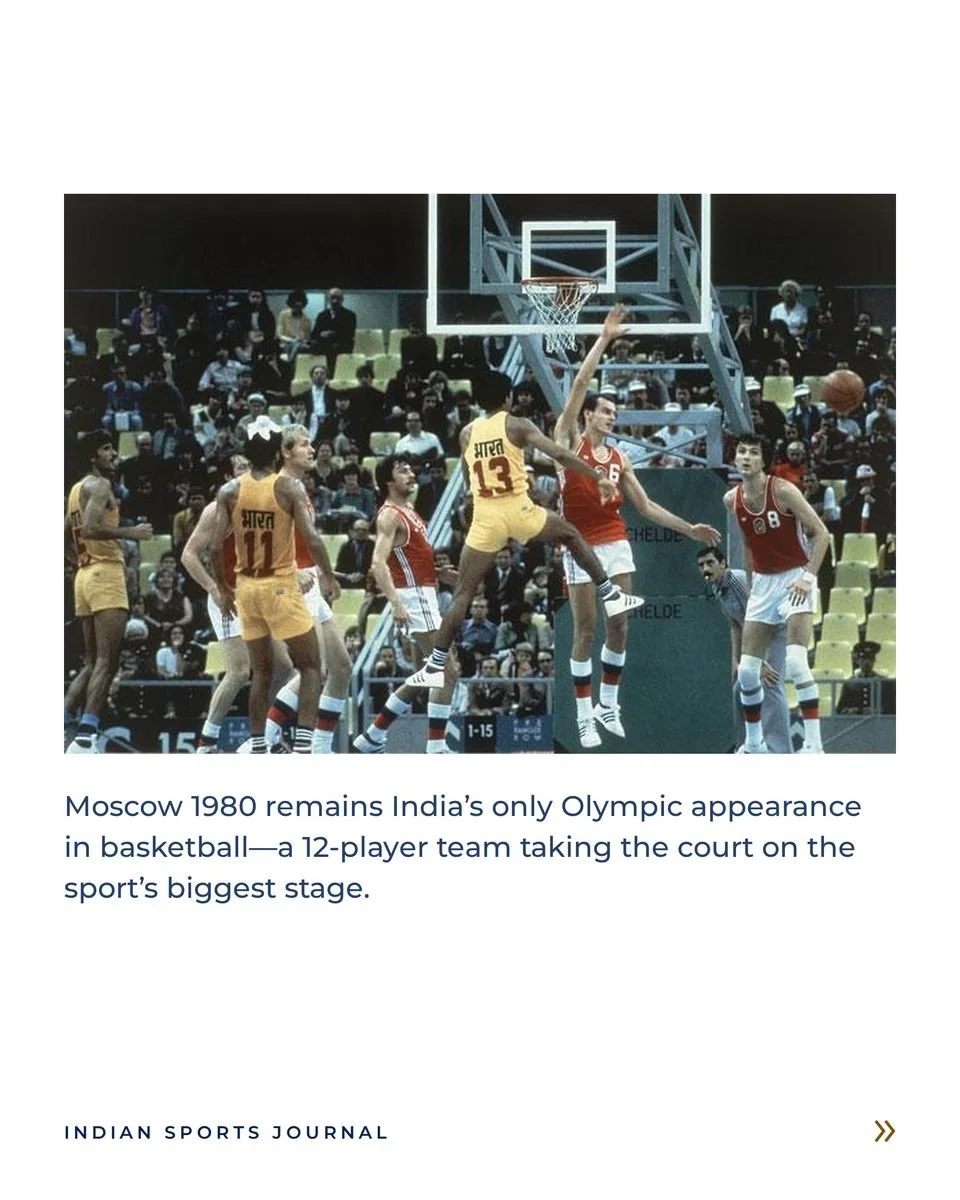
Moscow also produced the only Olympic basketball tournament India has played. The team lost to the Soviet Union 121–65, to Czechoslovakia 133–65 and to Brazil 137–64 in its group, lost every game it played and finished 12th of 12. ISJ’s check of slide 3 confirmed the opponent as the USSR, India’s first game.
Delhi in colour
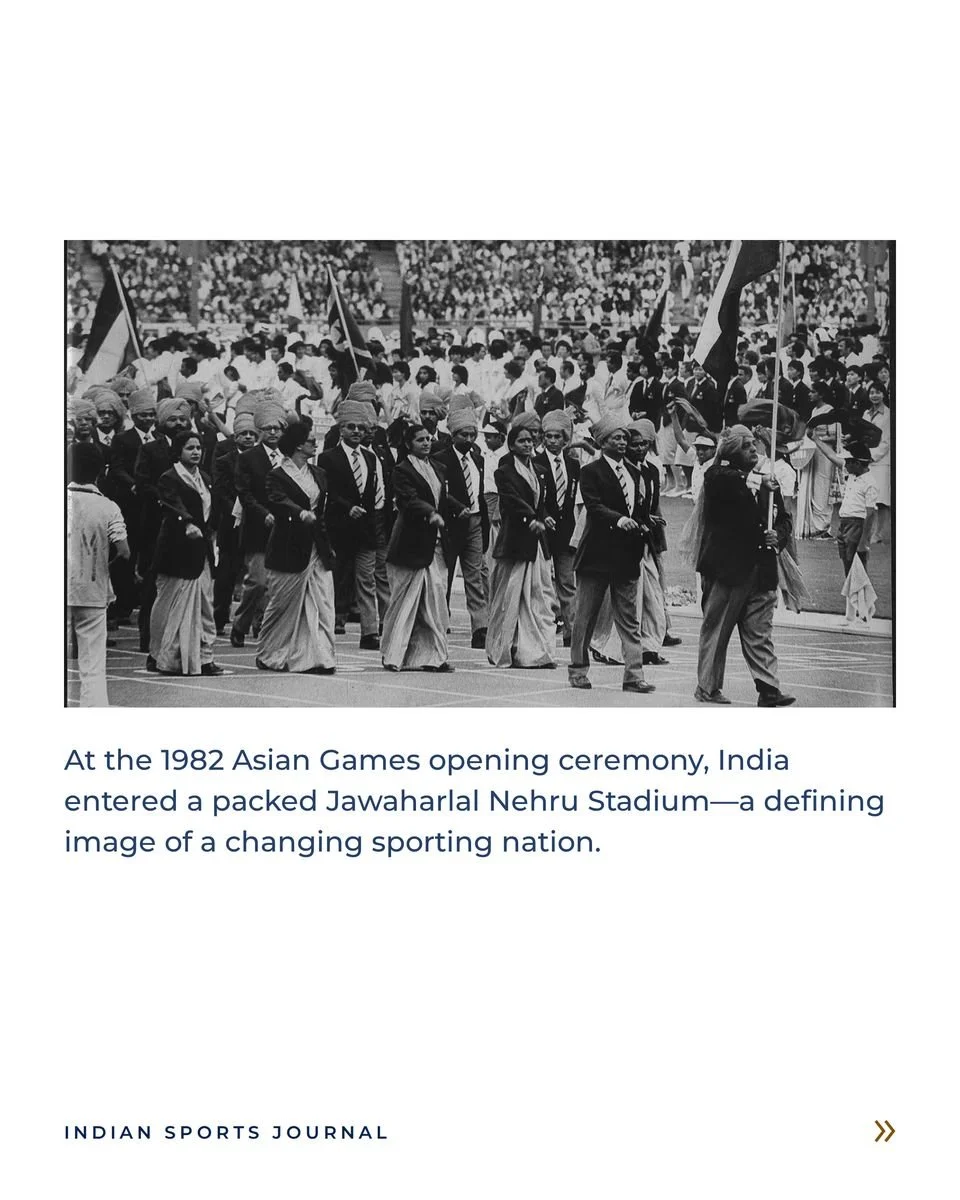
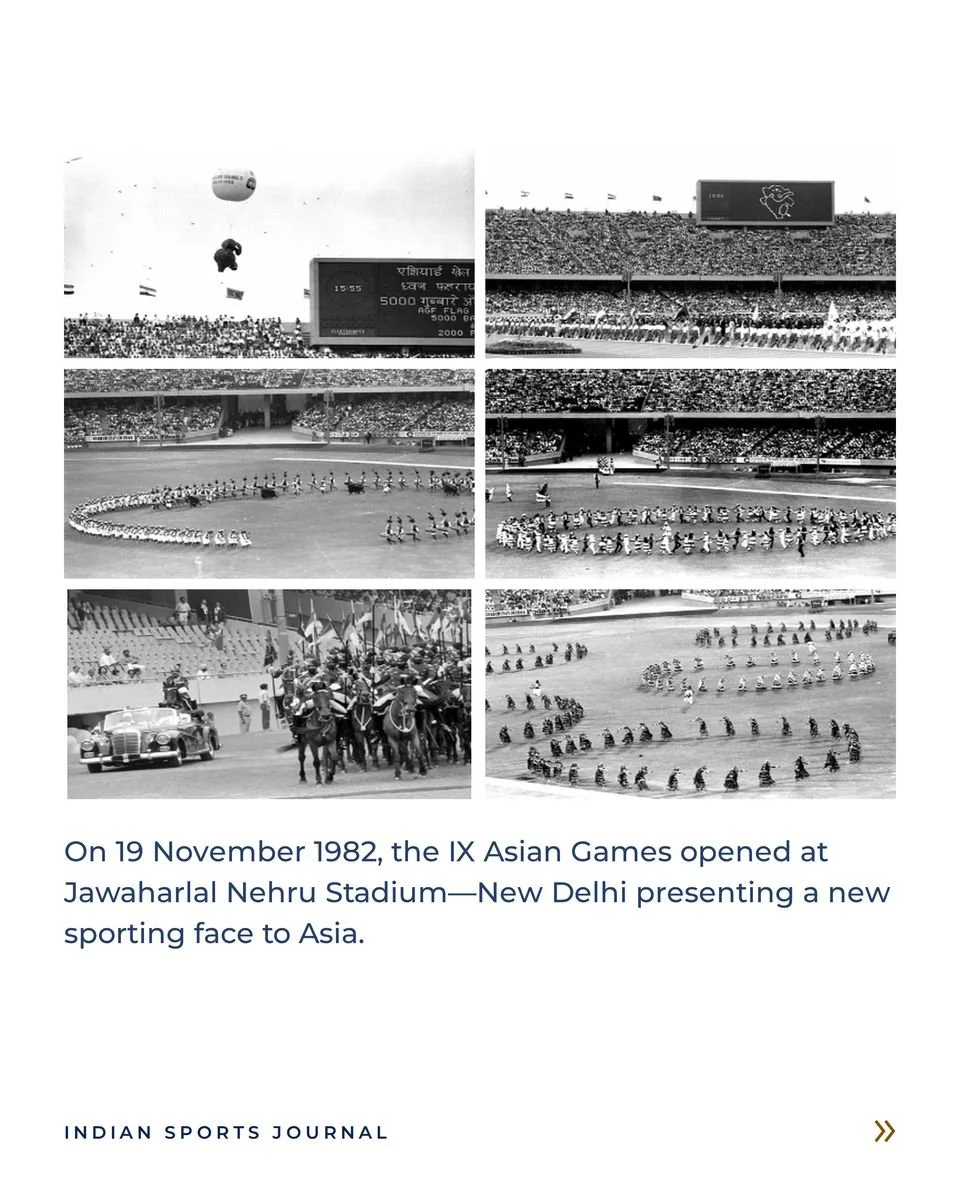
The IX Asian Games opened on 19 November 1982 at the Jawaharlal Nehru Stadium, built for the occasion, and ran until 4 December. President Zail Singh declared them open. Usha, then 18, took the athletes’ oath. Thirty-three nations came, the most in the Games’ history to that point.
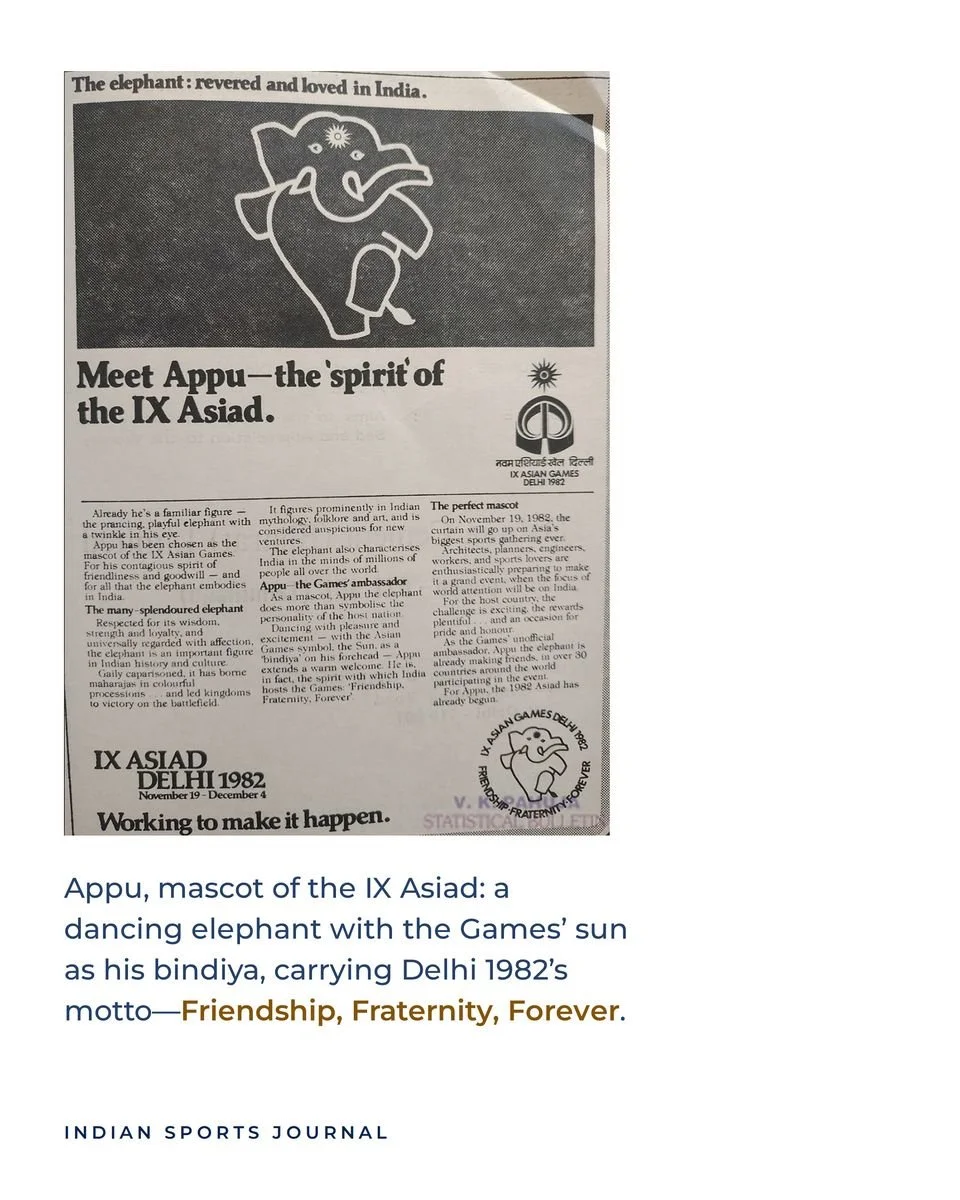
Doordarshan’s colour service, three months old, carried the Games. For the first time the national broadcaster could put a home Games on screen in colour, and the organisers gave it a face built for the screen: an elephant. Appu, the mascot, wore the Games’ sun on his forehead as a bindiya and carried the motto “Friendship, Fraternity, Forever”, which is how the 1982 advertisement on slide 18 introduced him.
India won 13 golds, 19 silvers and 25 bronzes and finished fifth. Four of the golds came on the track and in the field: Charles Borromeo in the 800m, M.D. Valsamma in the 400m hurdles, Chand Ram in the 20km walk and Bahadur Singh in the shot put. Usha took silver in the 100m and the 200m. The women’s hockey team won gold unbeaten. The men, at home, lost the final 7–1 to Pakistan.
Lord’s, and the long slide
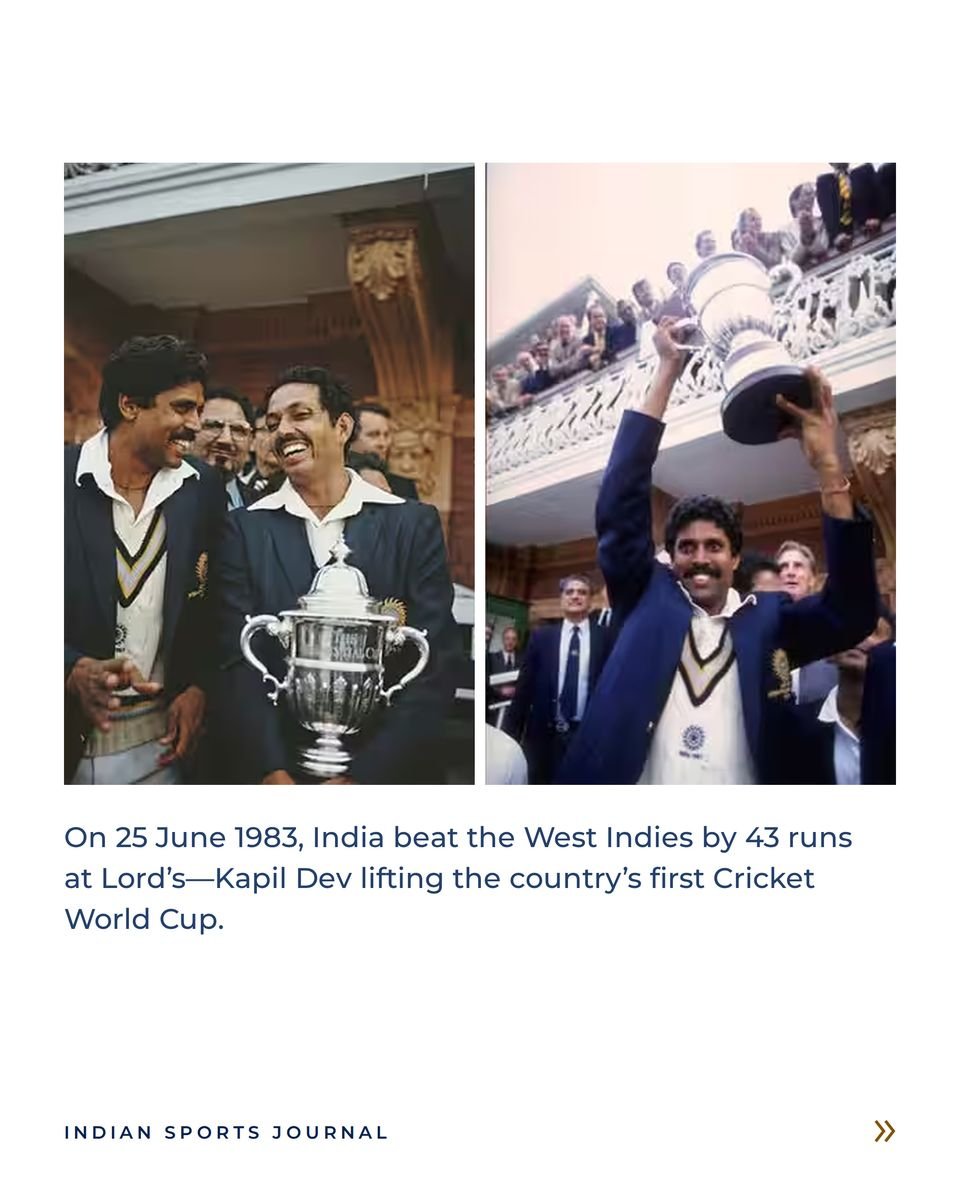
Seven months later came the title. On 25 June 1983 at Lord’s, India made 183 and bowled out West Indies, champions in 1975 and 1979, for 140 to win the World Cup by 43 runs. Mohinder Amarnath, with 26 and three wickets, was man of the match; Krishnamachari Srikkanth’s 38 was the top score. Kapil Dev lifted the Prudential Cup on the pavilion balcony, the photograph on slide 7.
Hockey went the other way, and the 7–1 in Delhi was the first sign. India were fifth at Los Angeles in 1984, last of 12 at the 1986 World Cup in England and sixth at Seoul in 1988, where they lost to Pakistan in the classification games. The next Olympic medal of any colour took 41 years, a bronze in Tokyo in 2021. The Moscow gold, won against a reduced field, was the end of an era rather than a return to one.
| Year | Event | Finish |
|---|---|---|
| 1980 | Olympic Games, MoscowBeat Spain 4–3 in the final; six teams | Gold |
| 1982 | Asian Games, DelhiLost the final 7–1 to Pakistan | Silver |
| 1984 | Olympic Games, Los Angeles | 5th |
| 1986 | World Cup, EnglandTwelve teams | 12th |
| 1988 | Olympic Games, SeoulLost to Pakistan in the classification games | 6th |
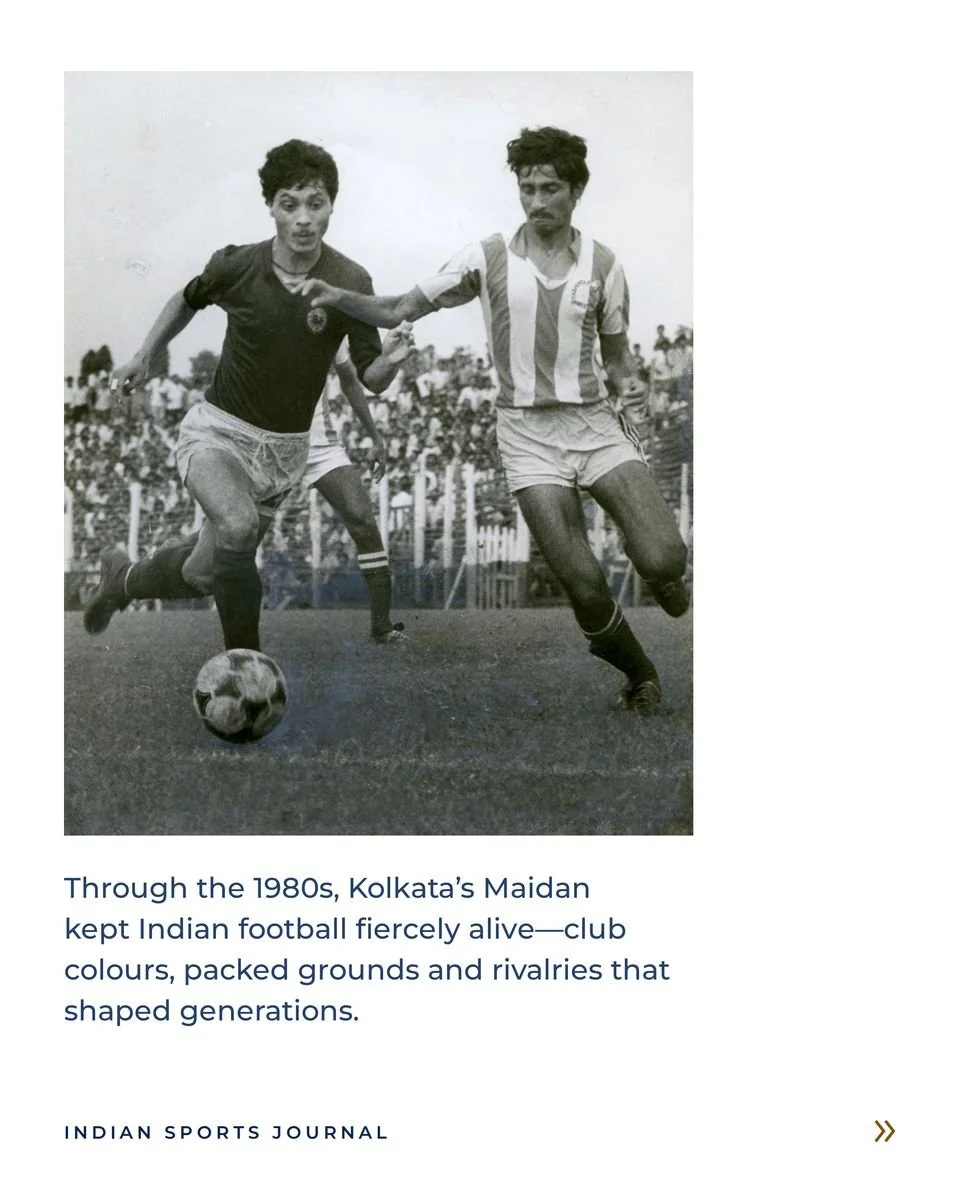
Football had its own reckoning. On 16 August 1980, 16 people died at Eden Gardens during a Mohun Bagan–East Bengal match, after stone-throwing spread panic through the stands, The Tribune has reported; Kolkata now marks the date as Football Lovers’ Day. Slide 8’s photograph of two players on a packed ground, probably in Kolkata, stands for the Maidan through the decade, but ISJ has not been able to identify the match, the players or the year, and the caption is a claim about the decade, not about the picture.
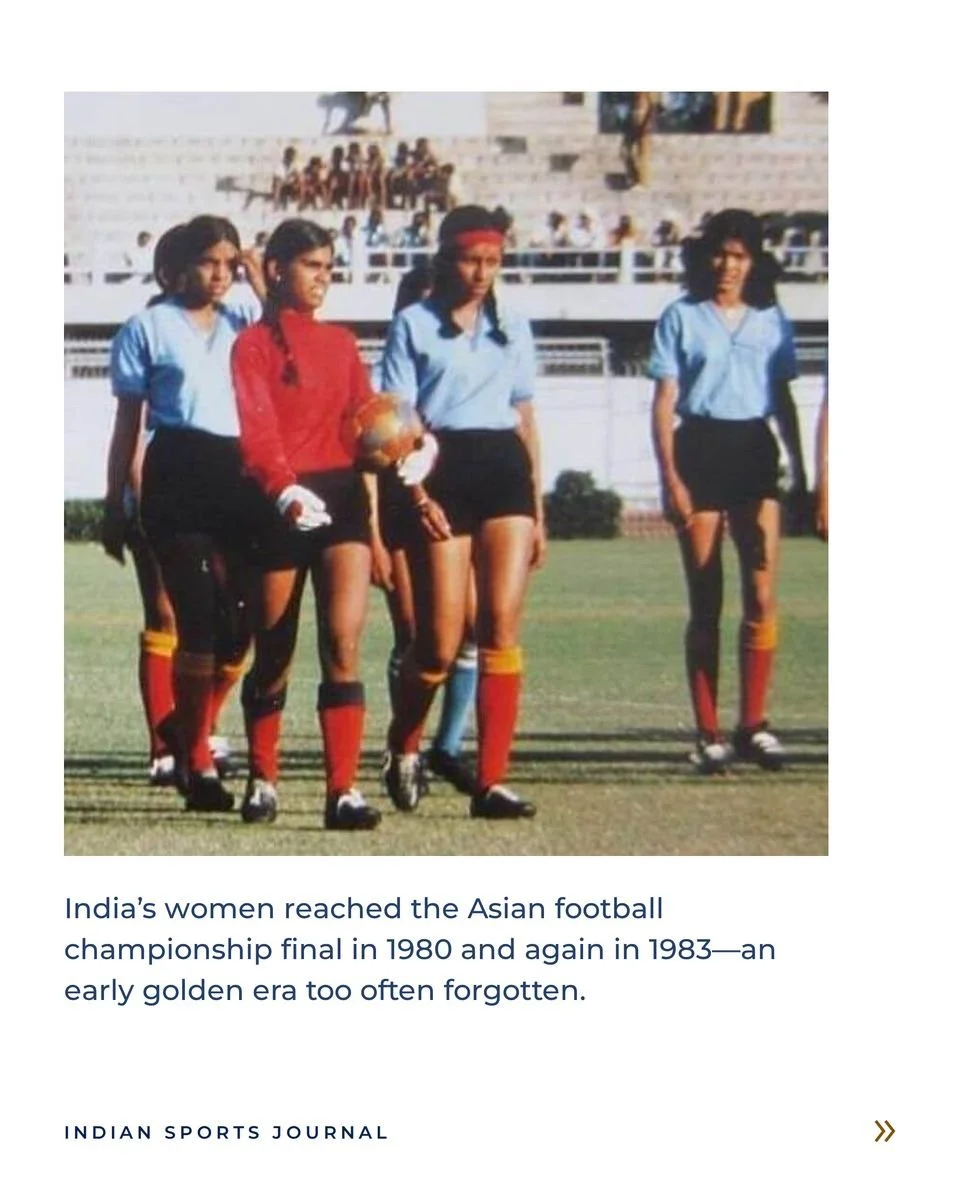
The women’s national team reached two Asian finals in the decade. The first was played in Calicut in January 1980, an edition originally scheduled for 1979; Chinese Taipei won 2–0. In Bangkok in April 1983, Thailand won 3–0. In between, India finished third in Hong Kong in 1981. The players in slide 12 have not been identified, and the All India Football Federation labels similar team photographs “representational”.
Names the world knew
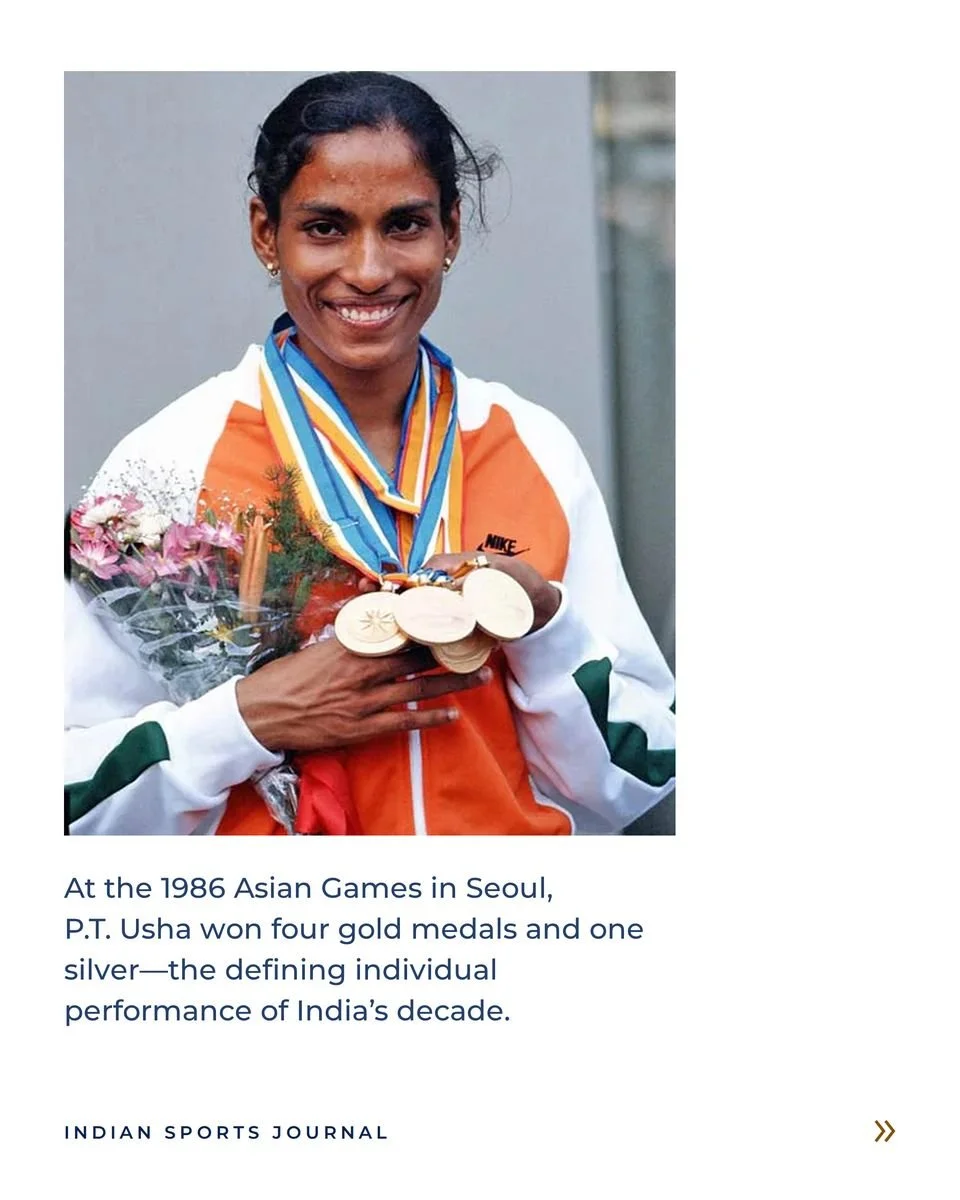
At Los Angeles in 1984 Usha finished fourth in the 400m hurdles in 55.42sec, one-hundredth of a second from bronze. At the Asian Games in Seoul two years later she won the 200m in 23.44, the 400m in 52.16, the 400m hurdles in 56.06 and the 4x400m relay, and took silver in the 100m behind the Philippines’ Lydia de Vega. Each of her golds came in an Asian Games record, ESPN has noted. The photograph on slide 4 shows four golds; the silver is not in the frame.
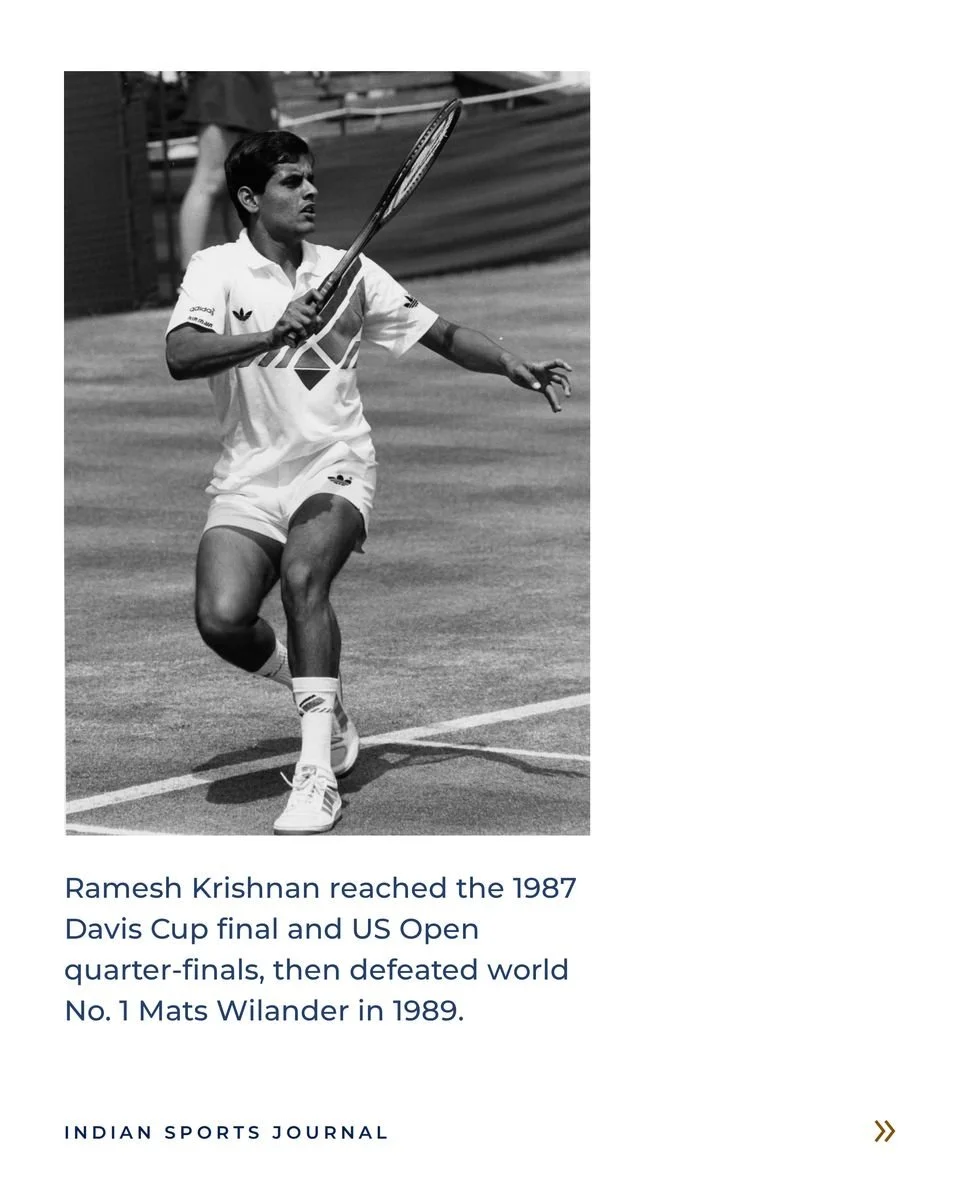
In tennis, two Indians took on the best players of the era. Amritraj, unseeded, led the third seed Connors 6–2, 7–5 in the 1981 Wimbledon quarter-final and lost the next three sets 6–4, 6–3, 6–2. It was his second Wimbledon quarter-final after 1973; he also reached the US Open last eight in 1973 and 1974. The slide does not date its photograph, and ISJ still cannot. Krishnan, the 1979 Wimbledon and French Open junior champion, reached the US Open quarter-finals in 1981 and 1987 and Wimbledon’s in 1986, and rose to No. 23 in January 1985. In the 1987 Davis Cup final, which India lost 5–0 to Sweden, he lost his singles to Wilander and Anders Järryd. On 19 January 1989 he beat Wilander, by then the world No. 1, in the second round of the Australian Open.
Jimmy George went abroad first. He joined Abu Dhabi Sports Club in 1979, the first Indian to play volleyball professionally, and in 1982 moved to Italy’s league with Pallavolo Treviso. He was in the India team that won bronze at Seoul in 1986, and died in a road accident in Italy on 30 November 1987, aged 32. Slide 9’s caption about Italy is correct. Its photograph is almost certainly not from Italy: the Arabic banner and the “Police” shirts in the stand point to his Abu Dhabi years.
The Lightning Kid
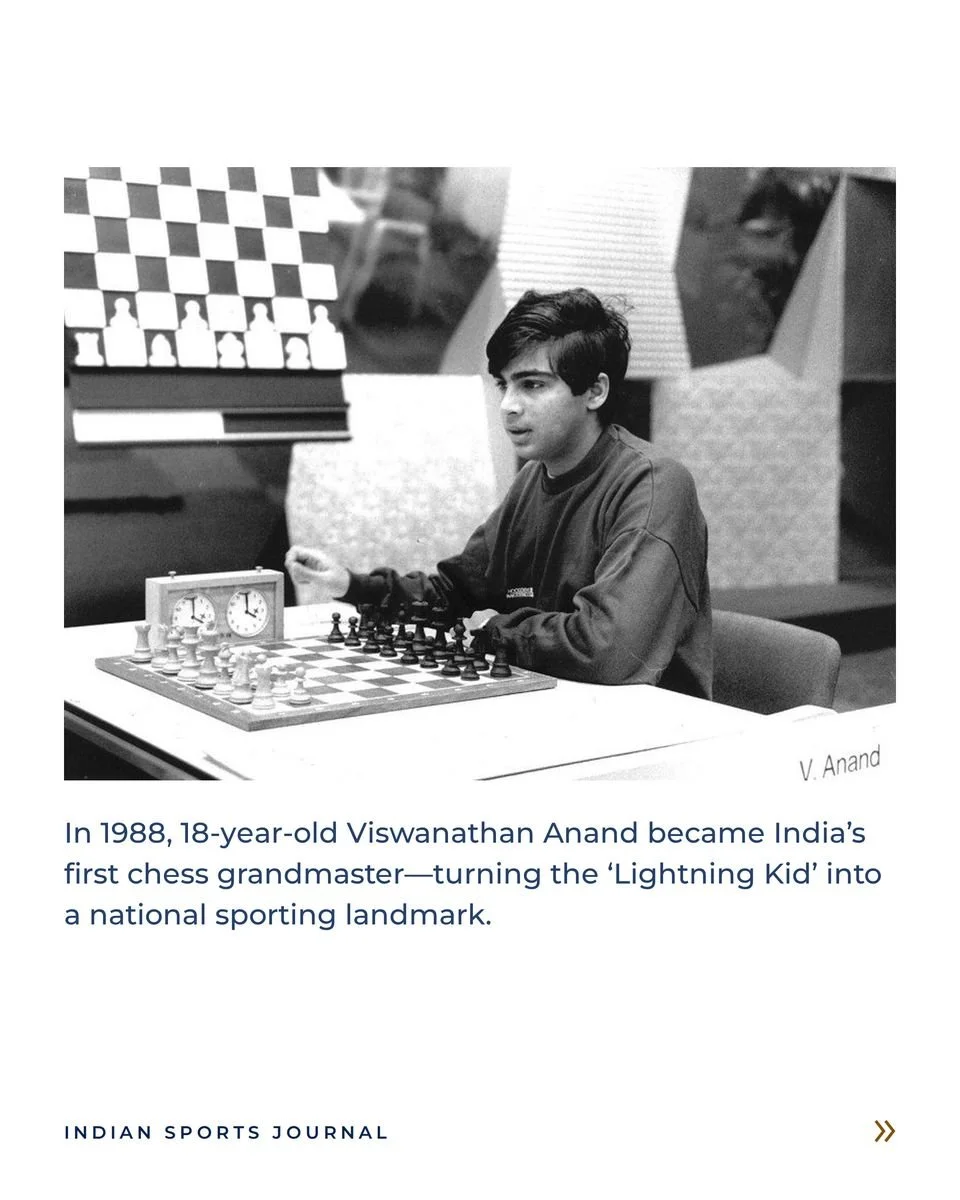
The decade closes with a teenager. Anand became, at 15 in 1985, the youngest Indian international master, and in 1987 the first Indian world junior champion, in Baguio. He earned the name “Lightning Kid” for how fast he played. His grandmaster title, India’s first, is usually dated 1988, after a final norm at the Sakthi Finance tournament in Coimbatore; Wikipedia gives both 1987 and 1988. The photograph on slide 2, with his name card on the table, has not been tied to Coimbatore or to any other event. The strongest lead in ISJ’s check was Wijk aan Zee in January 1989, where he shared first place; the frame has not been matched.
| Slide | Moment and photograph | Check |
|---|---|---|
| 02 | Anand, India’s first grandmasterEvent unknown; likeliest lead Wijk aan Zee, 1989 | Unplaced |
| 03 | India v USSR, Moscow 1980Basketball; lost 121–65 | Checked |
| 04 | Usha with her Seoul golds, 1986Four golds in frame; the silver is not | Checked |
| 05 | Padukone’s homecoming, Bangalore, 1980 | Checked |
| 06 | Padukone with a cup, 1980The trophy cannot be identified | Probable |
| 07 | Kapil Dev and Mohinder Amarnath, Lord’s, 1983 | Checked |
| 08 | Two footballers, probably in KolkataMatch, players and year unknown | Unplaced |
| 09 | Jimmy George at the netCaption: Italy, 1982. Photo: probably Abu Dhabi, 1979–82 | Not Italy |
| 10 | Asian Games opening, Delhi, 1982 | Checked |
| 11 | Captioned as the Moscow finalProbably England v India, Willesden, 1985 | Not Moscow |
| 12 | India’s women’s team, early 1980sEvent and players unidentified | Unplaced |
| 13 | Padukone at the All EnglandYear not fixed by the frame | Probable |
| 14 | India v Spain, Moscow 1980Spain’s Moscow kit; group game or final unknown | Probable |
| 15 | India’s contingent, Delhi opening, 1982 | Checked |
| 16 | Krishnan on grassLikely Wimbledon, c. 1986 | Probable |
| 17 | Amritraj at WimbledonYear unknown | No year |
| 18 | The Appu advertisement, 1982 | Checked |
Read together, the ledger splits the decade in two. The moments are fixed: nearly every score, date and final on the slides checks out against the record. The photographs that stand for them are harder to pin down. Six of the 17 are unplaced, undated or contradict their captions.
On 19 September the 20th Asian Games open in Aichi–Nagoya and run to 4 October, the same days of the month on which Delhi’s Games opened and closed in 1982. That Asiad arrived with colour television and an elephant, and handed the home hockey team a 7–1 defeat in the final. Forty-four years on, ISJ is still working out what some of the decade’s photographs show. The moments themselves are not in doubt.
Sourcing. ISJ’s own photo checks of 10 and 11 September 2026 (the photo-verification session, the ochre-set build and the carousel’s caption notes), which matched frames against Getty captions, Wikimedia Commons and AIFF archives. Results and dates: Olympedia and Olympics.com (Moscow 1980 hockey; Olympedia for the boycott and the round-robin scores); Wikipedia (1980 All England; 1980 Olympic basketball; 1982 Asian Games; Field hockey at the 1982 Asian Games; Doordarshan; 1983 World Cup final; 1981 Wimbledon men’s singles; PT Usha; Ramesh Krishnan; Vijay Amritraj; Jimmy George; Viswanathan Anand; Prakash Padukone); ESPN (Padukone’s 1980 All England; Usha at Seoul); The Bridge (Padukone’s 1980 titles; India at the Olympics in hockey); The Better India (Jimmy George); RSSSF (Asian Women’s Championship); The Tribune (Eden Gardens, 1980); Sportskeeda (1986 World Cup); Tennis Majors (date of the Wilander match). The 20th Asian Games dates are from ISJ’s Nagoya coverage.
Corrections to the carousel. Slide 11: photograph captioned as the 1980 Olympic final — kit (red shirts, white shorts, red socks) and advertising boards match the Getty frame captioned England v India, Willesden, 6 October 1985, per ISJ’s photo check; the caption’s 4–3 and 16-year wait are correct. Slide 9: “In 1982, Jimmy George joined Italy’s professional volleyball league” — correct, per Wikipedia and The Better India, but the photograph is probably from his Abu Dhabi Sports Club years, 1979–82 (Arabic banner, “Police” shirts), per ISJ’s photo check. Slide 2: “In 1988 … India’s first chess grandmaster” — the year is disputed (Wikipedia’s introduction and infobox say 1988, its body 1987; an eligibility date of 3 September 1987, attributed to ChessBase India in an earlier draft, could not be re-verified and is not used), and the photograph is not shown to be from 1988; likeliest lead Wijk aan Zee, January 1989, unconfirmed. Slide 3: “a 12-player team” — not checked against a squad list; left out. Slide 8: the photograph is unplaced, so the caption describes the decade, not the image. Slide 12: the photograph is not tied to either final.
Flag. 1982 Asian Games: athletes 3,411 (Wikipedia text) or 4,595 (infobox); events 196 in 21 sports or 147 in 23, depending on the source. 1980 women’s championship: RSSSF gives 15–21 January 1980, ISJ’s earlier check 11–20 January; the AIFF captions the team in Kochi but its article places the matches in Kozhikode (Calicut), which this page uses. Moscow hockey: Olympics.com calls India’s 4–2 win over the USSR a semi-final; Olympedia shows a round robin followed by the final, which this page follows. The 1982 men’s hockey final is dated 1 December at Shivaji Stadium by Wikipedia only; neither detail is used. Amritraj’s career-high ranking is No. 16 or No. 18 on the same Wikipedia page; not used. Slide 14’s photograph fits Spain’s Moscow kit but may show the group game rather than the final. Slide 16’s photograph matches a Getty set from Wimbledon, around July 1986, unconfirmed. Slides 6 and 13: the trophy and the year are not fixed by the frames. Slide 17: year unknown; Getty’s caption is cut off before the date. A 1980 Darjeeling Gold Cup derby comeback from 0–2, in an earlier cut of this deck, could not be verified (Wikipedia’s list gives the 1980 title to BSF Jalandhar and East Bengal’s 3–2 over Mohun Bagan to 1981) and is not used. Colour television: Wikipedia’s Nehru Cup page calls the February–March 1982 Nehru Cup in Calcutta “apparently the first colour television broadcast in India”; this page follows Wikipedia’s Doordarshan entry, which dates the introduction of colour to the live telecast of 15 August 1982. Rights: licences are still outstanding for the agency images.
Photographs. No credits are printed on the slides. ISJ’s check identified the slide 11 hockey frame and the slide 17 Amritraj frame as Getty images; the Krishnan, Usha and Kapil Dev photographs appear to be agency images. The slide 18 advertisement scan carries a library ownership stamp.