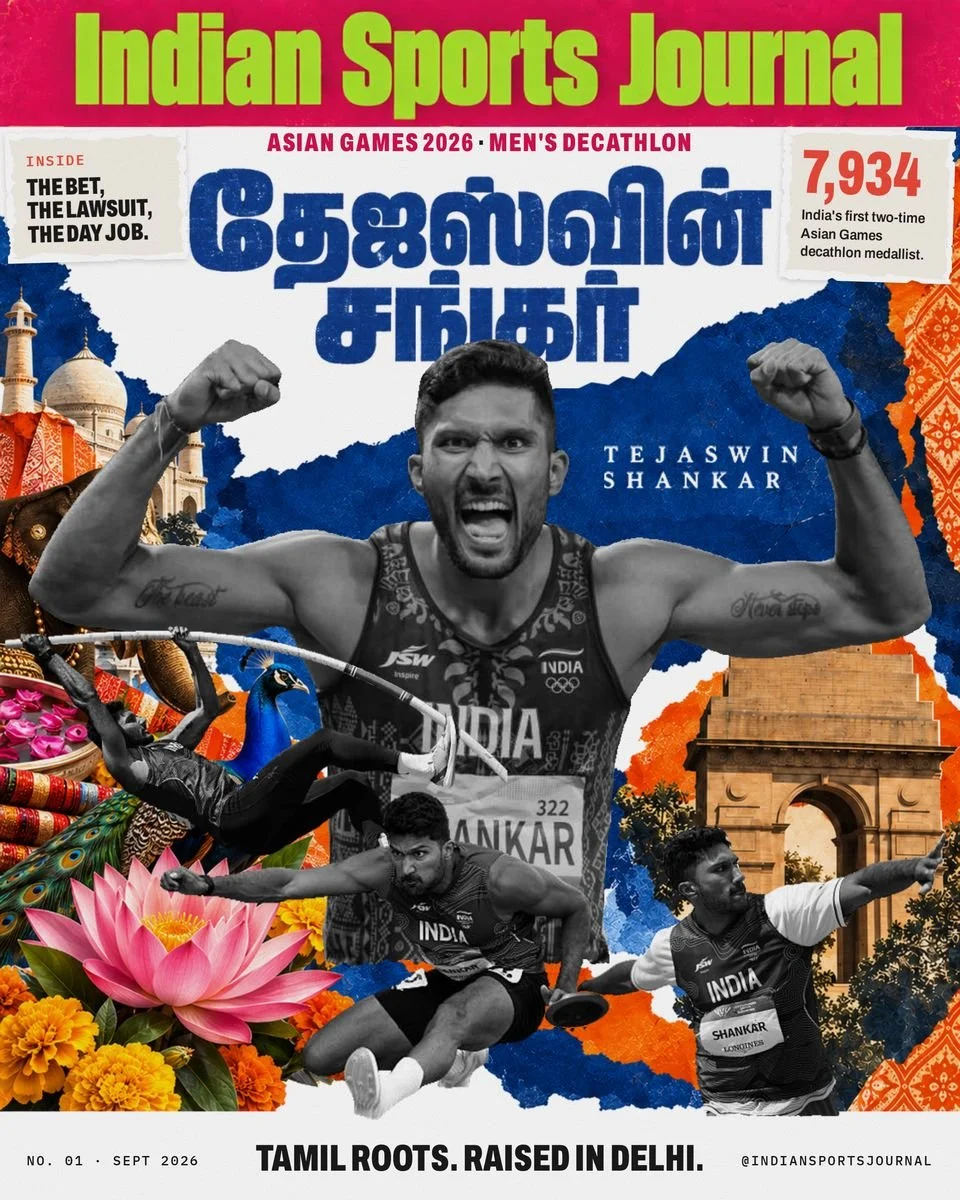
Tejaswin Shankar — The 78 Points He Wanted Back
India’s decathlete led the field going into the discus in Nagoya, fell to third in it and won the 1500m anyway. The bronze is his second Asian Games decathlon medal, eight weeks after a Commonwealth Games he nearly did not start.
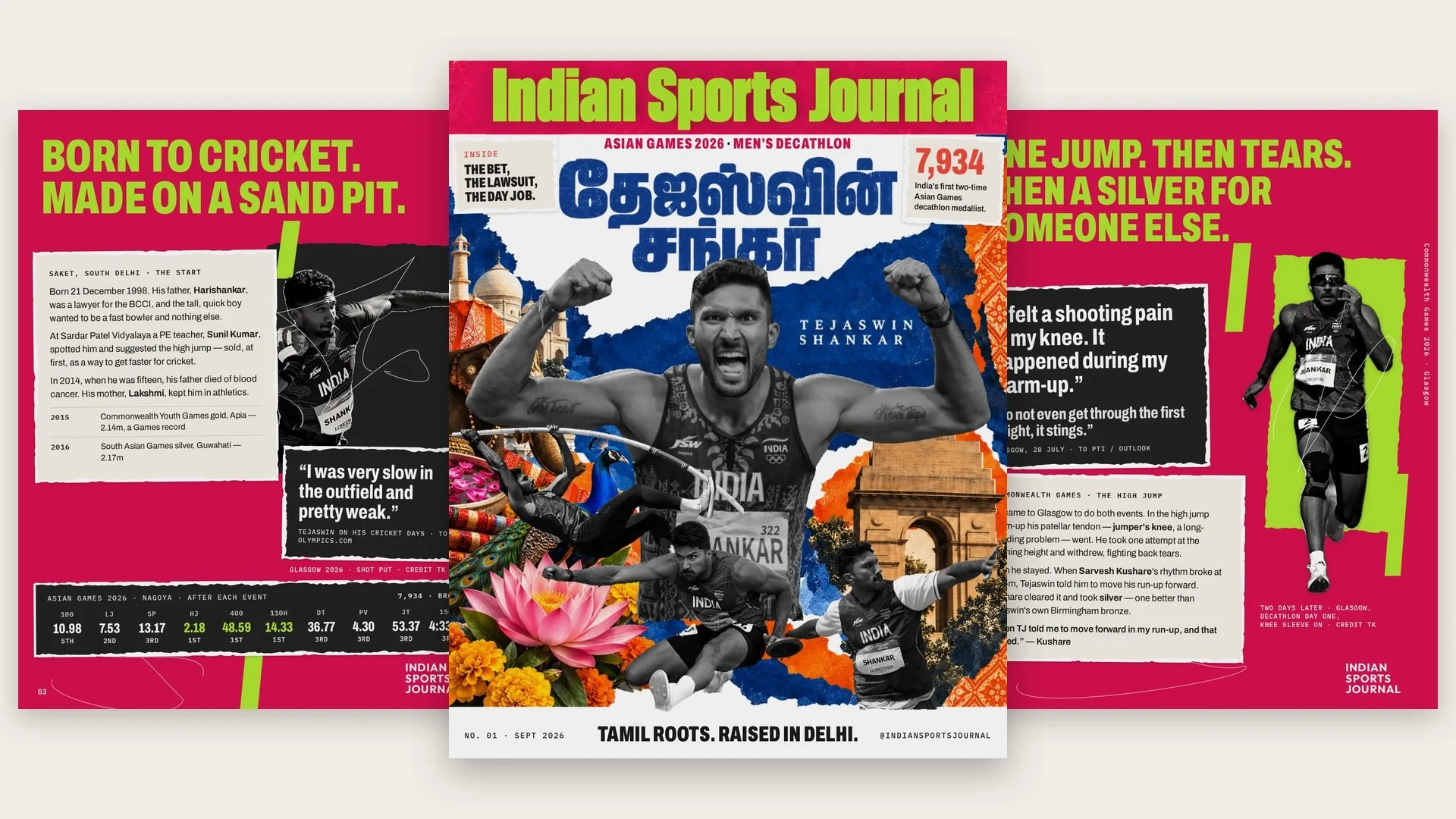
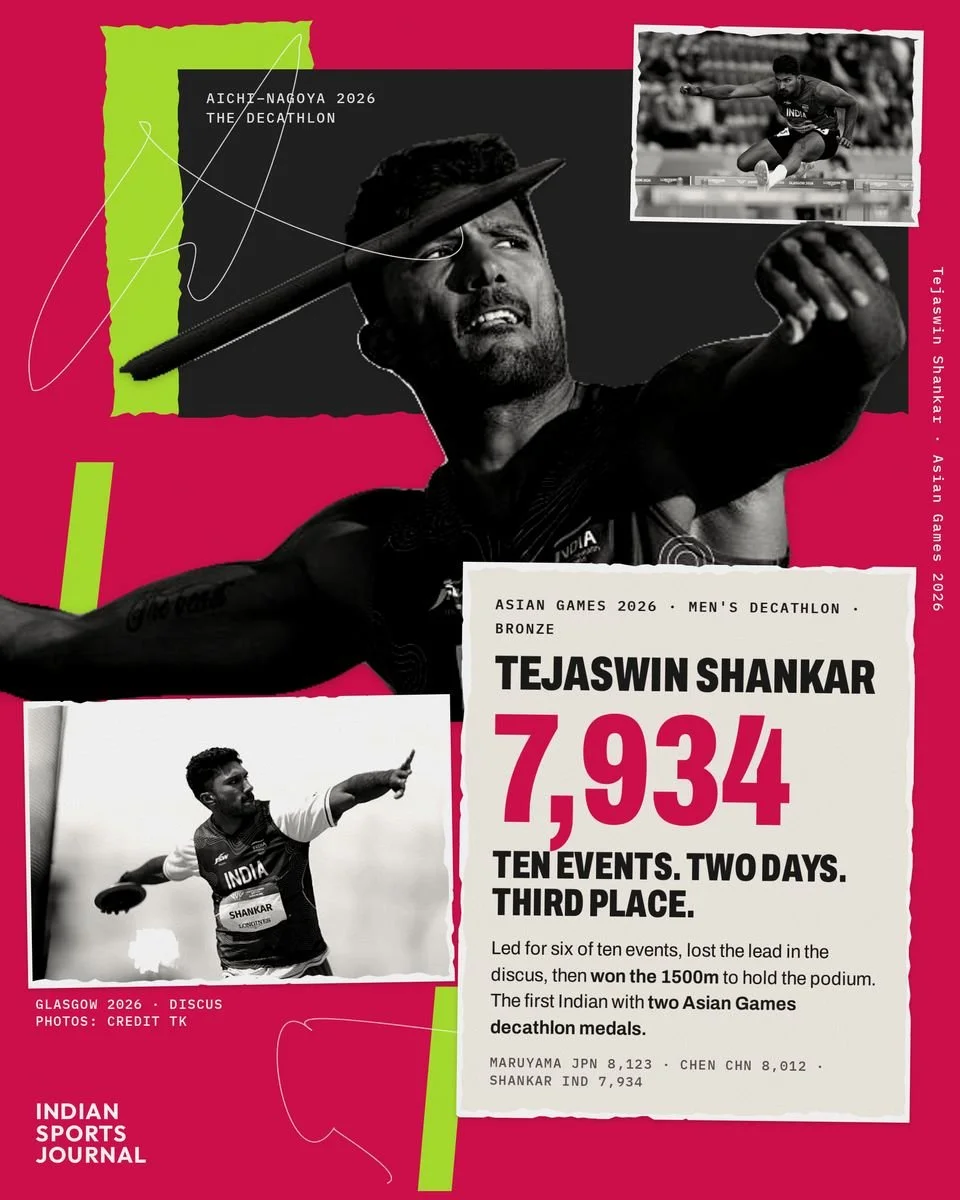
Tejaswin Shankar won the last race of the Asian Games decathlon on Sunday, and it changed nothing. He ran the 1500m in 4:33.09 at Aichi–Nagoya, ahead of Japan’s Yuma Maruyama, who came home in 4:33.92 with the gold already his. Shankar finished on 7,934 points for bronze, behind Maruyama’s 8,123 and the 8,012 of China’s Chen Xinghua. “I don’t think I won a bronze, I lost the silver,” he told PTI.
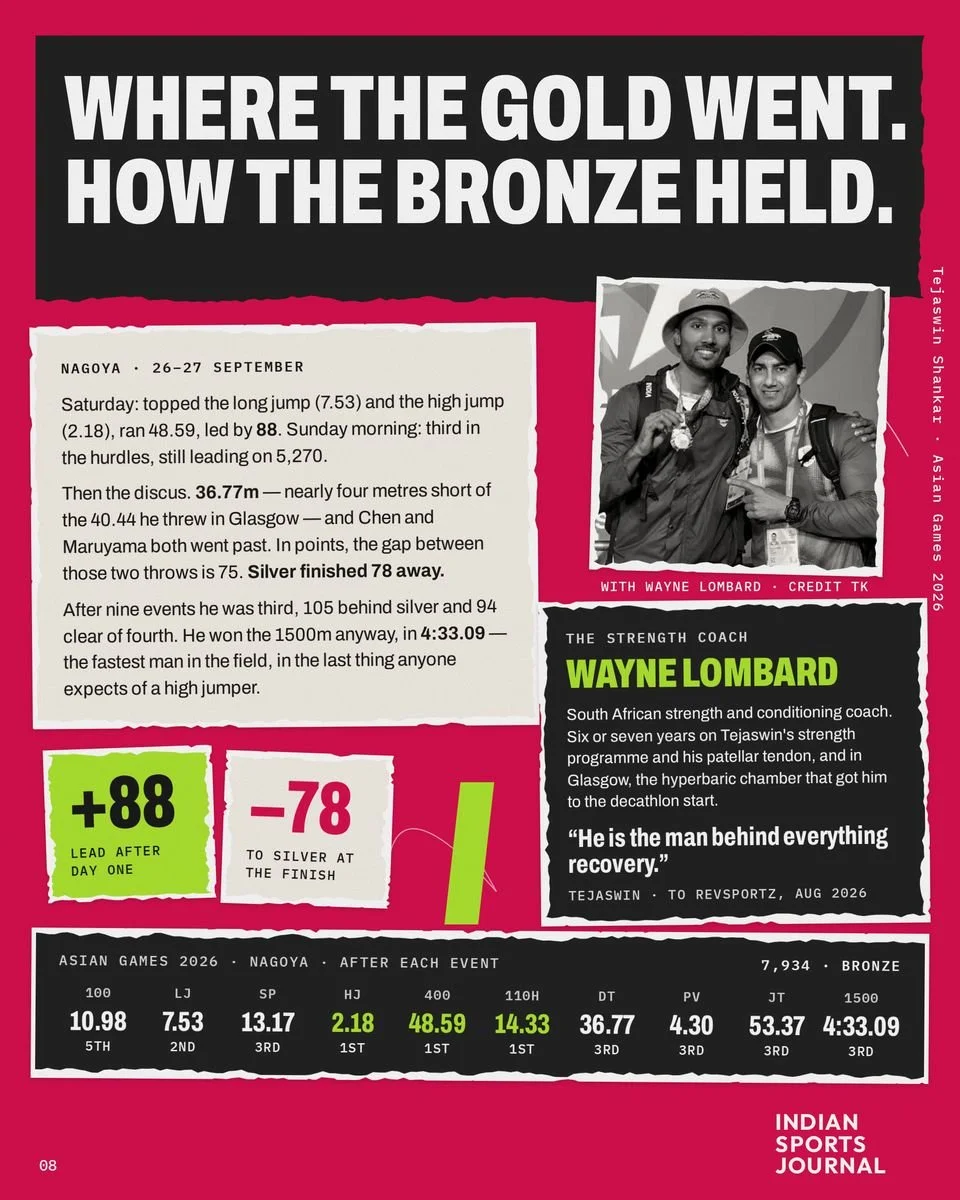
He had reason to see it that way. Shankar won the long jump and the high jump on Saturday, led overnight on 4,338 points and was still top of the table on Sunday morning: 5,270 after the 110m hurdles, 47 clear of Chen and 107 clear of Maruyama. Then came the discus. His best throw was 36.77m, nearly four metres short of the personal best he set at the Commonwealth Games in Glasgow in July, and by the end of the event he was third. On the scoring tables, the difference between those two throws is worth 75 points. Silver finished 78 away.
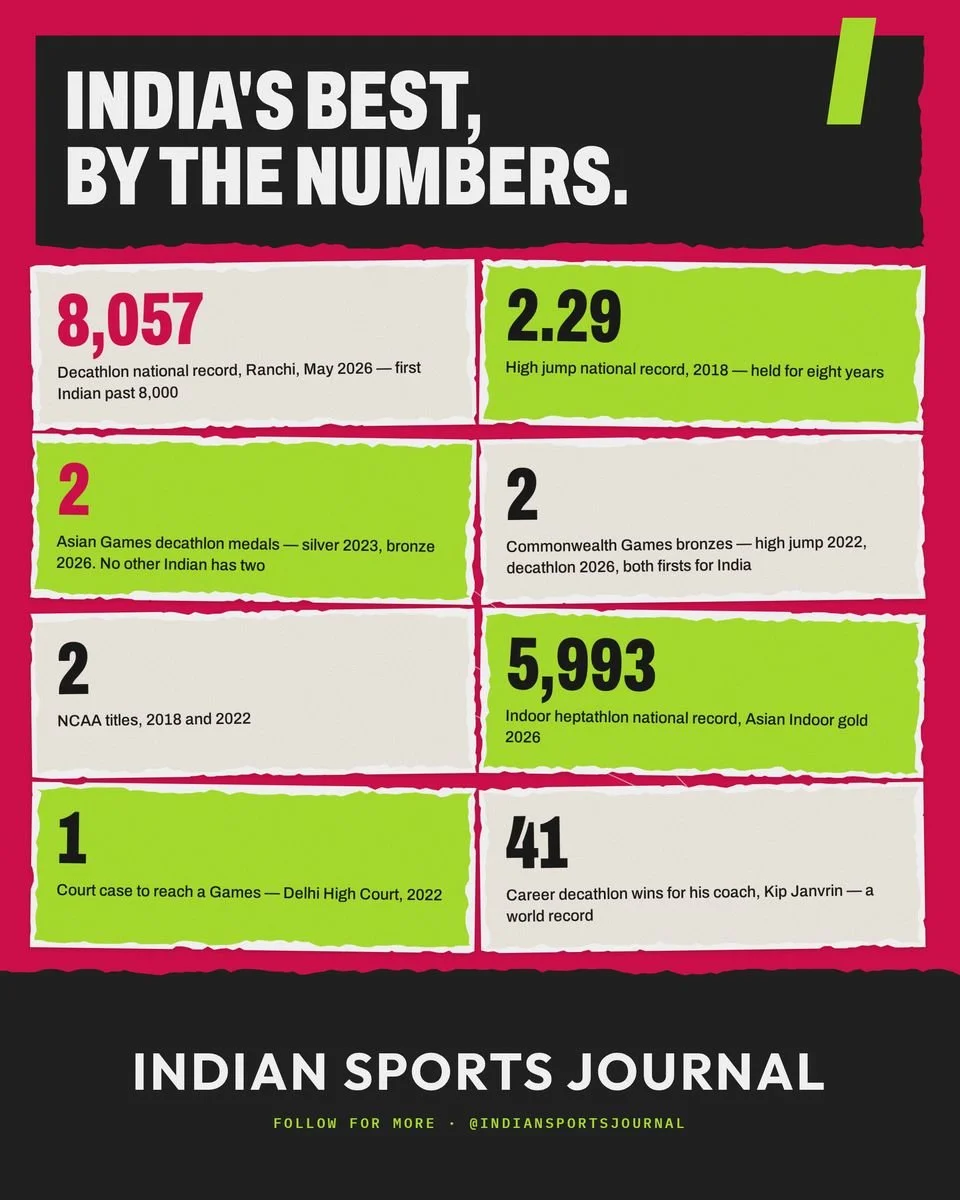
The bronze matters for more than consolation. It follows his decathlon silver at Hangzhou in 2023 and makes Shankar, according to IANS, the first Indian man to win two Asian Games medals in the event. It closes a season in which he became the first Indian past 8,000 points, won the Asian indoor heptathlon title and took India’s first Commonwealth decathlon medal on a knee he could barely jump on three days earlier. He did it while working as a graduate teaching assistant at Kansas State University. India’s best all-round athlete was made, in large part, by the American college system.
Where the silver went
Day one was built on his old event and its neighbours. Shankar ran 10.98 in the 100m, worth 865 points and fifth place. His 7.53m in the long jump (942 points) won the event and lifted him to second. He then won the high jump at 2.18m and ran 48.59 in the 400m to close Saturday in front. India’s second entrant, Thowfeeq Noushad, had 3,676 points after five events and did not start the hurdles; no reason was given for his withdrawal.
The hurdles kept him in front. Shankar ran 14.33, third in his heat, for 932 points. The discus took it apart. His 36.77m was worth 599 points and dropped him to third on 5,869, with China and Japan above him, and the two events that followed, pole vault and javelin, are not his strengths. He cleared 4.30m, threw 53.37m and stayed third.
| No. | Event · mark | Standing after |
|---|---|---|
| 1 | 100m · 10.98865 points | 5th |
| 2 | Long jump · 7.53m942 points; won the event | 2nd · 1,807 |
| 3 | Shot put · 13.17m | 3rd* |
| 4 | High jump · 2.18mWon the event | 1st* |
| 5 | 400m · 48.59End of day one | 1st · 4,338 |
| 6 | 110m hurdles · 14.33932 points; third in his heat | 1st · 5,270 |
| 7 | Discus · 36.77m599 points; 3.67m short of his Glasgow best | 3rd · 5,869 |
| 8 | Pole vault · 4.30m | 3rd* |
| 9 | Javelin · 53.37m | 3rd* |
| 10 | 1500m · 4:33.09Won the race, 0.83s ahead of Maruyama | 3rd · 7,934 |
Then he won the 1500m. Maruyama had beaten him over 1000m in the heptathlon at the Asian Indoor Championships in Tianjin in February, a defeat Shankar told PTI he had carried into Nagoya as motivation, even though he won that heptathlon and Maruyama took bronze. In Nagoya the overall order flipped; the last race went to Shankar.
He was blunt about why the total stopped where it did. Nagoya was his fourth decathlon of the year, on top of the indoor heptathlon in Tianjin; it was, he pointed out, Maruyama’s second. He felt it was one competition too many, PTI reported. “Three would be the absolute sweet spot,” he said. He said he was glad the Athletics Federation of India had let him skip the National Inter-State Championships, and said he valued consistency over a single big score. The three decathlons this year that can be checked — 8,057 in May, 7,976 in July, 7,934 on Sunday — all cleared 7,900.
A high jumper first
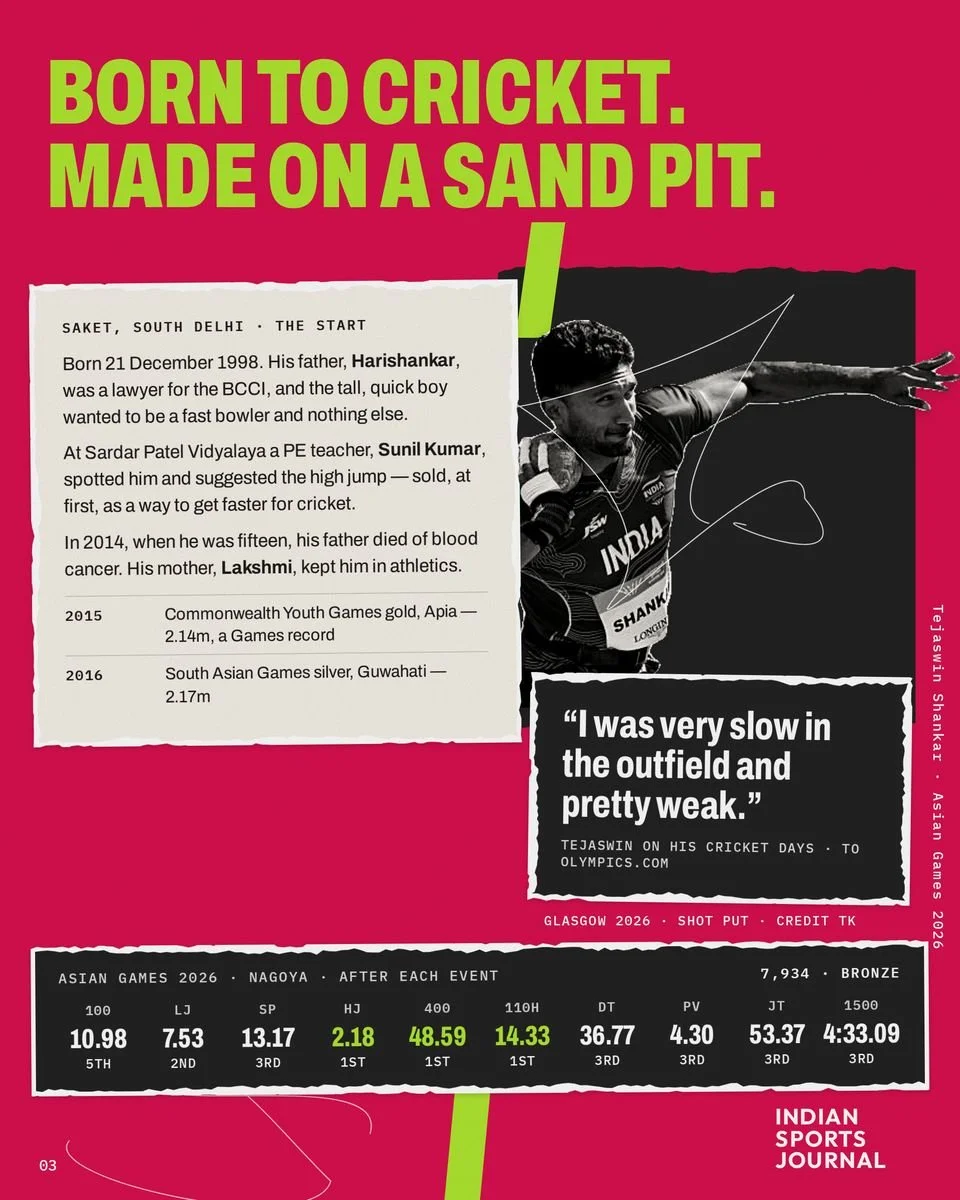
Shankar was born on 21 December 1998 in Saket, South Delhi. His father, Harishankar, was a lawyer for the Board of Control for Cricket in India, and cricket was the household sport; Outlook reports that the boy wanted to bowl fast. At Sardar Patel Vidyalaya a physical education teacher pushed him towards athletics as a way to get quicker for cricket, and a coach, Sunil Kumar, is credited by The Bridge with spotting him. His father was opposed. “My father was strictly against me taking up athletics,” Shankar told The Bridge in 2018; his mother, Lakshmi, helped him train anyway. Harishankar died of blood cancer in 2014, when his son was 15.
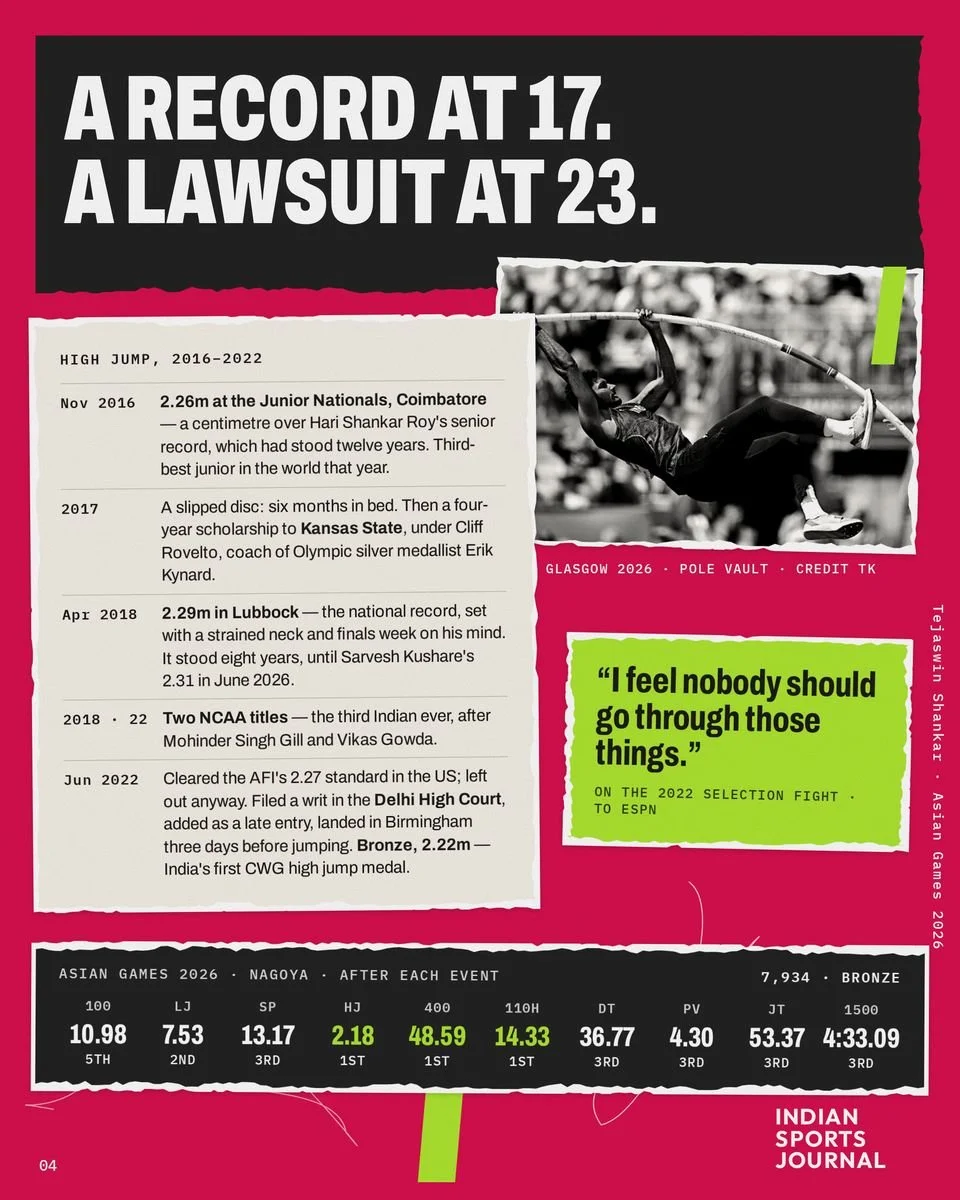
The jumping came quickly. Shankar won the 2015 Commonwealth Youth Games in Apia with a Games record of 2.14m, took South Asian Games silver in Guwahati the next year, and in November 2016 cleared 2.26m at the junior nationals in Coimbatore, a centimetre over Hari Shankar Roy’s 12-year-old national record. In 2017 a back injury slowed his year, ESPN reported. Kansas State then offered a four-year scholarship, on a call from Cliff Rovelto, the coach he called “the messiah of high jump”. In April 2018 he jumped 2.29m in Lubbock, Texas. That national record stood until Sarvesh Kushare cleared 2.31m in June this year. He won NCAA outdoor titles in 2018 and 2022.
The 2022 title, 2.27m, cleared the Athletics Federation of India’s mark for the Birmingham Commonwealth Games. He was left out anyway. Shankar went to the Delhi High Court, won, and was added in place of Arokia Rajiv; the organisers, who had refused India’s late-entry request on 7 July, accepted it on 22 July. “It has been a roller-coaster of emotions,” he said when he was cleared. In Birmingham he went over 2.22m first time and took bronze on countback, India’s first Commonwealth medal in the men’s high jump.
The accountant who took up ten events
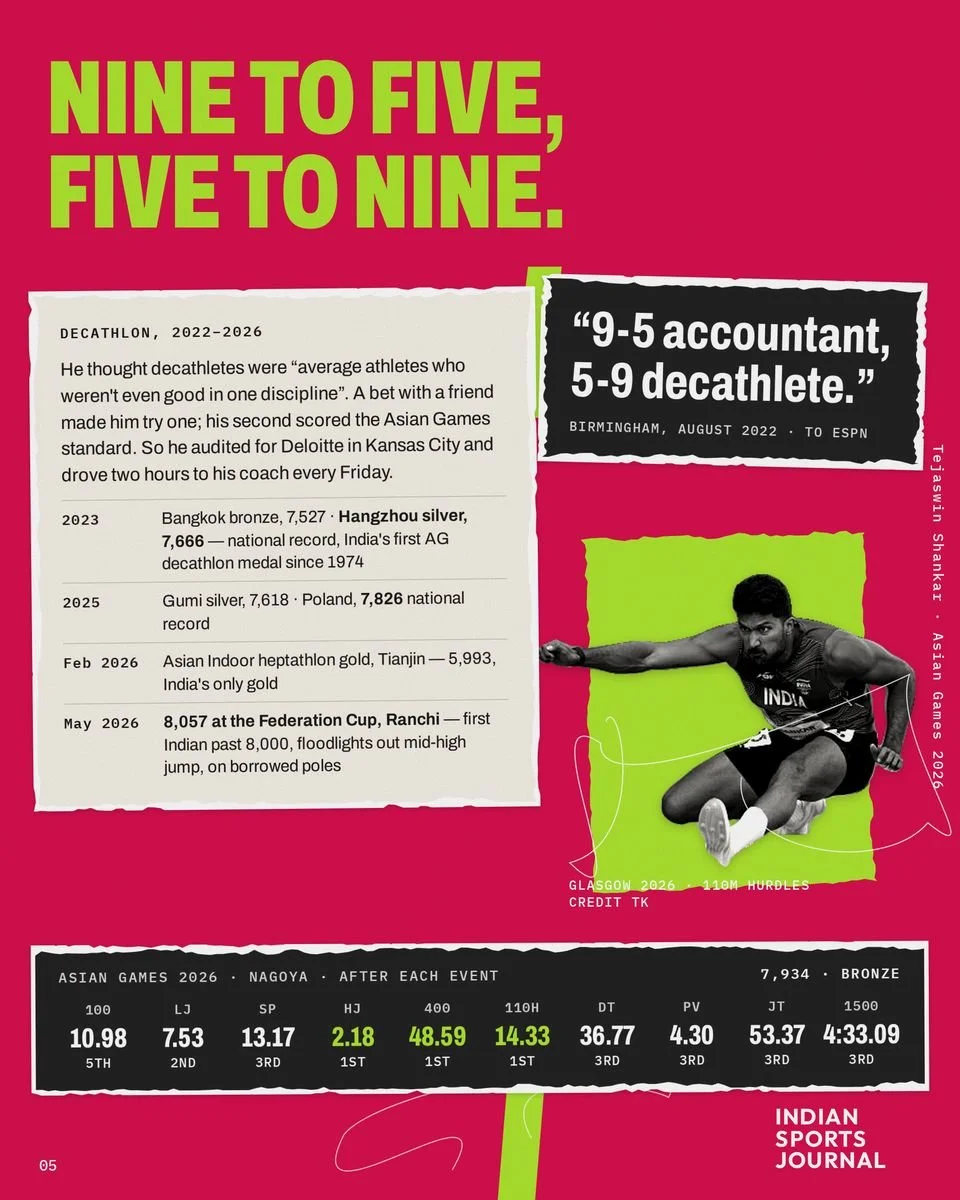
The day after that bronze, Shankar said it was “a certainty” he would contest the decathlon at the next Asian Games, and that he had a full-time offer from Deloitte in Kansas City to work as an accountant from September. He trained around the job. In 2023 he won decathlon bronze at the Asian Championships in Bangkok on 7,527 points, then silver at Hangzhou on 7,666, a national record that broke Bharatinder Singh’s 7,658. It was India’s first decathlon medal at the Asian Games since 1974, when Vijay Singh Chauhan won gold and Suresh Babu bronze. Gurbachan Singh Randhawa had won it in 1962.
The numbers kept rising. Silver at the 2025 Asian Championships in Gumi (7,618) was followed by 7,826 at the Czapiewski Memorial in Bydgoszcz, Poland, a national record set in fourth place at a World Athletics Combined Events Tour meeting. In February 2026 he won the heptathlon at the Asian Indoor Championships with a national indoor record of 5,993. At the Federation Cup in Ranchi in May he scored 8,057, the first Indian past 8,000, on a day the floodlights reportedly failed during his high jump. His 2.25m there was worth 1,041 points, and he ran the 1500m in 4:29.02. “I’m 6 seconds faster than what I was supposed to,” he told ESPN.
| Year | Event | Result |
|---|---|---|
| 2015 | Commonwealth Youth Games, ApiaHigh jump; Games record | Gold · 2.14m |
| 2016 | South Asian Games, Guwahati | Silver · 2.17m |
| 2016 | Junior Nationals, CoimbatoreBroke Hari Shankar Roy’s national record of 2.25m | NR · 2.26m |
| 2018 | Lubbock, TexasStood until Sarvesh Kushare’s 2.31m, June 2026 | NR · 2.29m |
| 2018 | NCAA Championships, Eugene | Gold · 2.24m |
| 2022 | NCAA Championships, Eugene | Gold · 2.27m |
| 2022 | Commonwealth Games, BirminghamAdded after a Delhi High Court petition; India’s first CWG high jump medal | Bronze · 2.22m |
| … high jump to decathlon … | ||
| 2023 | Asian Championships, Bangkok | Bronze · 7,527 |
| 2023 | Asian Games, HangzhouNational record; India’s first decathlon medal at the Games since 1974 | Silver · 7,666 |
| 2025 | Asian Championships, Gumi | Silver · 7,618 |
| 2025 | Czapiewski Memorial, BydgoszczFourth place; national record | NR · 7,826 |
| 2026 | Asian Indoor Championships, TianjinHeptathlon; national indoor record | Gold · 5,993 |
| 2026 | Federation Cup, RanchiFirst Indian past 8,000 | NR · 8,057 |
| 2026 | Commonwealth Games, GlasgowIndia’s first CWG decathlon medal | Bronze · 7,976 |
| 2026 | Asian Games, Aichi–Nagoya | Bronze · 7,934 |
Glasgow: one jump, then 48 hours
He went to Glasgow to do both events, and the first one ended in the warm-up. Before the high jump final on Monday 27 July, Shankar felt the patellar tendon go. “I felt a shooting pain in my knee. It happened during my warm-up,” he told PTI. “That’s why it’s called jumper’s knee.” He left after a single jump. “To not even get through the first height, it stings because I was in really great shape.”
He stayed in the arena. When Kushare’s rhythm broke at 2.25m, Shankar told him to move forward in his run-up. “Then TJ told me to move forward in my run-up, and that helped,” Kushare said. Kushare cleared it on his third attempt and took silver on countback behind Jamaica’s Romaine Beckford, a place better than Shankar’s own Birmingham bronze.
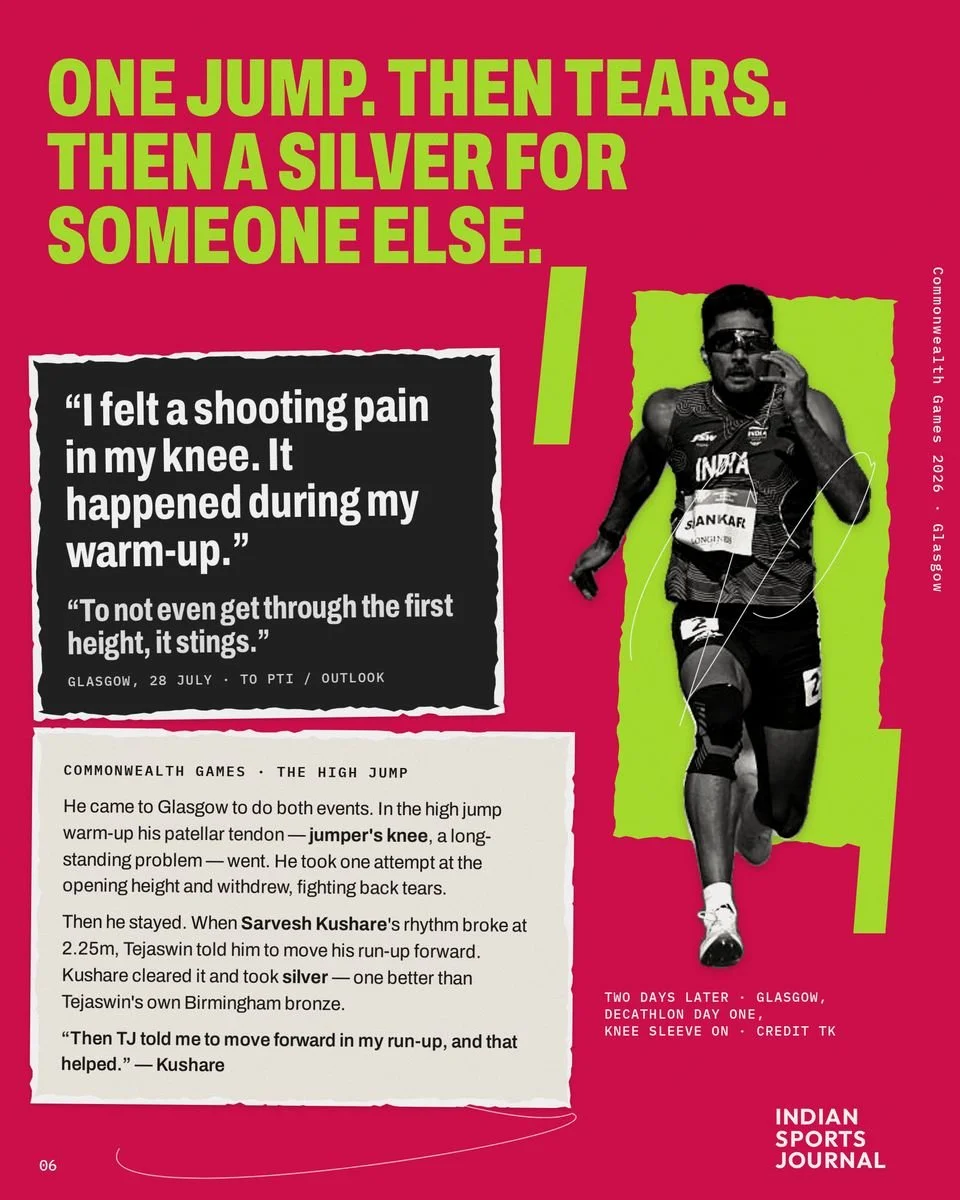
The decathlon began on Thursday. Dr Dinshaw Pardiwala, the sports surgeon, told him the tendon was intact and that competing carried no risk of rupture, RevSportz reported, but warned: “You might be in incredible pain.” Wayne Lombard, the South African strength and conditioning coach Shankar calls “the man behind everything recovery”, found a hyperbaric clinic 40 minutes’ drive away, telling him the aim was to “chase that 1%”. Murali Sreeshankar’s advice, as Deccan Herald summed it up, was to forget about the medal, forget about finishing the decathlon and take one event at a time.
He was seventh after the 100m, then jumped a lifetime-best 7.82m in the long jump, cleared 2.15m on the bad knee and ended day one second, 14 points behind Canada’s Damian Warner. His 40.44m in the discus was another personal best and left him three points behind Warner, 50 ahead of Grenada’s Lindon Victor. The pole vault dropped him to fourth; a 53.12m javelin put him back to third, and he held it through the 1500m for 7,976 points. Victor won a third straight Commonwealth title on 8,096, Warner took silver on 8,036, and India had its first Commonwealth decathlon medal.
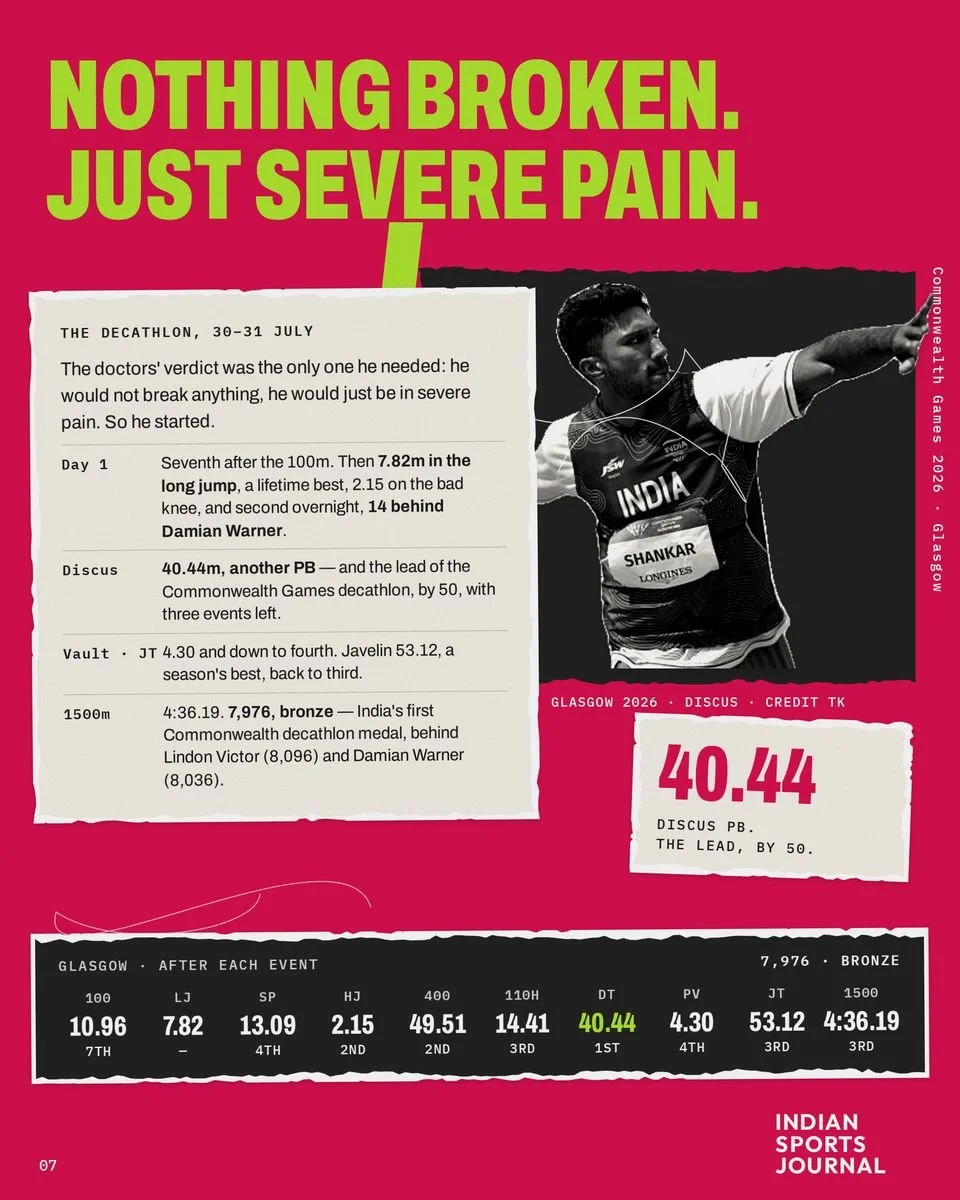
Set the two decathlons side by side and Nagoya was the better performance in six events, level in one and worse in three. Two of those three cost him 148 points between them.
The support system is in Kansas
In 2026 Shankar went back to Kansas State, where he had earned bachelor’s and master’s degrees in accounting, for a master’s in kinesiology. A graduate teaching assistantship pays for it; he teaches biomechanics and an introductory kinesiology course. Kansas State’s combined-events coach is Kip Janvrin, who at 35 became the oldest American to contest an Olympic decathlon, at Sydney 2000, and who holds the world record for career decathlon wins, 41. ISJ’s carousel names Janvrin as the reason for the arrangement.
The rest of the team travels. Lombard has worked with PV Sindhu, Vinesh Phogat and Sreeshankar; Pardiwala heads the Centre for Sports Medicine at Mumbai’s Kokilaben hospital. Shankar married the former sprinter Siddhi Hiray in 2024, and the two co-founded King’s Sports Group, which helps Indian student-athletes win US college scholarships — the route he took himself.
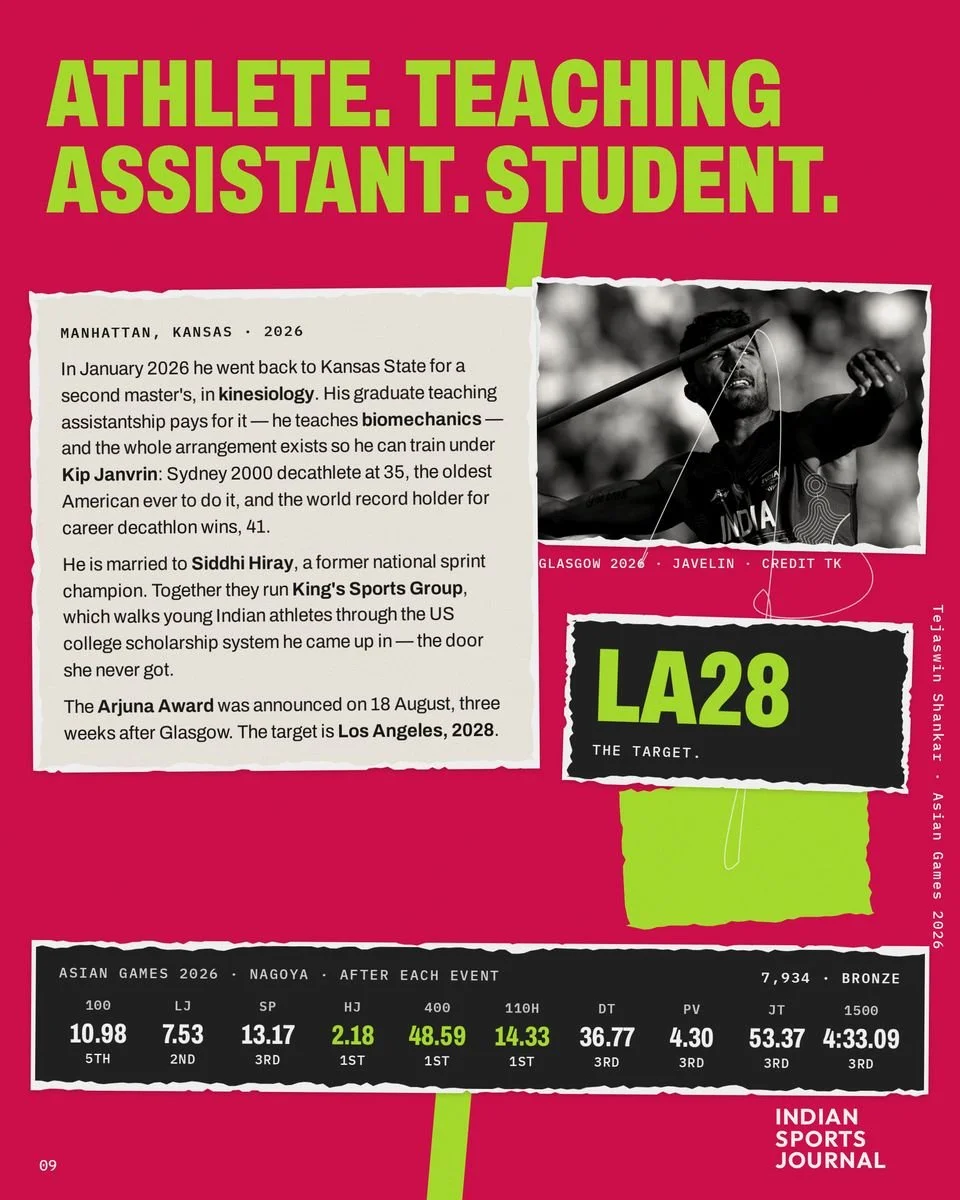
Recognition at home came late. The sports ministry announced the 2025 National Sports Awards on 18 August, with Shankar among 17 Arjuna awardees and no Khel Ratna given. Months earlier, with the list stalled since a December selection meeting, he had called the delay “not just demotivating to athletes and coaches but also a sign of disrespect.”
What comes next
The next number is 8,300. That, Shankar said after the event, is roughly what he needs to qualify for next year’s World Championships, and it is 243 points beyond his national record. He called it “my next challenge”. The longer target is Los Angeles 2028.
First he flies back to Manhattan, Kansas, and the teaching job that funds his degree. “I am a teaching assistant,” he said, “and I have to grade my assignments.”
Sourcing. Nagoya result and progression: PTI (Deccan Chronicle, ThePrint/Telangana Today), IANS (NewsBytes), myKhel, Asianet Newsable, Khel Now. Glasgow: PTI (Outlook, ThePrint), Outlook live blog, IANS, RevSportz (Boria Majumdar, 1–2 August), Deccan Herald, decathlon2000.com full results, ISJ’s Glasgow day notes. Career: Wikipedia, The Bridge, The Tribune, The Quint, Outlook, Kansas State Athletics, ISJ’s May 2026 athletics research. Awards: ANI (Tribune), IANS (The Statesman). Janvrin: Wikipedia. Points recomputed with the World Athletics scoring tables.
Corrections to the carousel. Slide 1: “Tamil roots” — not confirmed in any source checked; left out. Slide 2: “Led for six of ten events” — he was leading after the sixth event; he topped the standings after only three of the ten (high jump, 400m, hurdles), per myKhel, PTI and the deck’s own ledger. Slide 3: the Olympics.com quote “I was very slow in the outfield and pretty weak” — not found; not used. Slide 4: “third-best junior in the world”, the strained neck, “third Indian after Mohinder Singh Gill and Vikas Gowda”, “landed in Birmingham three days before jumping” and the ESPN quote “I feel nobody should go through those things” — not verified; not used. Slide 5: the ESPN quote “9-5 accountant, 5-9 decathlete”, dated Birmingham, August 2022 — not found, and his Deloitte job began in September 2022 per The Quint; the “average athletes” quote, the bet, the Asian Games standard in his second decathlon, the two-hour Friday drive, “India’s only gold” in Tianjin and the borrowed poles — not verified; not used. Slide 6: “two days later” — the high jump final was Monday 27 July and the decathlon began Thursday 30 July, per PTI. Slide 7: after the discus he was second, three behind Warner (5,938 to 5,935), not leading by 50, per Outlook’s live blog and decathlon2000 marks; the ledger’s standings after the shot put and hurdles are 5th and 2nd, not 4th and 3rd, and after the long jump 3rd; the medical go-ahead was Dr Dinshaw Pardiwala’s, per RevSportz. Slide 8: “+88” after day one and “105 behind silver, 94 clear of fourth” after nine events — not in wire copy; not used; Lombard’s “six or seven years” — not verified. Slide 9: “January 2026” — sources give 2026 only; Siddhi Hiray as “national sprint champion” — sources say former sprinter; “the door she never got” — not verified.
Flag. Whether Shankar cleared his opening height in the Glasgow high jump: PTI’s copy says he “could not continue after clearing his first attempt”; his own quote says he did not “get through the first height”, and ISJ’s day notes recorded no valid mark. “First Indian man to win two Asian Games decathlon medals” is IANS’s and Khel Now’s claim. Resolved at fact-check (28 October): Wikipedia’s list of Asian Games athletics medallists gives India six earlier decathlon medallists, each with one medal (Khurshid Ahmed 1951, Ronnie O’Brien 1954, Gurbachan Singh Randhawa 1962, M. G. Shetty 1970, Vijay Singh Chauhan and Suresh Babu 1974), and none from 1978 to 2018, so the claim holds. Fact-check changes: “One competition too many” is PTI’s summary of his view, not his words, and is no longer quoted; Sreeshankar’s advice is Deccan Herald’s paraphrase and is no longer in quotation marks; the 2017 “slipped disc, six months in bed” (slide 4) could not be confirmed, and ESPN (October 2017) reports only a back injury. The Nagoya shot put (13.17m) and 400m (48.59) on the carousel sum one point above PTI’s official day-one 4,338, so one of them is likely a centimetre or a hundredth out. Outlook (2026) says he wanted to be a fast bowler; The Bridge (2018) quotes him playing cricket “not with any ambition”. Deccan Herald reverses Victor’s and Warner’s Glasgow totals, and ISJ’s own Glasgow day notes had Warner as champion; IANS, RevSportz, Outlook and decathlon2000 give Victor 8,096, Warner 8,036. IANS calls him reigning Asian decathlon champion; he took silver at Gumi in 2025. That Janvrin coaches him personally is the carousel’s account; sources confirm only that Janvrin is Kansas State’s combined-events coach.