Kirpan ke Karigar — A Film in Black and White
The kirpan is written into India’s Constitution and measured to the centimetre by its aviation-security regulator. The people who grind it are barely recorded at all. ISJ’s new black-and-white film watches their work, with nothing on the soundtrack but the workshop.
The kirpan is written into the Constitution of India. Explanation I to Article 25, which guarantees freedom of religion, says that “the wearing and carrying of kirpans shall be deemed to be included in the profession of the Sikh religion.” In March 2022 the Bureau of Civil Aviation Security set its dimensions as well: a Sikh passenger may carry a kirpan on a domestic flight if the blade is no longer than 15.24 cm (6 in) and the whole kirpan no longer than 22.86 cm (9 in). When a public-interest petition challenged the rule, the Delhi High Court dismissed it that December, calling the exemption a policy decision taken after due deliberation.
The state, then, has spent decades defining the object. It has said very little about the people who make it, and nor has almost anyone else. The fullest published accounts of the kirpan trade that ISJ could find date from 2006 and 2010, and they do not agree on the numbers.
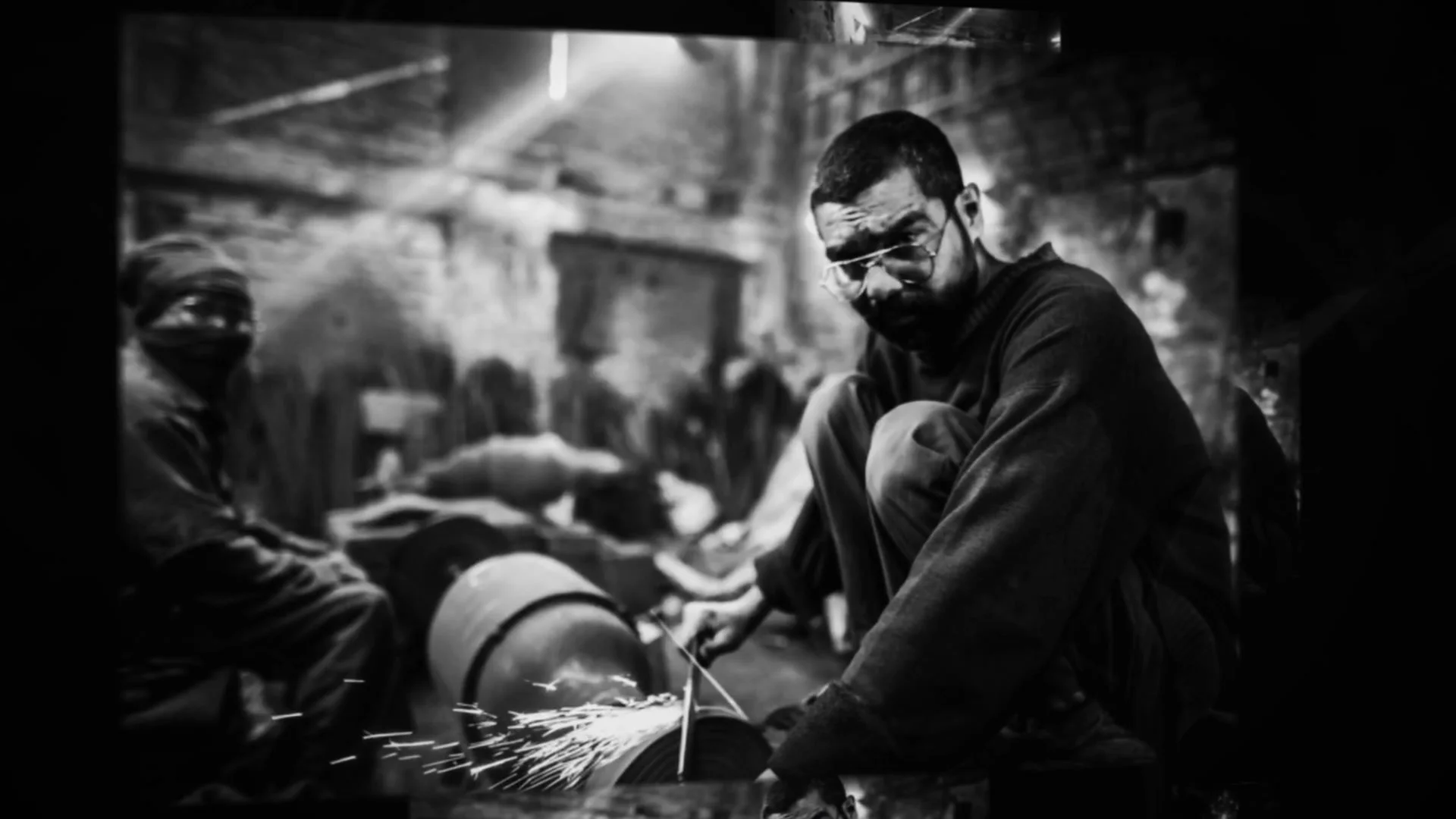
Kirpan ke Karigar, the craftsmen of the kirpan, is ISJ’s film about that missing link. It is built from a two-minute source film of handheld black-and-white footage: a karigar at a grinding wheel, a curved blade taking its edge, sparks, a rack of finished pieces, and still photographs at the end. There is no narration and no music. The only sound is the workshop. ISJ cut it two ways, as a 9:16 vertical reel and in the original 16:9, and closed both with a title in three scripts. The film does not answer the questions the record leaves open about this trade. It does put the person doing the work at the centre of the frame, which is where the record has rarely put him.
What the kirpan is
The kirpan is one of the five articles of faith, the panj kakar, that Guru Gobind Singh commanded at the Vaisakhi initiation of 1699, when he created the Khalsa. The others are kesh (uncut hair), kangha (a comb), kara (a bracelet) and kachhera (an undergarment). Initiated, or amritdhari, Sikhs keep all five. The Shiromani Gurdwara Parbandhak Committee (SGPC) has described wearing the kirpan as a must for initiated Sikhs under the Sikh Rehat Maryada, the community’s code of conduct. Harvard’s Pluralism Project adds that many Sikhs keep the emblems without having been initiated into the Khalsa.
Kesh — uncut hair and beard.
Kangha — a comb, usually wooden.
Kara — a bracelet, usually iron or steel.
Kachhera — an undergarment.
Kirpan — a curved, single-edged blade of steel or iron, carried in a sheath on a gatra, a strap worn across the body.
Commanded by Guru Gobind Singh at the Vaisakhi initiation of 1699 as the mark of the Khalsa. Initiated (amritdhari) Sikhs keep all five; the SGPC holds that the Sikh Rehat Maryada makes wearing the kirpan a must for them.
Its meaning runs on two levels. The Pluralism Project describes a practical function, as a weapon Sikhs are bound to use to protect the oppressed, and a symbolic one: “the sword of knowledge, which has cut the roots of ego.” The word comes from the Sanskrit kṛpāṇa, a sword or knife. A popular folk etymology splits it into kirpa, mercy, and aan, honour; reference accounts treat that reading as folk etymology rather than linguistic history.
The law’s interest is narrower. Article 25 protects the carrying of the kirpan as part of the faith; the 2022 aviation rule turned that protection into measurements.
How a kirpan is made
The most detailed account of the process in print is a Tribune report from August 2006, “City of ‘kirpans’”, by Varinder Walia and Neeraj Bagga. It described Amritsar as the hub of kirpan and sword making, with about a dozen large firms and scores of small units, and blacksmiths in Dhapai village, on the city’s outskirts, who had made swords and iron weapons for centuries.
The work, as the paper set it out, has three broad stages: forming, heat treating and finishing, which can overlap or be skipped. Traditional makers shape the metal. It is then ground, polished, stamped with a trademark, nickel-chrome plated and buffed. Grips and sheaths are fitted, and a velvet cover is added to attract customers. The labour is divided among specialists, so a single kirpan may pass through many hands. The inputs travel too: iron and sheet came from Mandi Gobindgarh, in Punjab, and grips from Moradabad, in Uttar Pradesh, to be fitted in Amritsar.
The craft had already changed by then. Before Partition, the Tribune reported, most of Amritsar’s kirpan artisans were Muslim. A kirpan once took close to a day to make; power tools had cut both the labour and the time. The objects had become lighter, from about 3 kg to 600 g by the Tribune’s figure, or 500 g by an ANI report’s in 2010, and their use had narrowed to religious rites and display. “Its usage has changed from being a vital weapon in battlefield,” said Sohan Singh, then president of the Kirpan Association.
The trade, in old numbers
The Tribune put the workforce at about 10,000 people working in the trade directly or indirectly, and its annual turnover at about ₹50 crore. Large units employed 12 to 15 people each and turned out about 150 kirpans a day, mostly for religious ceremonies. Prices ran from about ₹35 for a machine-made replica to ₹20 lakh or more for a hand-crafted, diamond-studded piece. A retailer could earn ₹40 to ₹60 on a sword; wholesale margins had shrunk to a few rupees. Buyers came from Gujarat, Rajasthan, Madhya Pradesh, Kerala, Orissa, Uttar Pradesh and Bihar, and demand rose near festivals.
Two reports in 2010 updated the picture without settling it. The news agency ANI, in January, also counted about 10,000 skilled artisans, put output at roughly 3,000 kirpans a day and turnover at about ₹50 crore, and quoted Amardeep Singh of Adarsh Kirpan Factory linking the rise in production to a fall in quality. Business Standard, in February, valued the cottage industry at ₹60 crore, with overseas demand from non-resident Indians and foreign tourists and exports to the United States, Canada, Australia and Europe. Shops lined the road to the Golden Temple; grooms carried kirpans at weddings.
Those are the fullest numbers ISJ could find, and they come from three reports more than 15 years old. A shorter Hindustan Times report in June 2017 counted only 30 to 40 manufacturing units left in Amritsar, down from hundreds, as cheaper Chinese-made kirpans took the market. None of them says how many of those 10,000 people do the specific work of putting the edge on a blade. That person, at that wheel, is the film’s whole subject.
What the film shows
The source is a single two-minute 1080p file of handheld black-and-white footage. ISJ’s edit logs describe what is in it: the karigar under a headlamp; bundled rods; sparks off the wheel; the blade’s tip and edge in close-up under his hand; the curved blade on the wheel throwing a fan of sparks; his face in profile as he dips the blade; a rack of finished blades; the man bent over his grinder; light falling through the workshop doorway; and, at the end, a run of still photographs.

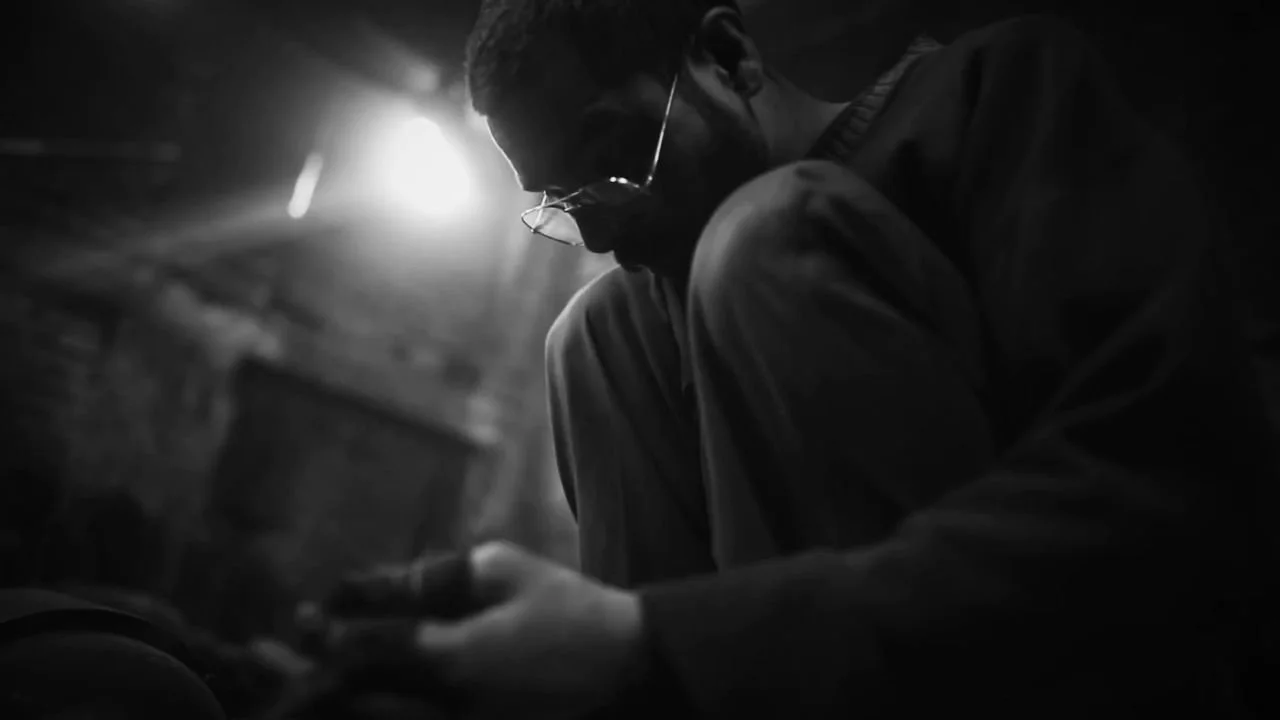
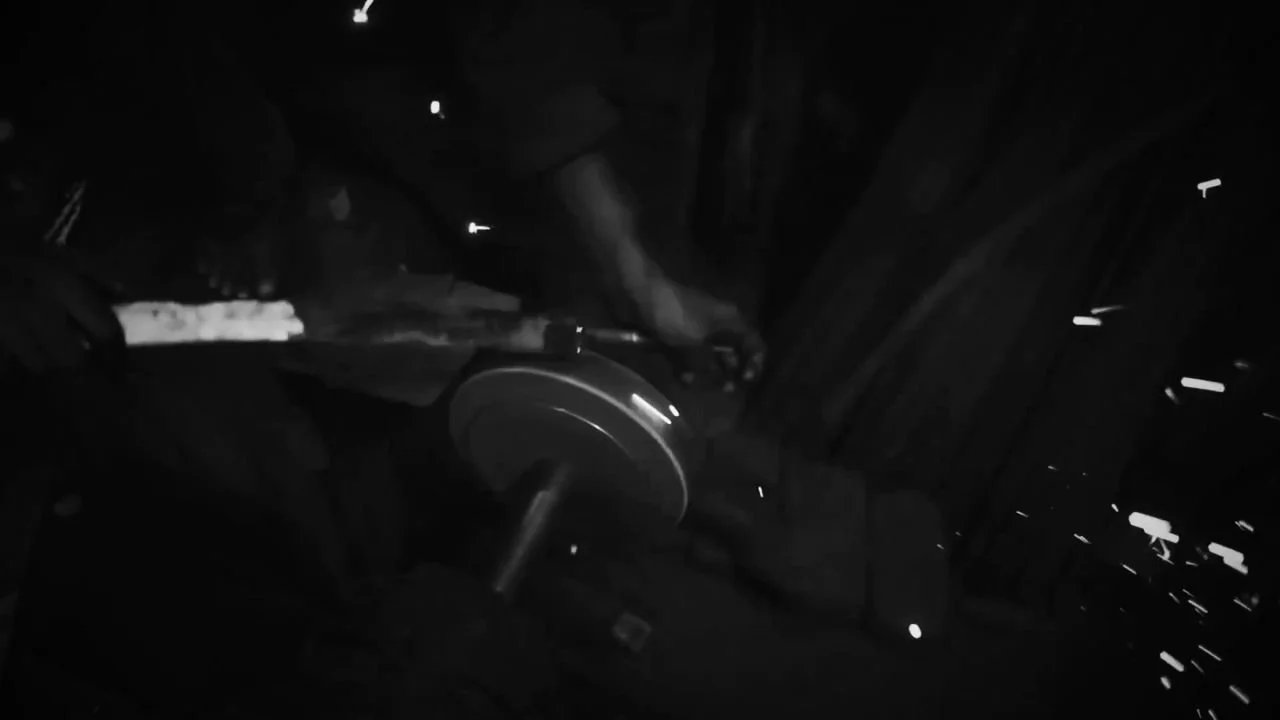
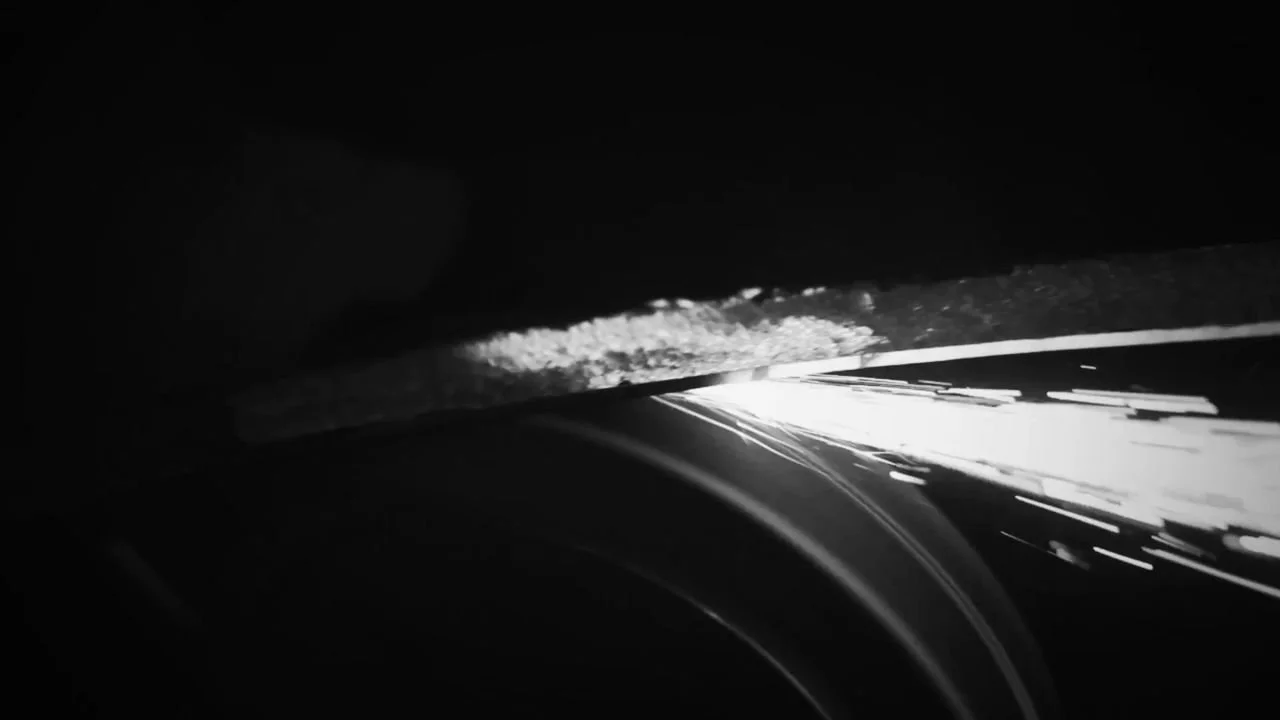
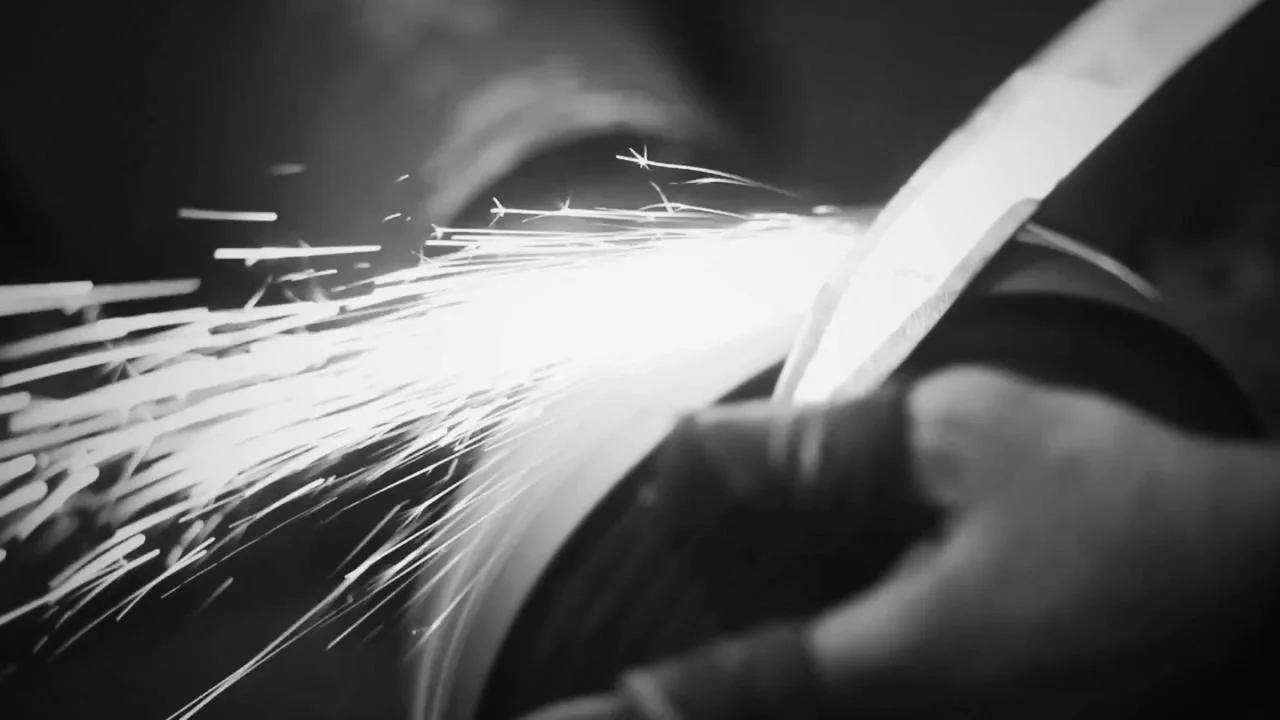
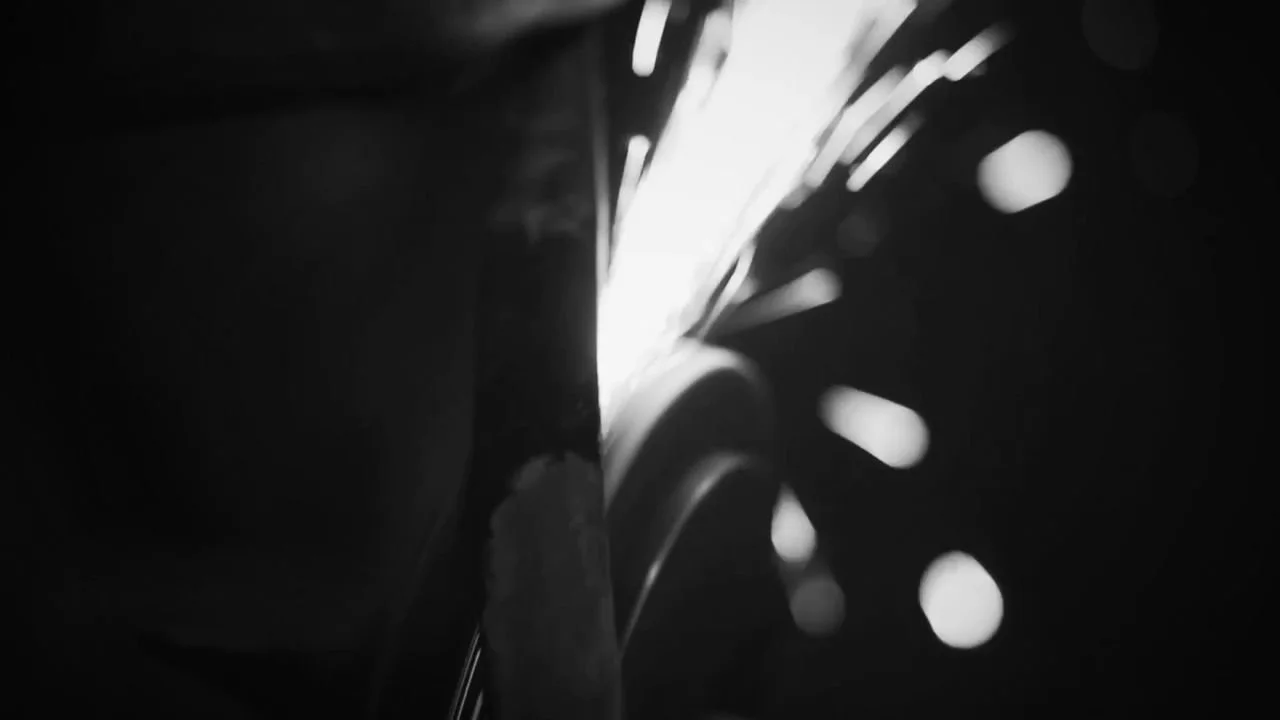
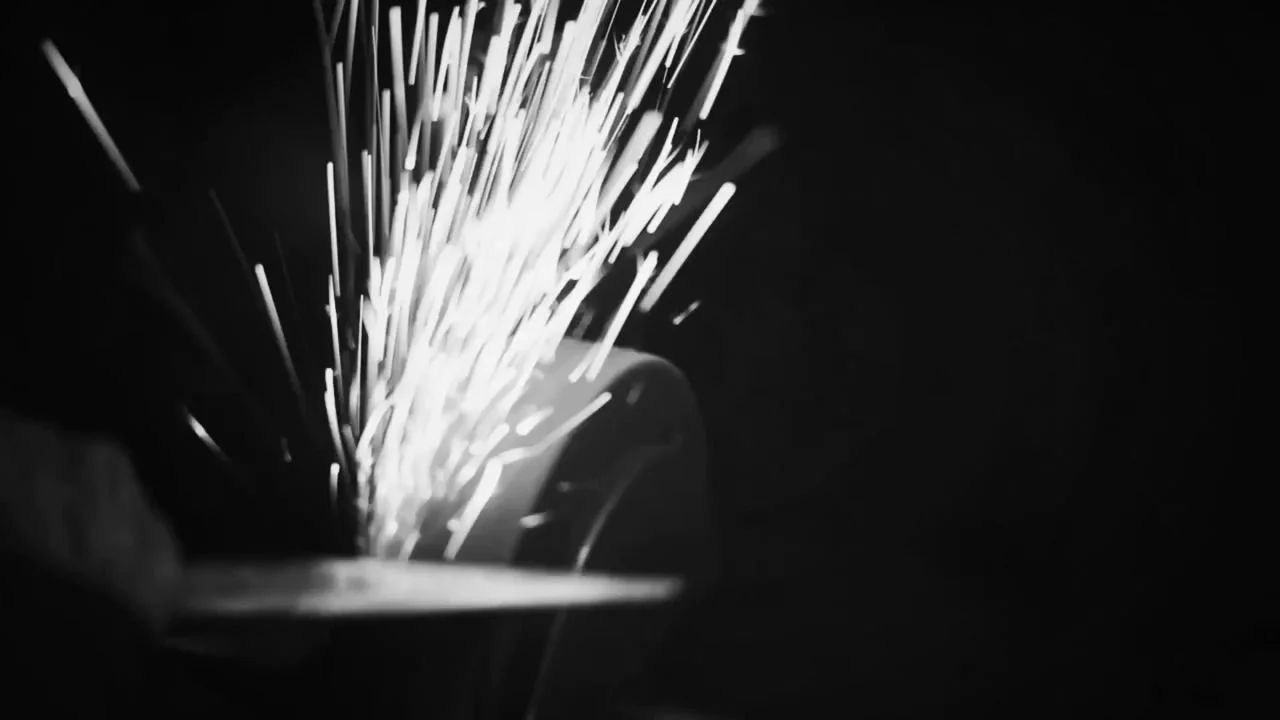
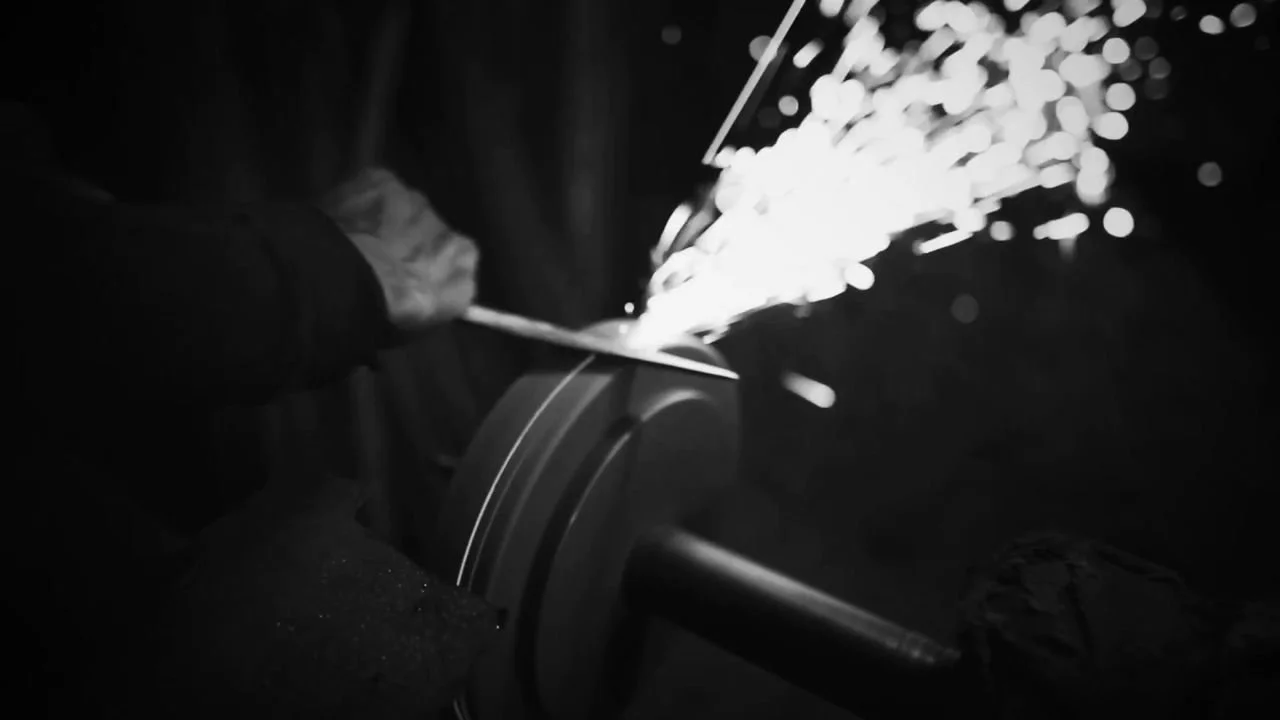
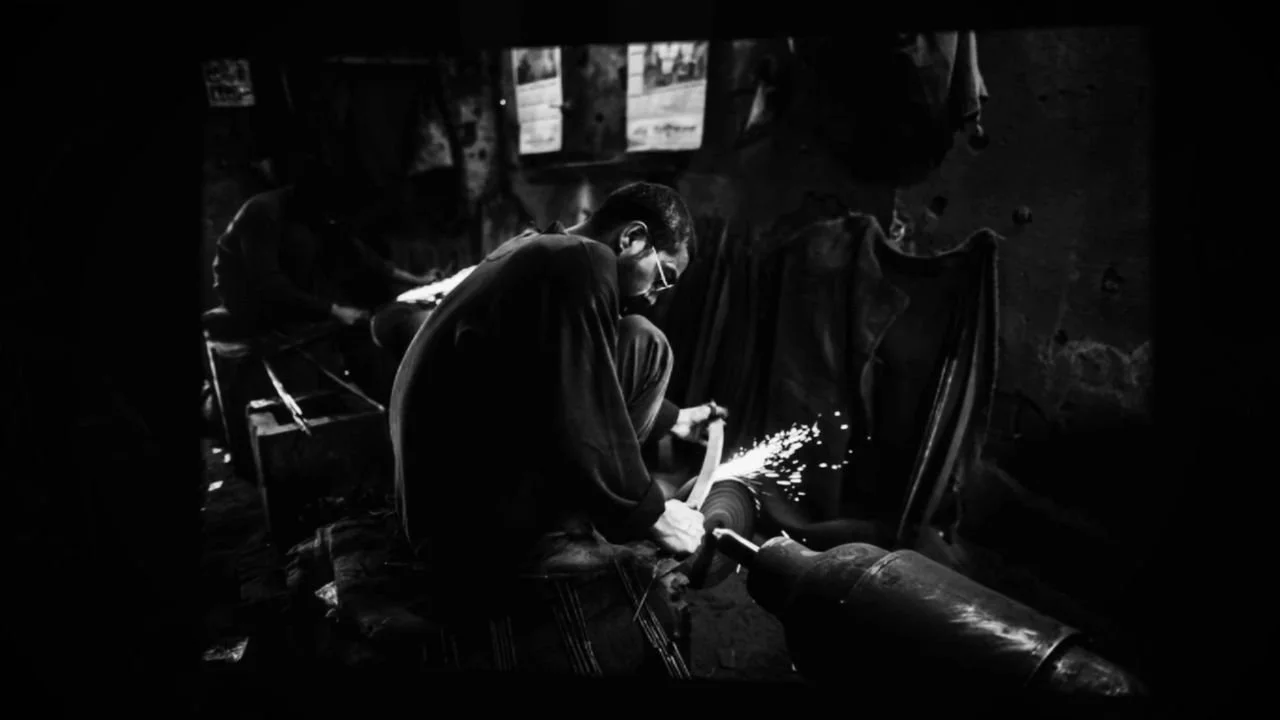
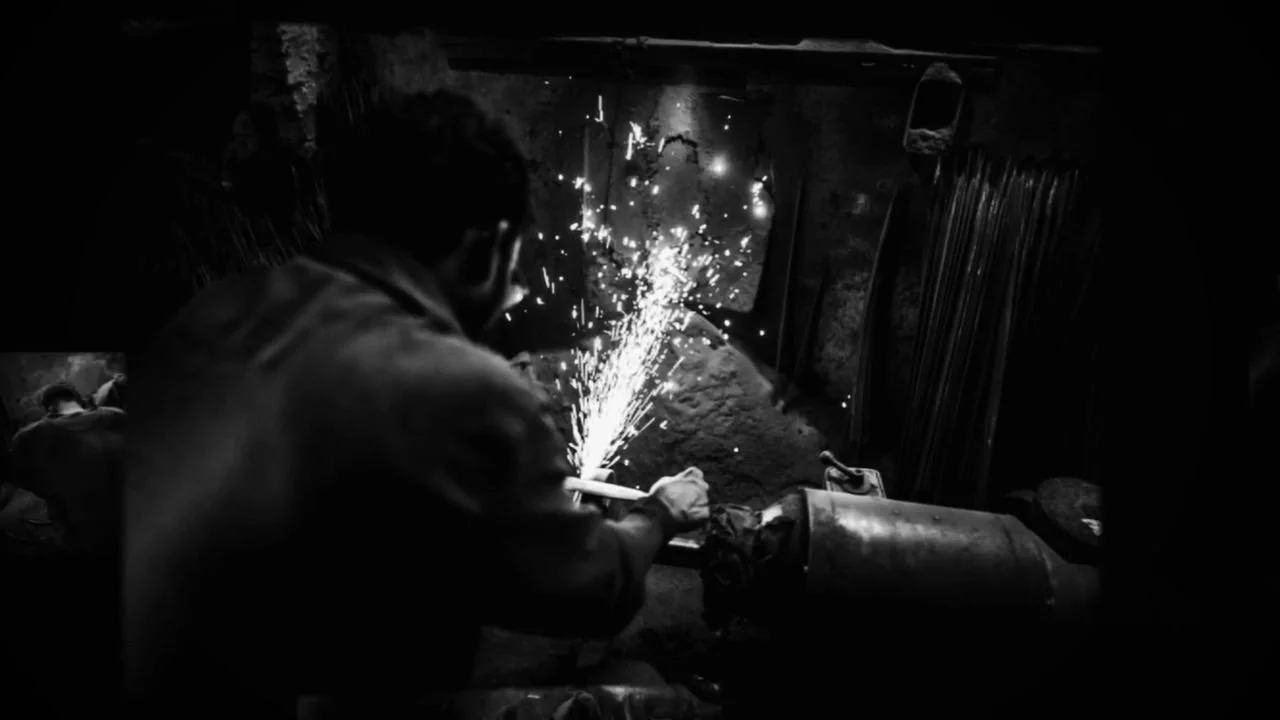
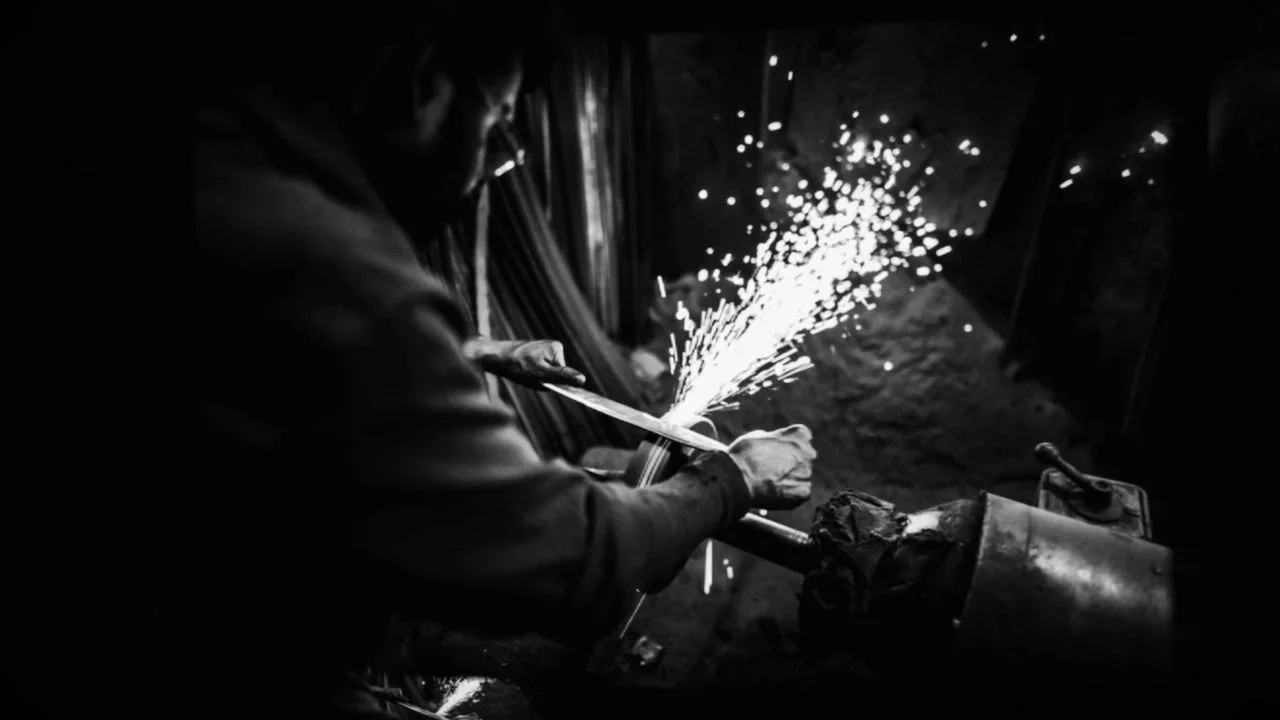
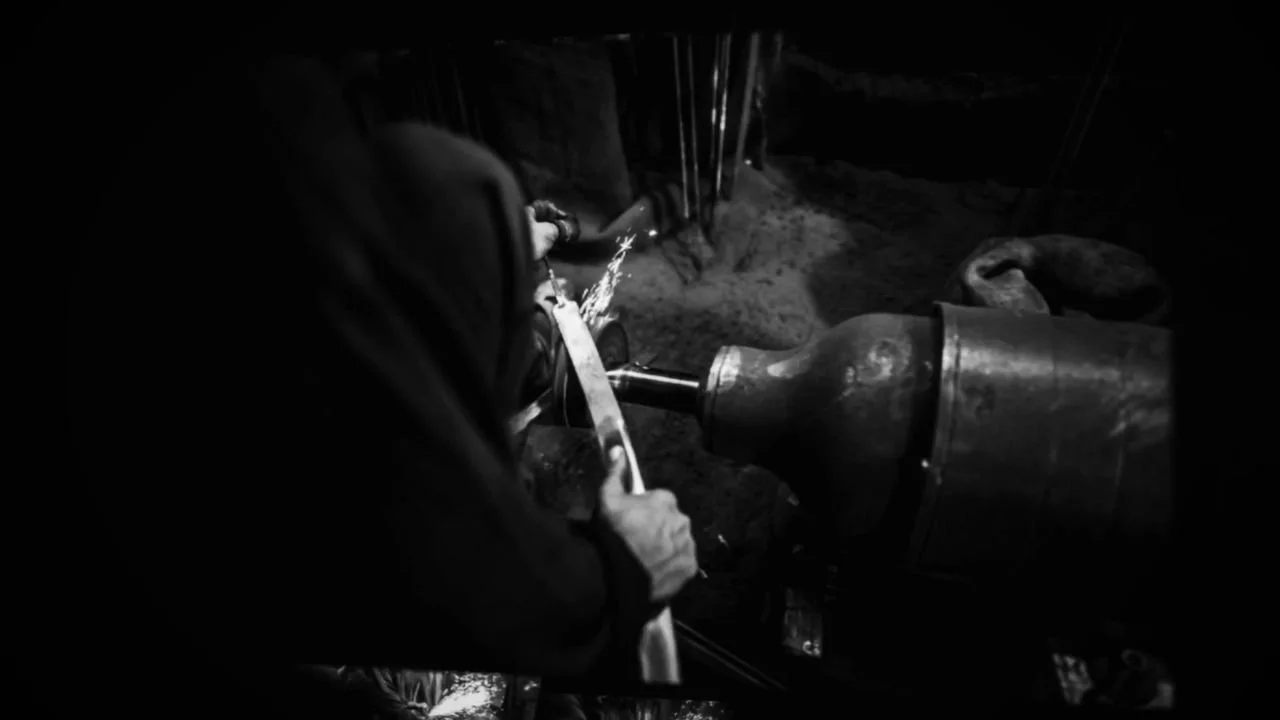
The sound is the workshop’s own. When the question of a music track came up during the edit, ISJ analysed the recording and found none. A motor drone between 60 and 500 Hz carries about 85 per cent of the energy. Over it, the blade’s contact with the wheel arrives in bursts about 0.23 seconds apart during the grinding runs, regular enough that a beat-tracking algorithm locks on at 136 beats a minute. It is the karigar’s stroke rate, not a tempo. Every second of audio in the finished cuts is that field recording; the bed that extends under the closing photographs is a reused stretch of the same recording.
What the record does not hold matters as much. ISJ’s production notes do not establish the town, the workshop or the names of the karigars. The film does not claim them, and neither does this article.
Turning it into a vertical reel was its own problem. A 9:16 crop keeps about a third of a 16:9 frame’s width, losing 68 per cent of it, so the edit reframed the footage shot by shot, following the action across the 47 shots detected in the source. An early 60-second version dropped footage. The finished versions do not: the moving footage runs in full, followed by a slowed coda of 14 still photographs, with the complete source recording underneath. Both cuts run 2 minutes 35 seconds.
| From | Movement | Length |
|---|---|---|
| 0:00 | Opening cardsKIRPAN KE KARIGAR, then कृपाण के कारीगर, over silence | 7 s |
| 0:07 | The filmThe source footage in full, with its location sound | 110 s |
| 1:57 | StillsFourteen photographs in slow dissolves; the workshop recording continues | 25 s |
| 2:22 | End cardsKIRPAN, कृपाण, ਕਿਰਪਾਨ, then the tribute card, which lands in silence | 13 s |
Three scripts, one correction
The source film’s own title card read KRIPAAN. ISJ changed it to KIRPAN, the usual romanisation of ਕਿਰਪਾਨ, at first by re-setting letters taken from the original card so that the typeface matched exactly. When the cards were later moved and set bold, the English was reset in a bold Didone-style serif and the Devanagari and Gurmukhi in matching bold serifs.
The finished film now opens on KIRPAN KE KARIGAR, which fades to blank and returns in Devanagari as कृपाण के कारीगर. It closes on the single word in all three scripts in turn: KIRPAN, then कृपाण, then ਕਿਰਪਾਨ, each fading out before the next fades in, so that two alphabets never share the screen. The Hindi is a choice. कृपाण is the classical spelling, close to the Sanskrit; the edit notes kept किरपान, a direct transliteration of the Punjabi, as the alternative.
The name on the last card
The last card reads A TRIBUTE TO THE KARIGARS OF KIRPAN, above a short rule and the words INDIAN SPORTS JOURNAL. It is the only text ISJ added to the film beyond the title cards.
ISJ is a sports journal, and the kirpan is not sporting equipment. The film sits instead beside another strand of ISJ’s work this month: its reporting from Akhara Bajrang Bali in Amritsar South, where, according to a 2024 study from Guru Nanak Dev University, about 50 members wrestle freestyle in an earth pit under a shed. The subjects are different. The interest is the same: the people who keep a practice alive by hand, and how little of their work reaches the page.
That is also the film’s limit, and ISJ is stating it rather than smoothing it over. The last published count of the trade’s workforce is 16 years old. The karigar on screen is unnamed. The voice-over scripts drafted for the film, in English and in Punjabi, leave two blanks rather than fill them with guesses: one for the number of blades that leave the workshop in a day or a week, and one for the town and the men’s names.
The Constitution names the kirpan. The aviation rules measure it to two decimal places. The film thanks the people who make it, in three scripts, and cannot yet print a single one of their names. That is where the next piece of reporting starts.
Sourcing and corrections. Details of the film come from ISJ’s September 2026 edit record (source file, edit logs, audio analysis and the final v6 cuts). Context on the kirpan comes from Harvard’s Pluralism Project, the SGPC, and Wikipedia’s articles on the Five Ks and the kirpan (for the Gurmukhi forms, the etymology and the physical description). The legal material comes from the Constitution of India and LiveLaw’s report of the Delhi High Court ruling of 22 December 2022, which sets out the Bureau of Civil Aviation Security notification of 4 March 2022. The trade figures come from The Tribune (3 August 2006), an ANI report carried by Oneindia (2 January 2010) and Business Standard (9 February 2010); the 2017 unit count comes from the Hindustan Times (Usmeet Kaur, June 2017, read via PressReader). The January 2010 figures are credited to ANI because that is the report located; no DNA copy of it was found. The film’s source title card read “KRIPAAN”; ISJ corrected it to KIRPAN.
Flag: location. ISJ’s record does not establish where the footage was shot, the workshop or the karigars’ names. Nothing in this article assigns a place, and the sister story’s Amritsar setting should not be read as the film’s.
Flag: “single take”. ISJ’s project note describes the source as a single two-minute take. The edit logs found 47 shot changes, a title card and a closing run of photographs inside the file, so this article describes it as one two-minute source film.
Flag: dated and conflicting figures. The workforce, turnover, output and price figures are 16 to 20 years old. Turnover is ₹50 crore (Tribune, ANI) or ₹60 crore (Business Standard); weight is 600 g (Tribune) or 500 g (ANI). No current workforce count was located. Wikipedia’s source for the decline of Amritsar’s workshops, the Hindustan Times of June 2017, was located on the 28 October recheck, and its count (hundreds of units down to 30 to 40; the piece gives both figures) is now in the copy. The same report says knife factories closed for six months after Operation Blue Star in 1984; that is left out pending the editor’s call. Wikipedia’s statement that Guru Hargobind settled swordsmiths near Darbar Sahib was not found in that report and stays out.
Flag: spellings. The Gurmukhi ਕਿਰਪਾਨ and ਪੰਜ ਕਕਾਰ follow standard references. The Devanagari कृपाण is the classical form ISJ chose for the cards, from the Sanskrit kṛpāṇa; किरपान is the transliterated alternative. On the 28 October recheck, Rekhta Dictionary’s Hindi entry for किरपान gave कृपाण as the correct form, a short sword usually kept by Sikhs. Romanisations of the five Ks vary (kara or karha; kachhera or kachera). The SGPC statement on the Rehat Maryada is undated on the SGPC site.