The Podium India Had Never Reached: Baranica Elangovan in Nagoya
Baranica Elangovan’s 4.15m was a height an Indian woman first cleared in 2014. The shared bronze it won in Nagoya was new: India’s first Asian Games pole vault medal in 75 years of the Games, built on a rebuilt take-off knee and ten years with one coach.
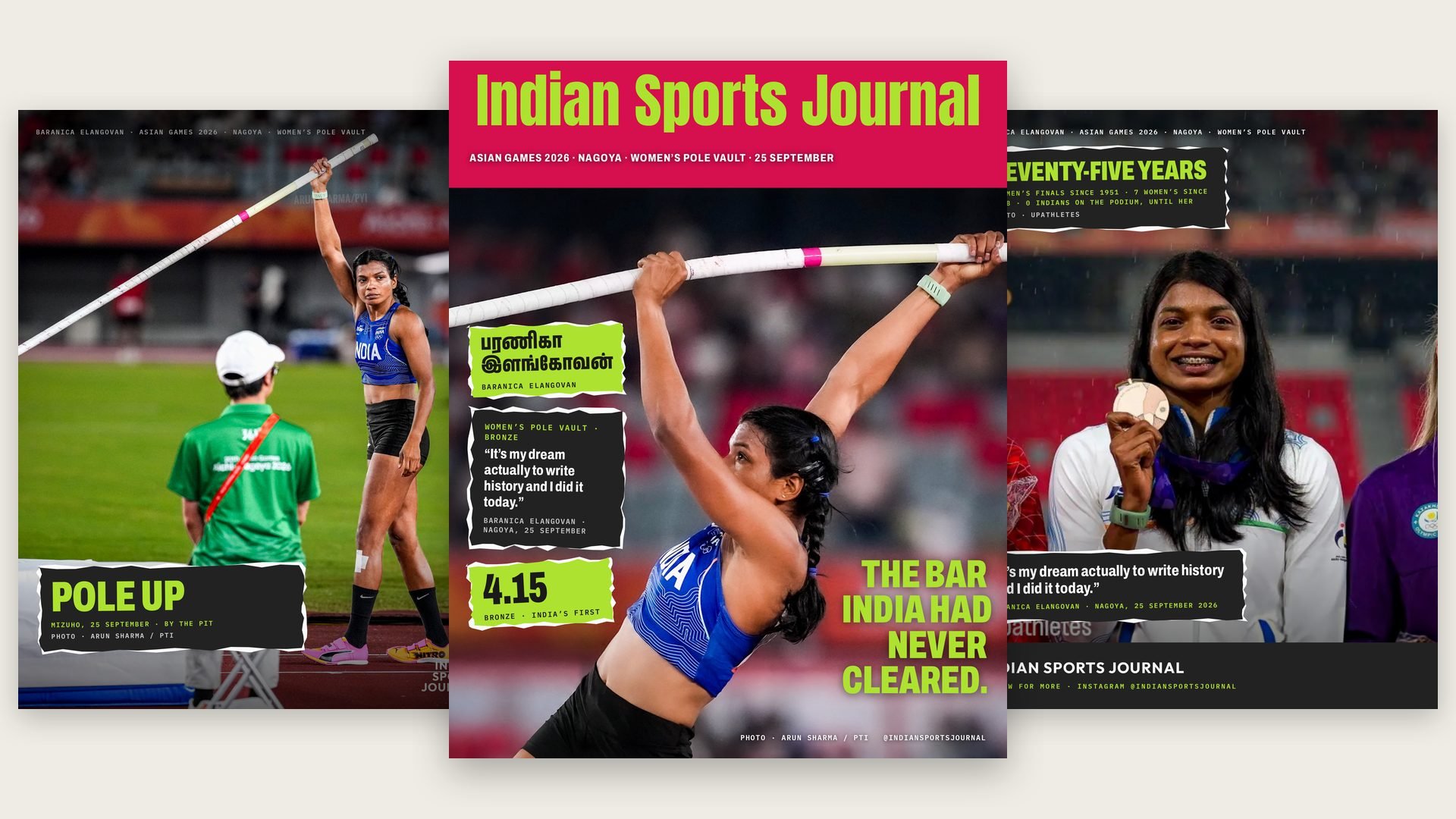
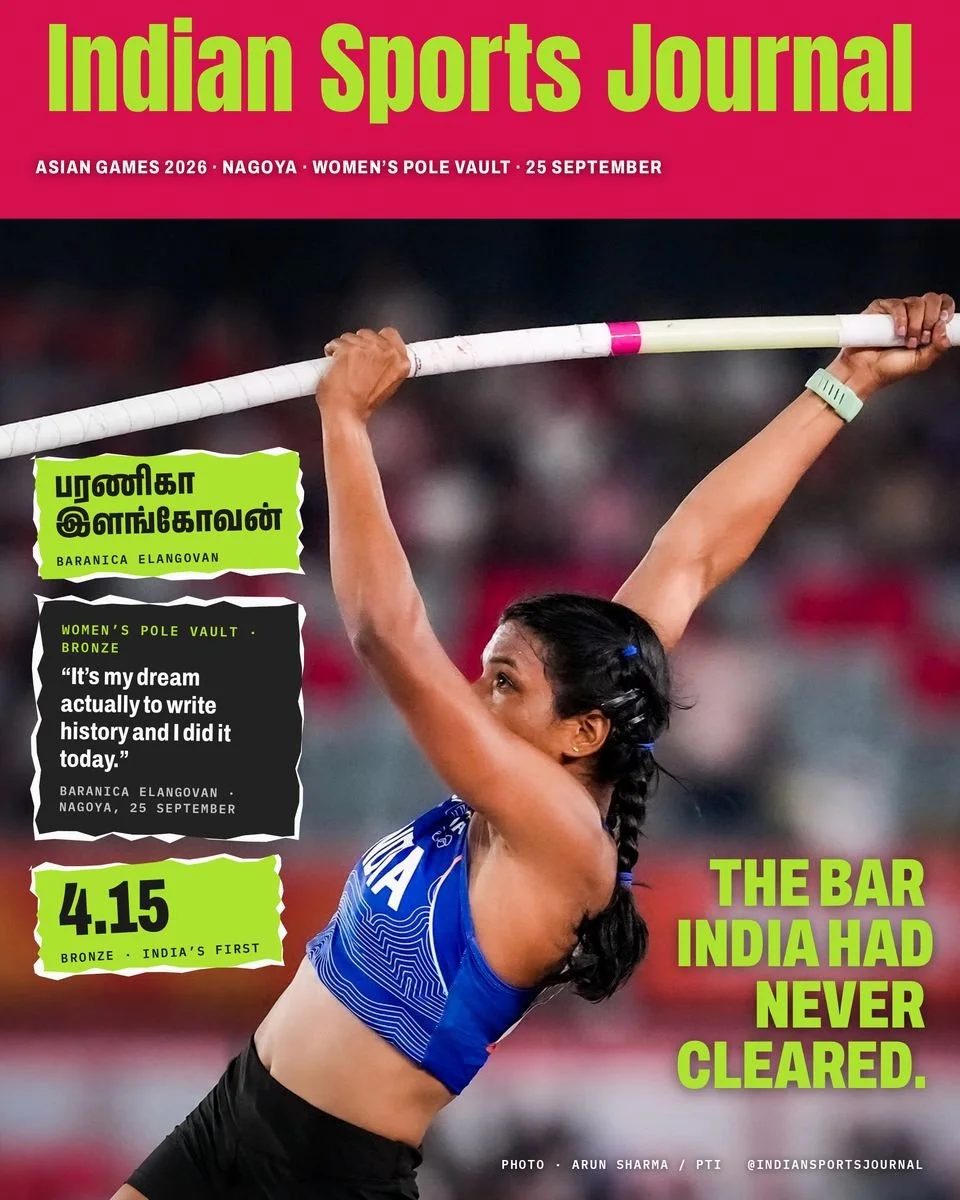
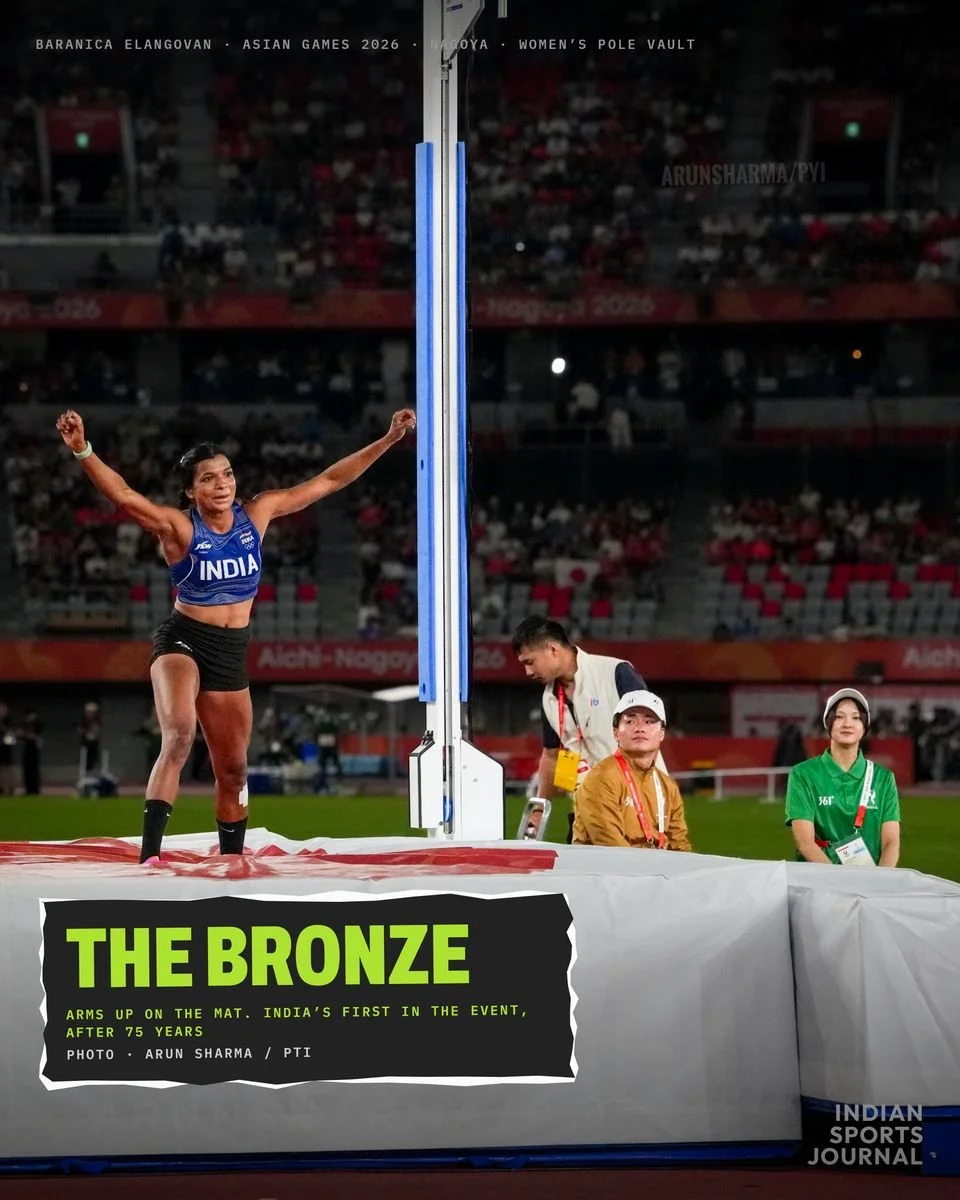
Baranica Elangovan cleared 4.15 metres at her second attempt at Paloma Mizuho Stadium in Nagoya on 25 September, failed three times at 4.25m, and by her own account did not realise what she had won. “I didn’t believe I’d won the medal,” she told IANS. “My colleague came up and said, ‘You were at the bronze, you won it.’” She had tied for third in the women’s pole vault with Kazakhstan’s Polina Ivanova, behind Japan’s Misaki Morota, who won with a personal best of 4.55m, and China’s Niu Chunge, second with 4.50m.
It is India’s first Asian Games medal in the pole vault, men’s or women’s. The men’s event has been held at all 19 Games from New Delhi in 1951 to Hangzhou in 2023, the women’s at all seven since Bangkok in 1998, and no Indian had finished in the top three of any of those 26 finals. “At least I have opened India’s account at the Asian Games,” Baranica, who is 29, told SAI Media.
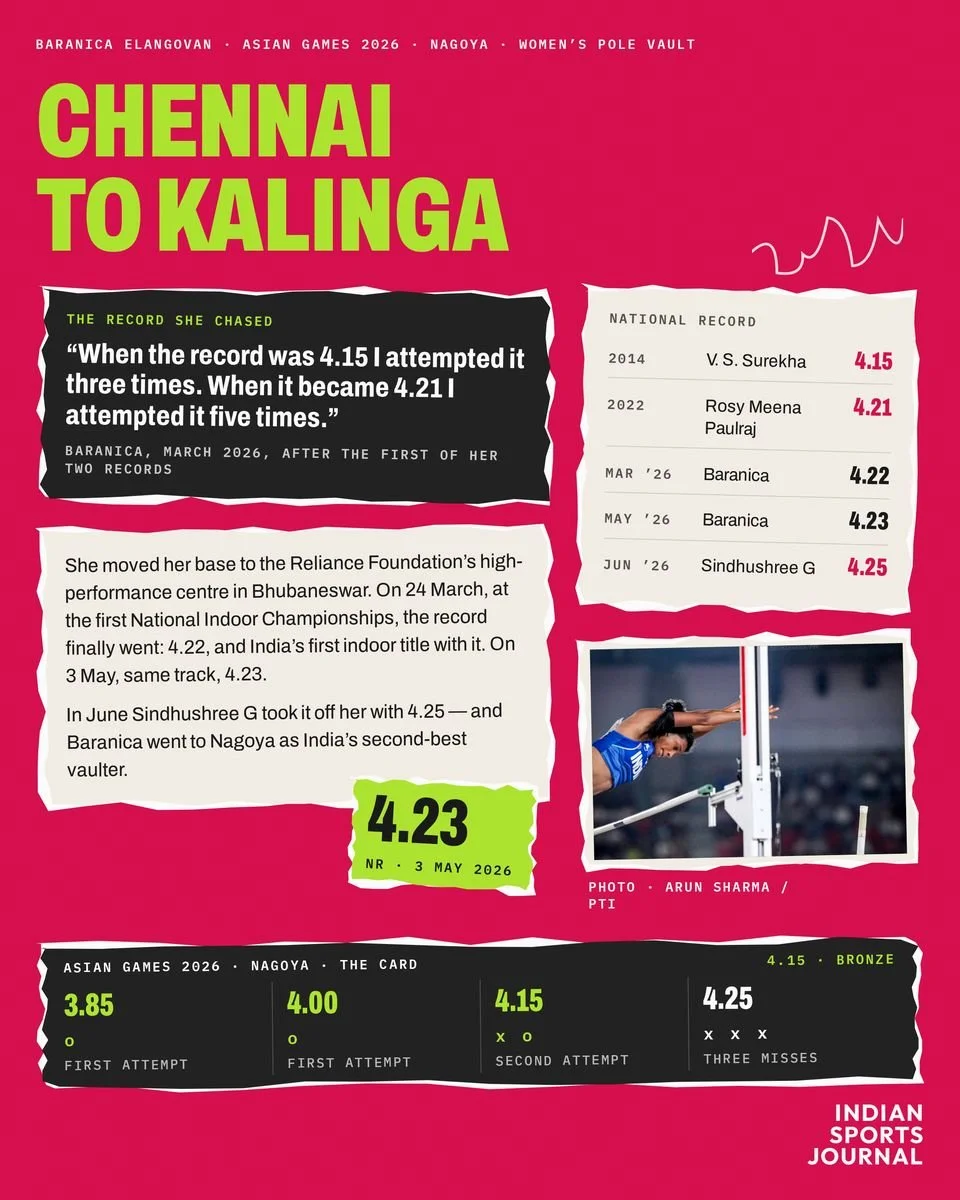
The height itself was not new, and that is worth holding on to. An Indian woman first cleared 4.15m in 2014, when V.S. Surekha set the national record there. Baranica’s own best is 4.23m, and the record has stood at 4.25m since June, when G. Sindhushree, India’s other vaulter in Nagoya, took it from her. What changed in Nagoya was the podium. The route to it ran through a college physical-education office in Chennai, a fall into the planting box in 2019 that wrecked her take-off knee, a no-mark at the 2023 Asian Championships and no place in the Hangzhou team. It also ran through one coach, Milber Bertrand Russell, who has now worked with three successive holders of India’s women’s record, in an event where a single pole costs about ₹1 lakh.
Same height, same misses
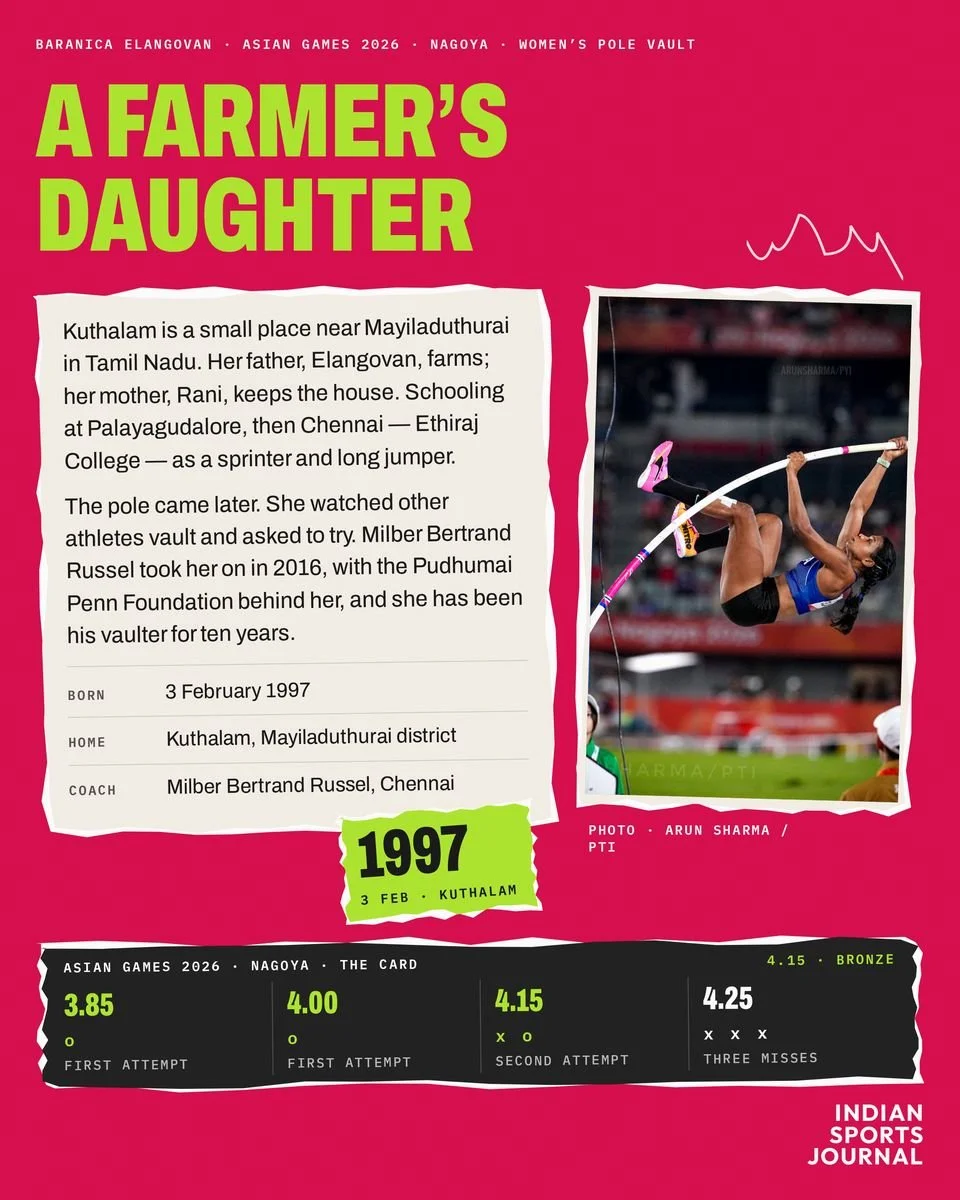
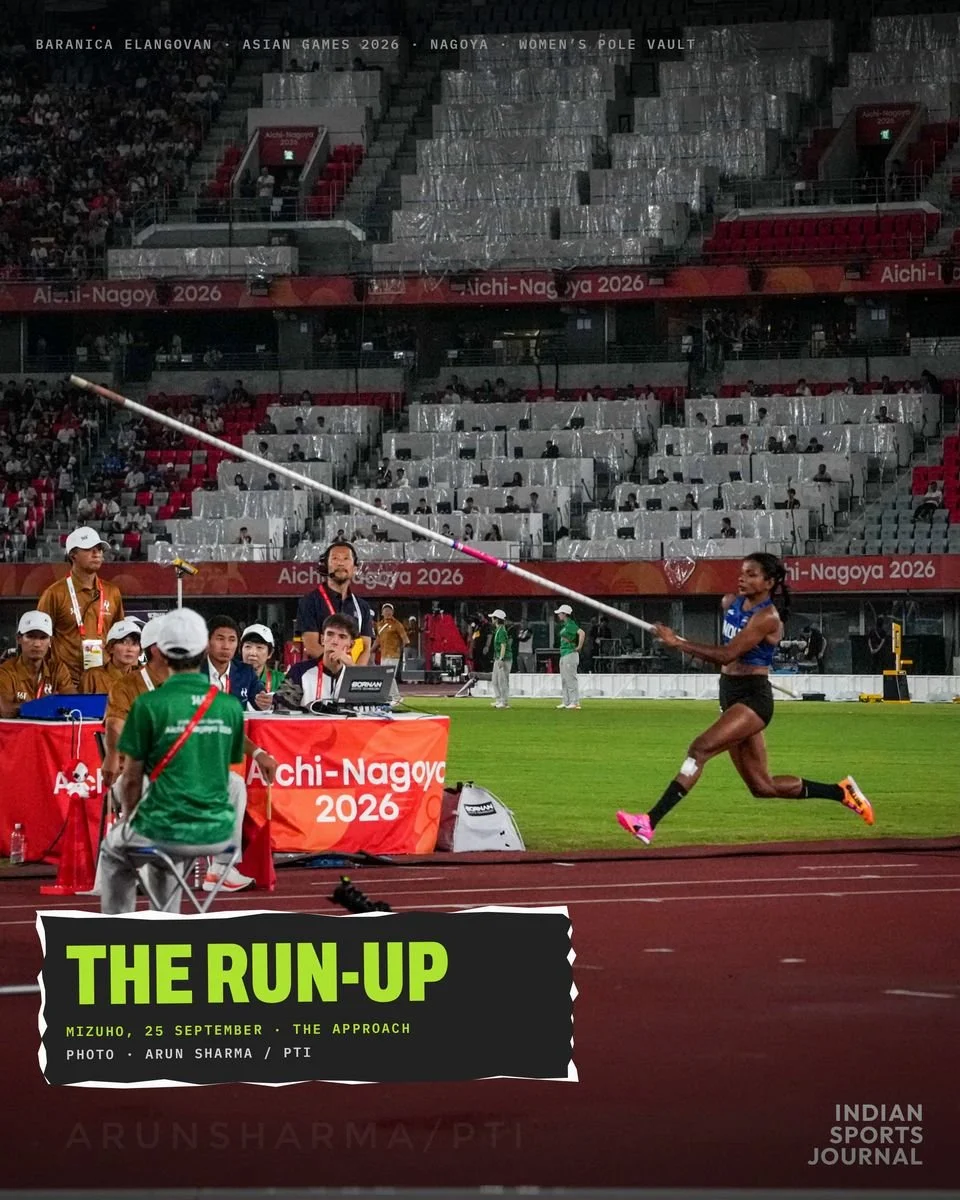
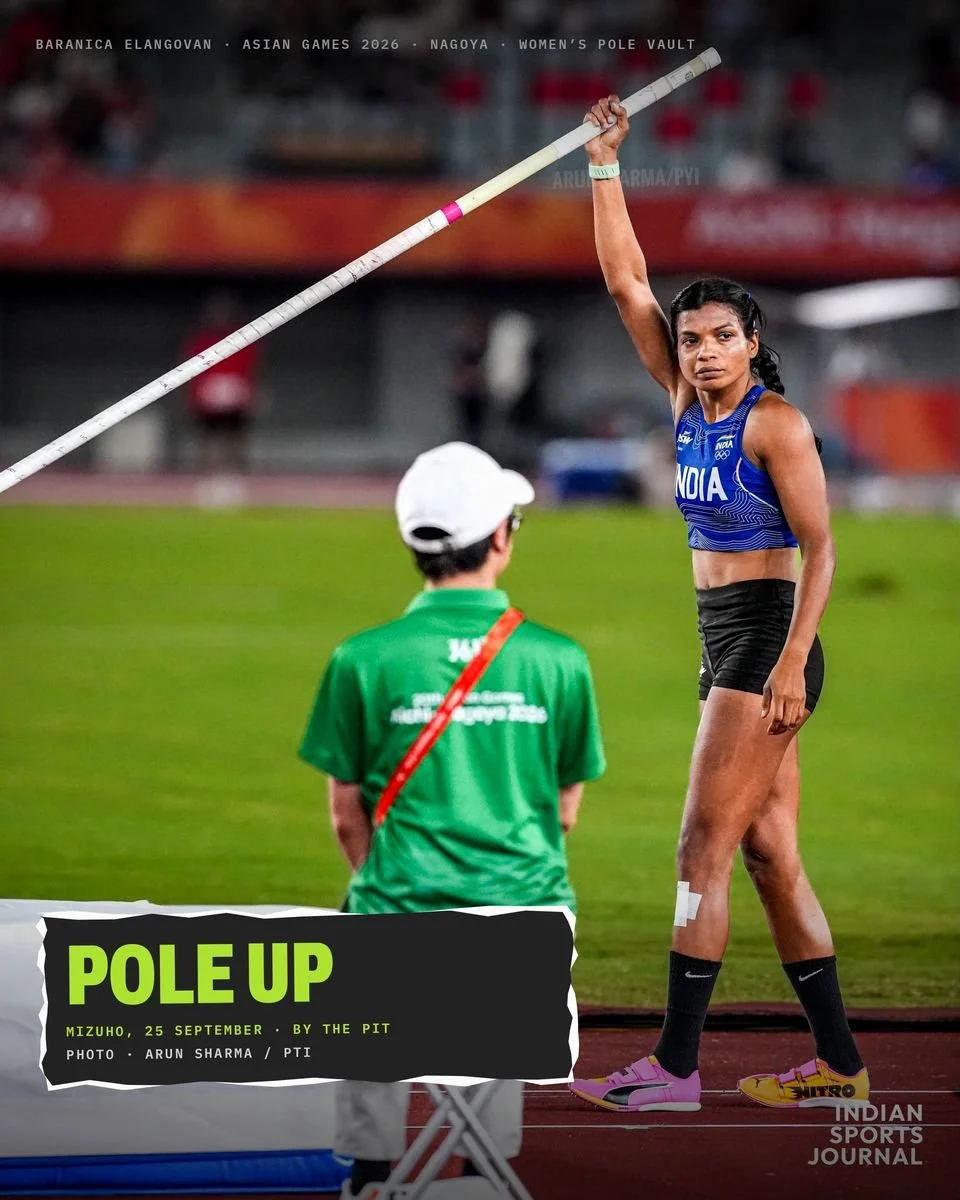
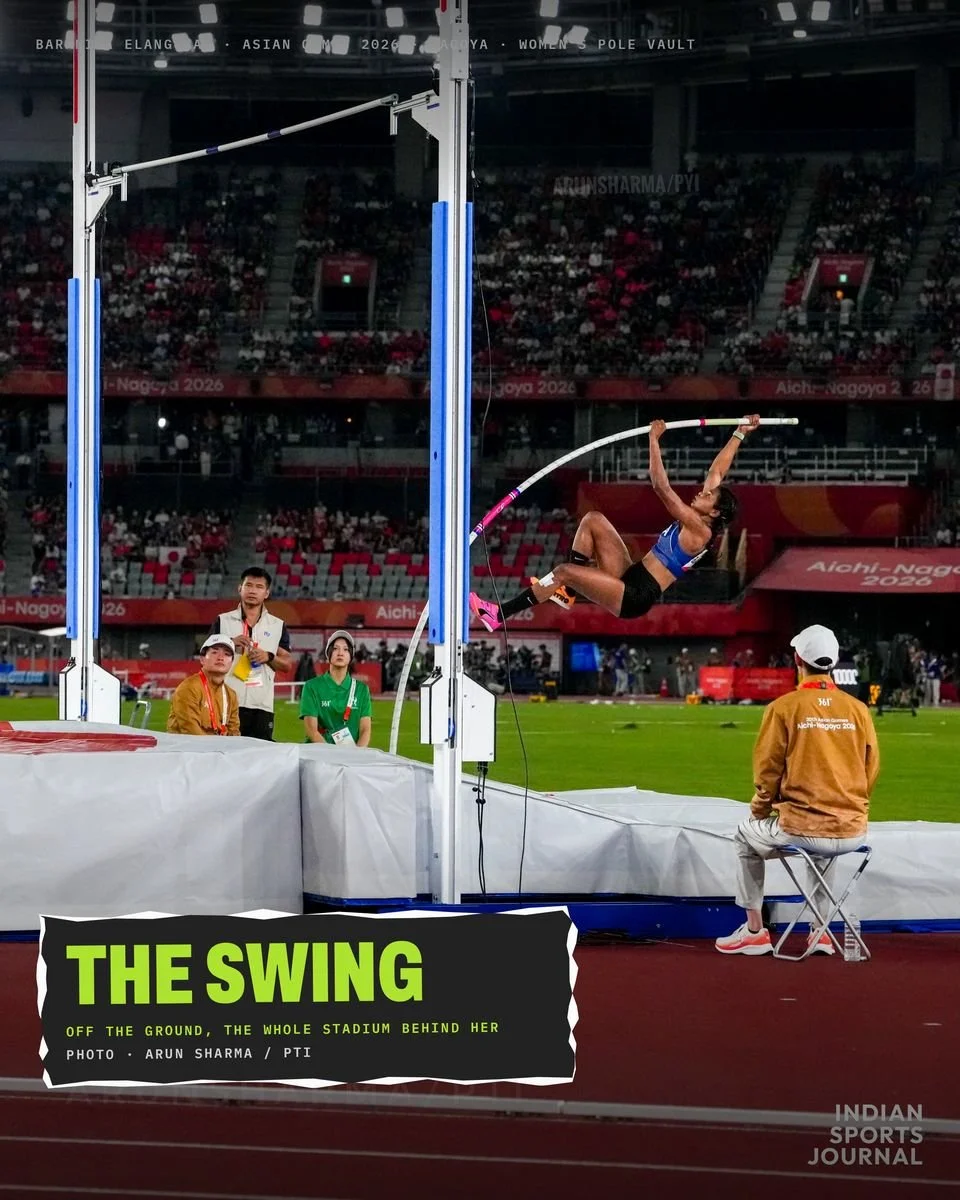
Baranica opened at 3.85m and cleared at the first attempt, then did the same at 4.00m. At 4.15m she missed once and went over with her second. The bar then went to 4.25m, the national record and two centimetres above anything she had cleared. She failed three times, as she had at the same height in Bhubaneswar in March, on the day she first broke the record.
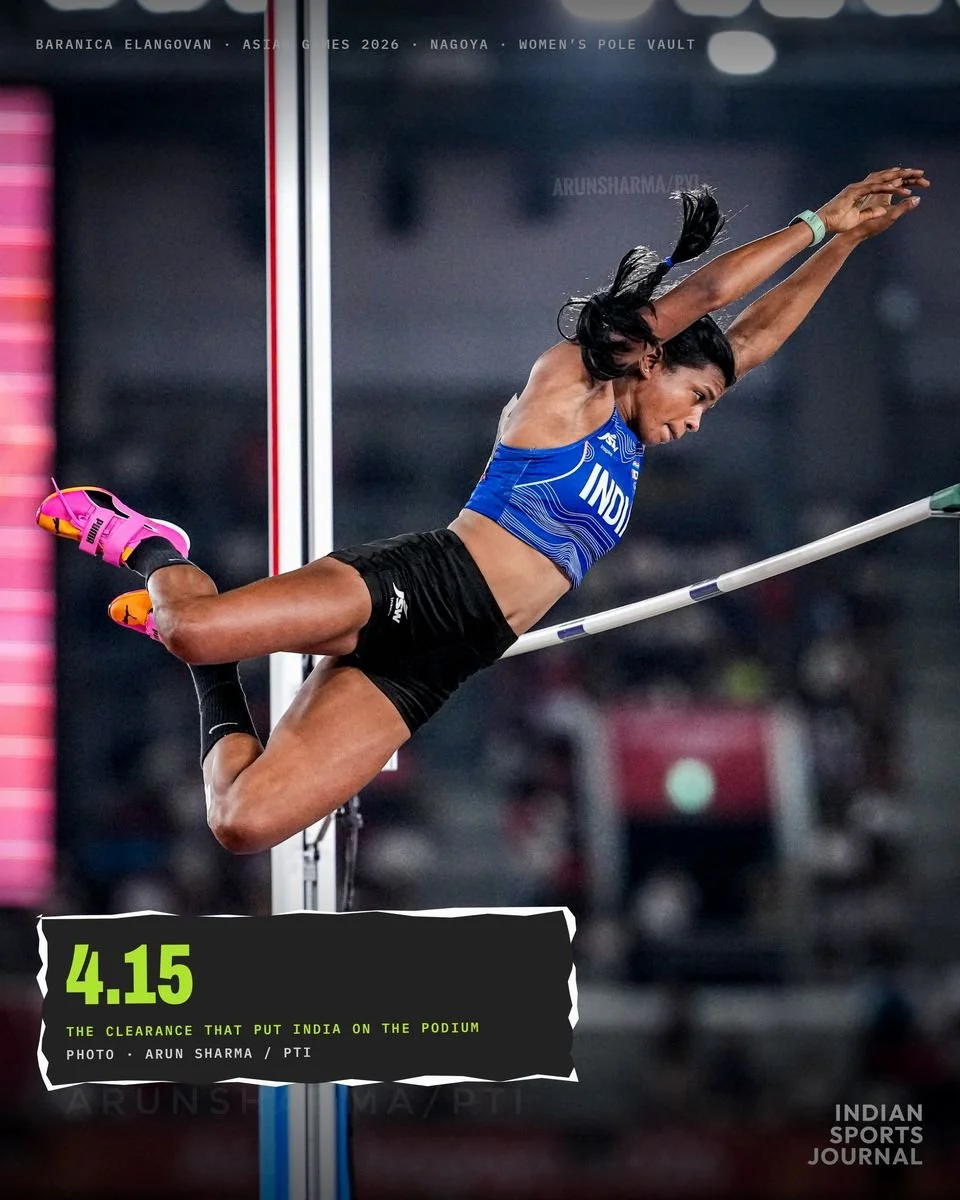
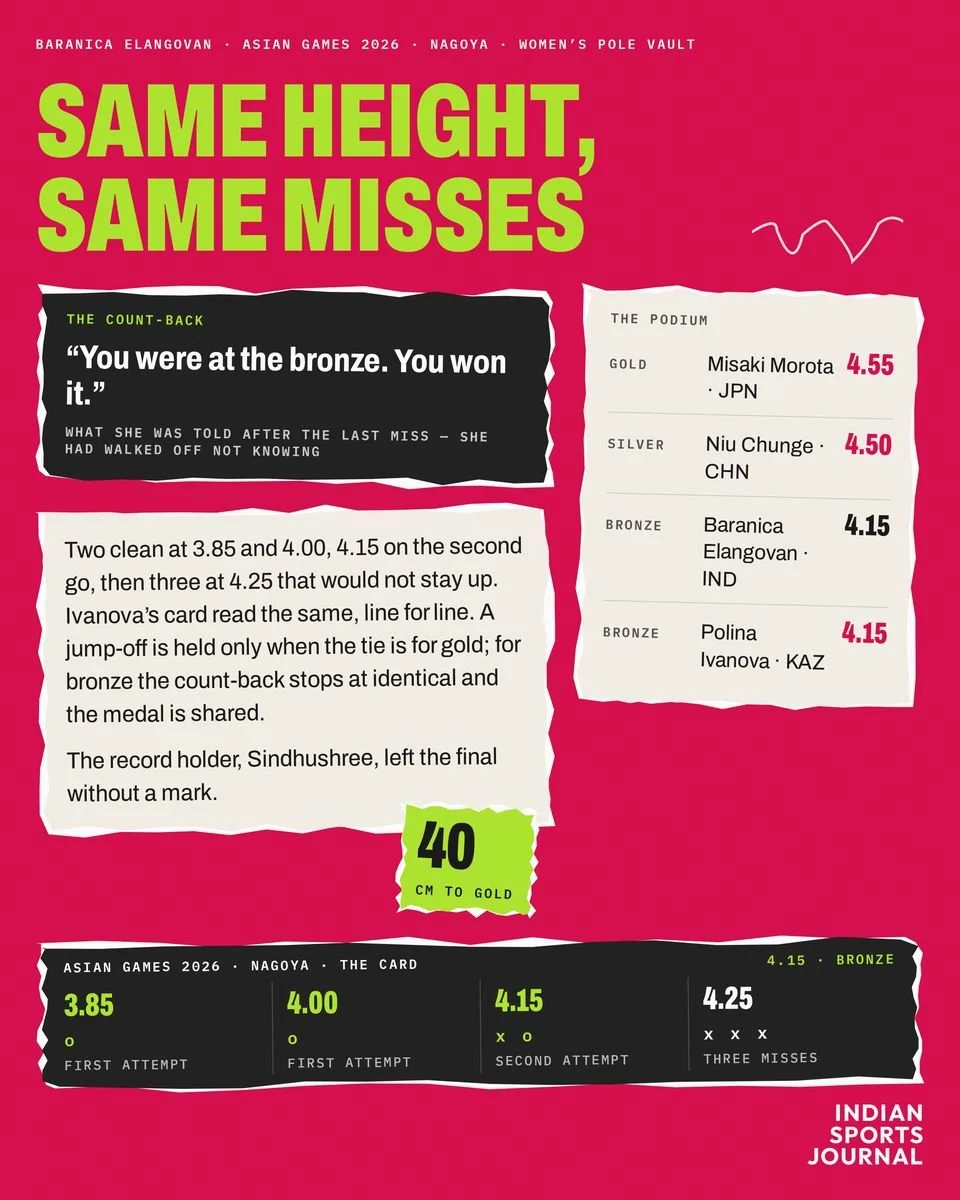
Ivanova also finished on 4.15m. World Athletics rules split a tie in the vertical jumps on two counts: fewer attempts at the last height cleared, then fewer failures across the whole competition up to that height. Only a tie for first place goes to a jump-off; any other tie that survives the count-back stands. Baranica had needed two tries at 4.15m and had one failure in all, so a shared bronze means Ivanova matched her on both counts. Failures above that height do not enter it; both women missed at 4.25m. Shared medals are not new in the event at the Asian Games: the women’s bronze was split in Doha in 2006, and the men’s in Hiroshima in 1994.
| Place | Athlete | Best |
|---|---|---|
| 1 | Misaki Morota, JapanPersonal best; silver in Hangzhou | 4.55 |
| 2 | Niu Chunge, ChinaSet the Asian record, 4.73m, in May 2026 | 4.50 |
| =3 | Baranica Elangovan, India3.85 O · 4.00 O · 4.15 XO · 4.25 XXX | 4.15 |
| =3 | Polina Ivanova, KazakhstanLevel on count-back; bronze shared | 4.15 |
| … places five onwards not shown … | ||
| — | G. Sindhushree, IndiaNational record holder (4.25m); no height cleared | NM |
Sindhushree, the record holder, failed to register a height and left the final without a mark, according to IANS and News On AIR. Morota, the Hangzhou silver medallist, won by five centimetres from Niu, who had set an Asian record of 4.73m at a Chinese grand prix in May. The gap from bronze to gold was 40 centimetres.
Baranica did not dress it up. “I’m disappointed with my performance today, because I was aiming for 4.30m but I have only cleared 4.15m,” she told myKhel. To ANI she said she had not been chasing a medal at all: “I was aiming for the performance.” She dedicated it to Russell. “This is for you, Anna,” she said, using the Tamil word for elder brother.
A pole-vaulter by chance
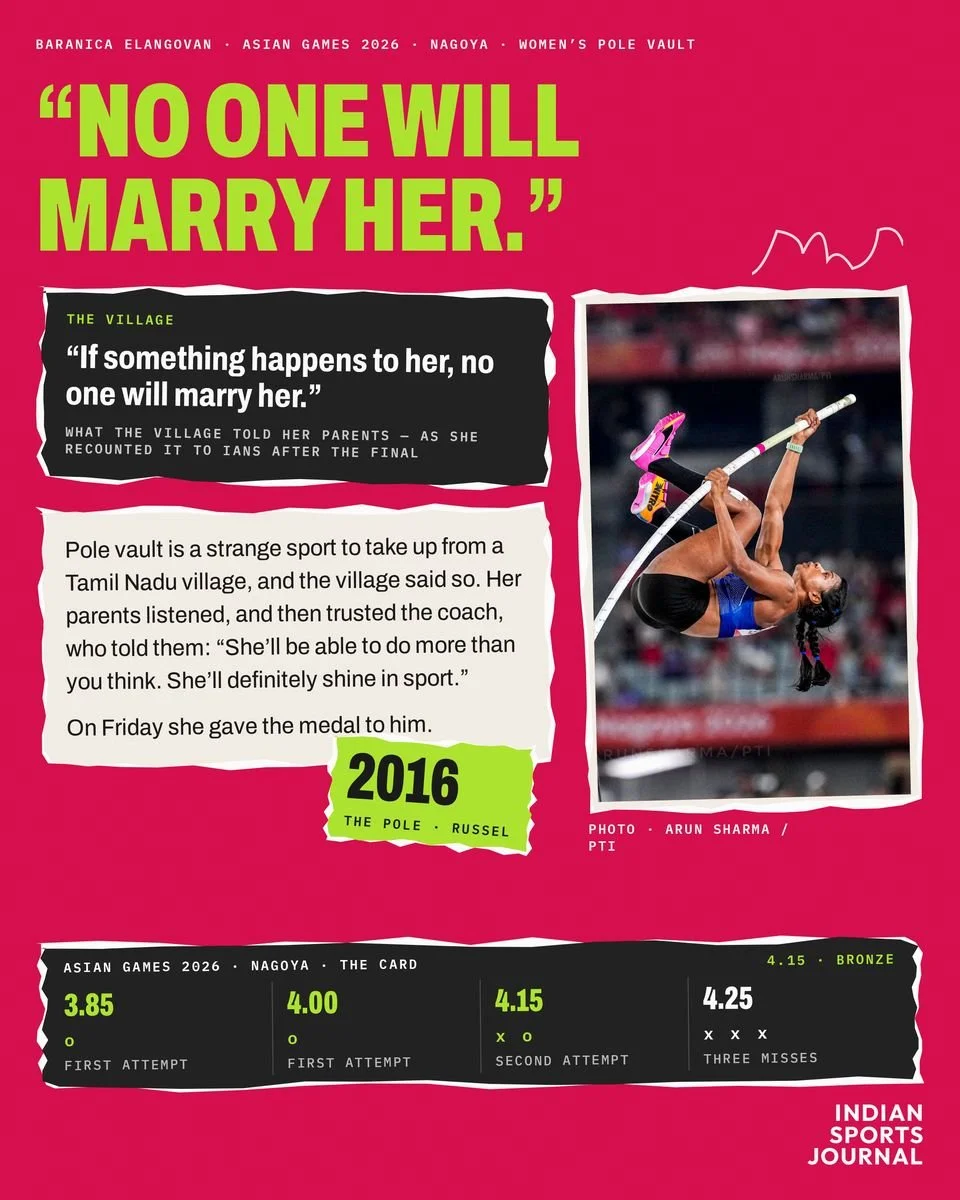
“I am a pole-vaulter by chance,” she told SAI Media, “and it was my coach who brought me to this level.” She was born on 3 February 1997 and comes from Kuthalam, near Mayiladuthurai in Tamil Nadu. At school she did the long and triple jumps. She moved to Chennai for college, at Ethiraj College, where she also played basketball, and in 2016 the physical-education director, Uma Devi, suggested the pole vault and put her in touch with Russell, according to PTI.
She weighed 42kg and doubted she could run with a pole at all. Russell’s first impression, DT Next reported in March, was that she would quit within two weeks. What kept her, she said, was watching others go over the bar: “I saw people flying, and I wanted to fly too.” It took about three years to build a technique, by her account, and her first medal came three years after she started.
The village had a view on all this. “Why let a girl take part in Pole Vault? This event is quite risky,” people told her parents, she recalled to IANS after the final. “If something happens to her, no one will marry her.” Russell’s answer to them, as she tells it, was: “She’ll be able to do more than you think. She’ll definitely shine in sport.” Her parents, she said, “didn’t listen to others; they believed in me.”
The take-off leg
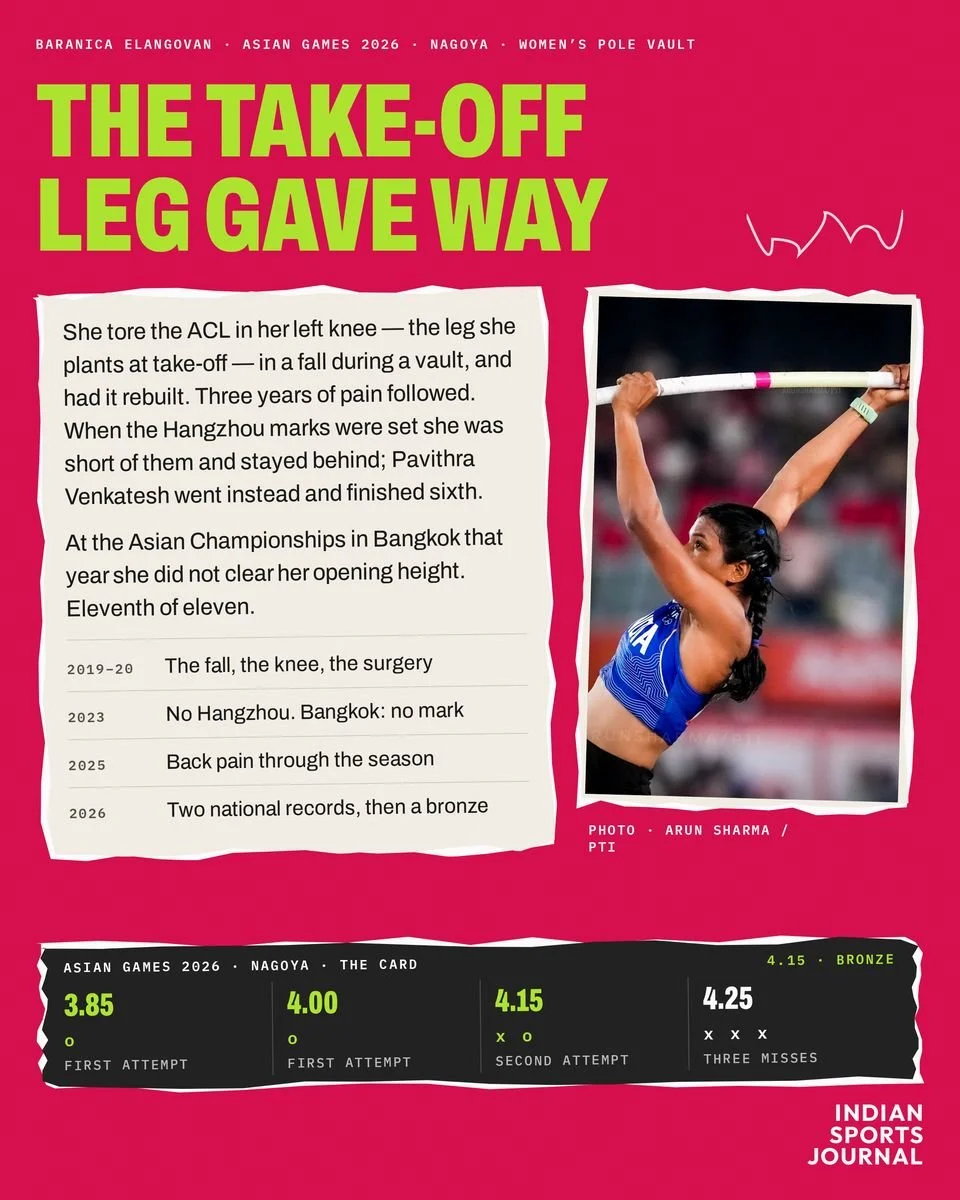
In 2019, two days before the Southern Railway trials in Chennai, she fell into the box during a vault and tore the anterior cruciate ligament and the meniscus in her left knee, the leg she takes off from. DT Next, which reported the details, put the fall down to poor landing-mat conditions. She had surgery in Coimbatore, in February 2019 by her own account to The Bridge, and was competing again about six months later at inter-college meets in Mangaluru. The knee was not right for years. At one stage, myKhel reported, she could train only every other day, and The Bridge reported that it took her two or three years to get back to her best.
In 2023 she moved her training from Chennai to the Reliance Foundation’s Odisha athletics high-performance centre at Kalinga Stadium in Bhubaneswar, where Russell now works. That July, at the Asian Championships in Bangkok, she was one of 11 starters in the pole vault and the only one who failed to clear a height. When India went to Hangzhou that autumn its vaulter was Pavithra Vengatesh, who finished sixth with 4.00m; Baranica’s Asian Games debut had to wait for Nagoya.
That November she won the National Games title in Goa at 3.90m after two weeks of preparation. “The injuries haven’t fully healed,” she told DT Next at the time, “but I must be on the court to ensure my consistency.” Her best rose to 4.10m in 2023 and 4.15m in 2024, according to DT Next and PTI.
Three records, one coach
Surekha’s 4.15m stood until October 2022, when Rosy Meena Paulraj raised it twice in a fortnight: to 4.20m at the National Games in Gandhinagar, then 4.21m at the National Open in Bengaluru. Baranica had been chasing it for years. “When the record for 4.15 metres I attempted it three times, when it became 4.21 I attempted it five times,” she said in March, as reported by Organiser.
On 24 March, the opening day of India’s first National Indoor Championships, in Bhubaneswar, she cleared 4.22m to win the title. On 3 May, at an indoor combined-events and pole vault meet in the same city, she cleared 4.23m at her third attempt. On 25 June, at the National Inter-State Championships at Kalinga Stadium, Karnataka’s Sindhushree went over 4.25m at her first attempt; Baranica was second with 4.20m. Both had passed the Athletics Federation of India’s Asian Games standard of 4.10m.
| Date | Holder | Mark |
|---|---|---|
| 2014 | V.S. SurekhaSet with Milber Russell’s guidance, per DT Next | 4.15 |
| 1 Oct 2022 | Rosy Meena PaulrajNational Games, Gandhinagar · a Russell pupil | 4.20 |
| 15 Oct 2022 | Rosy Meena PaulrajNational Open, Bengaluru | 4.21 |
| 24 Mar 2026 | Baranica ElangovanFirst National Indoor Championships, Bhubaneswar; then three failures at 4.25 | 4.22 |
| 3 May 2026 | Baranica ElangovanIndoor combined events and pole vault meet, Bhubaneswar; third attempt | 4.23 |
| 25 Jun 2026 | G. SindhushreeNational Inter-State, Kalinga Stadium; first attempt, on a borrowed pole · coach Vijeesh MM | 4.25 |
Three of the four women in that ledger have passed through Russell’s hands. He is 44, from Nagercoil in Kanniyakumari district, and competed nationally in the early 2000s until a back injury ended it, DT Next reported in March. He was working as a fitness trainer when Surekha, his former training partner, drew him back to the event; her 2014 record came with his guidance. Paulraj, the 2022 record-setter, was his pupil. Baranica has been with him for ten years. Sindhushree came by a different route, through the Sports Authority of India hostel in Bengaluru, which she joined in 2016, and her coach Vijeesh MM. She broke the record, she told DT Next, with a longer pole “brought by a friend of mine”.
That is how thin Indian pole vault is. A pole costs around ₹1 lakh and a vaulter carries at least four, DT Next reported in 2023, and Russell has said Tamil Nadu’s sports development authority owned only one or two until recently. Before Nagoya the AFI “tried every possible way with every airline to take our poles”, Baranica told IANS, and a preparatory camp at the University of Tsukuba helped her settle, ANI reported. She has watched the field grow. “When I started, there were only five to six competitors. Now, you can see around 15 competitors,” she told ANI. Russell’s assessment after the final, given to SAI Media, was plainer: “We still need better facilities, equipment, proper coaching, and more opportunities for young athletes to compete and develop.”
Forty centimetres
Tamil Nadu’s chief minister, C. Joseph Vijay, announced a ₹30 lakh incentive for her on the day of the final, through the state’s sports development authority. Her coach has already moved on to the next number.
“The next targets will be to consistently improve her personal best and move towards the 4.40-4.50m level,” Russell told SAI Media. He listed the work: consistency in the approach and take-off, more speed and power, more experience at the highest international level. “For me, this medal is not the destination. It is the beginning of the next chapter for Baranica.”
At 4.50m she would have equalled Niu’s silver-winning height in Nagoya; at 4.40m she would still have been 15 centimetres short of Morota. India waited 75 years for an Asian Games pole vault medal, and it came at a height an Indian woman had first cleared in 2014. The next one will have to be won higher.
On 10 October Baranica, competing for Railways, won the women’s pole vault at the 65th National Open Athletics Championships at the Jawaharlal Nehru Stadium in New Delhi with 4.10m, the only athlete over four metres. Mariya Jaison was second with 3.90m; Sindhushree was among those level at 3.80m (IANS, UNI, Khel Now).
Sourcing. Nagoya result and series: PTI (via The Federal and DT Next), IANS (Telangana Today, The Hans India, SocialNews), ANI (Devdiscourse), myKhel, Khel Now, News On AIR. Quotes: IANS (village, coach, “You were at the bronze”, poles), ANI (“This is for you, Anna”, the performance, the field), myKhel (4.30m), SAI Media via IANS and Outlook (Russell; “pole-vaulter by chance”; “opened India’s account”), DT Next (30 March and 26 June 2026; 7 November 2023), Organiser (the record attempts). Background: PTI via ThePrint (24 March 2026), DT Next, The Bridge, Orissapost, Jagran English (Kuthalam), World Athletics profile (date of birth). Records: The Bridge, indianathletics.in, IANS, PTI, ANI; ISJ’s June 2026 Athletics Recap. Medal history: Asian Games medal lists 1951–2022 and the 2022 Asian Games and 2023 Asian Championships results. Niu’s Asian record: The Star. Incentive: DT Next. Since publication: IANS, UNI, Khel Now.
Corrections to the carousel. Slide 1: the cover line “The bar India had never cleared” is wrong if read literally. V.S. Surekha cleared 4.15m in 2014, the women’s national record was 4.25m, and Indian men vault far higher; the first is the medal, not the height (Asian Games medal lists). Slides 1 and 12: the quote “It’s my dream actually to write history and I did it today” could not be found in any published report (PTI, IANS, ANI, SAI Media, myKhel); it is not used. Slide 2: she was a long and triple jumper who also played college basketball, not “a sprinter and long jumper”, per ANI, PTI and The Bridge. The slide’s “She watched other athletes vault and asked to try” leaves out that the event was first suggested to her by Ethiraj’s PE director, Uma Devi, who introduced her to Russell (PTI); seeing it, she has said, is what made her want to try (ANI, DT Next). Slide 2: her parents’ names and occupations, the Palayagudalore schooling and the Pudhumai Penn Foundation could not be verified (the foundation appears only on an unsourced biography site) and are not used. Slide 4: “she gave the medal to him”: she dedicated it to Russell (IANS, ANI, myKhel). Slide 6: “Back pain through the season” (2025) could not be verified. That she was “short of” the Hangzhou marks is also unverified; it is confirmed only that Nagoya was her Asian Games debut (myKhel, Outlook). “Eleventh of eleven”: she was one of 11 starters and the only one with no mark, so she was unranked (2023 Asian Championships results). Slide 8: the quote is a tidied version of what Organiser printed (“When the record for 4.15 metres I attempted it three times, when it became 4.21 I attempted it five times”); this page uses the printed wording. Slide 10: “Ivanova’s card read the same, line for line” is not verified. A bronze shared after count-back shows only that both women needed the same number of attempts at 4.15m and had the same total failures.
Flag. Injury year: her own account to The Bridge, and DT Next, date the fall and surgery to 2019 (surgery in February 2019); PTI repeatedly gives 2020. This page uses 2019. IANS’s 26 September report gives her age as 24 and her clearance as 4.20m; every other report and her World Athletics date of birth (3 February 1997) make her 29, and the result was 4.15m. Organiser gave her age as 28 in March. PTI’s report of the final says she won the June Inter-State title “with 4.20m”; she was second at 4.20m behind Sindhushree (IANS, The Bridge). PTI’s June report put the previous record at 4.20m; IANS and The Bridge say 4.23m. One IANS report (25 September) said the AFI still listed 4.23m as the national record, and ratification of the 2026 marks has not been confirmed by ISJ. Morota’s 4.55m is a personal best per PTI and a Japanese record per myKhel. UNI called it a Games record, which it is not: Li Ling’s 4.63m from Hangzhou stands. The coach’s surname is spelt Russell by PTI, IANS, ANI and SAI, and Russel by ISJ’s slides, DT Next and Organiser; this page uses Russell. Her account of the village exchange (IANS) has the coach reassuring her parents; Jagran English reverses it. This page follows her quoted words. Kuthalam as her home rests on Jagran English; PTI gives Mayiladuthurai. She has given both three and four years for her record chase. PTI and myKhel put her weight at 42kg when she started; The Bridge says 45kg. Ivanova’s full series could not be found. Pavithra Venkatesh, as the slide spells it, appears as Vengatesh in the Hangzhou results.