Neeru Dhanda — Two Days, Three Podiums
Ten days after a hospital stay, the Army shooter from a one-room house in Sangatpura set an Asian record in a rain-soaked final, then won a second gold with Kynan Chenai the next afternoon.

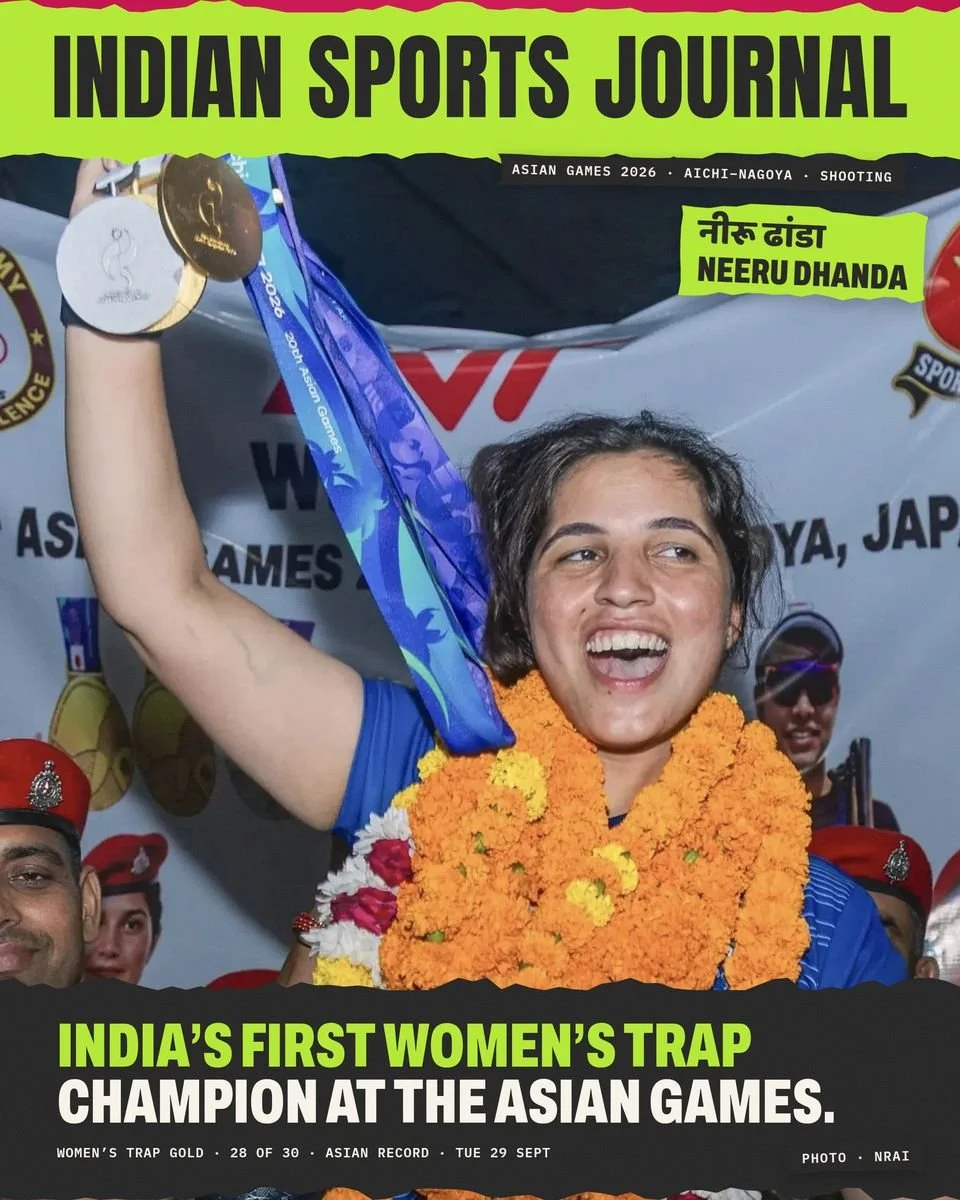
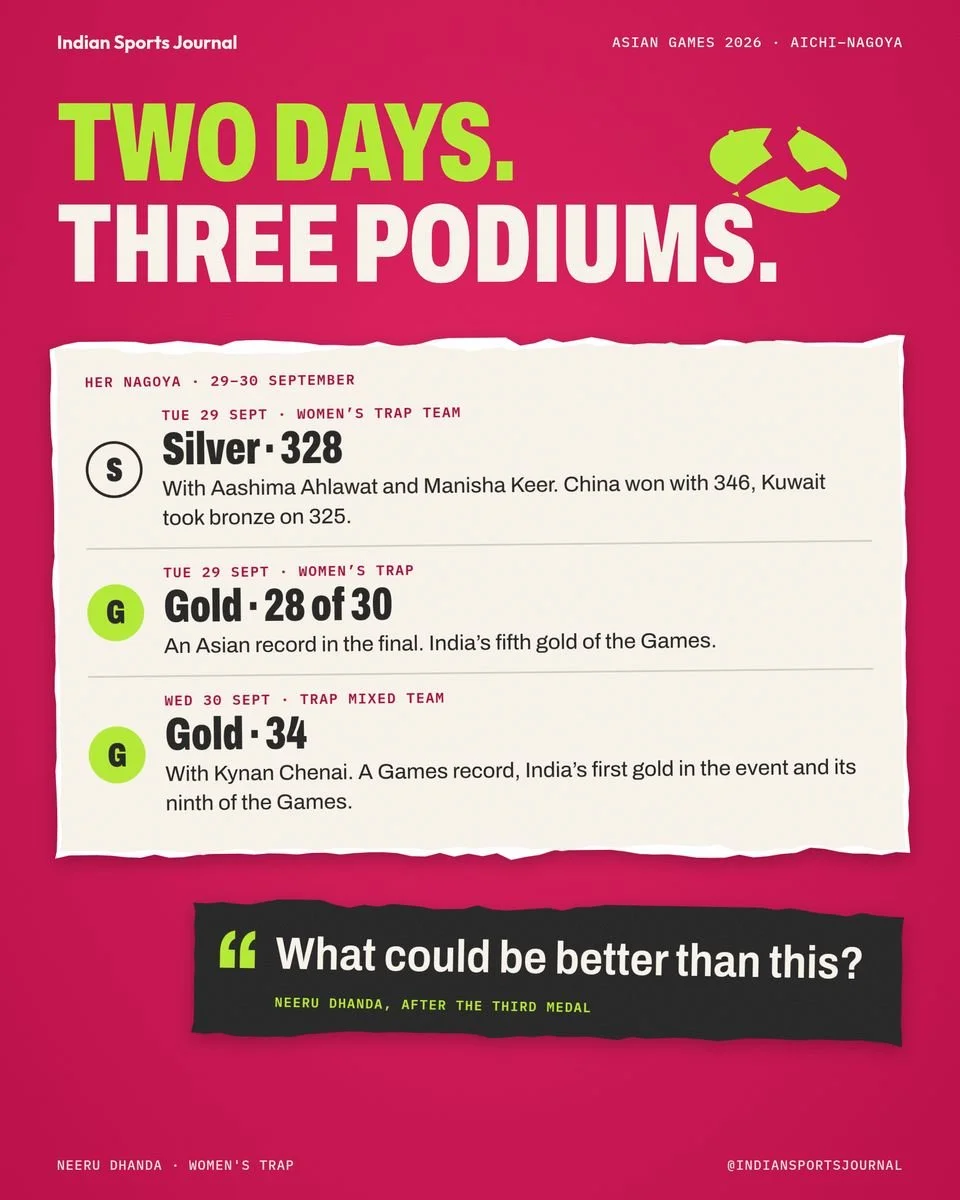
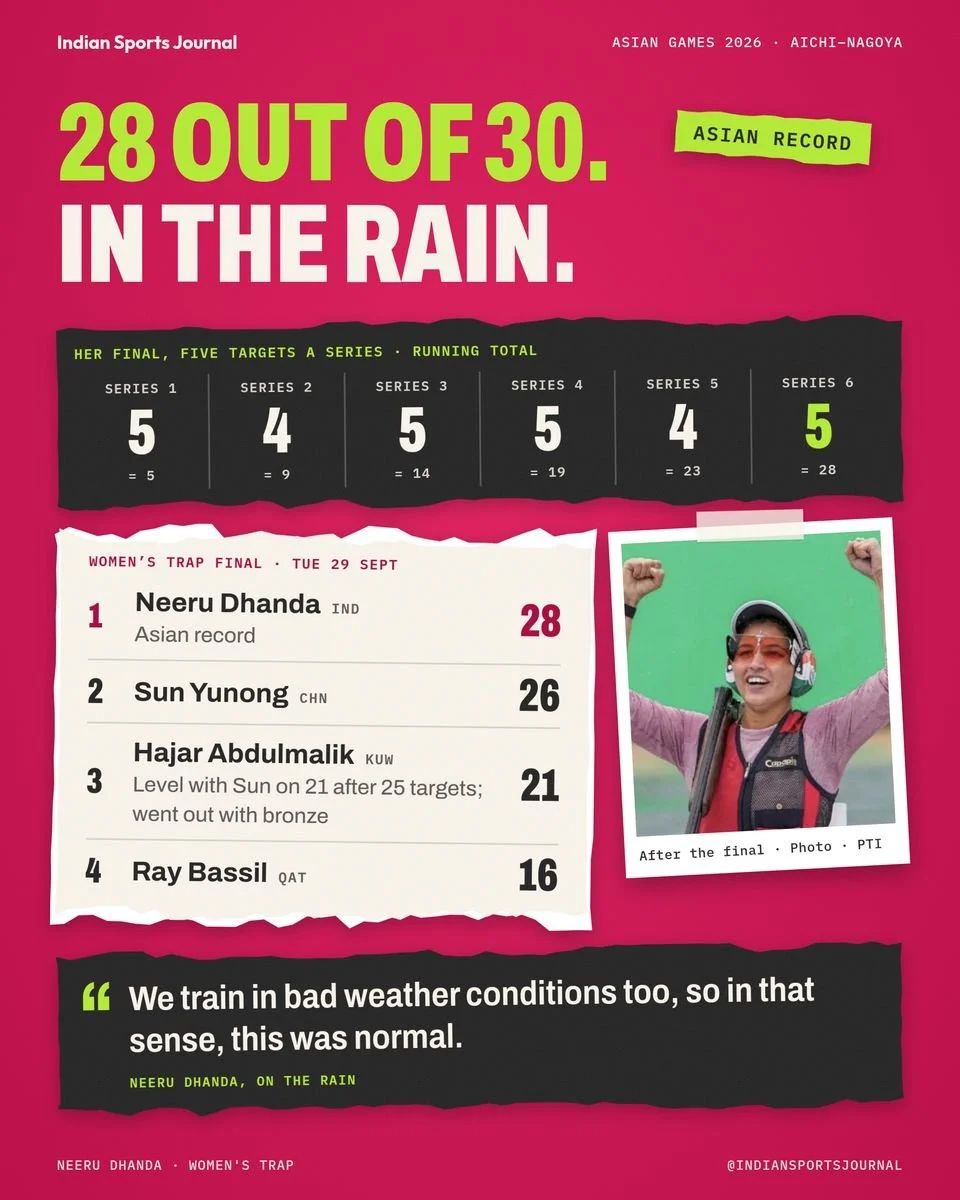
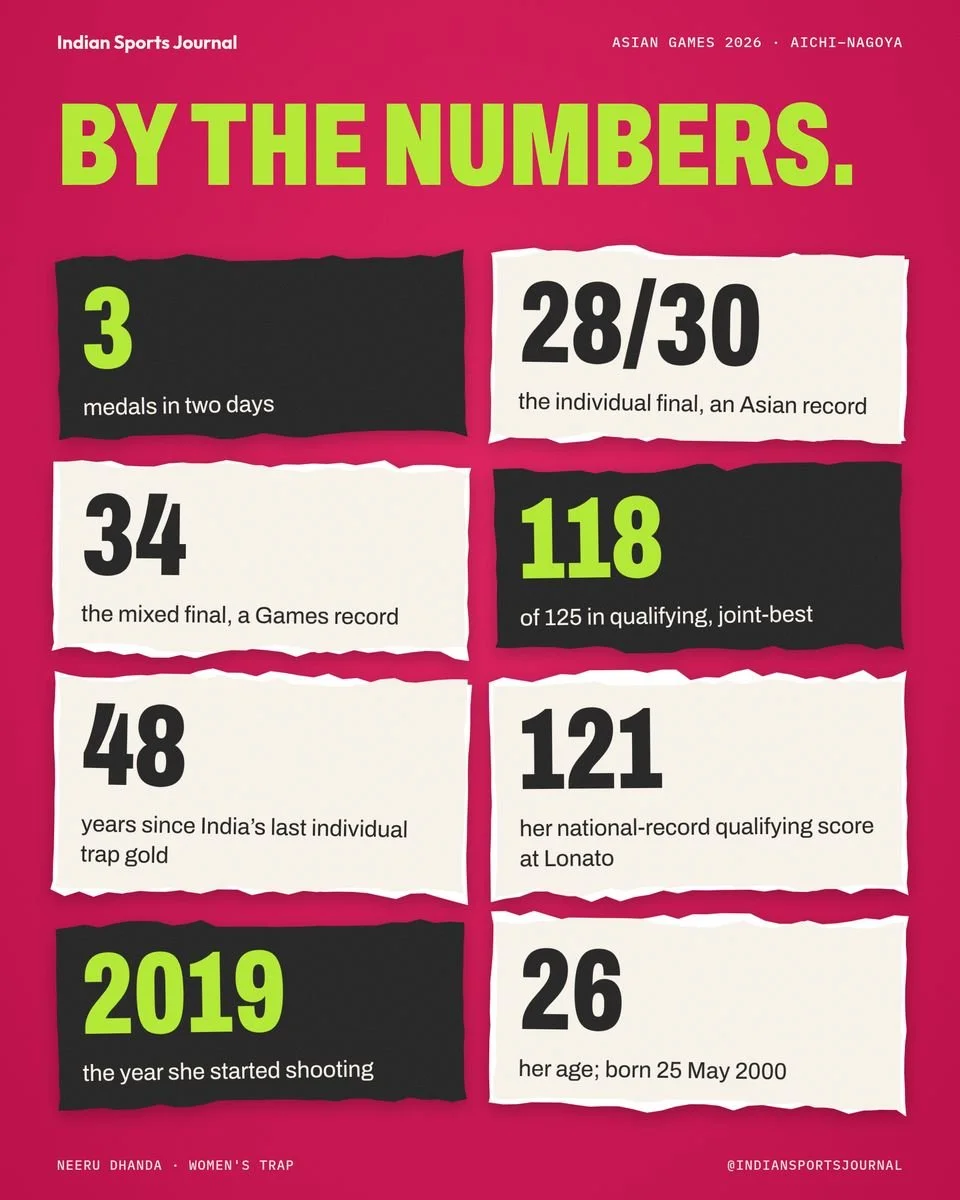
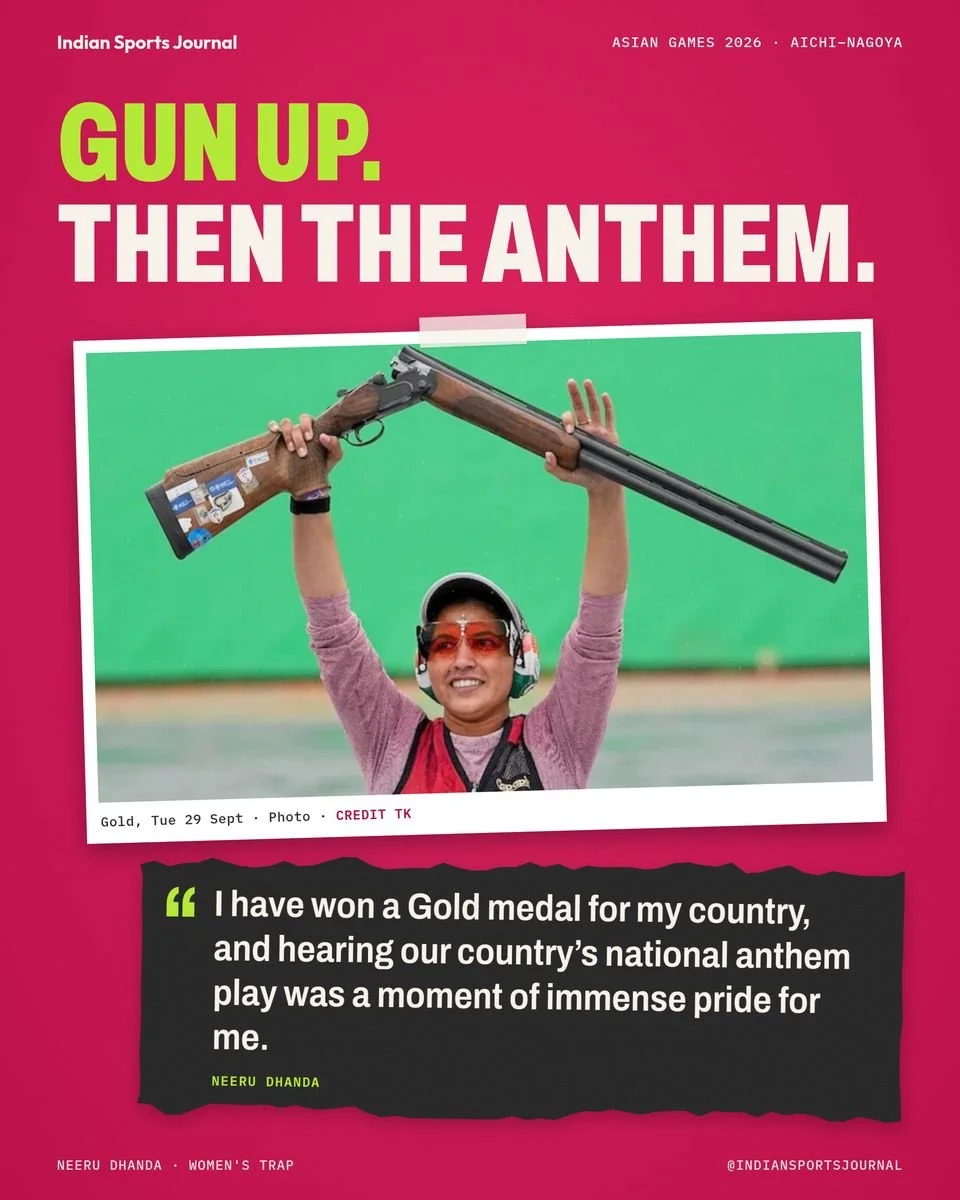
Neeru Dhanda did not train through India’s pre-Games camp. Ten days before the women’s trap final at the Aichi–Nagoya Asian Games she was in a hospital bed, and she reached Japan late. On Tuesday she hit 28 of 30 targets in that final, in rain that had fallen all day, and won gold by two from China’s Sun Yunong. The 28 is an Asian record.
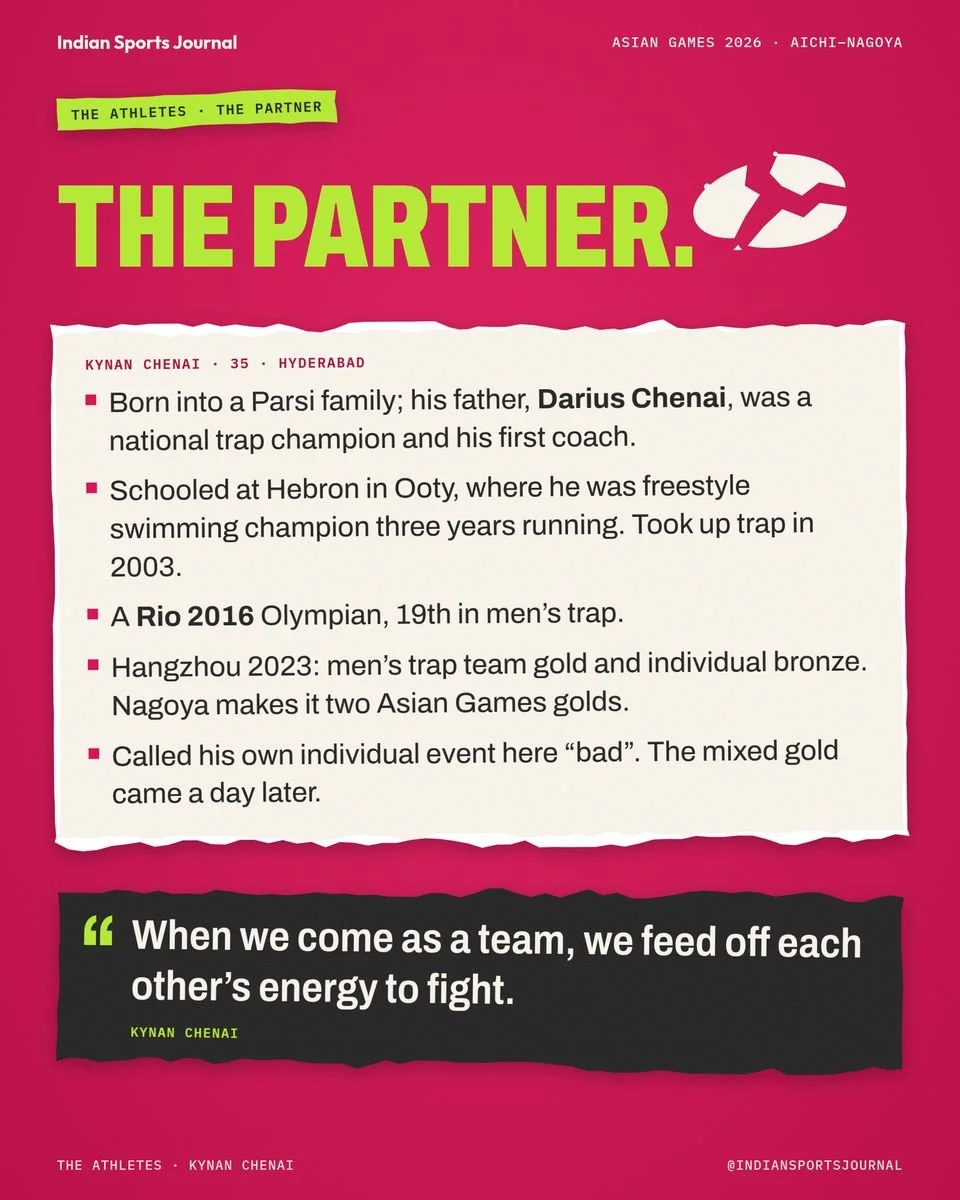
It was her second medal of the day. Her qualifying score of 118 had already carried India to silver in the team event with Aashima Ahlawat and Manisha Keer. On Wednesday she added a third, gold in the trap mixed team with Kynan Chenai; the pair shot 34 in the final, a second Asian record in two days, and India’s ninth gold of the Games.
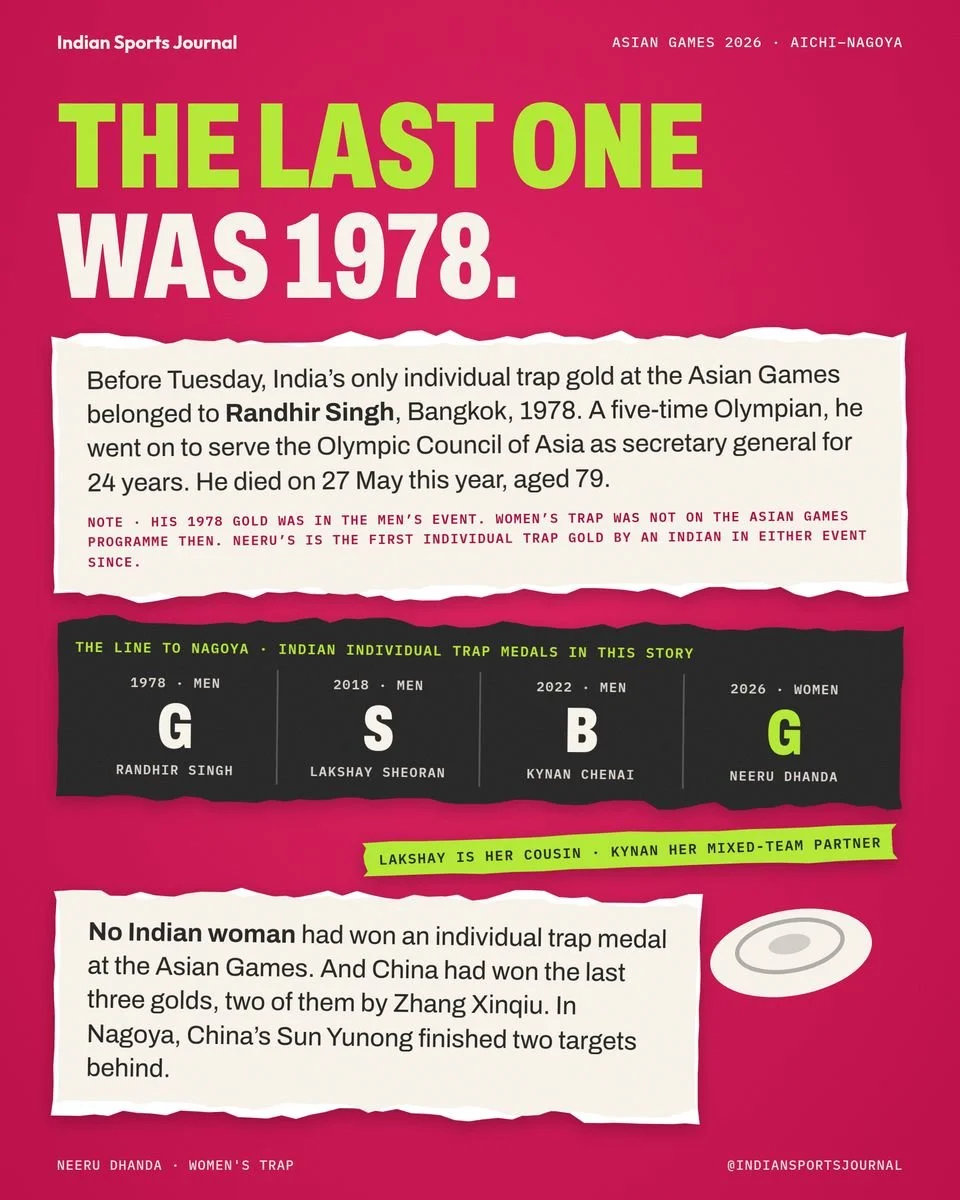
No Indian woman had won an individual trap medal at the Asian Games, an event first held in 1990. The only Indian to win an individual Asian Games gold in trap before her was Randhir Singh, at Bangkok in 1978. According to Olympics.com, Neeru is also the first Indian woman to win Asian Games gold in any shotgun event, and the first Indian shotgun shooter to win two titles at one edition. She is 26. She took up the sport at 19, on borrowed guns, from a family that holds a below-poverty-line ration card. What carried her to Nagoya was a cousin’s medal, a state academy in Bhopal, an Army job and a foreign coach, and a tie-break rule that had cost her before and, this time, did not.
Silver first, then the rain
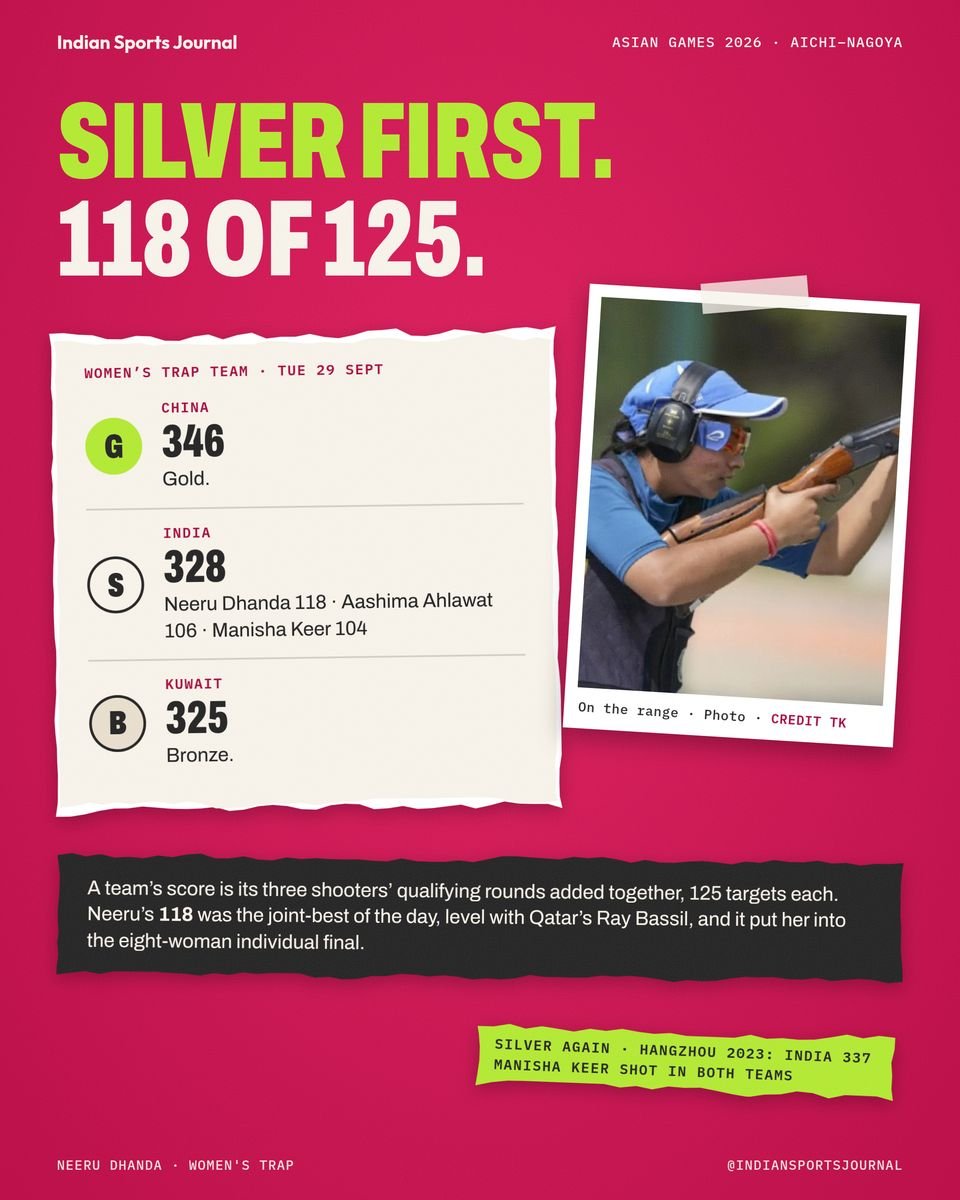
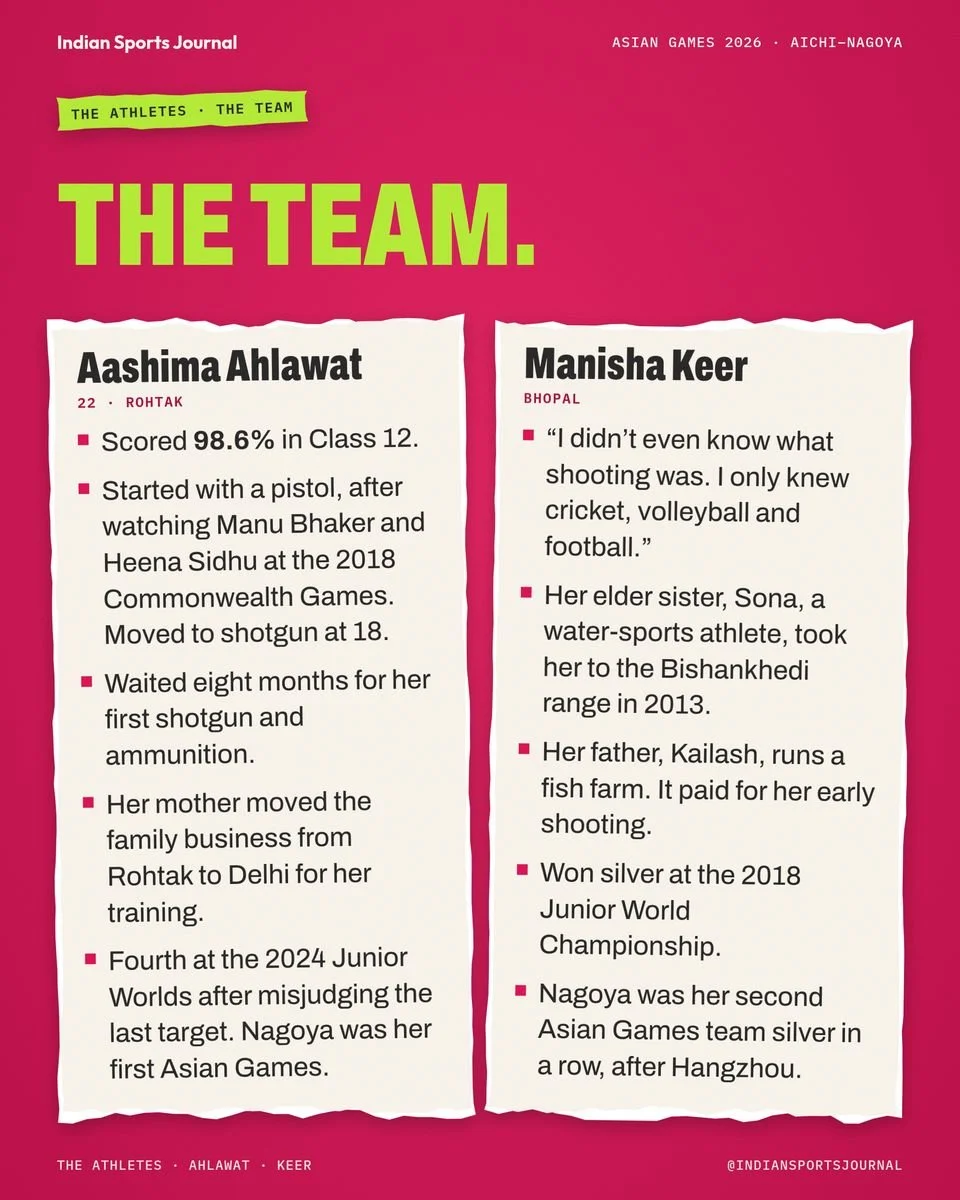
Trap qualifying is 125 targets, five rounds of 25, spread over three days. Neeru finished level with Qatar’s Ray Bassil on 118 and won the shoot-off for first place 2-1. A team’s score is its three shooters’ qualifying totals added together: Neeru’s 118, Ahlawat’s 106 and Keer’s 104 made 328, 18 behind China and three ahead of Kuwait. It was India’s second successive silver in the event. Keer, a fisherman’s daughter from near Bhopal and a junior world silver medallist in 2018, was also in the team that took silver with 337 at Hangzhou in 2023. Ahlawat, 22, from Rohtak, was at her first Asian Games; her mother had agreed to let her shoot only if she scored 96 per cent in her Class 12 exams, and she scored 98.6.
The final ran under rules that came into force on 1 January. Eight finalists now get one shot per target, over 30 targets. Two go after the first 10, two more after 15, then one after each block of five until two remain. A tie for the bronze place is not shot off: the higher place goes to the lower start number, which qualifying sets. Because the format is new, its records are young. The Asian mark Neeru broke was 24, set by Chinese Taipei’s Liu Wan-Yu at Doha in January, and Liu was in this final. The world record is 30.
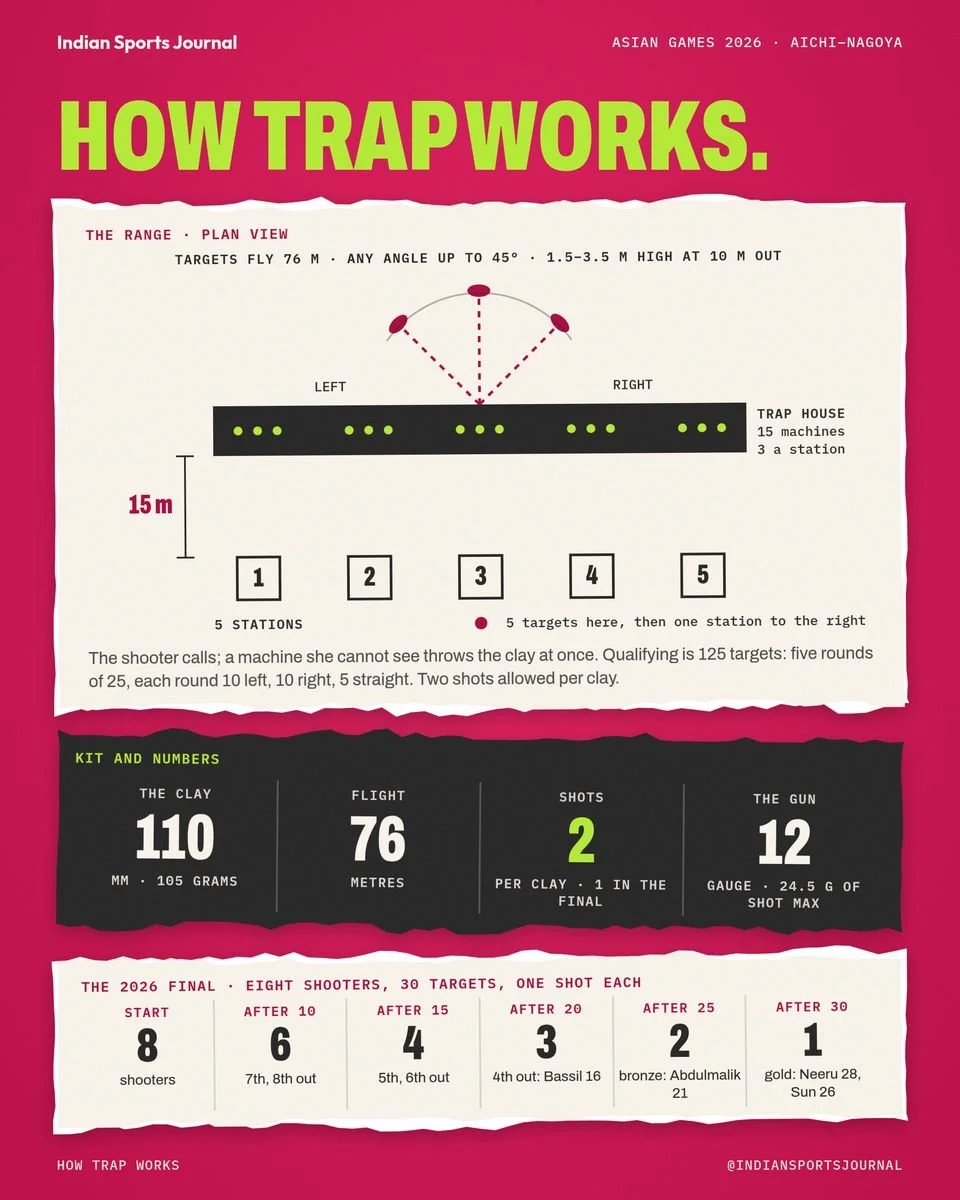
Neeru opened with five straight hits, then missed the ninth target and dropped into a tie for third behind Sun and Kuwait’s Hajar Abdulmalik, both on 10. After 15 targets the three were level on 14. Neeru hit the next five while Sun and Abdulmalik dropped two each, and she led by two. She missed target 25, her second and last miss, and still went into the final five two clear. Sun hit all five. Neeru needed four.
With one target left to win it, Wilson said, she was shown a yellow card for taking too long, a decision he called “really unfair” because, in his view, the timer had been started early. He objected to the jury. “Neeru was incredible. She was more composed than anybody,” he said. She settled herself and hit it.
Further down the order, two places went on ties. Bassil and China’s Zhu Jingyu were level on 13 after 15 targets, and Zhu, who had qualified behind Bassil, went out. Sun and Abdulmalik were level on 21 after 25, and Sun’s lower start number sent her through to shoot for gold; Abdulmalik took bronze.
“It just rained all day,” Wilson said afterwards. By the final the light was going, and he described the water running down shooters’ necks and “bouncing off” the rib of the gun as they aimed. Neeru was less dramatic. “We train in bad weather conditions too, so in that sense, this was normal,” she told ANI. The line she repeated to herself, she told The Times of India, was that even if a storm came, she would not look down.
The line from Bangkok
Randhir Singh won the trap at the 1978 Asian Games in Bangkok, India’s first Asian Games shooting gold. He went to five Olympics, from Mexico City to Los Angeles, and spent 24 years, 1991 to 2015, as secretary general of the Olympic Council of Asia. He died in New Delhi on 27 May, aged 79. Neeru dedicated her gold to the soldiers on India’s borders and to him. “He used to meet us and hug us so lovingly,” she said, as reported by The Pioneer.
In the 48 years between, Indian men came close. Lakshay Sheoran took trap silver at Jakarta in 2018 and Chenai bronze at Hangzhou in 2023. Ronjan Sodhi’s gold at Guangzhou in 2010 came in double trap, a separate event. Women’s trap had belonged to China: Zhu won it in 2014, Zhang Xinqiu in 2018 and 2022. Zhu was in Tuesday’s final and finished fifth.
Neeru’s gold was India’s fifth of the Games, its first individual gold in Nagoya, and its second in shooting, after Suruchi Singh and Kamaljeet won the 10m air pistol mixed team.
Fourth in, first out
Mixed-team qualifying began at 10am the next day. Neeru shot 63 of 75, which she put down to stiffness from the day before and the way the rain and cold had affected her body, Onmanorama reported. Chenai shot 73. Their 136 took the last of four places in the final, behind China (142, a Games record), Qatar (139) and Iran (138).
Under the new format the four pairs shoot one final together. India hit six of their first 10 and were joint last. Then they did not miss: 10 from 10 drew them level with Qatar on 16 as Iran went out on 12, and another 10 put them two clear, 26 to 24, as China went out on 23. Eight of the last 10 made 34 to Qatar’s 32. Chenai missed only his first target and finished with 19 of 20; Neeru, who dropped her last two, had 15. The previous Asian record, 30, belonged to Qatar’s Mohammed Al-Rumaihi and Kholoud Al-Khalaf, set in Doha in January.
The event had been held once before, at Jakarta in 2018, where Bassil won it for Lebanon and India’s pair finished sixth. It was left off the programme at Hangzhou. On Wednesday Bassil was half of Qatar’s silver-medal pair.
Chenai, 35, a Rio 2016 Olympian, had shot 115 in the men’s individual event and missed the final. “Personally, I had a bad individual competition. And I had a fresh start today,” he told IANS. The barrel he used belongs to his father, Darius, a former national trap champion. “I stole it from him,” he said. He told IANS he kept quiet in the final so as not to disturb her routine; Neeru’s account is that he talked with his hands. “He constantly gestured to push me; he said I have to fight, I have to fight till the last shot,” she said.
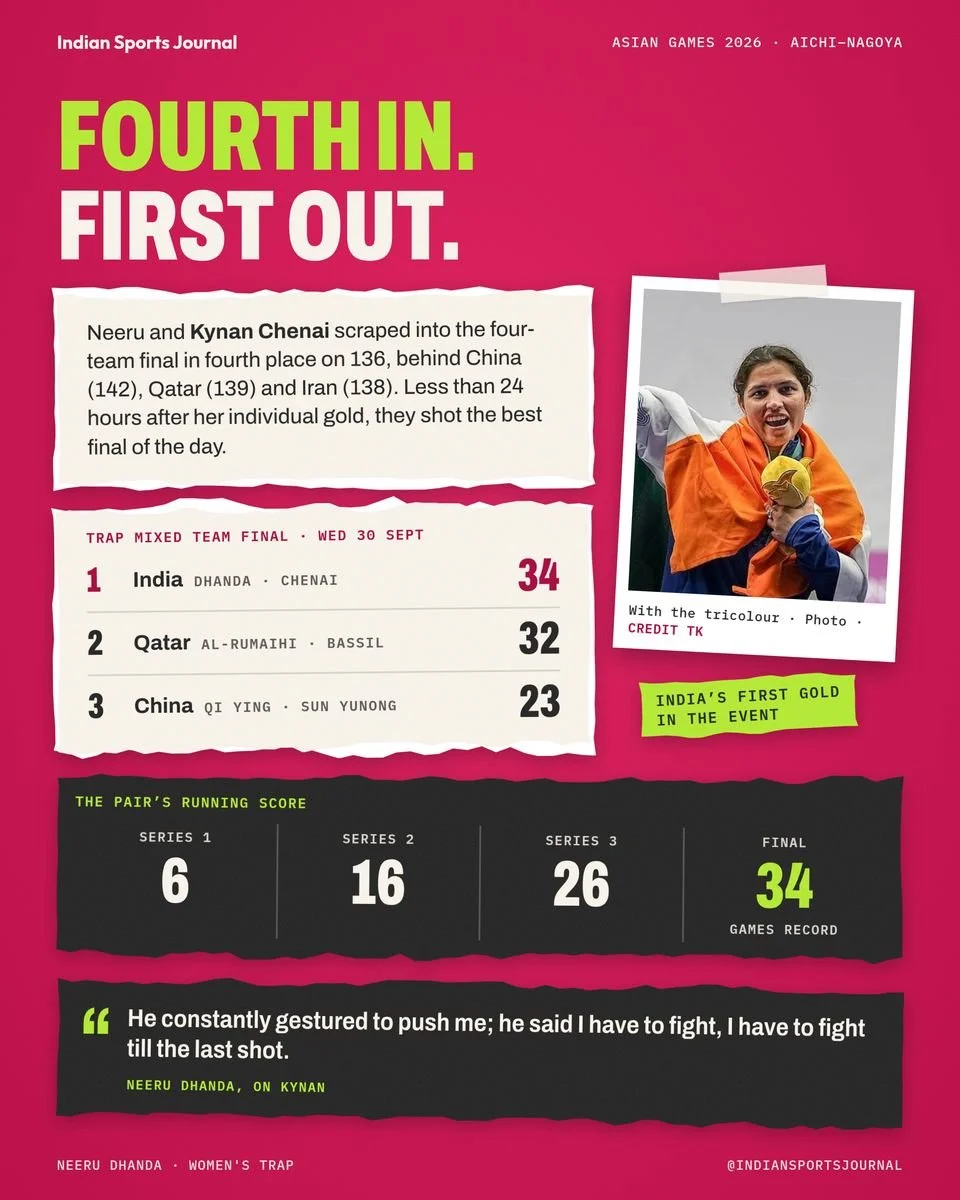
“What could be better than this?” she said to ANI afterwards.
Five days on water
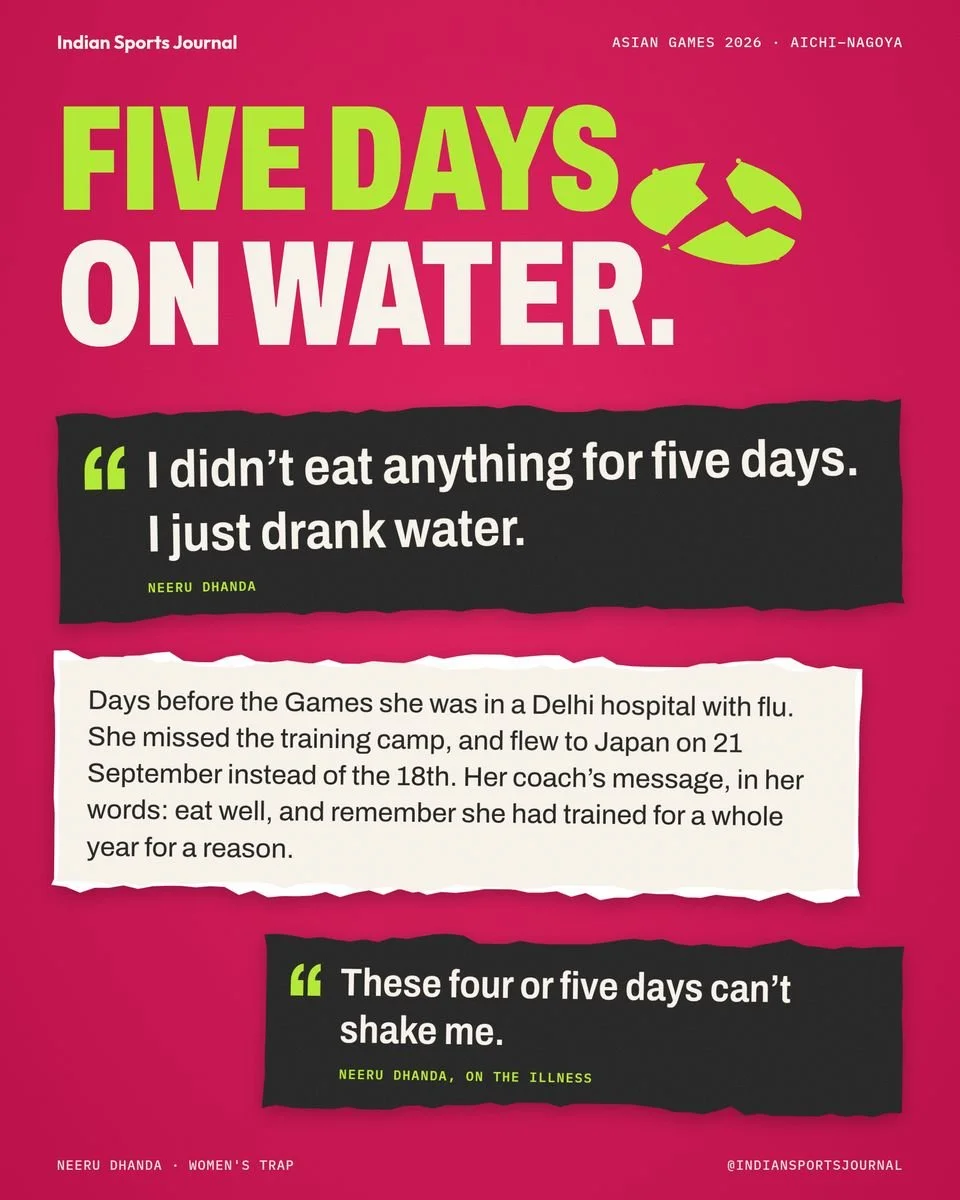
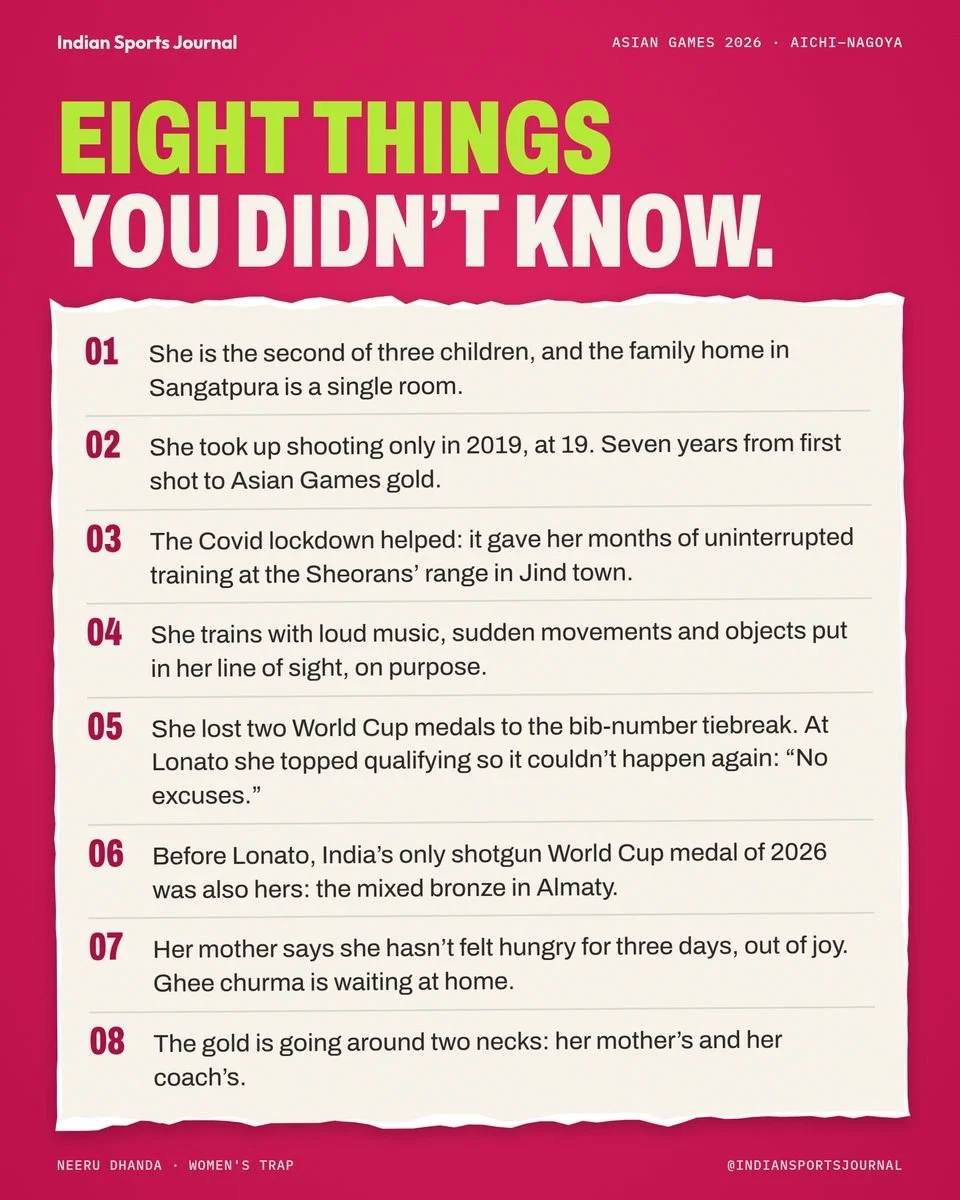
The medals were won by someone who, a fortnight earlier, had wondered whether she would make the trip. “Only 10 days ago, she was in hospital for three days back in Delhi,” Wilson, India’s foreign shotgun coach and the 2012 Olympic double trap champion, told ANI on the day of the individual final. She missed the camp and flew to Japan on 21 September instead of the 18th, according to The Tribune, arriving with the team physio and no training behind her. “I didn’t eat anything for five days. I just drank water,” Neeru said.
Accounts of the illness differ: flu in one report, a suspected H1N1 infection in others, dengue in two, and the hospital’s city varies with them. The notes below set them out. What is consistent is the man on the phone. Mansher Singh, the four-time Olympian who has coached her for six years, called every day. His message, in her account to IANS: take care of herself, eat well, and remember that she had trained for a whole year. “So, these four or five days can’t shake me,” she said.
A borrowed gun, a tin can
Sangatpura is a village of about 2,500 people in Haryana’s Jind district. Neeru’s father, Suresh Dhanda, is a farmer; her mother, Sudesh Devi, kept the family going by selling buffalo milk. The family lives in one room with unpainted walls that now carry her medals, and she is the second of three children. Sudesh Devi learned of the gold from a stranger’s call to her keypad phone while she was walking to the ration shop. “We don’t have a TV or smartphone,” she told The Times of India.
The spark was Lakshay Sheoran’s silver at Jakarta. Lakshay, whom most reports call her cousin, is the son of the Jind wrestler Somveer (Sombir) Sheoran, a relative who encouraged her and gave her logistical support when she started in 2019, aged 19. Her first targets were tin cans, and reports differ on whether the double-barrel she first fired was her family’s own or the Sheorans’. Lakshay’s parents then took her to the Madhya Pradesh State Shooting Academy in Bhopal, which supplied guns and ammunition. The Covid lockdown, The Tribune reported, gave her months of training in near-isolation at Sombir Sheoran’s place in Jind town.

She has her own explanation for that route, given to ANI after the mixed final.
“I believe God gave me the struggles at a young age for a reason.”
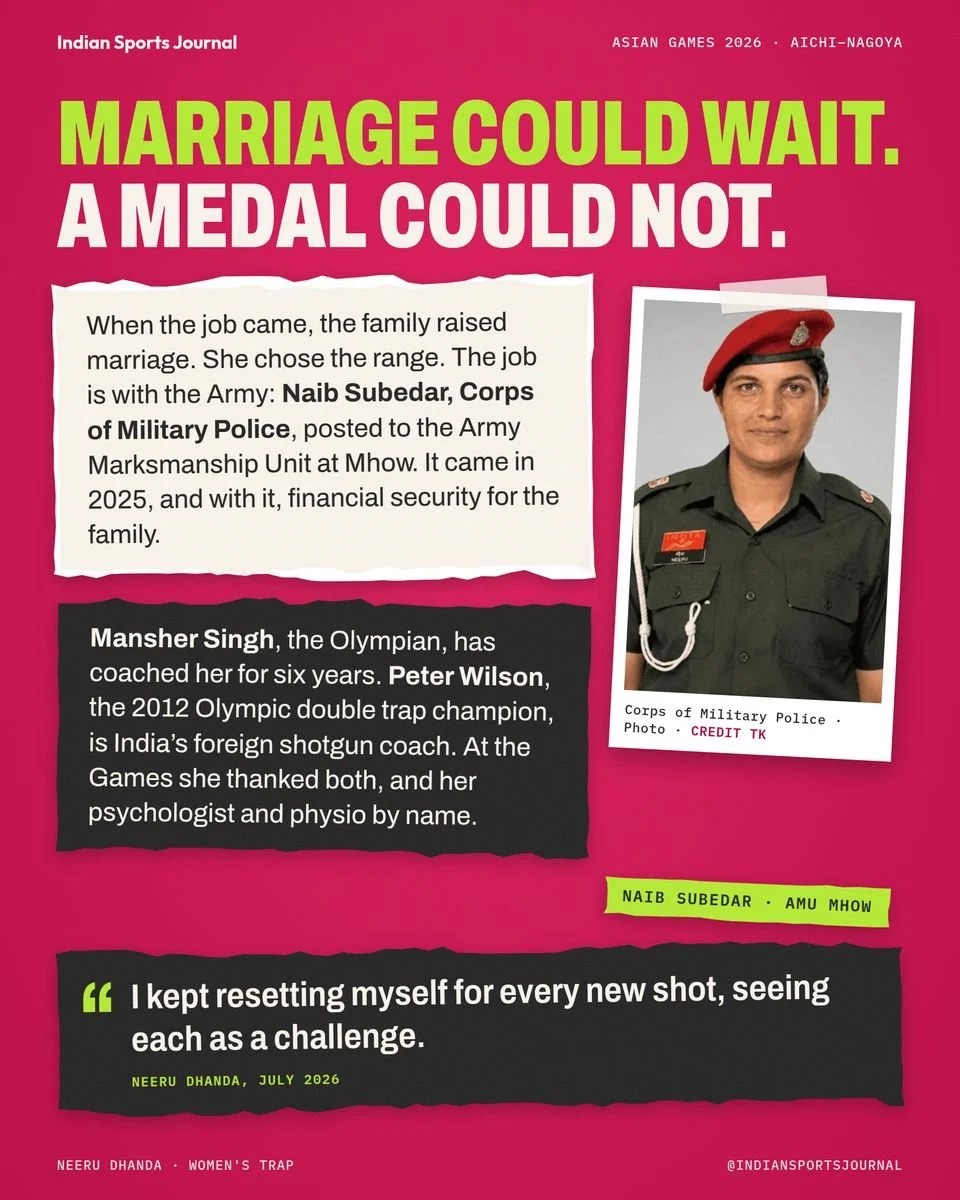
In 2025 the Army took her in as a Naib Subedar in the Corps of Military Police, posted to the Army Marksmanship Unit at Mhow, and the job gave the family financial stability. When marriage came up at home, she told her family, according to The Tribune, that marriage could wait and a medal could not. Her mother says Neeru promised to build them a proper house first.
The support around her is layered. Mansher Singh has been with her “right from the grassroots level,” she says; Wilson coaches the national trap squad; and in Nagoya she thanked the team physio and psychologist by name. The federation, she told IANS, has gone from one national camp a year to two or three. “We create such situations in training, where we have to fight distractions,” she said. “We train with loud music and other distractions.”
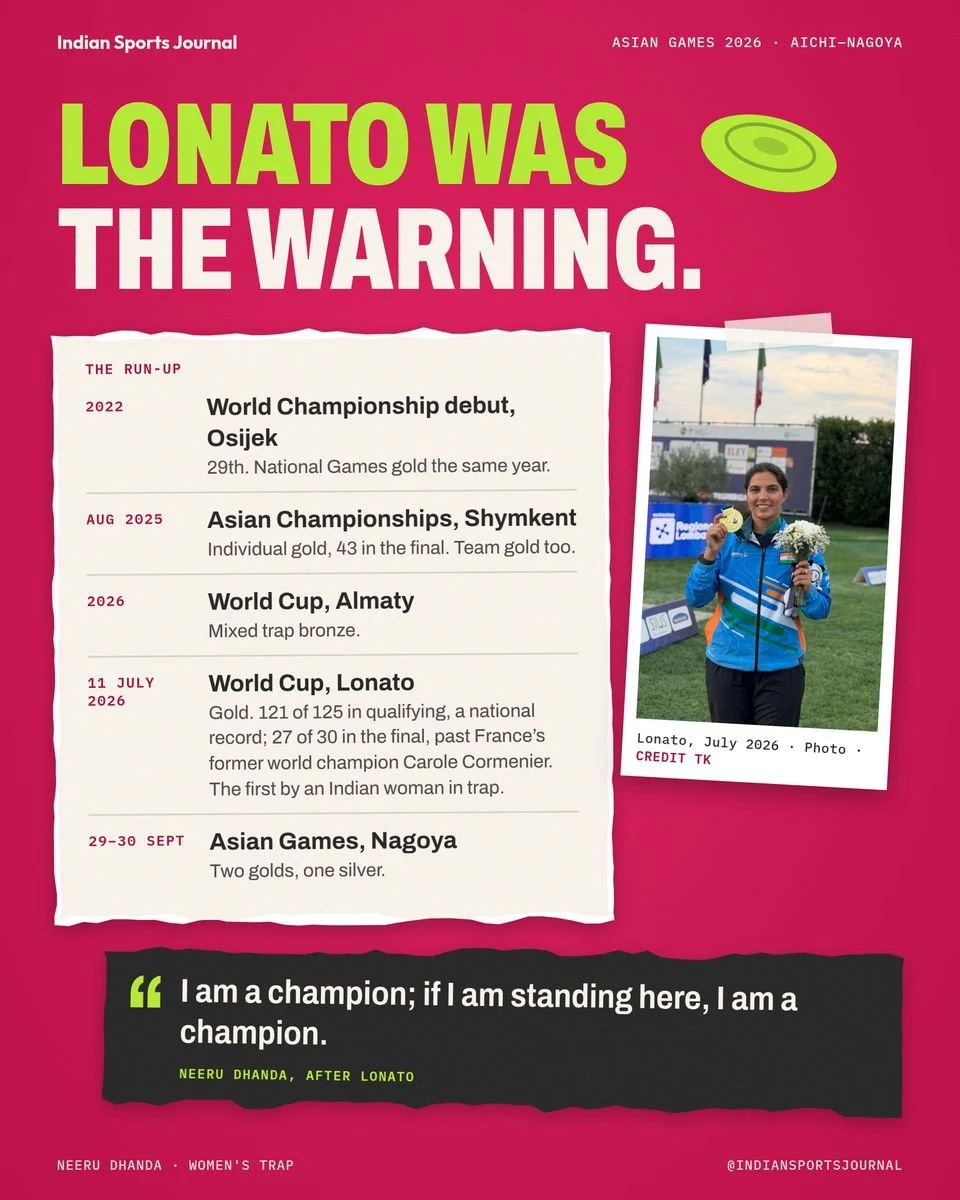
The tie-break that settled Tuesday’s bronze had cost her before. At Lonato in July 2025, in her first World Cup final, she was level with two others after 35 targets and went out on bib number, finishing fourth. “In the last two World Cups, I missed out on a medal because of the bib number rule,” she told The Bridge a year later, after going back to Lonato and topping qualifying with a national-record 121. “This time, I didn’t want to leave anything to chance. No excuses,” she said. She won that final with 27 of 30, breaking a 25-all tie with France’s Carole Cormenier, a former world champion, over the last targets: the first World Cup trap gold by an Indian woman. “My mindset was: I am a champion; if I am standing here, I am a champion,” she said then.
What comes next
Wilson wants his shooters to rest first: “a couple of weeks off, maybe a touch longer, just to decompress,” he said in Nagoya. Then the World Championship in Doha, from 1 November, where she has said her aims are an Olympic quota place and a gold medal. “Then we’ll go hard for Doha, for the World Champs,” Wilson said. Her stated goal beyond that, since Lonato, has been gold at the 2028 Los Angeles Olympics.
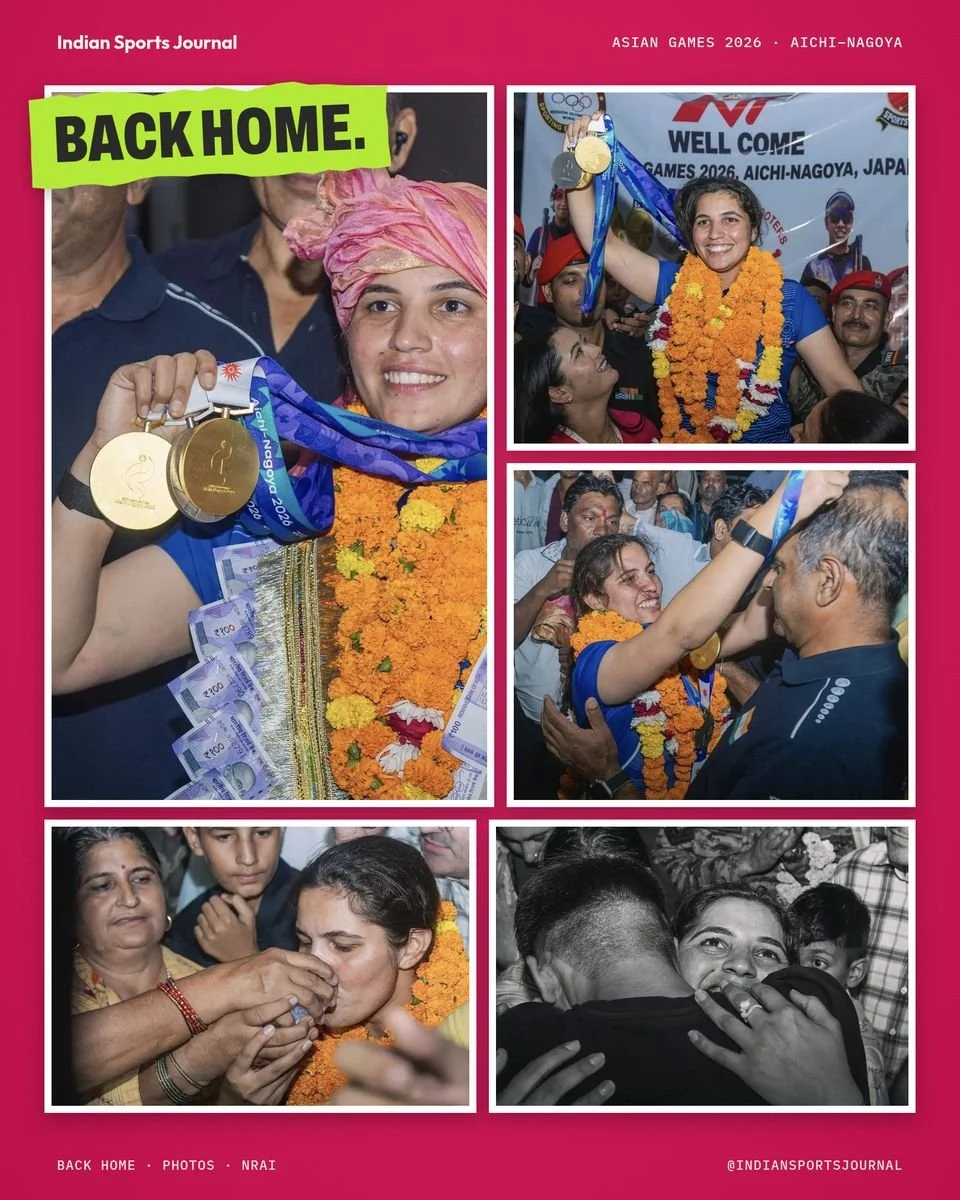
Before Doha, home. Her mother has churma waiting, and Neeru has two people in mind for the gold medals. “I want to put this medal around my mother’s neck and my coach’s neck,” she told ANI.
The tie-break in a trap final favours whoever qualified higher. In Lonato and again in Nagoya, the shooter at the top of qualifying was Neeru. In Doha, the 125 targets start again from zero.
Flag-bearer. Neeru was named India’s women’s flag-bearer for the closing ceremony at Mizuho Park Athletic Stadium on 4 October. She had already flown home and travelled back to Nagoya for it, The Free Press Journal reported.
Honours. On 12 October Defence Minister Rajnath Singh felicitated the Services’ medallists, who won 27 of India’s 85 medals as India finished fourth, according to the Defence Ministry, and the Army chief, Gen. Dhiraj Seth, honoured the Army’s, who won 20. Neeru dedicated all three of hers to the Army (ANI). On 14 October three Haryana ministers honoured her in Sangatpura with cash awards totalling ₹45 lakh (UNI).
Next. The ISSF lists her at No. 13 in women’s trap. The World Championship in Doha opens on 1 November.
Sourcing. Every score, target, record, start number and qualifying total is from the official Aichi–Nagoya 2026 results (Bornan timing, via ISSF and the Asian Shooting Confederation) and ISSF news; the final format from the ISSF 2026 rulebook. Reporting: Olympics.com; ANI (via Republic World, NewKerala, Devdiscourse); IANS (via NewKerala, IBTimes, IANSlive); Peter Wilson’s Nagoya press conference (The Hans India); The Pioneer; Onmanorama and The Federal; The Tribune (October 2022; July and September 2026); The Times of India; Outlook; Business Today; The Hindu; NDTV; UNI; Telangana Today; India Today; ETV Bharat; The Free Press Journal; The Bridge (July 2025, July 2026). Randhir Singh from the OCA and Wikipedia; earlier Games results from ASC results books and Wikipedia; dates of birth from ISSF and Olympedia; Chenai’s schooling from Deccan Chronicle and Sportskeeda. The Since-publication box: The Free Press Journal, ANI, the Defence Ministry release (via NewKerala), UNI and the ISSF athlete profile.
Corrections to the carousel. Slides 2, 8 and 17: the mixed-team 34 is called a Games record — the official results list it as an Asian record too, beating 30 by Mohammed Al-Rumaihi and Kholoud Al-Khalaf (Doha, 21 January 2026). Slide 8: “less than 24 hours after her individual gold” — the two finals started at 14:00 on 29 September and 14:30 on 30 September per the official results, about a day apart; the 9-slide cut’s “a day after” is right. Slide 9: “in a Delhi hospital with flu” — diagnosis and city are disputed (see Flag); the coach’s message as she gave it to IANS does not include “for a reason”. Slide 10: “her first gun was his, an Indian-made double-barrel” — Outlook and The Tribune (2022) say her first shots, at tin cans, were with the family’s own double-barrel; Business Today and The Pioneer say a gun belonging to Lakshay’s father; her father told The Times of India she practised with Lakshay’s. “She played kabaddi first” — not found; ANI has her naming her paternal aunt Ajado Devi, a kabaddi player, as an inspiration. Slide 13: “freestyle swimming champion three years running” — Sportskeeda lists 2004, 2006 and 2009; the Chenai quote drops “basically” and “and we never give up” from the IANS original. Slide 14: Ahlawat “moved to shotgun at 18” — India Today says she picked up a pistol at 18 before switching; Keer’s sister Sona as a “water-sports athlete”, the Bishankhedi range “in 2013” and her father Kailash’s “fish farm” were not found (The Times of India calls him a fisherman). Slide 16: item 4’s “sudden movements and objects put in her line of sight” and item 7’s “hasn’t felt hungry for three days” were not found; item 5 rests on her own account (see Flag). 9-slide cut: slide 3 dropped the 18-slide version’s “level with Sun on 21 after 25 targets”, which the official target grid confirms; slide 7’s “ten days before the Games” — Wilson’s “10 days ago” was said on 29 September, about ten days before her final.
Flag — records. The official results and ISSF mark the 28 as an Asian and Games record (previous Asian record 24, Liu Wan-Yu, Doha, 20 January 2026). One UNI wire said she “equalled” the Asian record; Business Today called it a Games record only; PTI (via The Pioneer and DT Next) called her 118 a qualification Games record, but the official qualification record is 124 (Wu Cuicui, 2023). NDTV and IANS (via The Sentinel) gave the previous mixed-team Asian record as 33; the official results and PTI say 30.
Flag — the illness. Flu (The Tribune, 30 September); suspected H1N1 in a Bhopal hospital (The Times of India); an H1N1 scare (Telangana Today, The Pioneer); dengue, with a week in a Delhi hospital (The Times of India city edition) or a Delhi admission (The Tribune, 29 September); three days in a Delhi hospital (Wilson to ANI). On arrival: left 21 September instead of the 18th (The Tribune), three days late (TOI), two days late (India Today).
Flag — family. The Tribune (October 2022 and July 2026) reported that the family moved from Jind to Shivpuri, Madhya Pradesh, more than a decade ago, and she competes for Madhya Pradesh domestically; September reporting (TOI, The Tribune, ETV Bharat, UNI) places the family home in Sangatpura. Lakshay is her “cousin” in most reports, her “maternal uncle’s son” in The Tribune (2022); Outlook calls Somveer “her maternal aunt’s son”, while Wikipedia and TOI make Somveer Lakshay’s father. Her younger brother is a graduate student per The Tribune, a wrestler per ETV Bharat.
Flag — other conflicts. The bib rule: she told The Bridge she missed medals at her last two World Cups because of it, and The Tribune that she had “missed out on the finals the last three times”; The Bridge’s July 2025 report confirms one case (Lonato 2025, fourth, out on bib number). Event history: Chenai told IANS this was the mixed event’s first Asian Games; ASC results and Olympics.com show it was held at Jakarta 2018. Shooting gold count: TOI called hers India’s first shooting gold of the Games; Olympics.com makes it the second. Almaty partner: IANS, All India Radio and the Asian Shooting Confederation’s results name Vivaan Kapoor; Olympics.com has “Vivaan Kumar”, and The Federal and PTI (via The Pioneer and Onmanorama) said the bronze came with Chenai. This page follows the results. Rank: TOI says she was recently promoted to Subedar; the Defence Ministry still listed her as Naib Subedar on 12 October. Ages: The Free Press Journal gives her as 27 and Telangana Today gives Chenai as 37; ISSF and Olympedia dates of birth (25 May 2000; 29 January 1991) make them 26 and 35. One Pioneer report prints the dedication as to “Raja Ranjit Singh”; another names Raja Randhir Singh. World Championship dates: 1–14 November (The Tribune) or 1–15 November (ANI). Lonato 2026 final: The Bridge has her level with Cormenier on 25 before the last targets and finishing on 27 of 30, without Cormenier’s total; the earlier “27-25” margin was dropped as unconfirmed (fact-check, 28 October). Not used: IANS reported that the mixed gold earned India a Los Angeles 2028 quota; no other source confirms it. The official results list her as “Neeru”, a single name.