India’s leagues after the ban
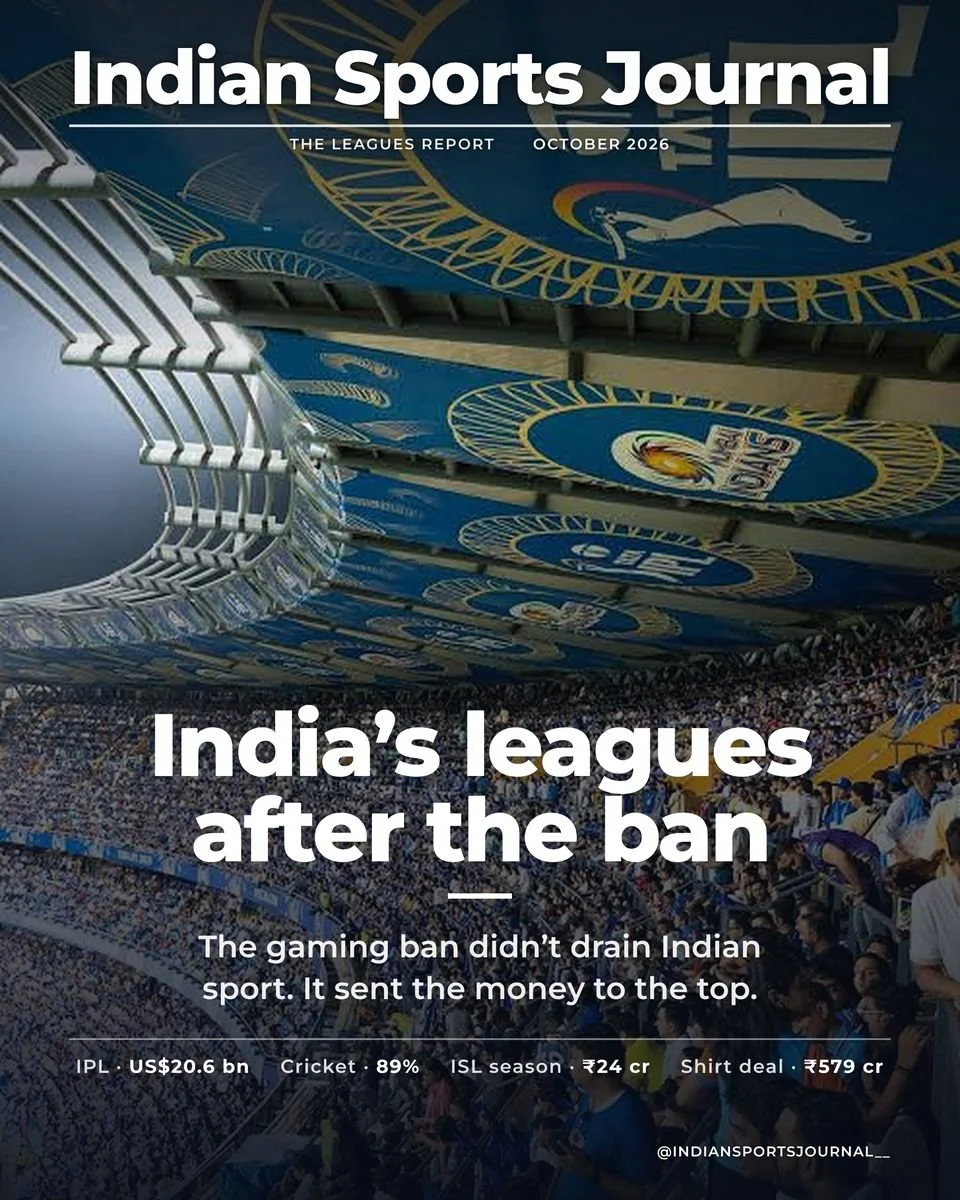
Fourteen months ago Parliament outlawed online money games and took some of the biggest spenders out of Indian sport. The money did not leave. It went to the top of the game, and everything below cricket is sharing less of it.
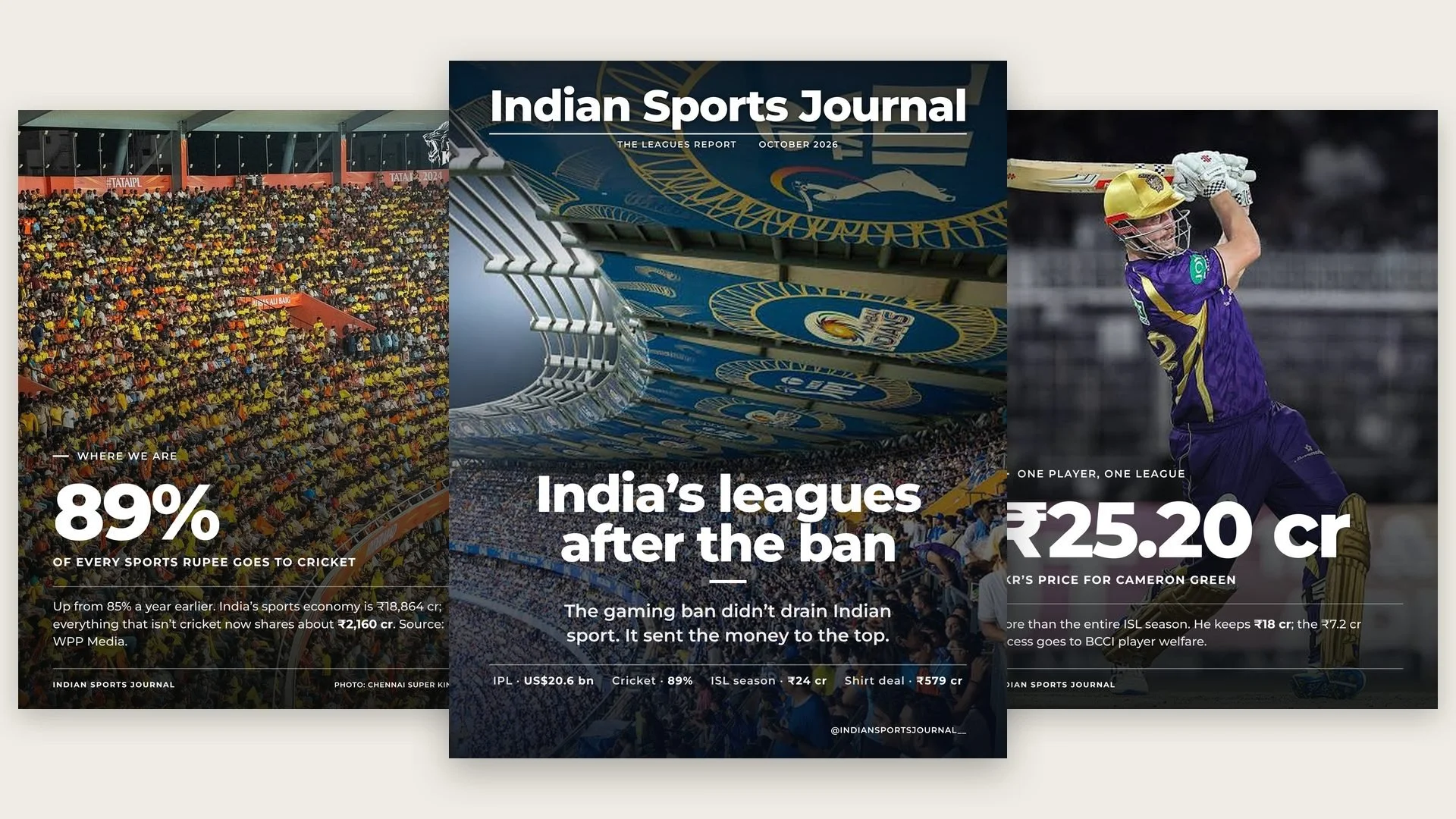
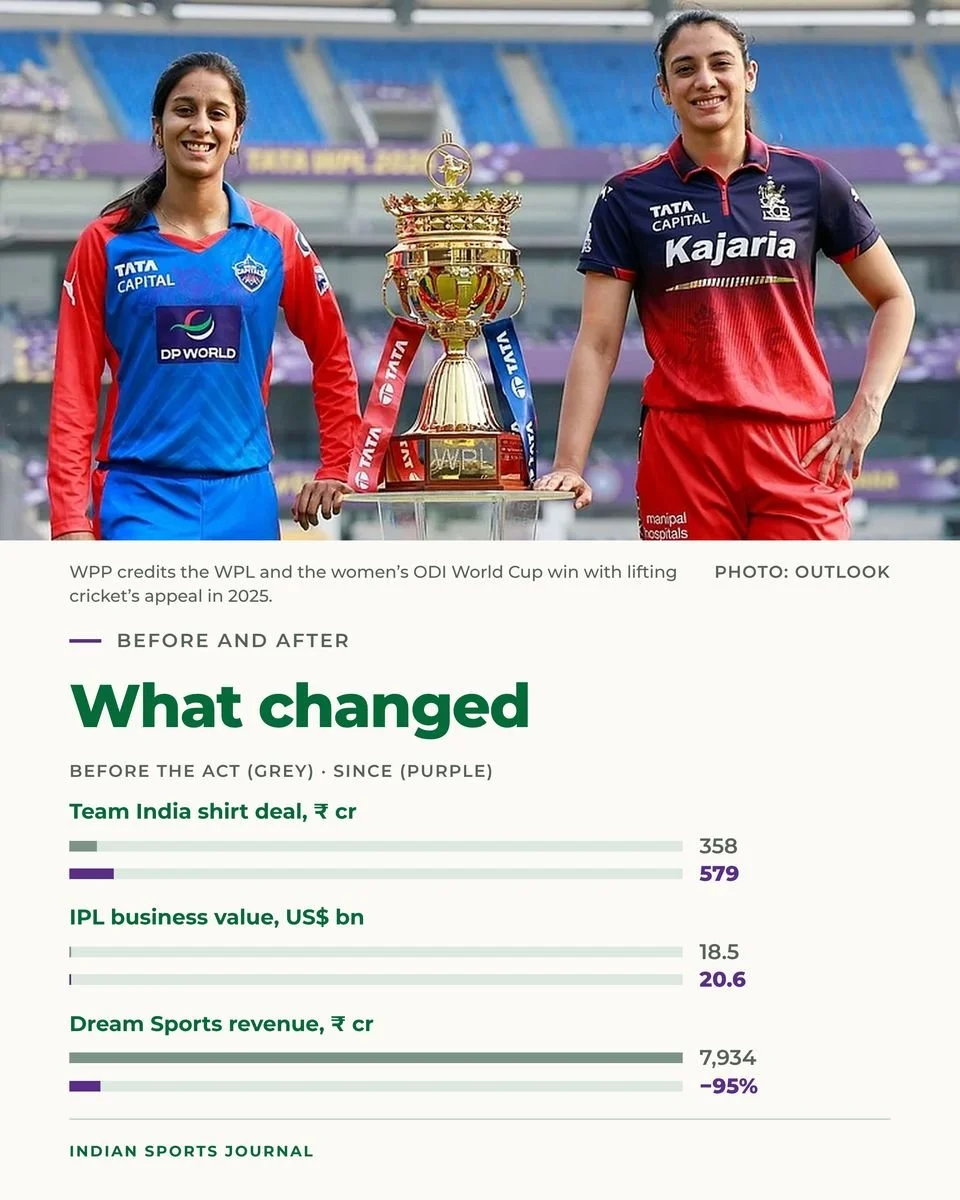
In August 2025 Parliament took three days to end real-money gaming in India. The industry it ended had been paying for a large part of Indian sport: the name on Team India’s shirt, a share of IPL advertising that agencies put anywhere from a fifth to two-fifths, and sponsorships further down, such as A23’s on the Prime Volleyball League. Fourteen months later the sport it paid for is richer. Apollo Tyres pays ₹579 crore for the shirt Dream11 held for ₹358 crore. Houlihan Lokey put the IPL’s business value at US$20.6 billion in July, up 11.4 per cent in a year. Buyers have agreed to pay more than ₹15,000 crore each for two IPL franchises.
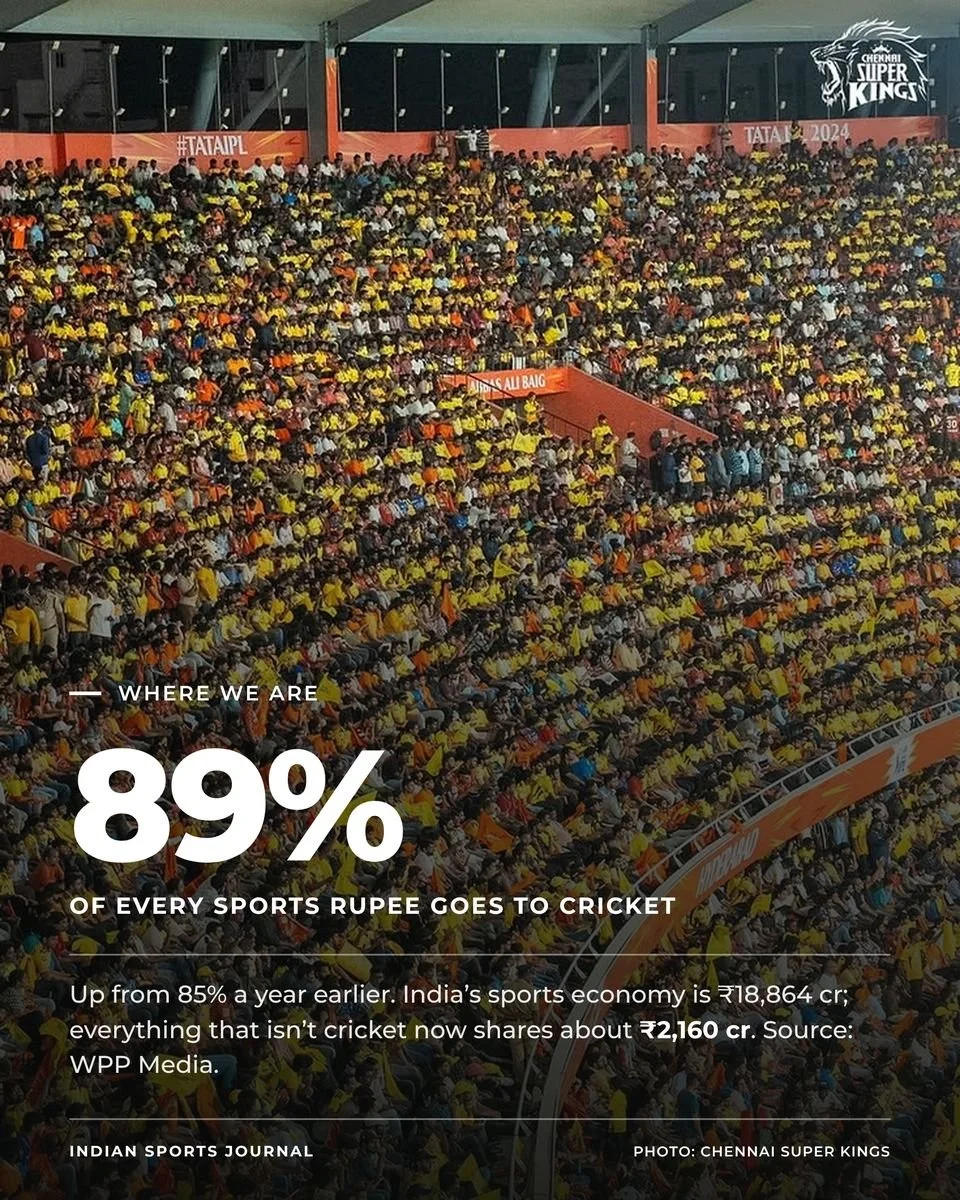
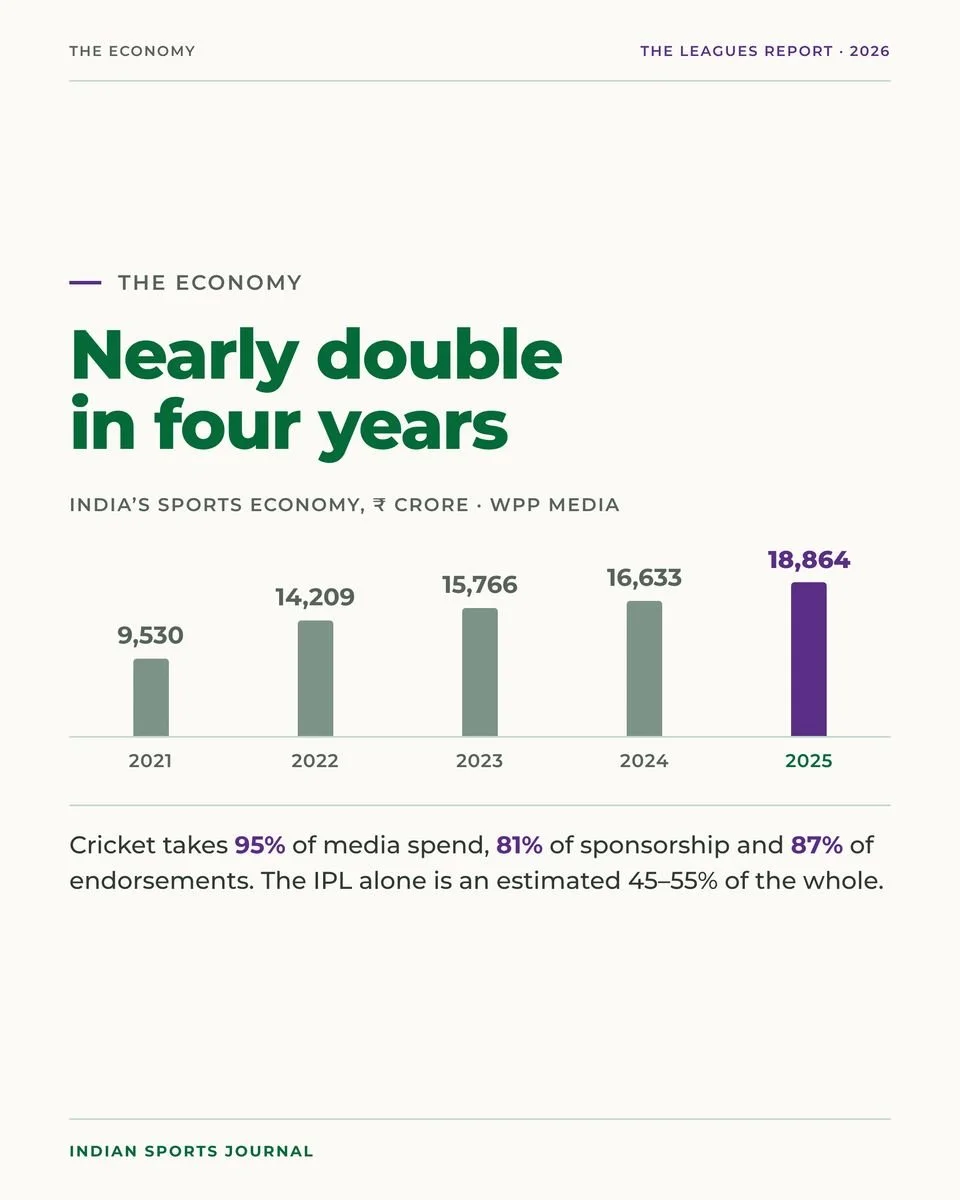
The money did not spread. WPP Media’s Sporting Nation report puts India’s sports economy at ₹18,864 crore in 2025, up 13.4 per cent, and cricket’s share of it at 89 per cent, up from 85 per cent a year earlier. Every other sport together shared about ₹2,160 crore. Worked back from WPP’s own growth figures, that is roughly ₹300 crore less than in 2024.
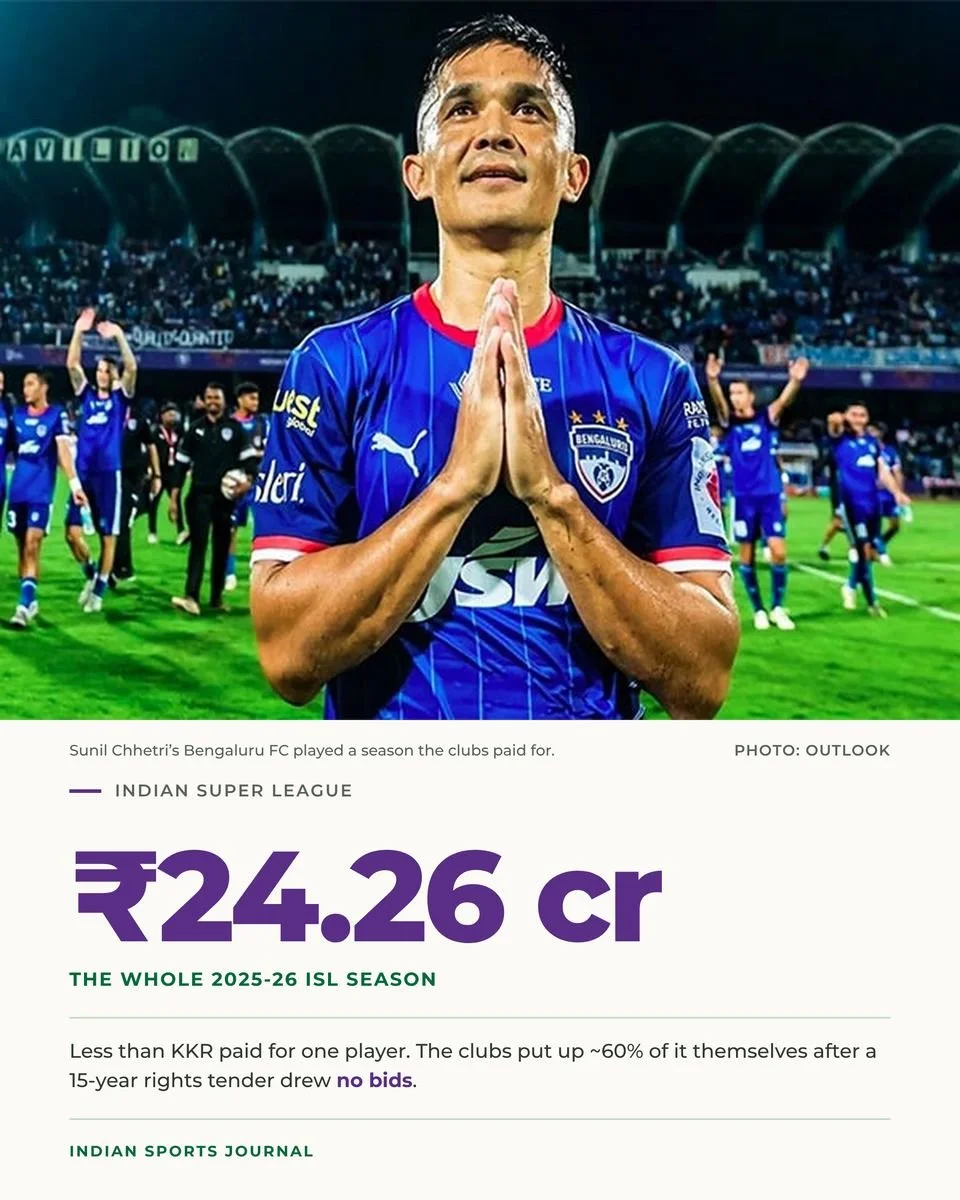
That is the shape of Indian sport after the ban. The gaming money went, the top of the market more than replaced it, and the replacement stopped at cricket. The whole 2025-26 Indian Super League season was budgeted at ₹24.26 crore, less than Kolkata Knight Riders bid for one Australian all-rounder at the IPL auction.
Three days in August
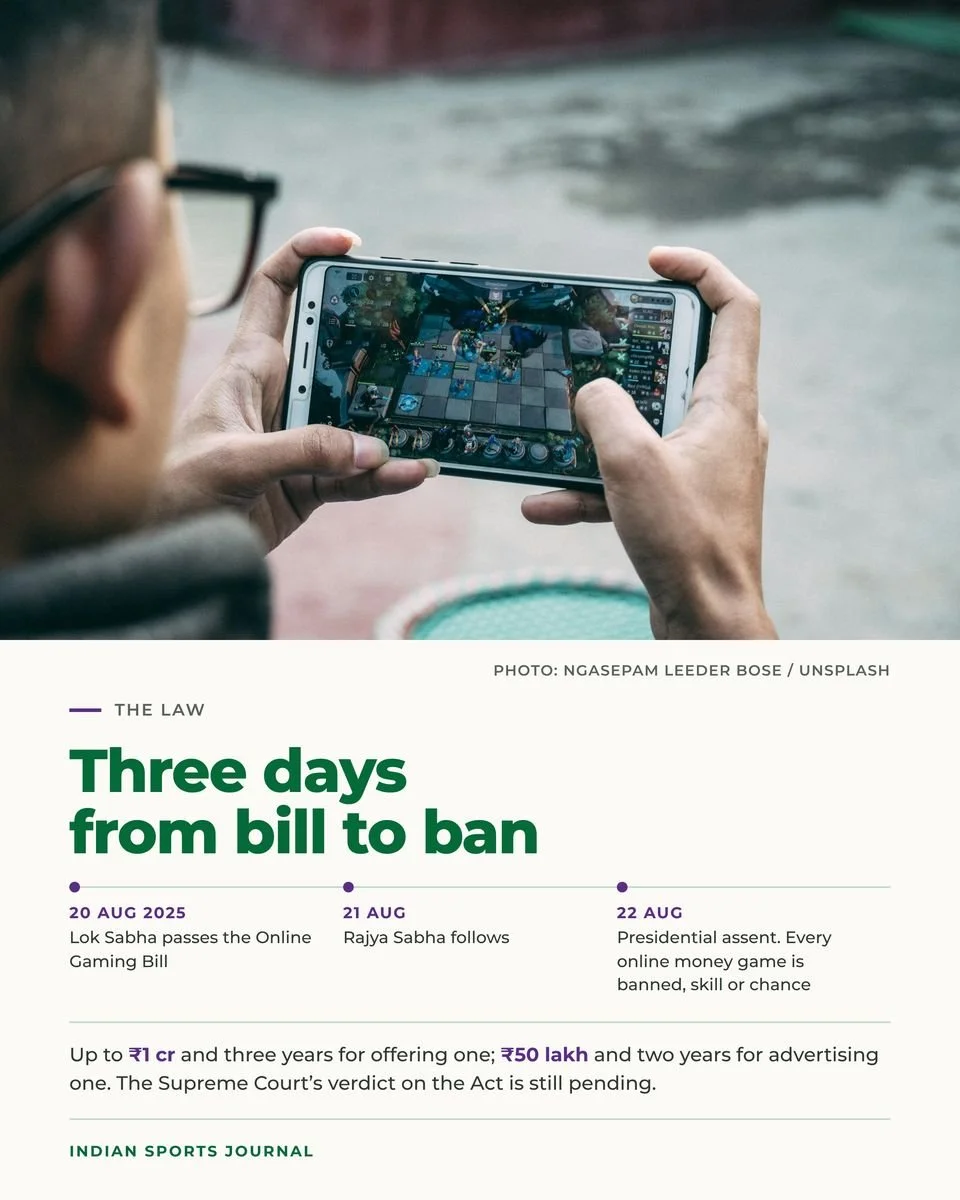
The Promotion and Regulation of Online Gaming Bill passed the Lok Sabha on 20 August 2025 and the Rajya Sabha the next day. President Droupadi Murmu gave her assent on 22 August. The Act prohibits every online game played for money, whether it is a game of skill or of chance. Offering one carries up to three years in prison and a fine of up to ₹1 crore; advertising one, up to two years and ₹50 lakh. The penalties fall on operators, advertisers and payment handlers, not on players.
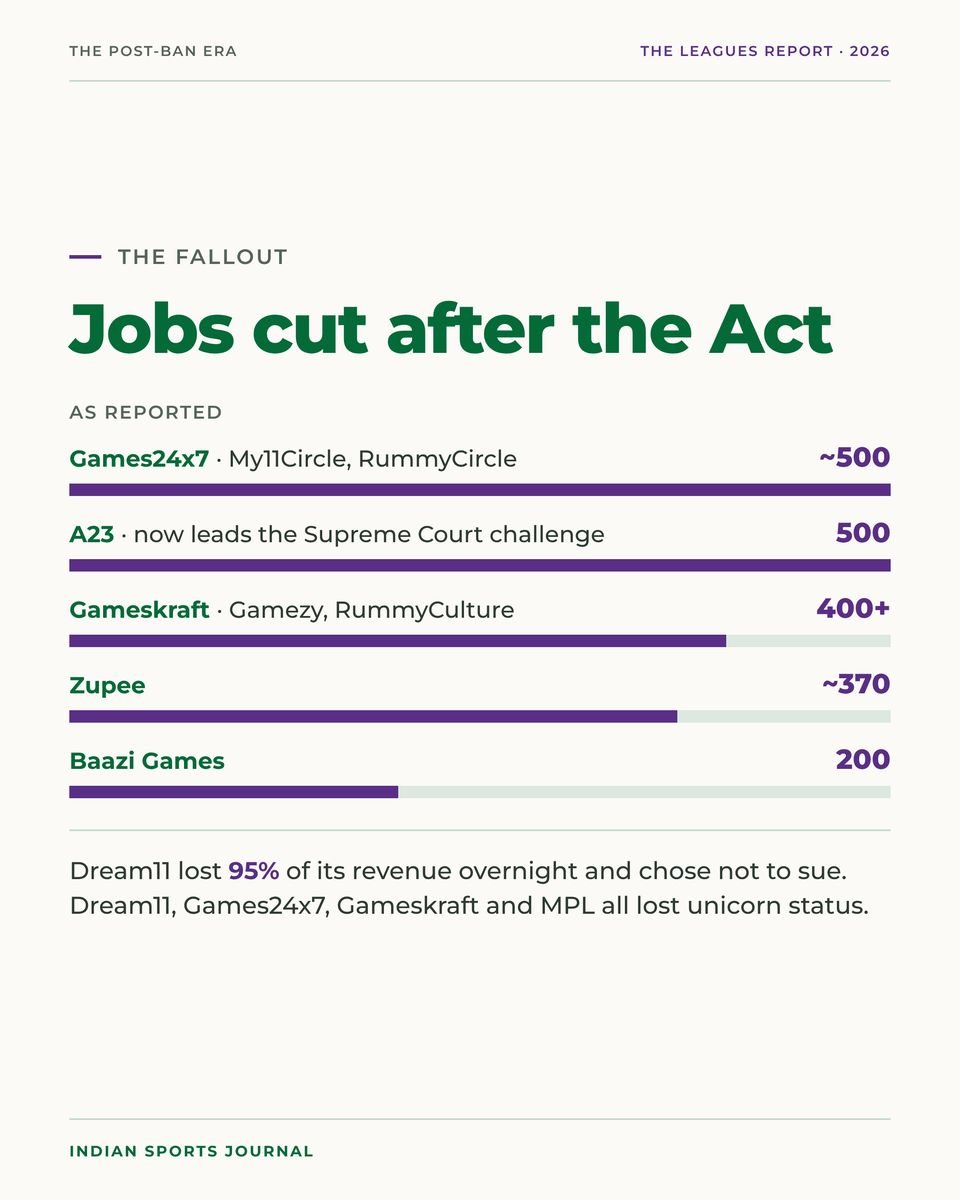
The companies did not wait for the law to take effect. Its rules were notified on 22 April 2026, and the Act and the rules came into force on 1 May. Dream11 said on 21 August, the day after the Lok Sabha vote, that it would shut its paid contests. About 95 per cent of its parent’s revenue had come from that model, The Week reported, and chief executive Harsh Jain said the company would not challenge the law in court. Dream Sports had reported revenue of ₹7,934 crore in 2023-24 and ₹6,759 crore in 2024-25, according to Entrackr’s reading of its filings.
The rest of the sector cut staff. A23’s parent, Head Digital Works, laid off about 500 people, Storyboard18 reported. Games24x7, which runs My11Circle and RummyCircle, cut between 400 and 500, depending on the report. Gameskraft cut 120 in September 2025; Indian Startup News put its cuts at more than 400 by November. Zupee cut 170, then about 200 more in January. Baazi Games, which runs PokerBaazi, cut about 200. In September the ASK Private Wealth Hurun India report removed Dream11, Games24x7, Gameskraft and MPL from its list of unicorns.
Head Digital Works brought the first legal challenge, in the Karnataka High Court. In September 2025 the Supreme Court took over the challenges pending in three high courts; the case is now before a bench led by Chief Justice Surya Kant. The Economic Times reported a final hearing listed for 6 and 7 October; ISJ could not confirm whether it went ahead. There is still no verdict.
The shirt and the ad hole
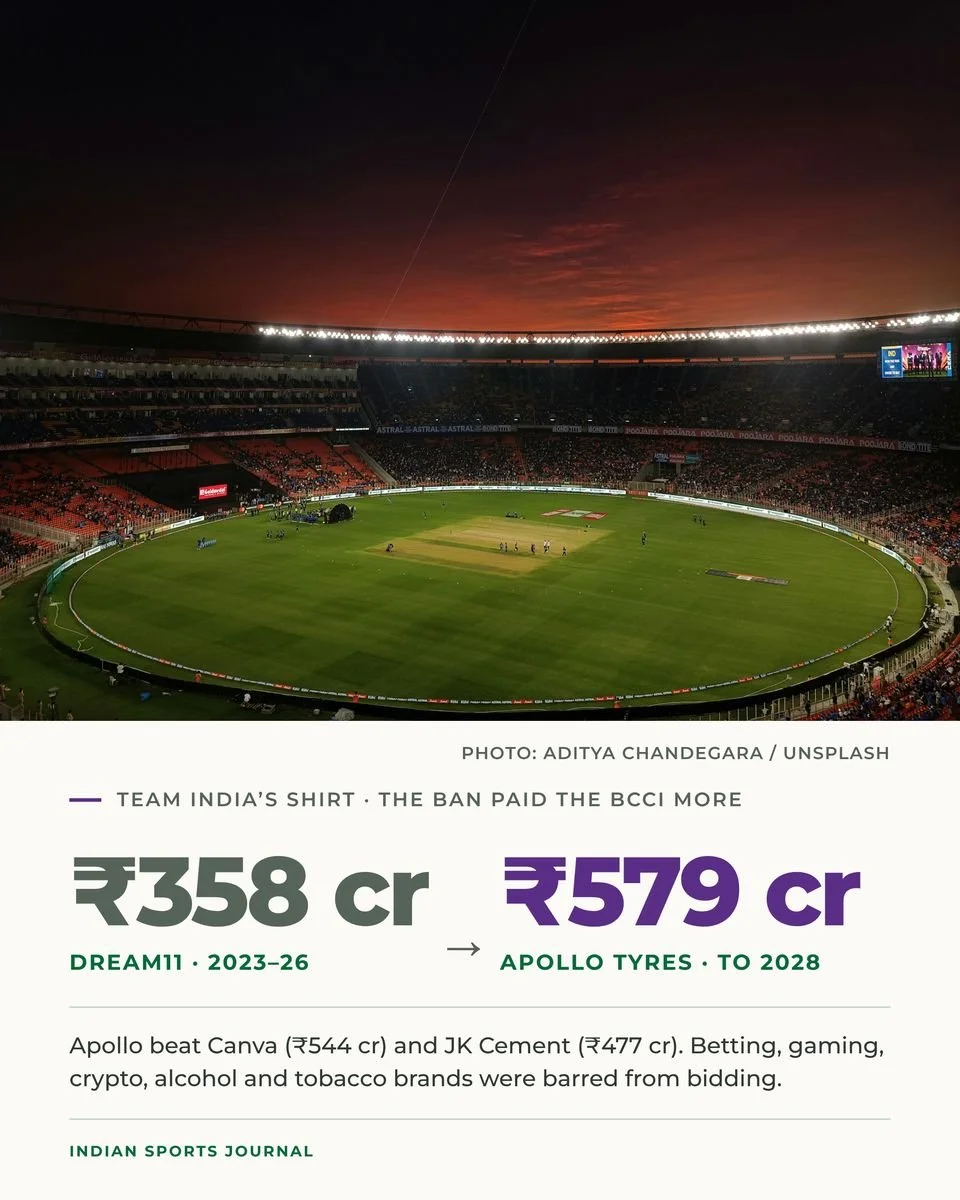
Dream11 had signed for the India shirt in July 2023, at ₹358 crore over three years. When the Act ended that deal, the BCCI tendered the rights again and barred real-money gaming, crypto, tobacco and alcohol brands from bidding. On 16 September 2025 Apollo Tyres won with ₹579 crore for the rights to March 2028, ahead of Canva at ₹544 crore and JK Cement at ₹477 crore. The ban cost the board its sponsor and won it a deal worth ₹221 crore more for the same shirt, over a shorter term.
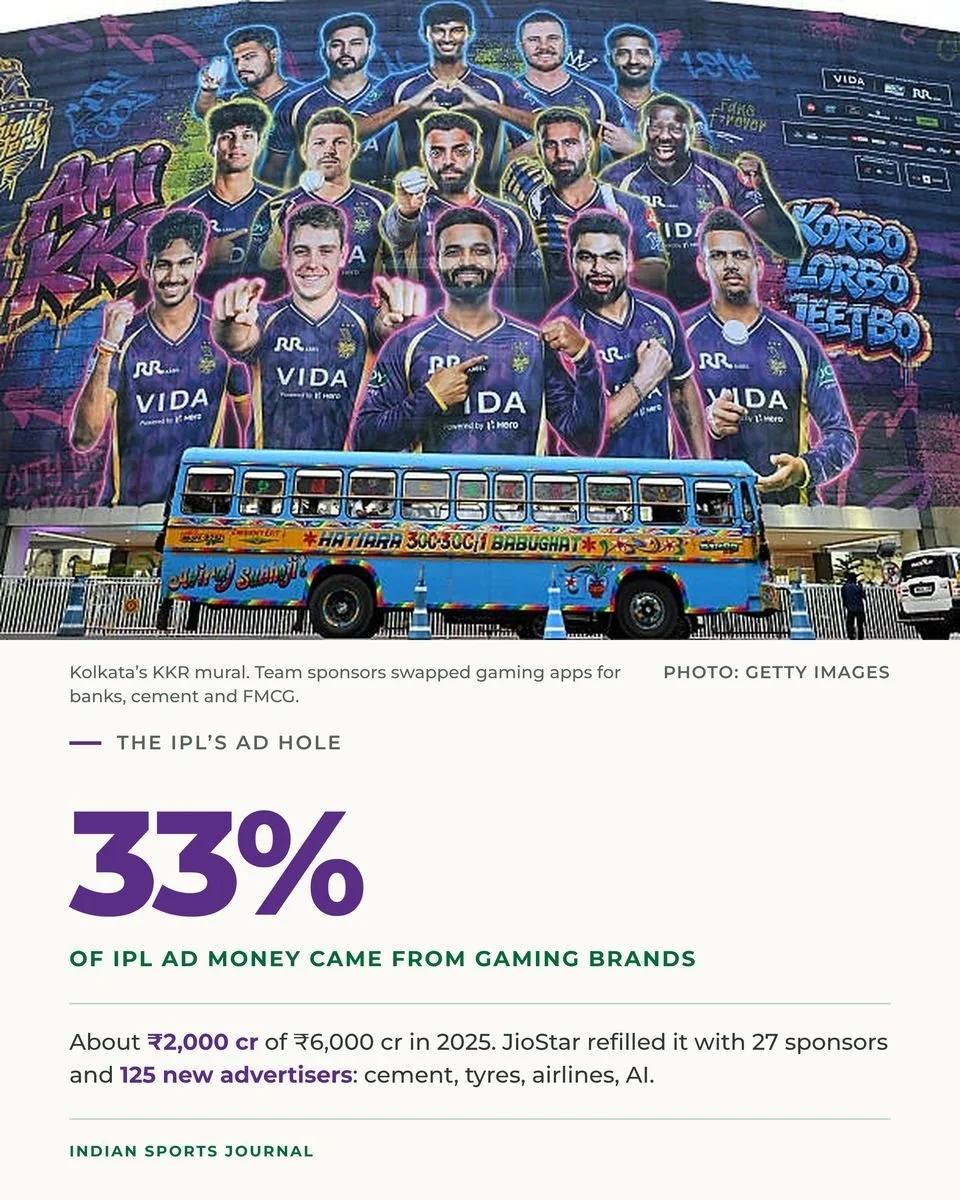
The IPL’s hole was bigger, and nobody outside JioStar knows its exact size. In August 2025 the estimates ran from about a quarter of IPL advertising, some ₹1,500 crore of ₹6,000 crore by Social Samosa’s figures, to 35-40 per cent, or ₹3,500-4,500 crore, according to Yasin Hamidani of Media Care Brand Solutions, speaking to Outlook Business. Manish Sharma of Arena Media later put gaming at 18-20 per cent at its peak. ISJ’s carousel used a third, about ₹2,000 crore. That sits inside the range, but it is an estimate, not a disclosed number.
What filled it is clearer. JioStar signed 27 sponsors for IPL 2026, led by Google’s AI Mode, with Birla Opus, Hero MotoCorp and Amazon below it and associate partners from MRF to Amul. Agencies told BestMediaInfo that mouth fresheners and biscuits had climbed the advertiser table and that aviation, banking and consumer tech were spending more. Estimates of what the 2026 season earned in advertising still diverge, from about ₹4,900 crore, “broadly stable” in projections BestMediaInfo cited, to more than ₹6,000 crore elsewhere. Houlihan Lokey puts the league’s total revenues for the year above US$1.8 billion.
Cricket’s 89 per cent
WPP Media’s numbers explain where the extra money went. India’s sports economy has nearly doubled in four years, from ₹9,530 crore in 2021. Media spending, at ₹9,571 crore, is now more than half of it. Sponsorship grew 7 per cent to ₹7,943 crore and endorsements 10.3 per cent to ₹1,350 crore.
Cricket took 95 per cent of the media money, 81 per cent of sponsorship and 87 per cent of endorsements. Its own revenue rose 17.9 per cent to ₹16,704 crore. WPP credits the WPL and India’s first women’s ODI World Cup, won in November 2025, with widening its commercial base, and describes the market as having absorbed the loss of gaming advertisers through traditional categories. The arithmetic says that absorption happened almost entirely inside one sport. Cricket added about ₹2,500 crore; everything else, by ISJ’s calculation from the report, lost about ₹300 crore.
The ownership rush
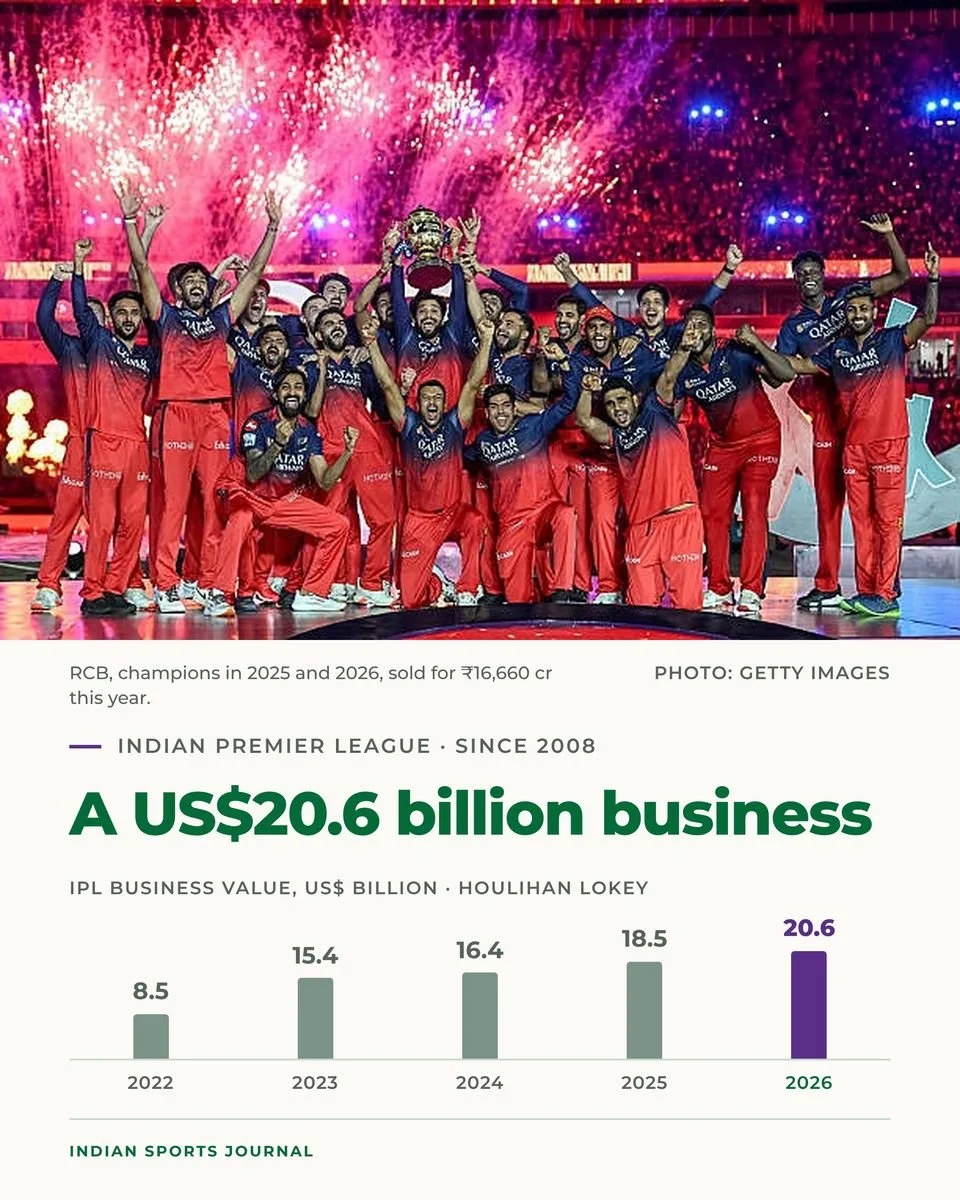
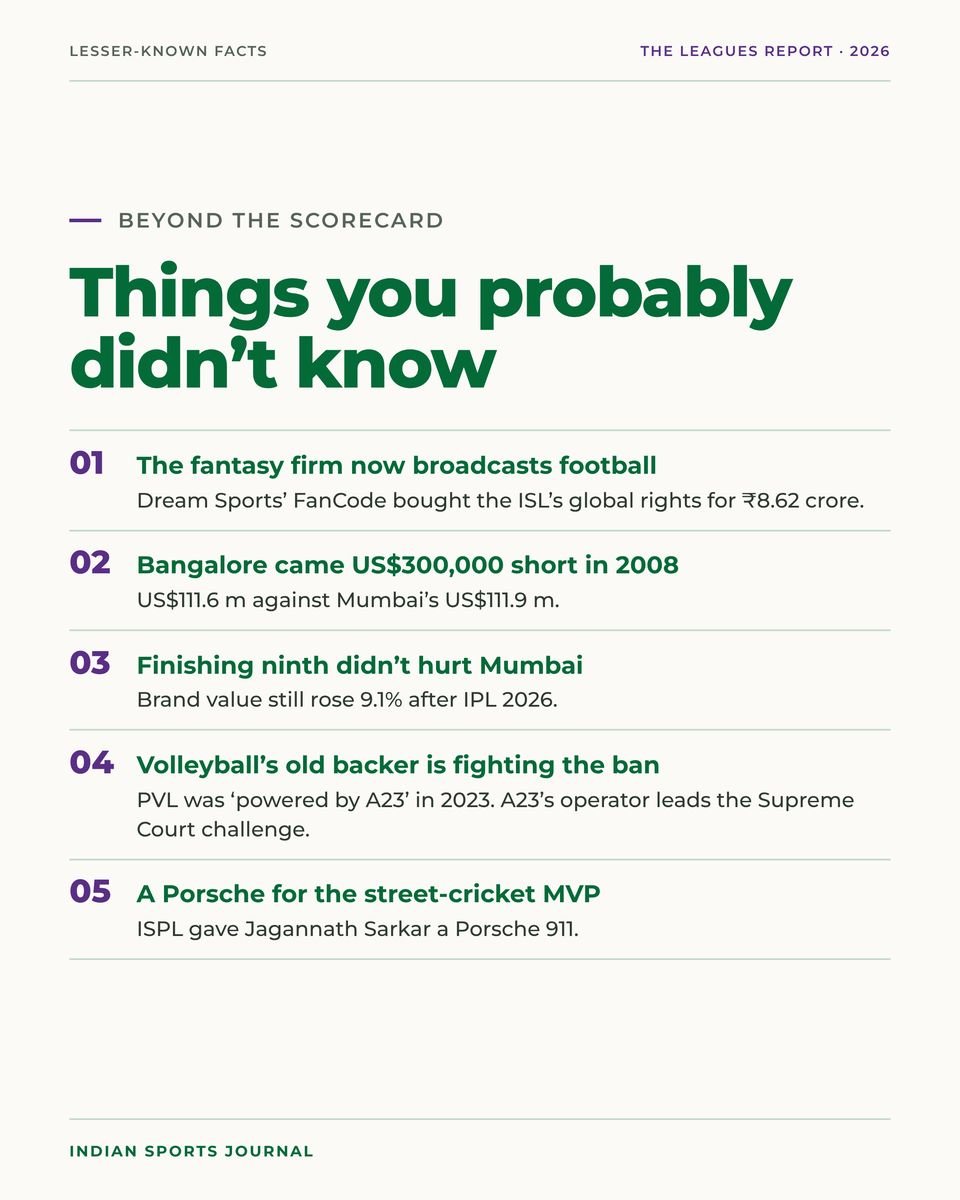
Houlihan Lokey’s valuation study, published on 29 July, put the IPL’s value as a business at US$20.6 billion and its brand at US$4.3 billion, both up by double digits for a second straight year. Royal Challengers Bengaluru, champions in 2025 and again in May, became the first franchise brand the bank has valued above US$300 million, at US$312 million. Mumbai Indians rose 9.1 per cent to US$264 million in a season they finished ninth, with four wins from 14 matches. “Cricket’s evolution into a globally owned, institutionally backed asset class has accelerated further in 2026,” said Harsh Talikoti, a director in the bank’s Financial and Valuation Advisory business.
Not every valuer agrees. D&P Advisory put the IPL at ₹76,100 crore in 2025, down from ₹92,500 crore two years earlier, and named the gaming ban among the causes; Brand Finance’s December estimate cut the league’s ecosystem value 20 per cent to US$9.6 billion. The methods differ. The sale prices are harder to argue with.
On 24 March United Spirits agreed to sell all of Royal Challengers Sports, the company that owns RCB’s IPL and WPL teams, to a consortium of the Aditya Birla Group, the Times of India Group, David Blitzer’s Bolt Ventures and Blackstone’s BXPE fund for ₹16,660 crore, all cash, about US$1.78 billion. In 2008 the same franchise went for US$111.6 million, US$300,000 short of Mumbai’s US$111.9 million. This year’s price is about 16 times that.
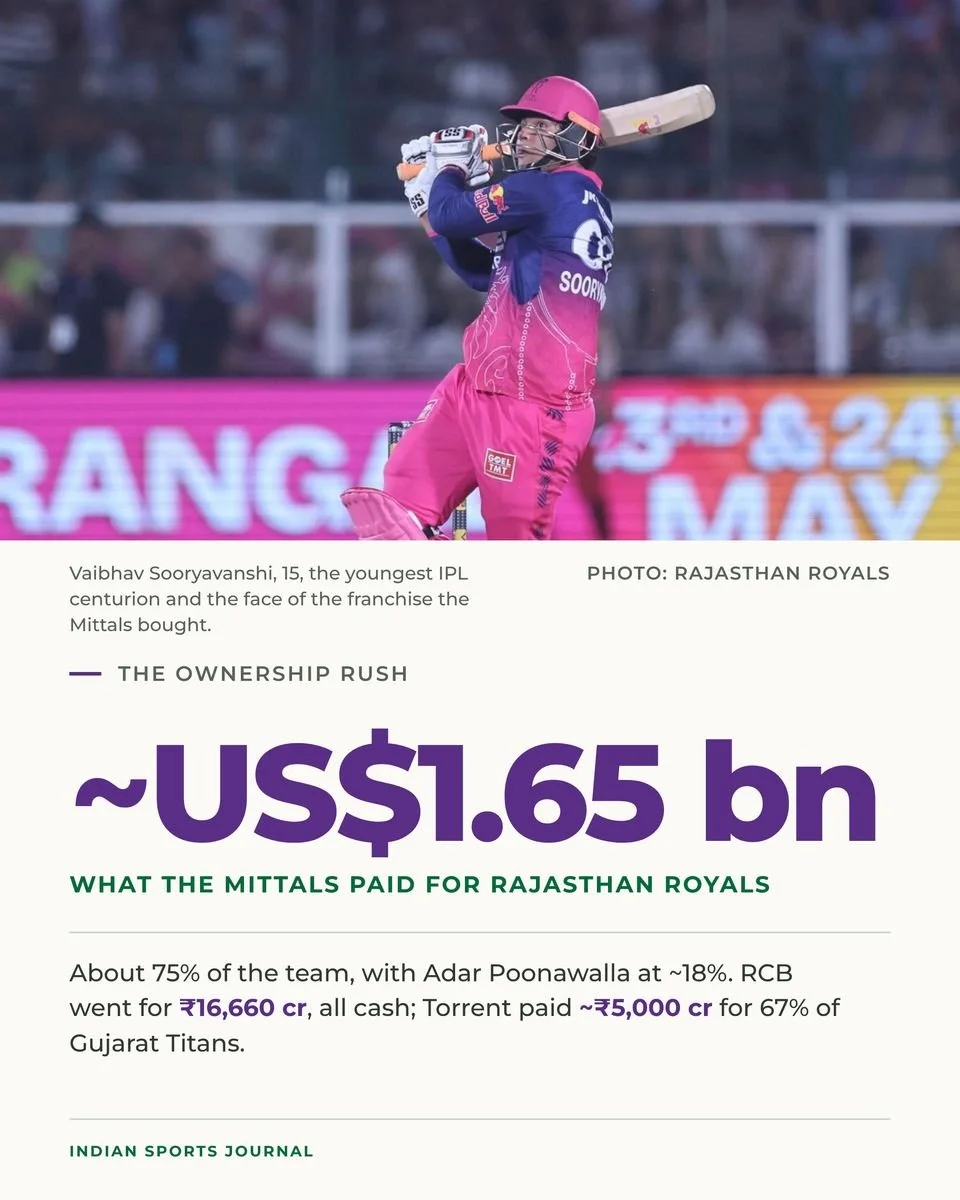
In May, after a bid led by Kal Somani fell through, the Lakshmi Mittal family agreed to buy about 75 per cent of Rajasthan Royals with Adar Poonawalla, who takes about 18 per cent; existing investors including Manoj Badale keep about 7 per cent. Business Today put the price at about US$1.65 billion, or ₹15,660 crore, for a package that includes the Paarl Royals and the Barbados Royals, with BCCI and competition approvals still to come. Before the Act, in 2025, Torrent had paid about ₹5,035 crore for 67 per cent of Gujarat Titans.
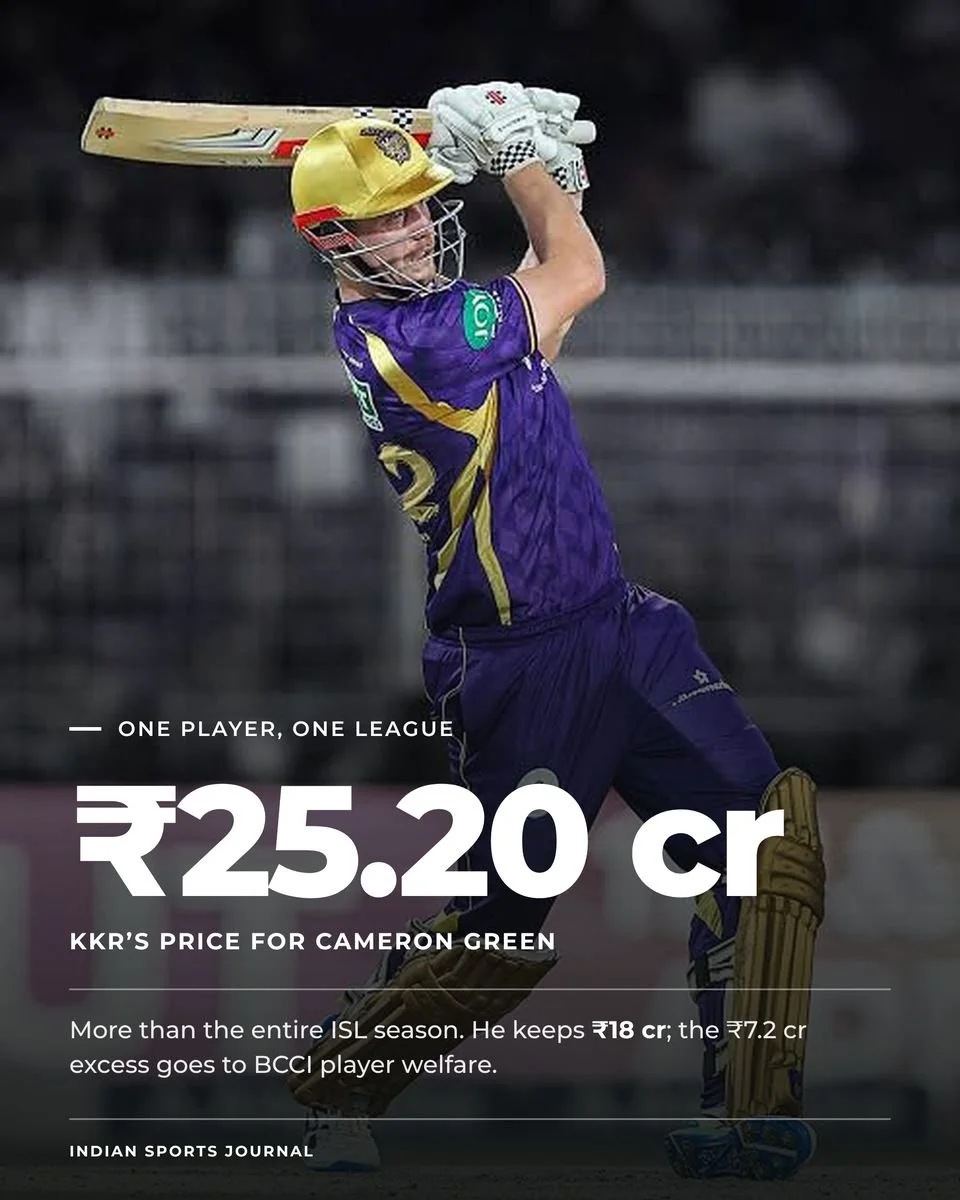
Player prices moved the same way. At the auction in December, Kolkata Knight Riders bid ₹25.20 crore for Cameron Green, the most ever paid for an overseas player. Under the IPL’s new ceiling he keeps ₹18 crore; the other ₹7.2 crore goes to the BCCI’s player-welfare fund.
The rest of the field
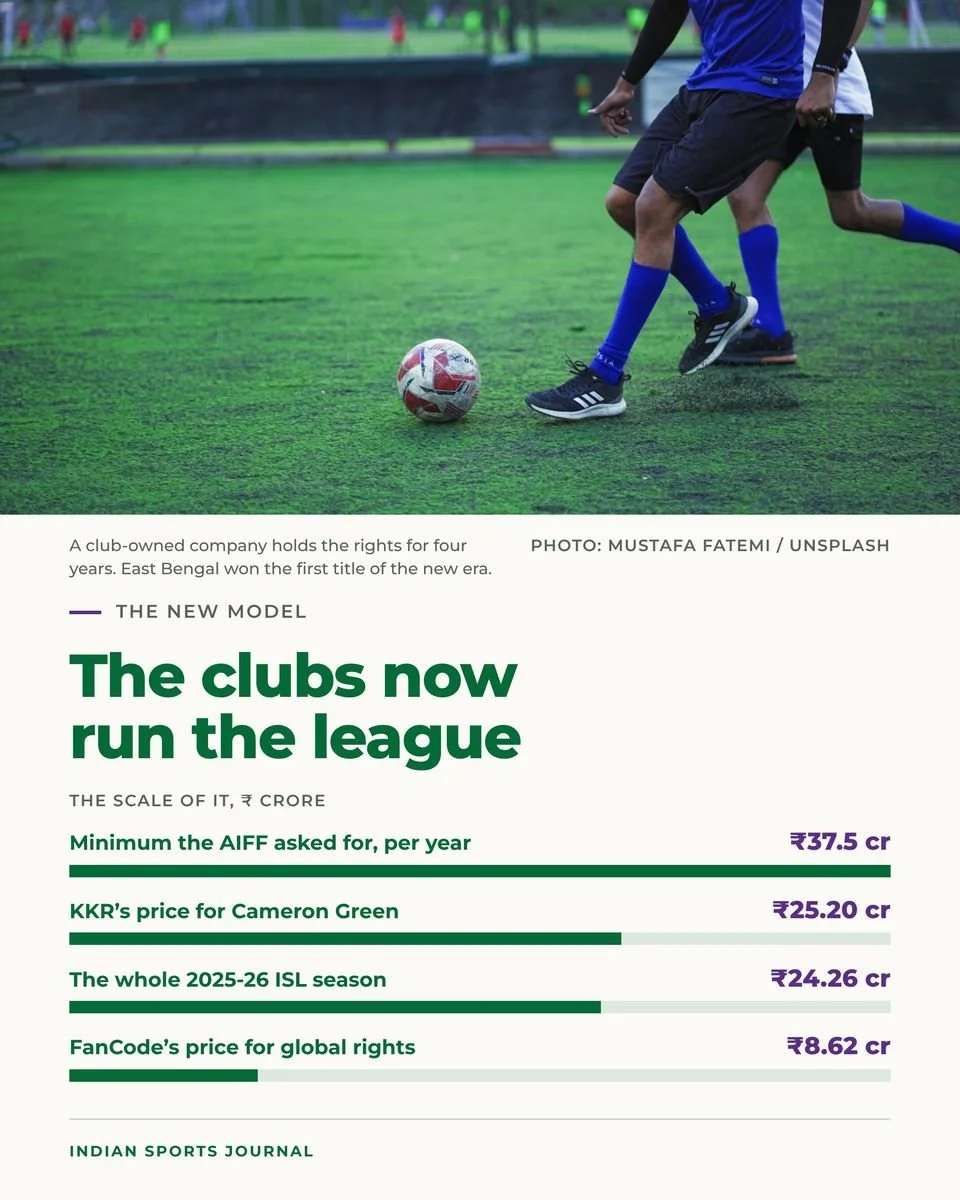
Indian football shows what the ban-era market offers a sport outside cricket. The AIFF’s 15-year contract with FSDL ran out in December 2025. Its tender for a replacement, seeking a minimum guarantee of ₹37.5 crore a year for 15 years, drew no bids in November. The 2025-26 season was saved in a single round of 91 matches that began on 14 February, on a budget of ₹24.26 crore, Khel Now reported. The AIFF said it would carry 40 per cent of that, only a quarter of which was guaranteed money; each club was asked for ₹1 crore. FanCode, the streaming arm of Dream Sports, took the global rights for ₹8.62 crore, BestMediaInfo reported, citing sources. The fantasy company that lost its paid contests to the Act now broadcasts the national football league, for about ₹9.5 lakh a match.
| Who | What | ₹ crore |
|---|---|---|
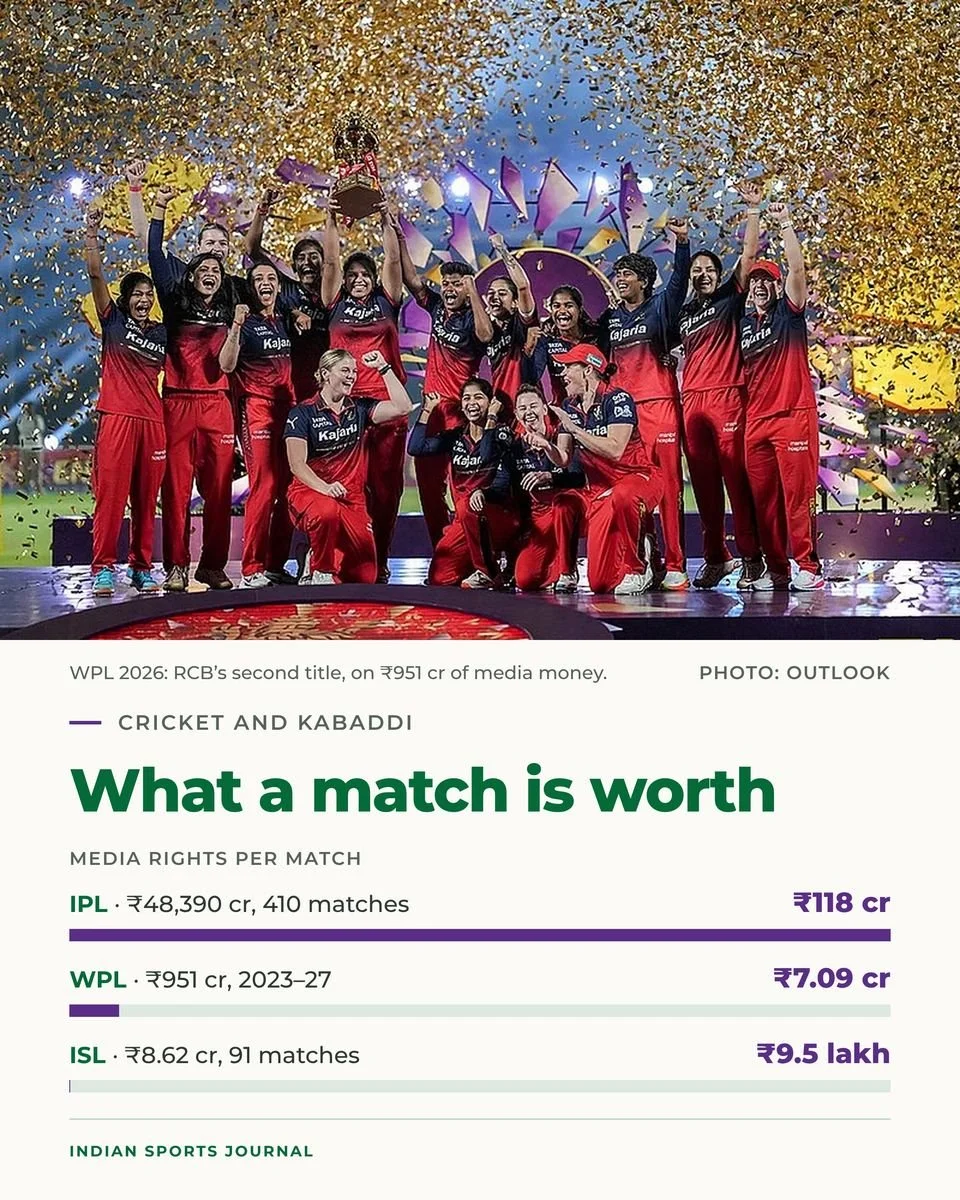
| IPL | Media rights, per match₹48,390 crore for 410 matches, 2023–27 | 118 |
| AIFF | Minimum a year it sought for ISL rights15-year tender, November 2025: no bids | 37.5 |
| KKR | Auction price for Cameron GreenHe keeps ₹18 crore; ₹7.2 crore to BCCI player welfare | 25.20 |
| ISL | The whole 2025-26 season, as budgetedAIFF plan; clubs asked for ₹1 crore each | 24.26 |
| FanCode | Global rights to that season, as reportedTV and digital, 91 matches | 8.62 |
| WPL | Media rights, per match₹951 crore, 2023–27 | 7.09 |
| ISL | Rights, per match₹8.62 crore over 91 matches: about ₹9.5 lakh | 0.095 |
East Bengal won that season, their first ISL title. In July the clubs and the AIFF agreed a four-year deal under which a company controlled by the clubs runs the league’s commercial side, pays the federation ₹1.1 crore a club for 2026-27 and gives it 10 per cent of net profits. Jamshedpur FC chose to leave rather than pay. The 2026-27 season kicked off this month with Sony Sports Network on television and every match free on YouTube. No rights fee has been disclosed.
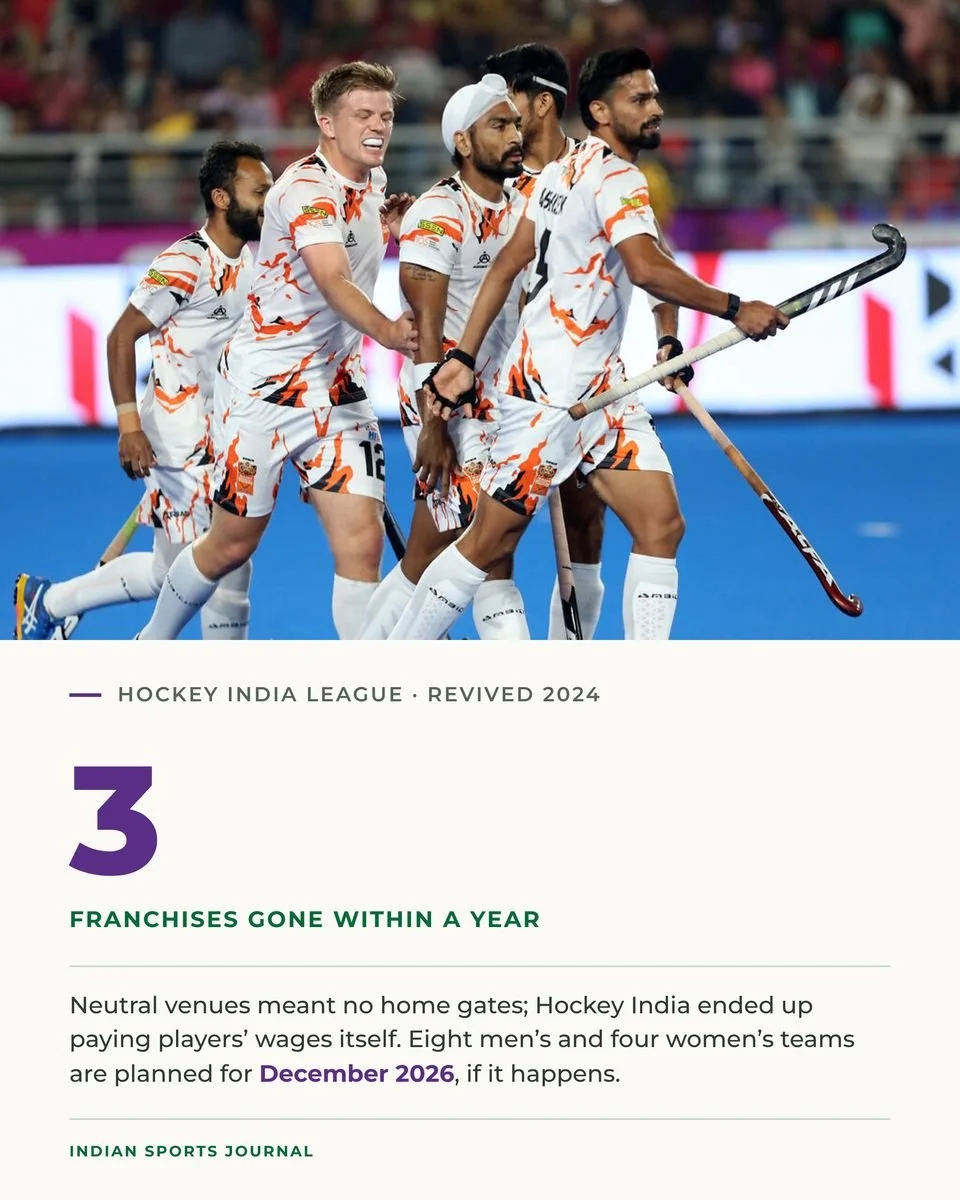
Hockey’s revival hit the same wall. The Hockey India League returned in December 2024 after seven years away, played at neutral venues in Rourkela and Ranchi, so franchises had no home gates or local sponsors. Within a year three teams had gone: Team Gonasika and the women’s Odisha Warriors in August 2025, UP Rudras in September. Some women’s players said they had been paid only 20 per cent of what they were owed a month after their league ended, ThePrint reported. “If we have to sustain the league in the long run, we need to reduce the expenses of the franchises,” Dilip Tirkey, Hockey India’s president, told the paper. The league’s governing council took over UP Rudras’ place and ran a team itself in the 2025-26 season.
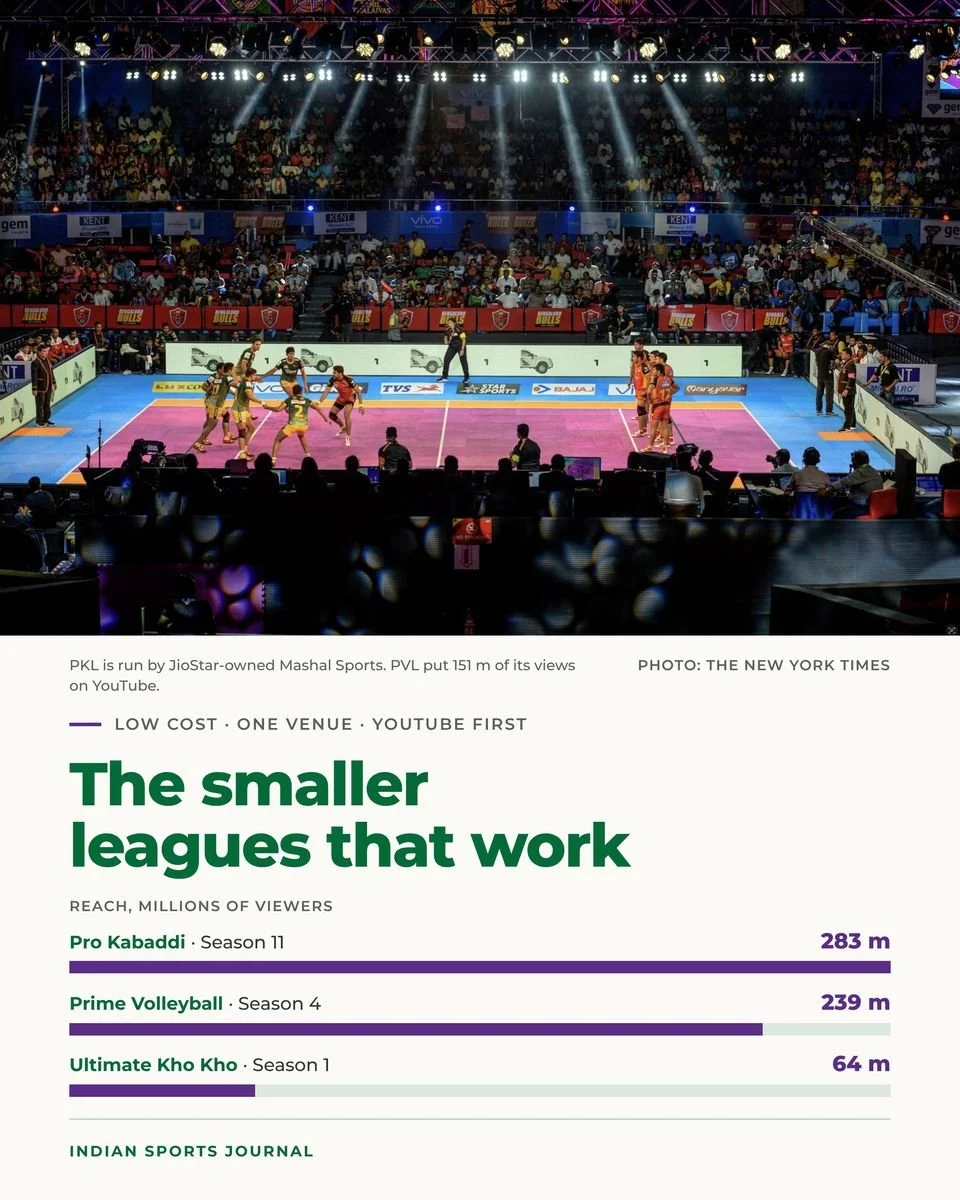
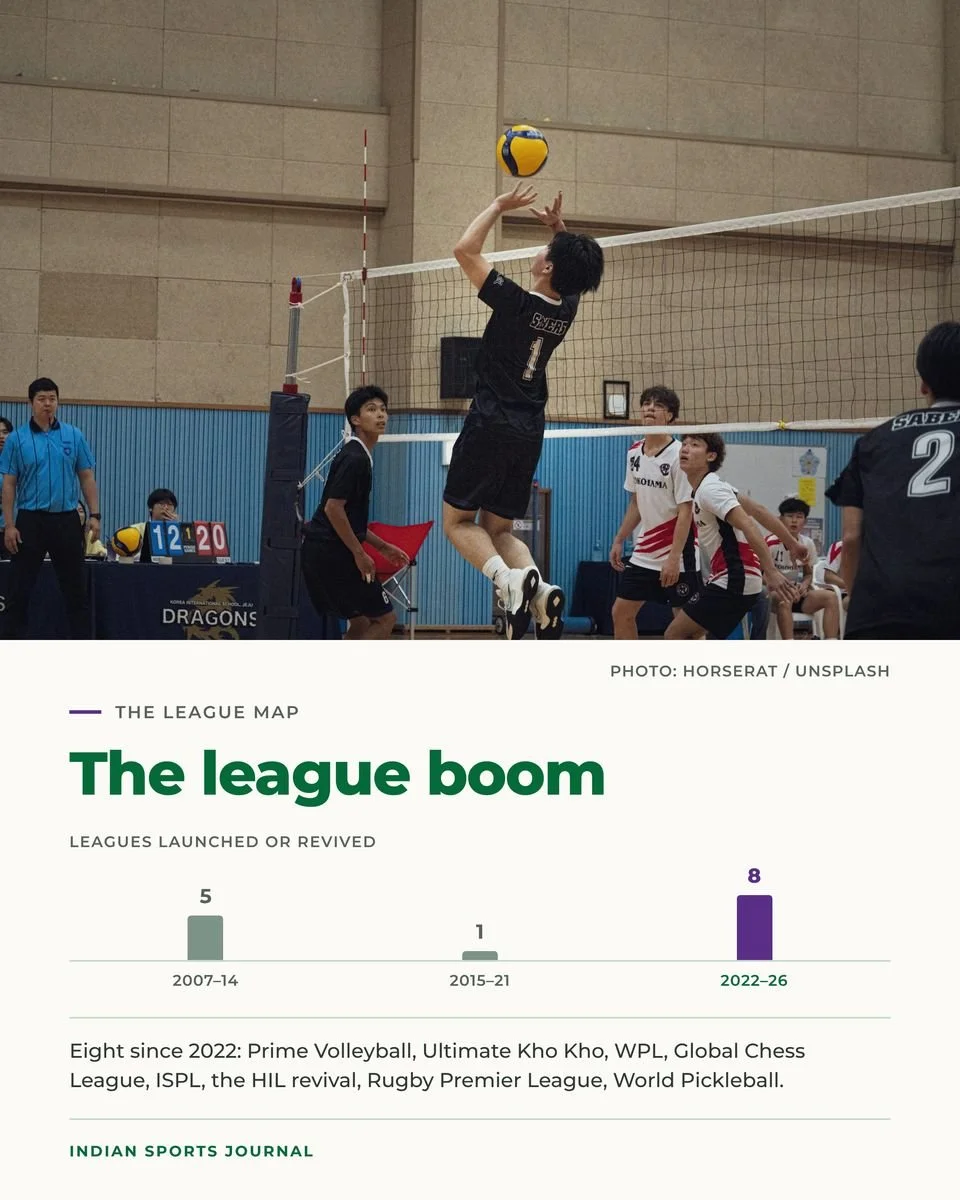
The smaller leagues that are holding up are built small: one venue, a free stream. Prime Volleyball’s fourth season, played in one city, Hyderabad, in October 2025, reported 239 million views, 151 million of them on YouTube, by its own count. It was “powered by A23” in 2023, a sponsor now caught by the Act. Ultimate Kho Kho drew 64 million viewers in its first season in 2022, 41 million of them in India. The Pro Kabaddi League belongs to Mashal Sports, owned by JioStar. The Indian Street Premier League, a tennis-ball T10, gave the most valuable player of its third season, Jagannath Sarkar of Chennai Singams, a Porsche 911 in February. India has added eight leagues since 2022: Prime Volleyball, Ultimate Kho Kho, the WPL, the Global Chess League, the ISPL, the revived HIL, the Rugby Premier League and the World Pickleball League.
Who holds the money
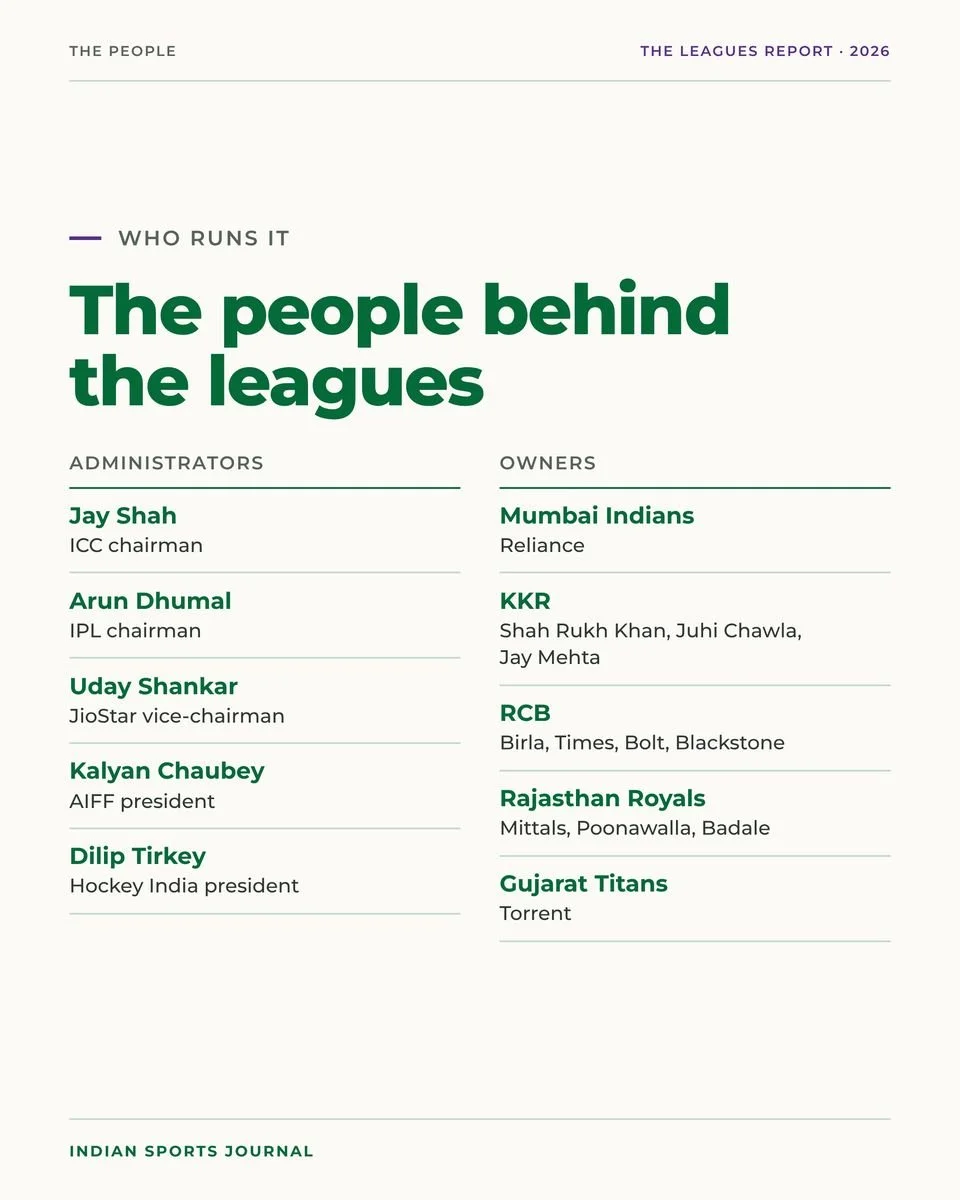
The people who decide where Indian sport’s money goes are few. Jay Shah, the BCCI’s former secretary, chairs the ICC. Arun Dhumal chairs the IPL. Uday Shankar is vice-chairman of JioStar, which broadcasts the IPL and owns the Pro Kabaddi League’s operator. Kalyan Chaubey runs the AIFF and Dilip Tirkey Hockey India. Reliance owns Mumbai Indians and controls JioStar, its joint venture with Disney. Shah Rukh Khan, Juhi Chawla and Jay Mehta own KKR; Birla, Times, Bolt and Blackstone have agreed to buy RCB; the Mittals, Poonawalla and Badale are taking Rajasthan; Torrent controls Gujarat.
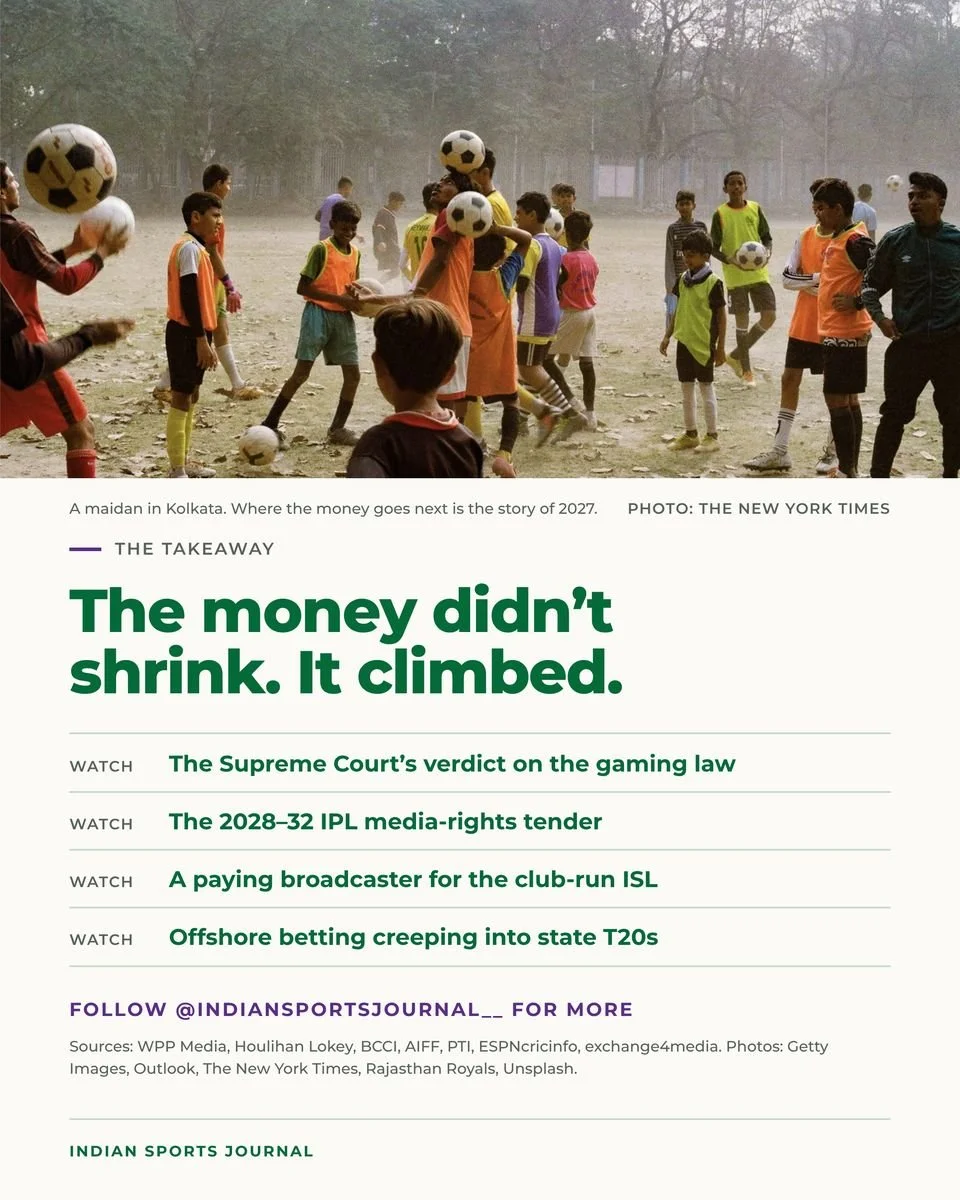
Four questions will decide whether the money stays where it is. The Supreme Court has still to rule on the Act. The IPL’s media rights for 2028-32 will be sold before the current cycle ends in 2027, against a 2026 season in which Houlihan Lokey counted linear TV ratings down 18.8 per cent and connected-TV reach up 26 per cent. The club-run ISL needs a broadcaster that pays. And the state T20 leagues are exposed to offshore betting: Tamil Nadu’s government has already gone after surrogate advertising by offshore betting platforms during the TNPL, Storyboard18 reported.
The gaming money left. The sport’s money climbed past it. The next rights cycle will show whether any of it ever reaches the leagues below.
Sourcing. The Act: Deccan Herald (assent, 22 August 2025), SCC Online (penalties), Wikipedia and MediaNama (rules notified 22 April 2026; Supreme Court listings), Supreme Court Observer, Telangana Today (5 August 2026 hearing). Gaming fallout: Business Today (21 August 2025), The Week (26 August 2025), Storyboard18 (Harsh Jain; A23 and Games24x7 layoffs), Inc42, Outlook Business, Indian Startup News (Gameskraft, 10 November 2025), YourStory (Zupee, January 2026), Business Standard (Hurun unicorn list, 11 September 2025), Entrackr (Dream Sports filings, 9 February 2026). Shirt: PTI via Outlook (16 September 2025). IPL advertising: Social Samosa (26 August 2025), Outlook Business (23 August 2025), BestMediaInfo, Storyboard18 (27 sponsors, 30 March 2026). Economy: WPP Media, Sporting Nation 2026, via Outlook and Storyboard18 (24 March 2026); GroupM ESP for 2022 and 2023. Valuations and sales: Houlihan Lokey IPL Valuation Study 2026 (29 July 2026) and its 2023–25 releases via Storyboard18; D&P Advisory via exchange4media; Brand Finance (December 2025); PTI via ThePrint (RCB, 24 March 2026); Business Today (RR, 3 May 2026); CricTracker and Bar & Bench (Gujarat Titans); Herald Goa and Gulf News (Mumbai’s season); ESPNcricinfo and Business Today (Green). Football: Onmanorama (tender, 8 November 2025), Khel Now (₹24.26 crore budget), BestMediaInfo (FanCode), Latestly and the AIFF (club-led model, 8 July 2026), Khel Now and myKhel (2026-27 broadcast); ISJ’s Jamshedpur FC reporting (August 2026). Hockey: ThePrint (23 September 2025), Wikipedia (2025-26 HIL), IANS (May 2026). Other leagues: PVL press release via The Tribune/ANI (13 January 2026), Wikipedia citing Mint (Ultimate Kho Kho), ThePrint (ISPL). The non-cricket decline and the per-match ISL figure are ISJ’s arithmetic.
Corrections to the carousel. Slide 4: “Dream11 lost 95% of its revenue overnight” — 95 per cent is the share of revenue its paid model provided (The Week), not a reported fall; “A23 · now leads the Supreme Court challenge” — see the lead-petitioner flag below; both noted in the caption. Slide 6: “33% of IPL ad money … about ₹2,000 cr of ₹6,000 cr in 2025” — not traced to a named source; published estimates run from 18–20% (Arena Media, via BestMediaInfo) through 25%, about ₹1,500 crore of ₹6,000 crore (Social Samosa), to 35–40%, ₹3,500–4,500 crore (Media Care, via Outlook Business); the article gives the range. Slide 6: “125 new advertisers” — not traced to a published source; ISJ’s June 2026 IPL research report gives the figure without a citation; left out. Slide 7: the three pairs of bars share one scale across different units (₹ crore, US$ billion, ₹ crore), so the IPL bars barely show; Dream Sports’ ₹7,934 crore is 2023-24 revenue (2024-25: ₹6,759 crore, per Entrackr); “−95%” is the share of revenue Dream11’s paid model provided, per The Week, not a reported fall. Slide 10: kicker reads “Cricket and kabaddi”, but the chart shows the IPL, the WPL and the ISL (football); no kabaddi figure appears. Slide 12: “East Bengal won the first title of the new era” — East Bengal won the 2025-26 season, which the AIFF ran before the club-led model began in 2026-27. Slide 13: “Hockey India ended up paying players’ wages itself” — reported: the HIL Governing Council took over UP Rudras’ place and fielded its own team (IANS, Outlook); no report found that Hockey India paid all players. Slide 13: “December 2026” — Hockey India said in May 2026 the next edition starts in January 2027 (IANS); eight men’s and four women’s teams was the 2025-26 lineup. Slide 14: labelled “reach, millions of viewers” — PVL’s 239 million is cumulative views (88.2 million live TV plus 151 million YouTube), self-reported; Ultimate Kho Kho’s 64 million is Season 1, 2022; Pro Kabaddi Season 11’s 283 million was not found in any published source and is left out. Slide 15: the 2007–14 (5) and 2015–21 (1) counts rest on an unstated definition; the 2015–21 bar leaves out leagues such as the Pro Wrestling League (2015) and Ultimate Table Tennis (2017). The eight launches since 2022 check out. Slide 16: “The IPL alone is an estimated 45–55% of the whole” — not found in WPP Media’s report coverage or elsewhere; left out.
Flag. Commencement: slide 3 dates the ban to assent. The government said in 2025 that the ban would take effect on 1 October 2025, but the Act was still unnotified in January 2026 (Storyboard18); gazette notifications of 22 April 2026 brought the Act and its rules into force on 1 May 2026 (MediaNama, Mondaq, Business Standard), as ISJ’s The Fold also records. The article dates the law’s effect to 1 May 2026; the industry shut its paid games in August 2025. The Supreme Court: ET (via MediaNama) reported a final hearing listed for 6–7 October 2026; what happened on those dates could not be confirmed. Lead petitioner: slide 18 says A23’s operator leads the challenge; Head Digital Works filed the first case and Supreme Court Observer captions the batch Head Digital Works v Union of India, but Telangana Today names Dr K A Paul as lead petitioner. IPL valuation: Houlihan Lokey (US$20.6 billion, rising) against D&P Advisory (₹76,100 crore for 2025, falling) and Brand Finance (US$9.6 billion, −20%) — different methods, all shown. IPL 2026 advertising income: about ₹4,900 crore in projections cited by BestMediaInfo against more than ₹6,000 crore in other estimates. Games24x7 layoffs: 400 (Storyboard18) to 500 (Inc42); Gameskraft’s 400-plus may include the September 120 (Indian Startup News does not say). FanCode’s ₹8.62 crore is reported from sources, not confirmed by the AIFF; the ₹24.26 crore is a budget, not audited spending. Rajasthan Royals: the deal was agreed in May with closing expected in the third quarter of 2026 (Business Today); ISJ could not confirm completion. RCB: the sale was agreed on 24 March subject to BCCI and Competition Commission approval (ISJ’s June 2026 IPL research, citing Business Standard, which gave about ₹16,600 crore); ISJ found no report of completion, so the copy says agreed. PVL’s figures come from a paid press release. Outlook’s report says the Apollo deal runs two and a half years in one place and three in another; the end date, March 2028, is consistent.
Photographs. As printed on the slides: slide 2, Chennai Super Kings; slide 3, Ngasepam Leeder Bose / Unsplash; slide 5, Aditya Chandegara / Unsplash; slide 6, Getty Images; slide 7, Outlook; slide 8, Getty Images; slide 9, Rajasthan Royals; slide 10, Outlook; slide 11, Outlook; slide 12, Mustafa Fatemi / Unsplash; slide 14, The New York Times; slide 15, HorseRat / Unsplash; slide 20, The New York Times. Slides 1, 13 and 19 carry photographs with no printed credit. Slide 20’s photo line omits Chennai Super Kings (slide 2).