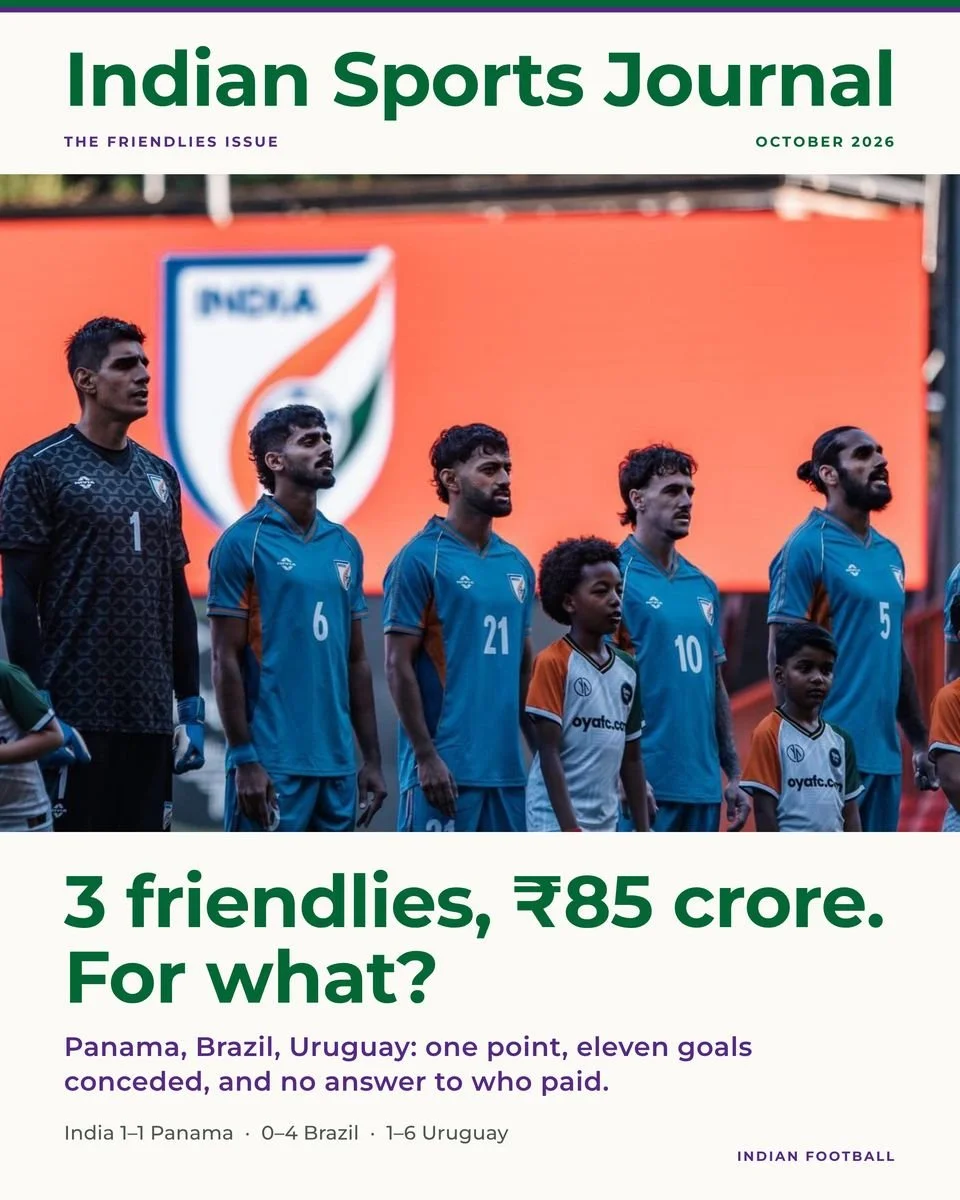
Three Friendlies, ₹85 Crore. For What?
In twelve days India played three teams from this summer’s World Cup, took one point, scored twice and conceded eleven times. The reported bill runs to ₹80–90 crore. The federation has not said what it was, or whose money paid it.
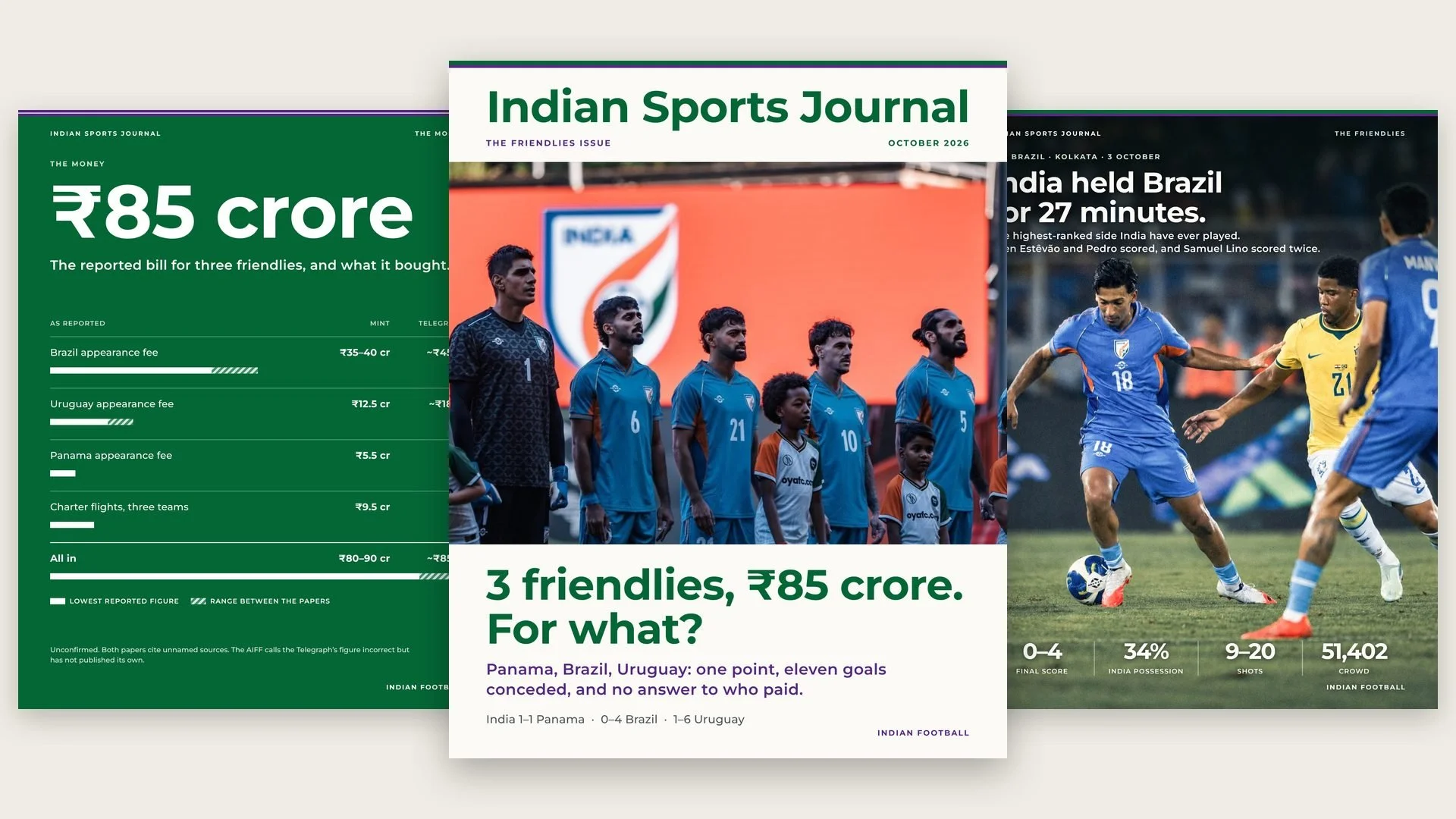
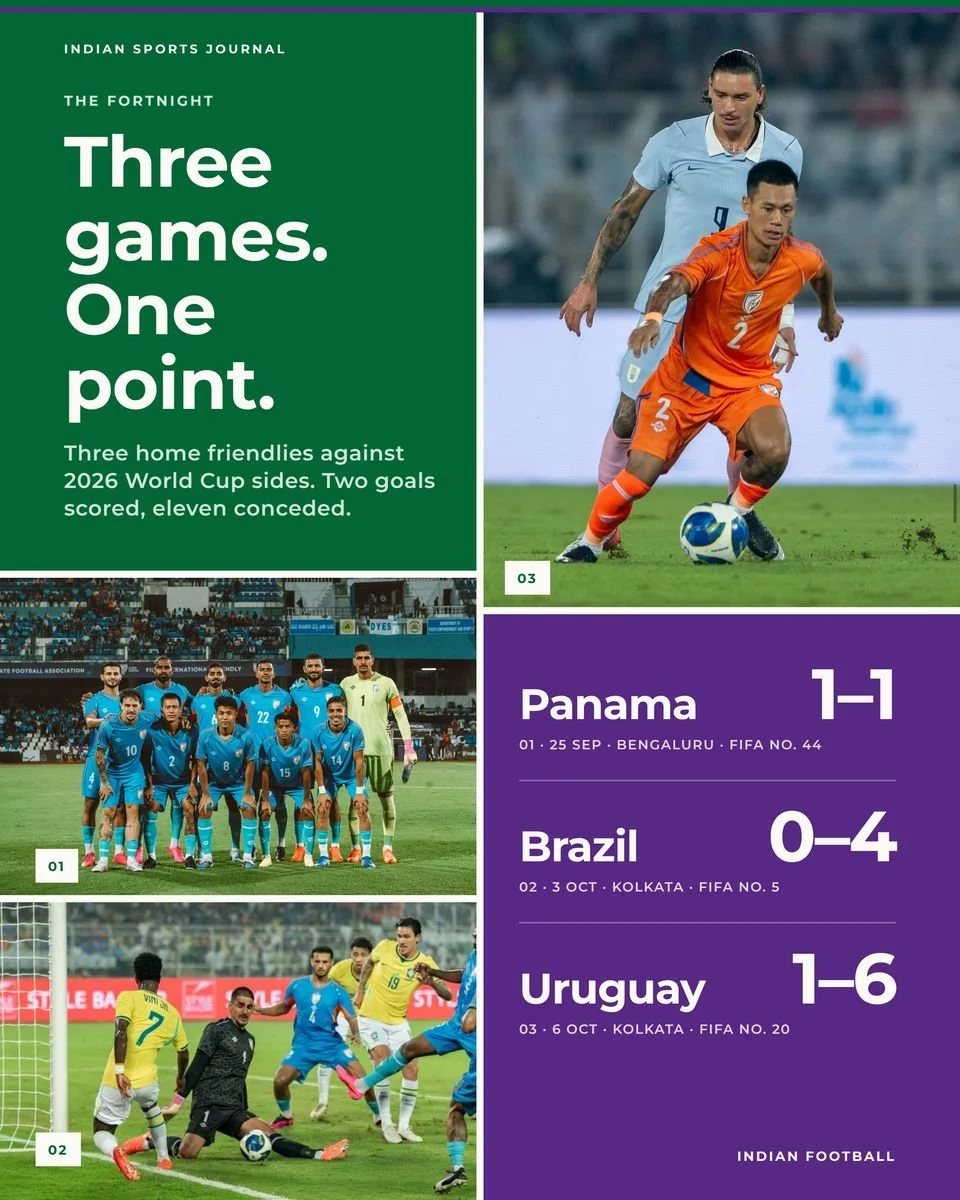
The Indian Super League starts again tonight, four days after Uruguay scored six goals at Salt Lake Stadium. Between 25 September and 6 October, India played three teams that had been at the World Cup in June and July: Panama in Bengaluru, then Brazil and Uruguay in Kolkata. They drew one, lost two, scored two goals and conceded eleven.
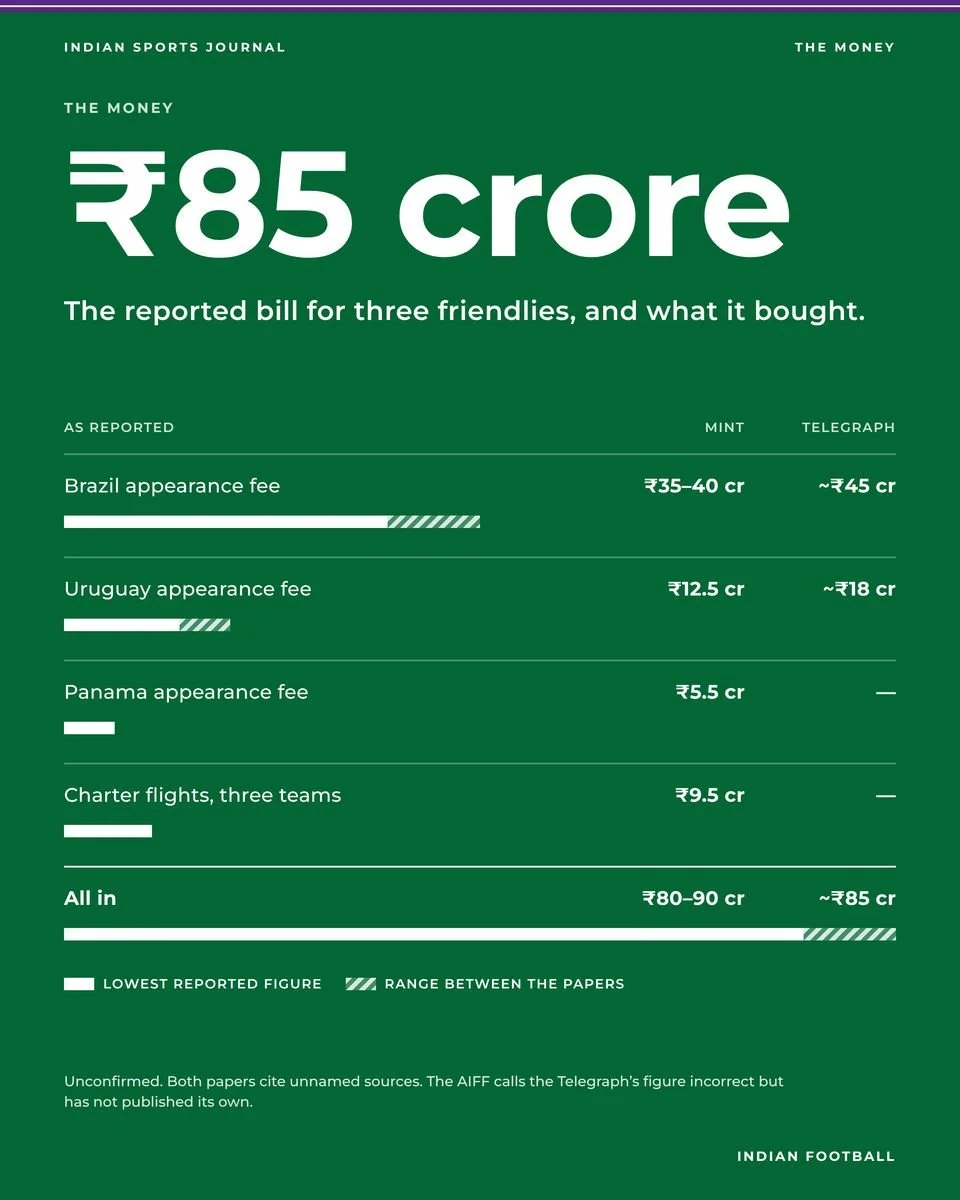
None of the three visitors came cheap, and the All India Football Federation has published no figure for what they cost. Mint, citing a federation source, put Brazil’s appearance fee alone at ₹35–40 crore, and the reports that carried its figures put the whole window at ₹80–90 crore. ISJ’s ₹85 crore is the middle of that range. This week’s issue of The Week puts the conservative total at ₹70 crore and the high estimates at ₹90 crore.
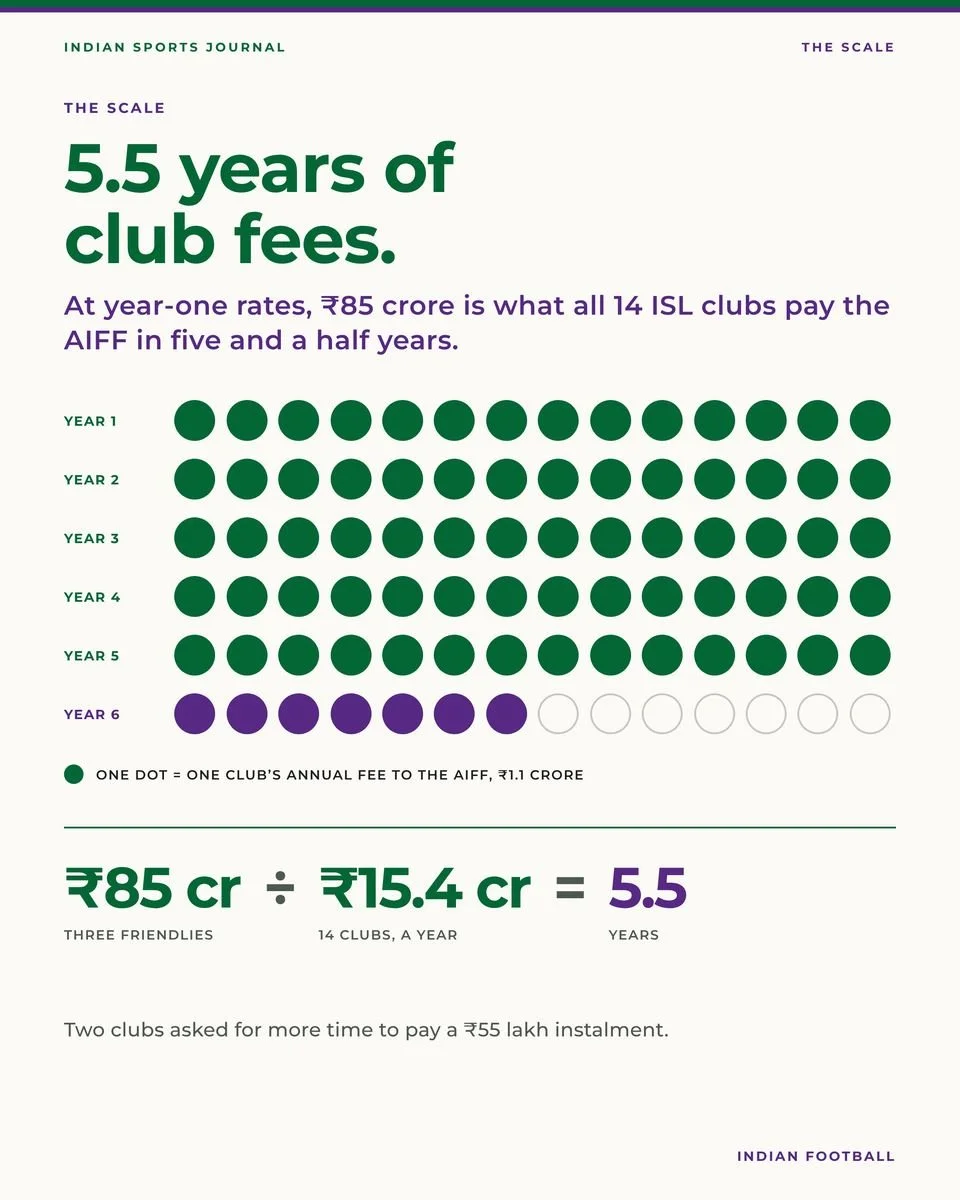
The number matters because of what sits next to it. At ₹85 crore, the three matches cost almost six years of the participation fees the 13 ISL clubs now pay the federation. That is about as much as the AIFF’s total booked expenditure up to 28 February this year, ₹85.47 crore by its own figures. They were arranged in the months after the national league nearly stopped, and India pulled out of a FIFA tournament to fit one of them in. The crowds they were meant to bring arrived late, cheaply or for free. And the federation that signed the contracts goes to elections on 20 December.
Three nights
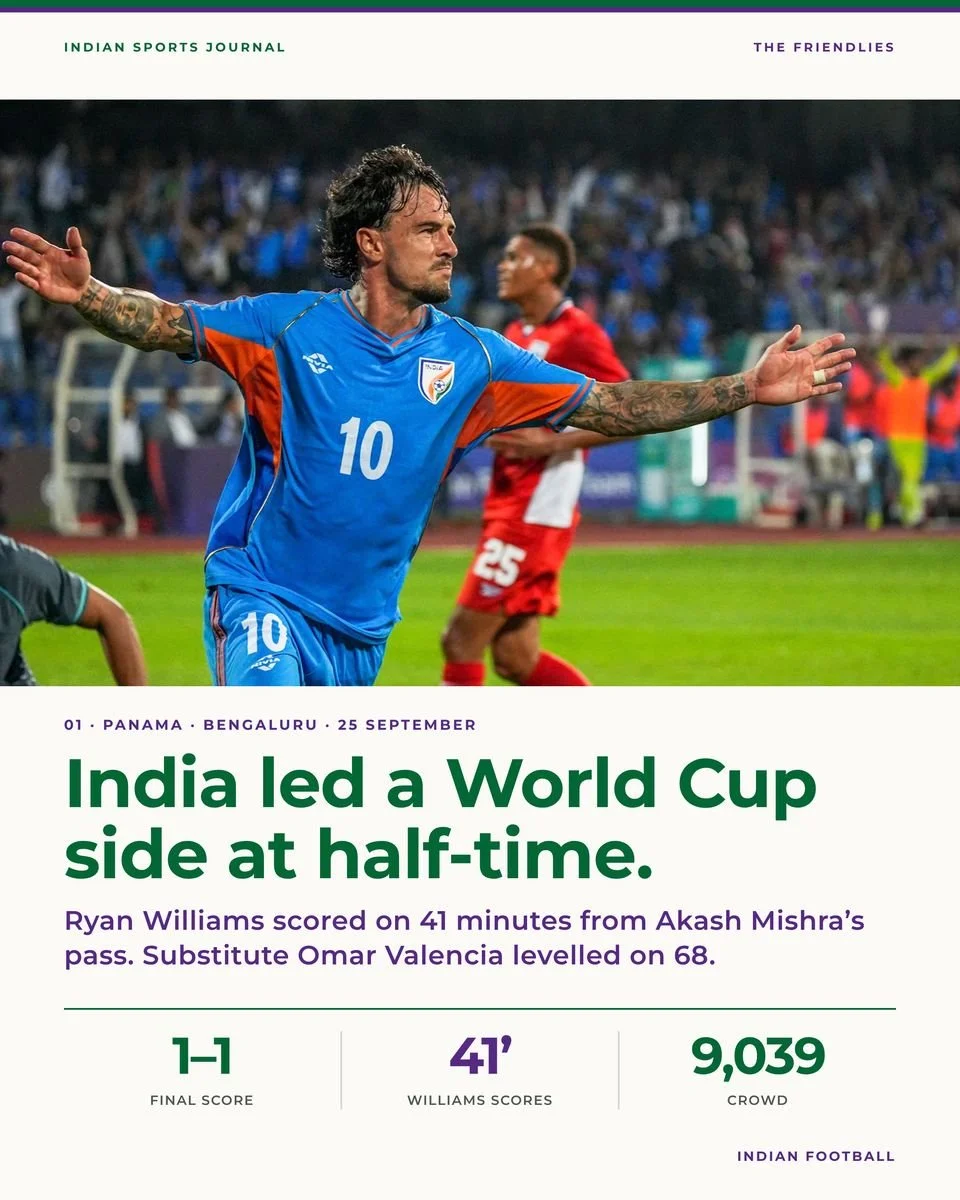
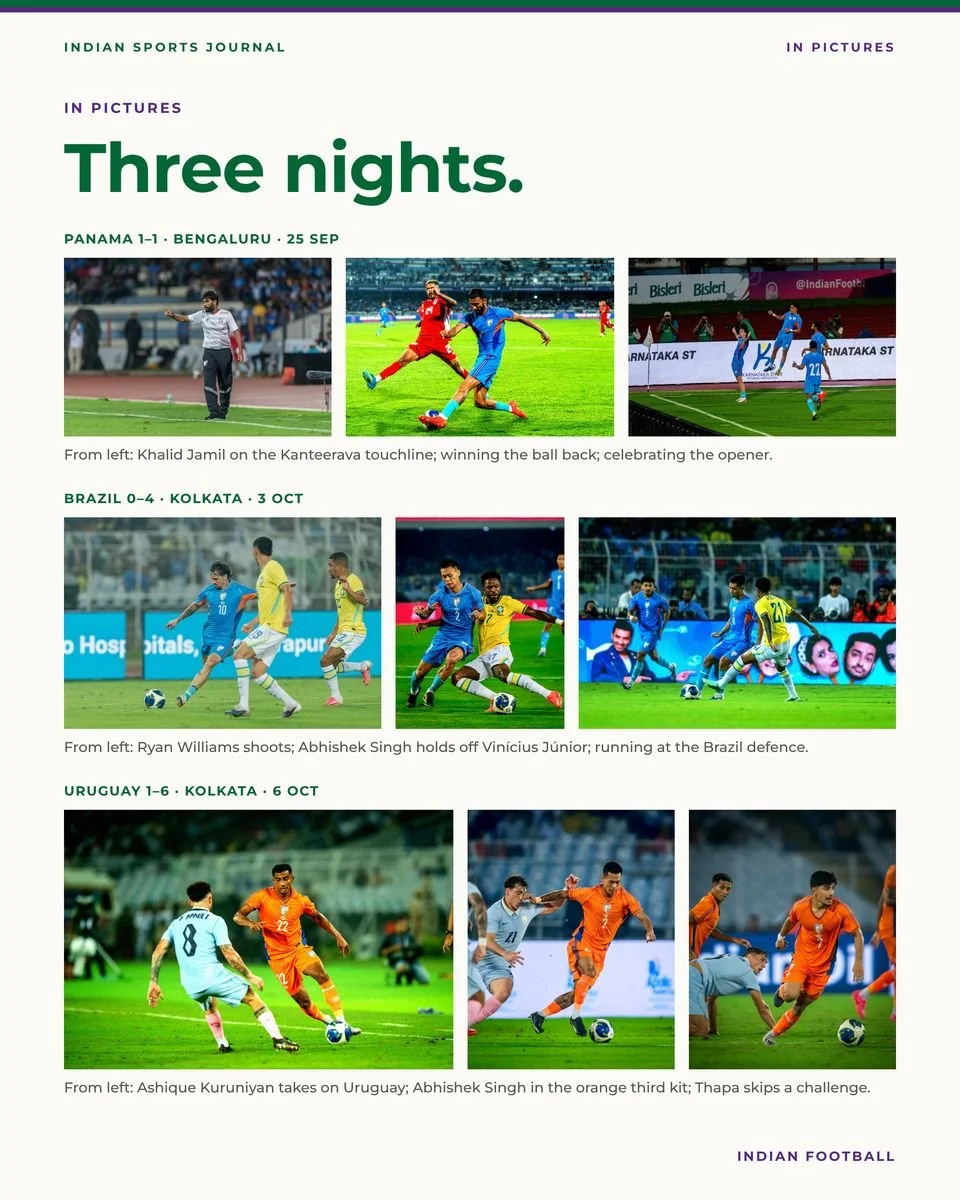
The best evening was the first. At the Sree Kanteerava Stadium on 25 September, against a Panama side ranked 44th, 94 places above India, Ryan Williams ran onto Akash Mishra’s pass and scored in the 41st minute. Omar Valencia, a substitute, equalised with a left-footed shot into the top corner in the 68th. Panama had left the World Cup in June without a goal, after defeats by Ghana, Croatia and England. The 1–1 was watched by 9,039 people in a ground that holds almost 26,000.
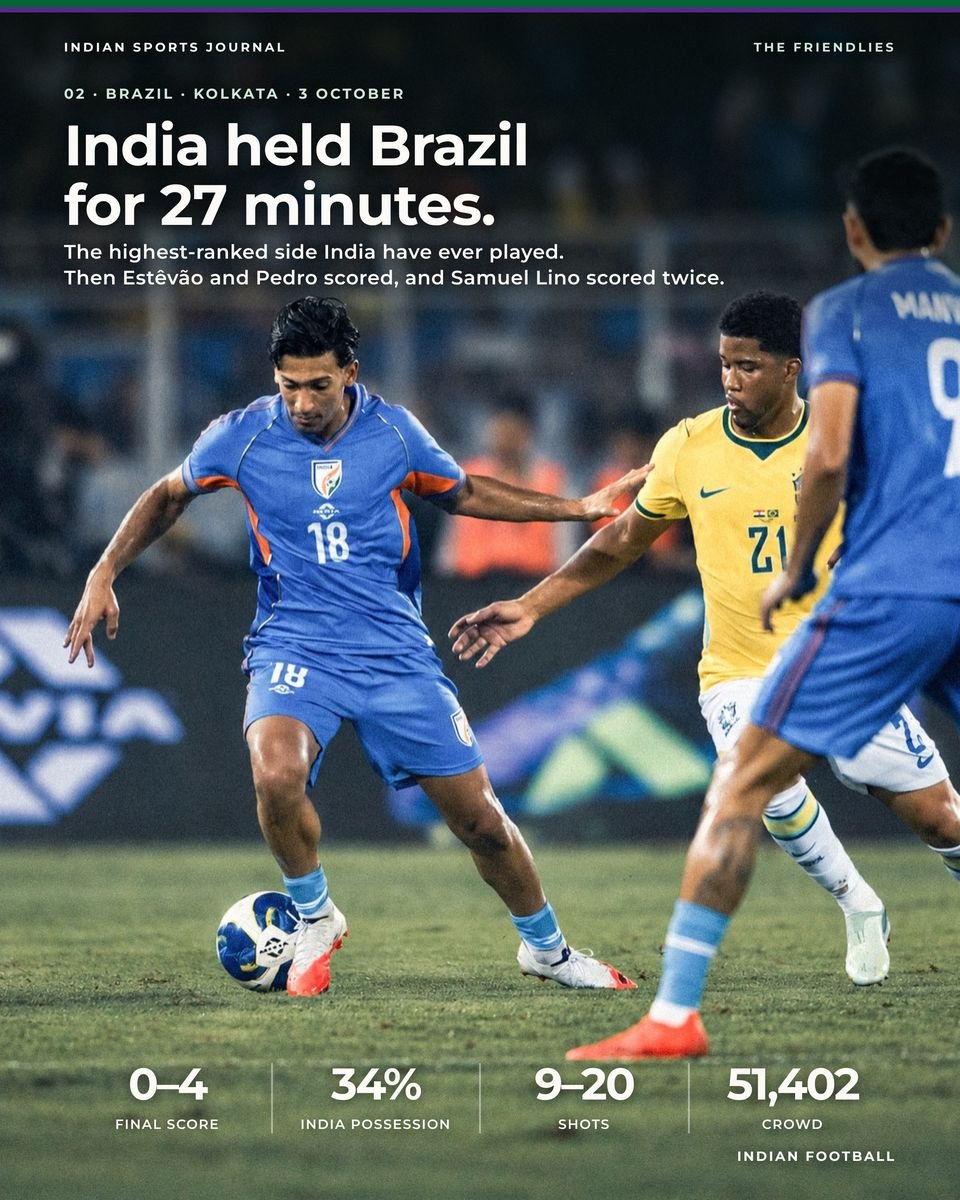
Brazil, ranked fifth, were the highest-ranked opponent India had faced since FIFA’s rankings began in 1993. They came three months after Norway put them out of the World Cup in the last 16, 2–1, and Carlo Ancelotti made eight changes from the side that had beaten Australia 4–2 four days earlier, Reuters reported. India held them for 27 minutes. Estêvão scored in the 28th, then put Pedro through for the second in the 42nd. Samuel Lino, on for Vinícius Júnior, scored in the 58th minute and again in stoppage time. India had 34 per cent of the ball and nine shots to Brazil’s 20. Khel Now counted all four goals as coming from individual errors.
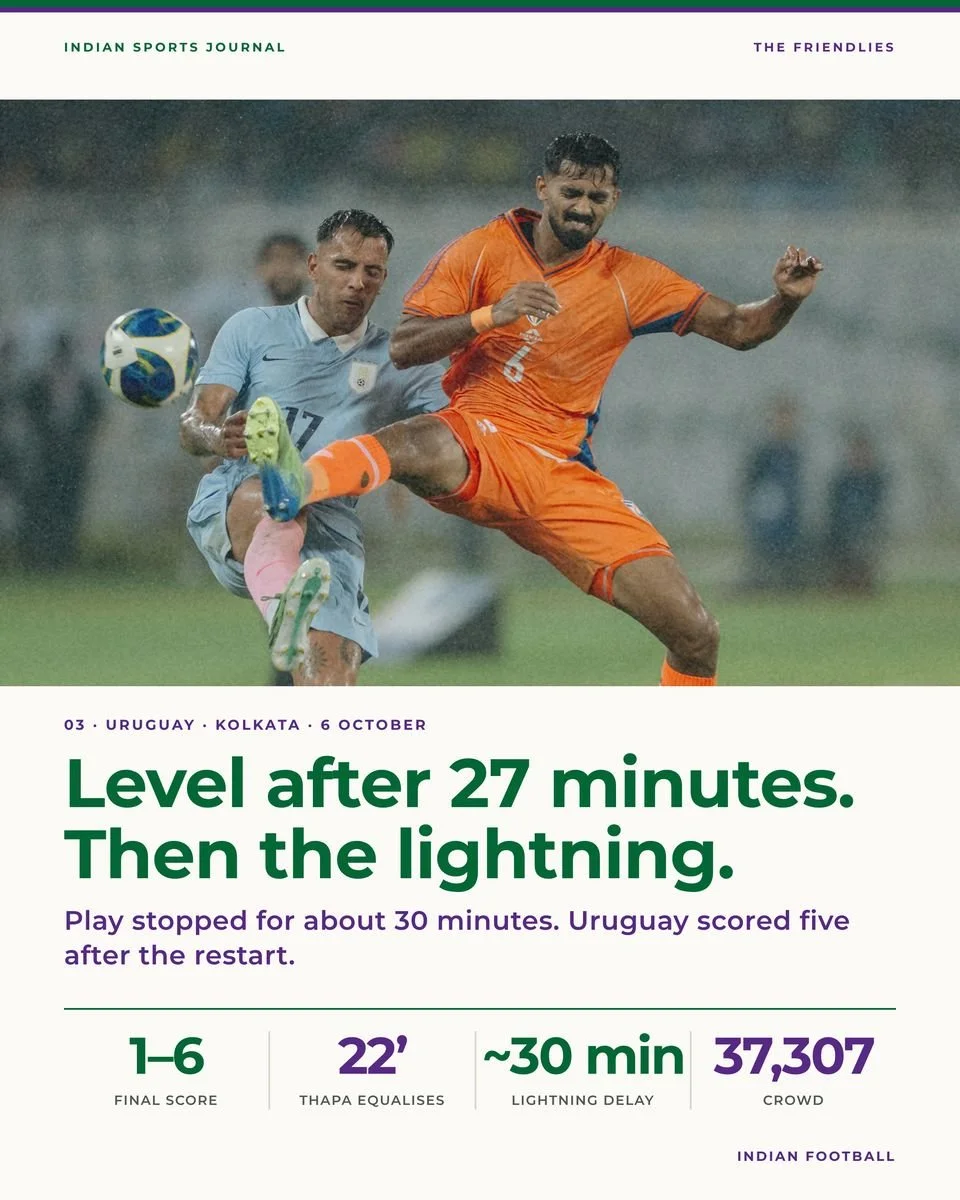
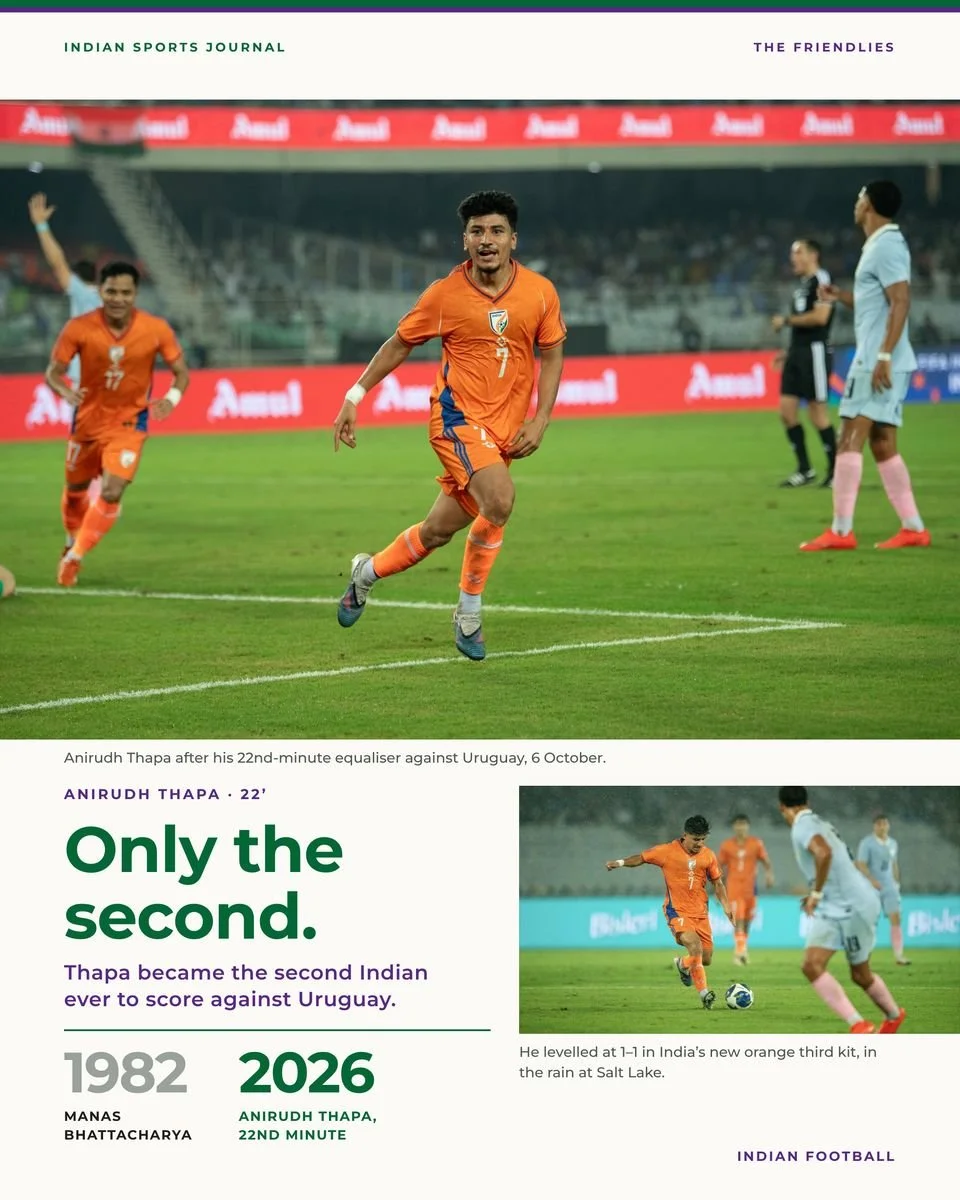
Uruguay, ranked 20th, had gone out of the World Cup in the group stage, which cost Marcelo Bielsa his job. Diego Forlán, appointed in August and once a Mumbai City forward in the ISL, brought them to Kolkata. Darwin Núñez scored a penalty in the 11th minute. Anirudh Thapa equalised in the 22nd, following up after the goalkeeper spilled a shot from Williams, and became the second Indian to score against Uruguay; the first was Manas Bhattacharya, in a 3–1 defeat at the Nehru Cup in February 1982. After 27 minutes, with the score 1–1, lightning near the stadium stopped play for about half an hour. Uruguay scored five times after the restart.
| Date | Match | Score |
|---|---|---|
| 25 Sep | India v Panama, BengaluruPanama 44th; out in the World Cup group stage without scoring. Williams 41 (Akash Mishra); Valencia 68. Crowd 9,039. | 1–1 |
| 3 Oct | India v Brazil, KolkataBrazil 5th; out in the World Cup last 16, 2–1 to Norway. Estêvão 28, Pedro 42, Lino 58, 90+4. Crowd 51,402. | 0–4 |
| 6 Oct | India v Uruguay, KolkataUruguay 20th; out in the World Cup group stage. Núñez 11 pen, Thapa 22, Araújo 28, 59, Zalazar 53, Sanabria 71, Aguirre 86. Play stopped after 27 minutes for lightning. Crowd 37,307. | 1–6 |
| Total | Played 3, drawn 1, lost 2 | 2–11 |
Reuters counted the Brazil defeat as India’s sixth match without a win; Uruguay made it seven. “The more they play such tough matches, the more they will improve,” the AIFF president, Kalyan Chaubey, told ANI the next day.
The bill
The federation has never said what the window cost. When Mint reported, citing an AIFF source, that the Brazilian confederation would receive ₹35–40 crore out of a Brazil budget of about ₹50 crore, including a charter flight of roughly ₹6 crore, the AIFF did not confirm it; asked by Khel Now in early September, it had declined to disclose the fee, citing a confidentiality clause. The reports that carried Mint’s figures added ₹12.5 crore for Uruguay and ₹5.5 crore for Panama, without naming a source, and an expected total of ₹80–90 crore. The Week’s estimate for Brazil is higher, ₹40–50 crore, and it adds charters for all three teams: ₹6 crore, ₹3 crore and ₹50 lakh.
The AIFF’s answer, in August, was a statement that called claims of an ASEAN Cup penalty incorrect and said it was concerned about “the public circulation of unverified figures and claims regarding its finances”. It said it would “pursue appropriate legal remedies” against those who continued to knowingly publish or circulate “false and defamatory statements”. It has not published figures of its own.
What is on the record is part of its balance sheet. A bank-balance statement prepared for the AIFF’s finance committee, seen by Khel Now, showed ₹11.25 crore in the federation’s regular savings accounts on 28 March, ₹22.45 crore in accounts it labels FIFA and AFC, and ₹21.63 crore in fixed deposits and bonds: ₹55.33 crore in all. Bhaichung Bhutia, the former India captain, told PTI in August that spending on this scale was a “wrong priority” while clubs were struggling.
| Item | As reported |
|---|---|
| Brazil appearance feeMint, citing an AIFF source: ₹35–40 cr. The Week: ₹40–50 cr. | ₹35–50 cr |
| Uruguay appearance feeGulf News, National Herald, The Week: ₹12.5 cr. National Herald, 8 Oct: about ₹12 cr. | ₹12–12.5 cr |
| Panama appearance feeSame reports: ₹5.5 cr. National Herald, 8 Oct: ₹5 cr. | ₹5–5.5 cr |
| Charter flightsMint: about ₹6 cr for Brazil. The Week: ₹6 cr, ₹3 cr and ₹50 lakh for the three teams. | ₹6–9.5 cr |
| All inThe Week: ₹70 cr conservatively, up to ₹90 cr. Reports from 22 Sep: ₹80–90 cr. | ₹70–90 cr |
| For scale: AIFF savings accountsRegular savings balance, 28 March 2026, per Khel Now. | ₹11.25 cr |
| For scale: all 13 ISL clubs’ fees₹1.10 cr per club for 2026–27. | ₹14.3 cr |
Who paid
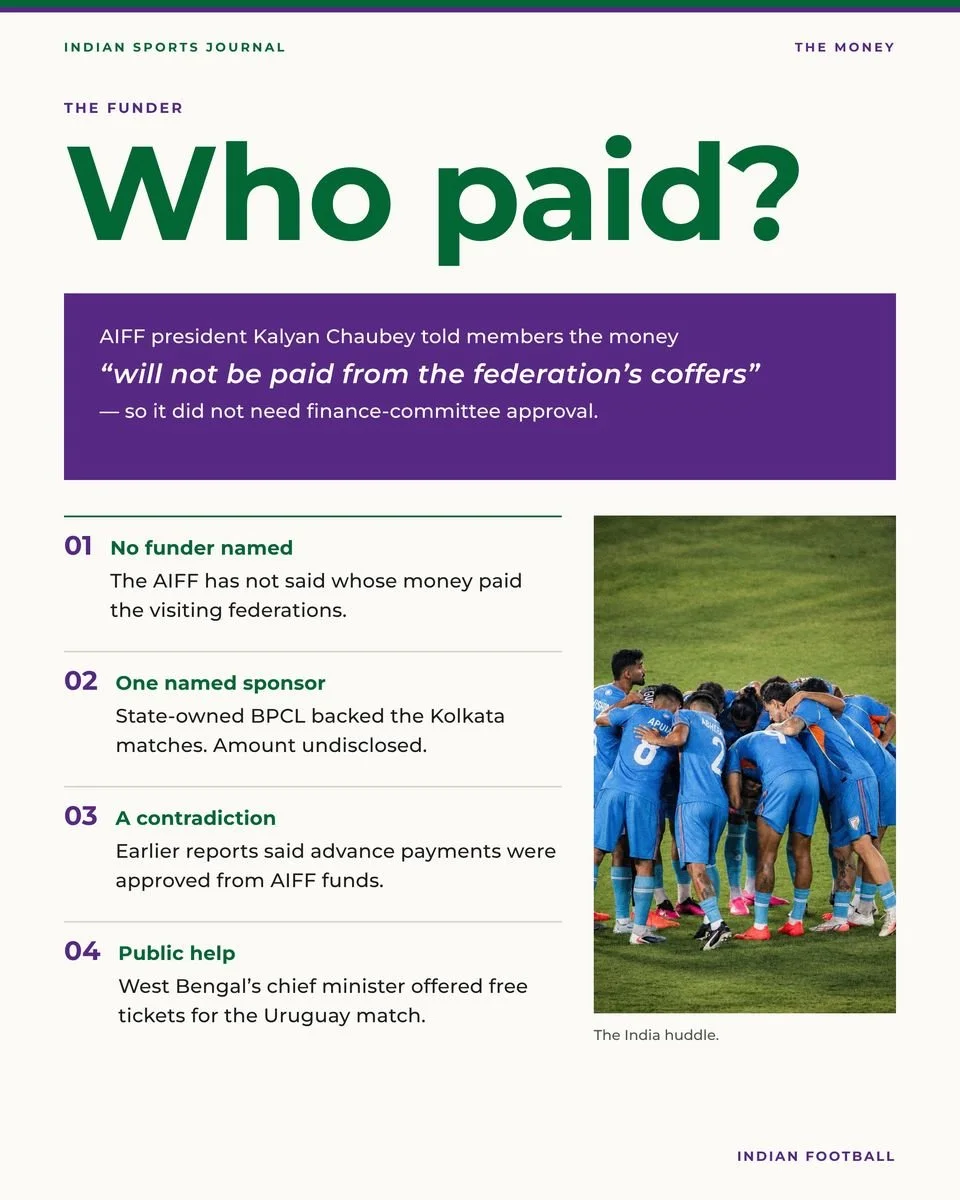
Chaubey’s position, as reported, is that the federation is not paying. He told members of the federation’s working committee that losses would not come out of AIFF coffers, the National Herald reported, and Inside World Football reported that he had said payments to the visiting teams would not come from the federation’s funds or fall under its finance committee. The AIFF constitution, stakeholders told the National Herald, requires governing-body sanction for any spending above ₹5 crore.
The record from before the matches is less tidy. In August, officials told the executive committee that the AIFF would pay an advance to the Brazilian confederation and recover it later from sponsors and private partners, PTI reported. Bhutia said he had asked about it. “I asked how can the AIFF take such a risk?” Gulf News reported in September that executive committee members had approved initial payments from federation funds without being clear on the full arrangements.
Three other parties are named in the reporting, none with a number. Bharat Petroleum, the state-owned oil company, announced on 5 October that it was sponsoring the two Kolkata matches; it disclosed no amount. The West Bengal government’s share, if it has one, has not been stated. And on the weekend of the Brazil match the state’s chief minister, Suvendu Adhikari, offered free passes for the Uruguay match to about 22,000 people who had bought tickets for Lionel Messi’s visit to the same stadium last December, which ended in chaos. “I would ask them to come and watch the match,” he said.
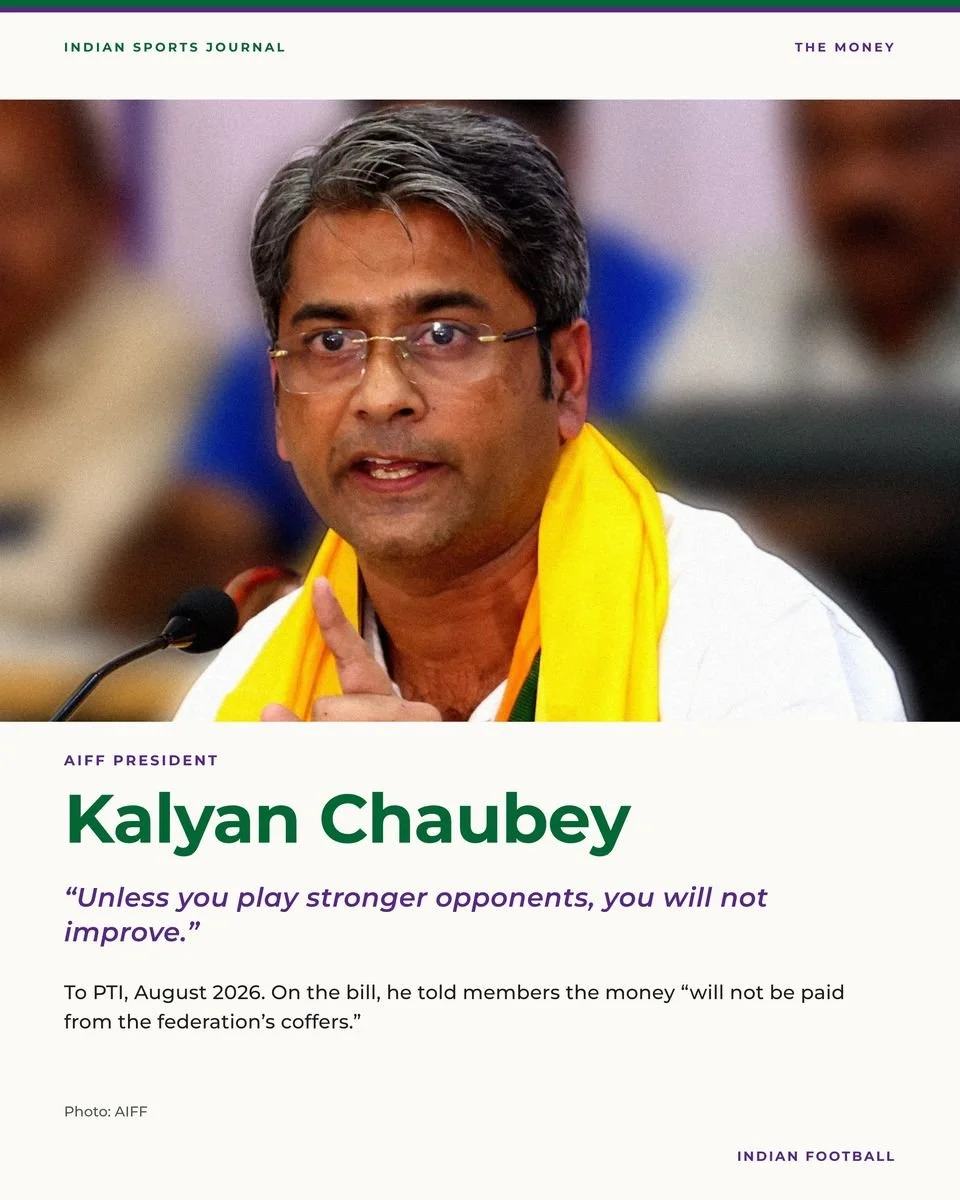
Chaubey’s case for the matches is a football one. “Unless you play stronger opponents, you will not improve,” he told PTI on 7 August, a week after Brazil were confirmed. “When, ranking-wise, you are not in a decent position, it is very difficult to convince a superior opponent to play against you.”
The gate
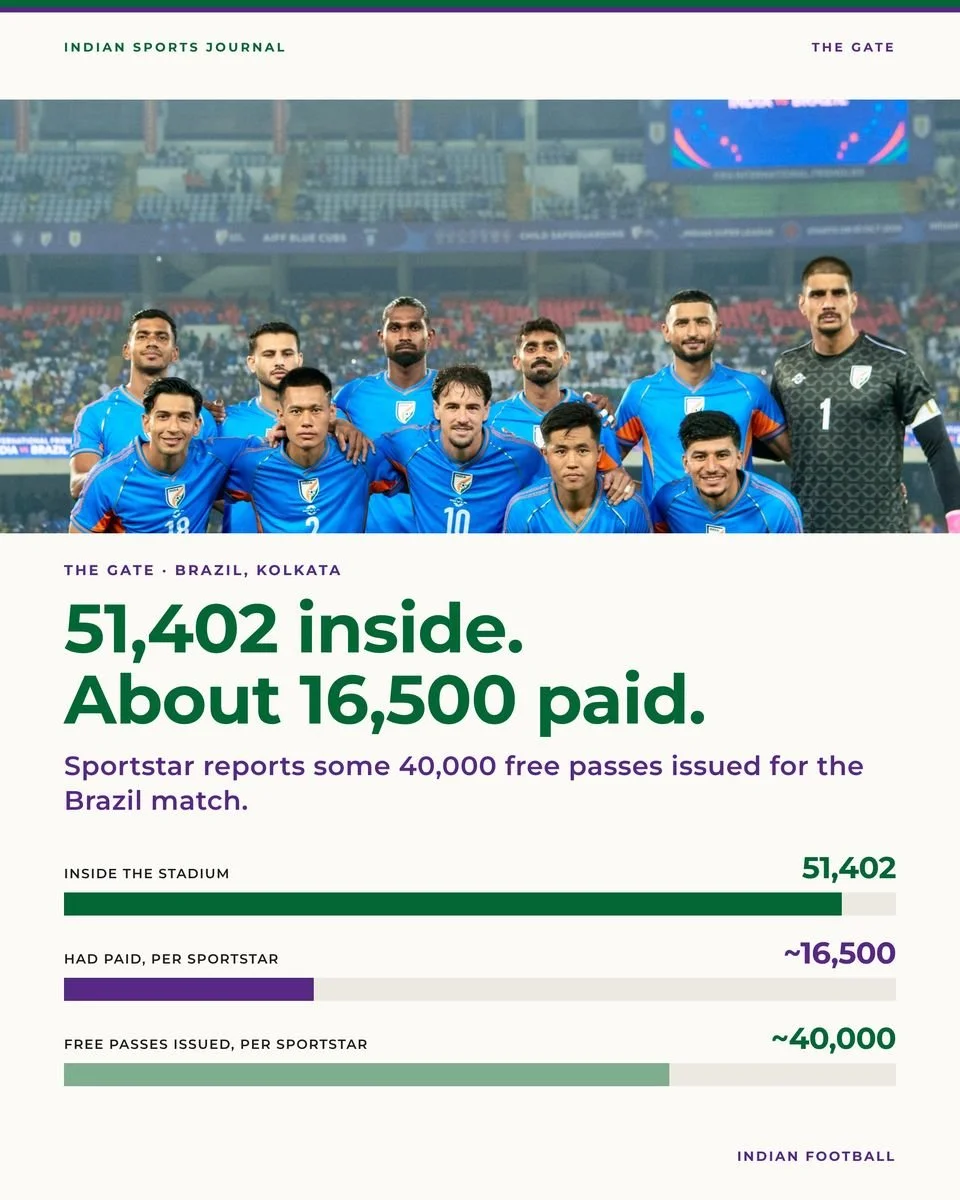
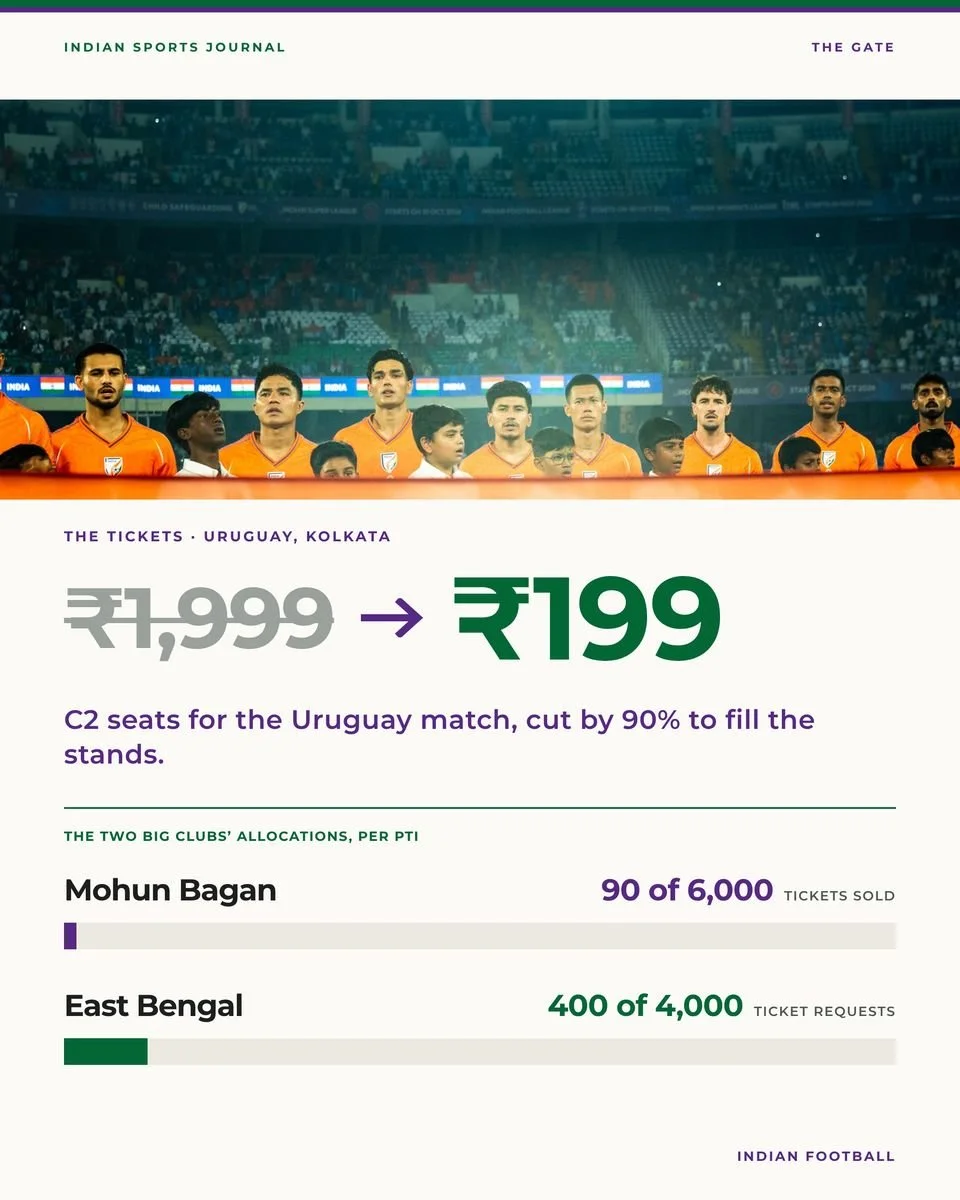
Kolkata was supposed to be the easy part. The lower-priced tickets for Brazil sold out within an hour in September. By match day, PTI found, the rest had not gone. Two hours before kick-off, seats priced from ₹3,500 to ₹6,000 were still on sale, and the crowd at kick-off looked to be below 30,000. The allocations given to the city’s clubs had barely moved: Mohun Bagan had sold 90 of its 6,000 tickets, East Bengal had requests for 400 of its 4,000, and the Indian Football Association, the nominal host, had 24 requests for 2,000. “People here are used to seeing matches for less than Rs 500,” an IFA official told PTI.
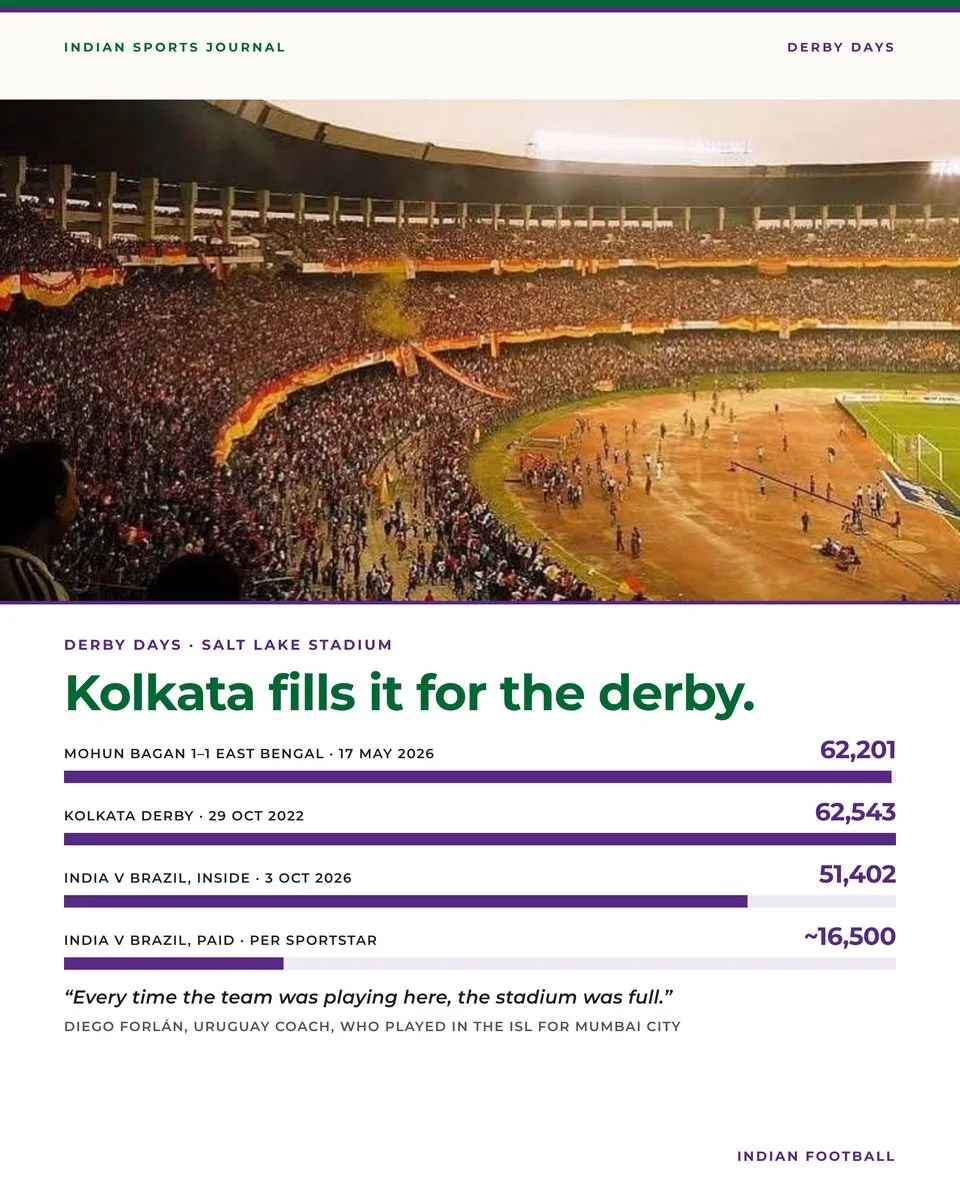
The official attendance, 51,402, was announced after complimentary passes were handed out during the match, PTI reported. Inside World Football put the number of free passes at about 40,000. The stadium holds 68,000.
The day after Brazil, the AIFF cut seats in the two C2 blocks for Uruguay from ₹1,999 to ₹199; the Messi passes were handed out on 5 October. PTI estimated 15,000 inside at kick-off. The official attendance was 37,307. In Bengaluru, Khel Now reported, tickets for Panama started at ₹849, ₹950 with fees, for a place on a cement slab; the same seats, it said, cost around ₹500 on an average ISL matchday. “There is always a price you need to pay to watch a World Cup team in action,” the AIFF deputy secretary general, M. Satyanarayan, said.
Diego Forlán had seen the other version of the city. “Every time the team was playing here, the stadium was full,” he said at his press conference on the eve of the Uruguay match. The derby in October 2022 drew 62,542, the third-largest crowd the ISL had recorded.
The trade
To play Brazil, India gave up a tournament. On 6 August the AIFF executive committee decided to play Brazil on 3 October and to take part in the first FIFA ASEAN Cup, in the same international window, with two squads. India had been drawn in Group A of its first division with Indonesia, Malaysia and Singapore. A week later the federation withdrew. “We have pulled out of the FIFA ASEAN Cup since we can’t play both Brazil and FIFA ASEAN Cup,” Satyanarayan told PTI. Unnamed sources quoted by The Week and the National Herald said FIFA rules would not let India send a second-string side; FIFA has not said so in public. “Skipping the FIFA ASEAN Cup is just a bad, bad decision,” Bhutia said.
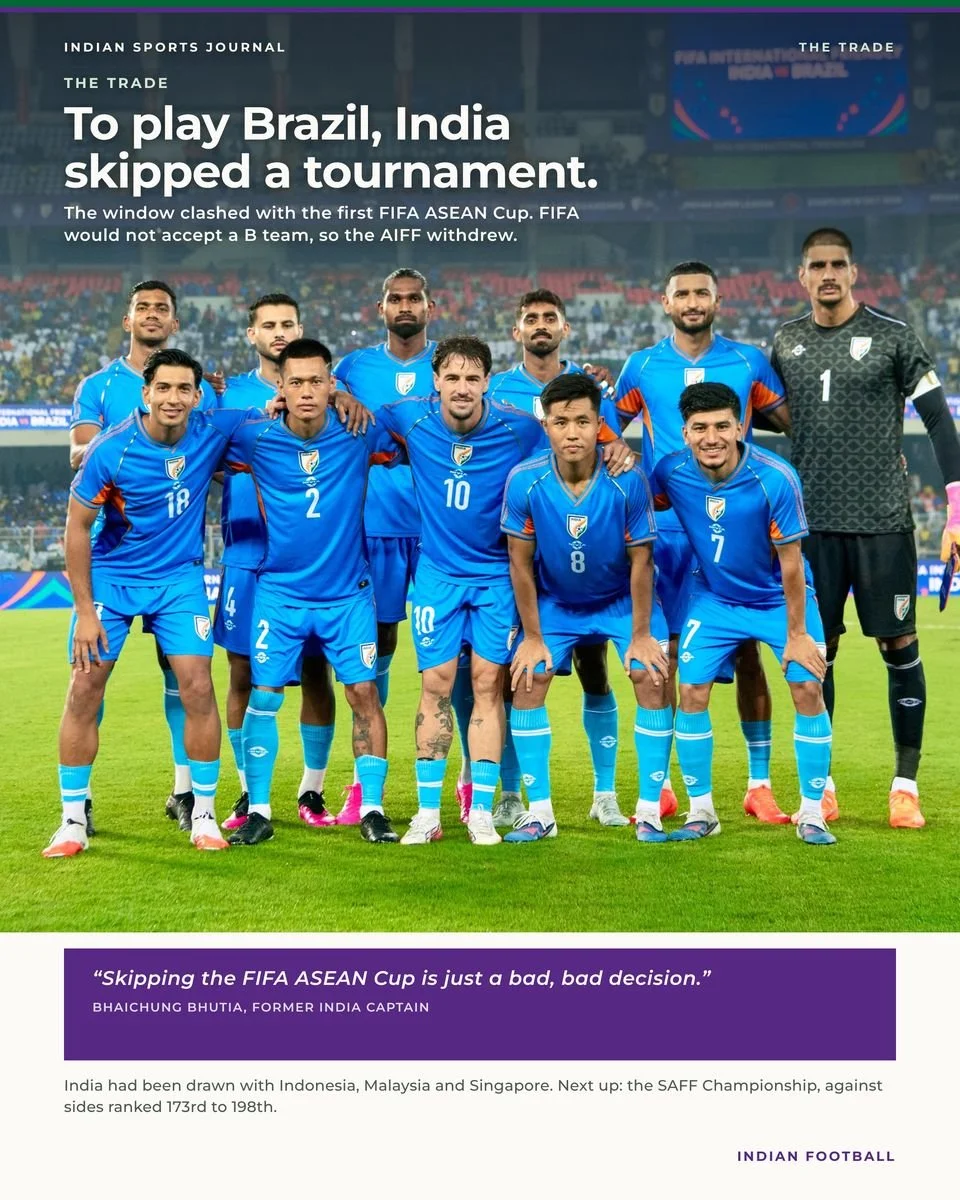
The next competitive matches are at the SAFF Championship in Dhaka, which starts on 4 November; Khel Now has reported that India are likely to send an under-23 or reserve side there, because the senior team is due in New Zealand for friendlies on 12 and 15 November. India’s group holds Maldives and Pakistan, ranked 173rd and 198th in July.
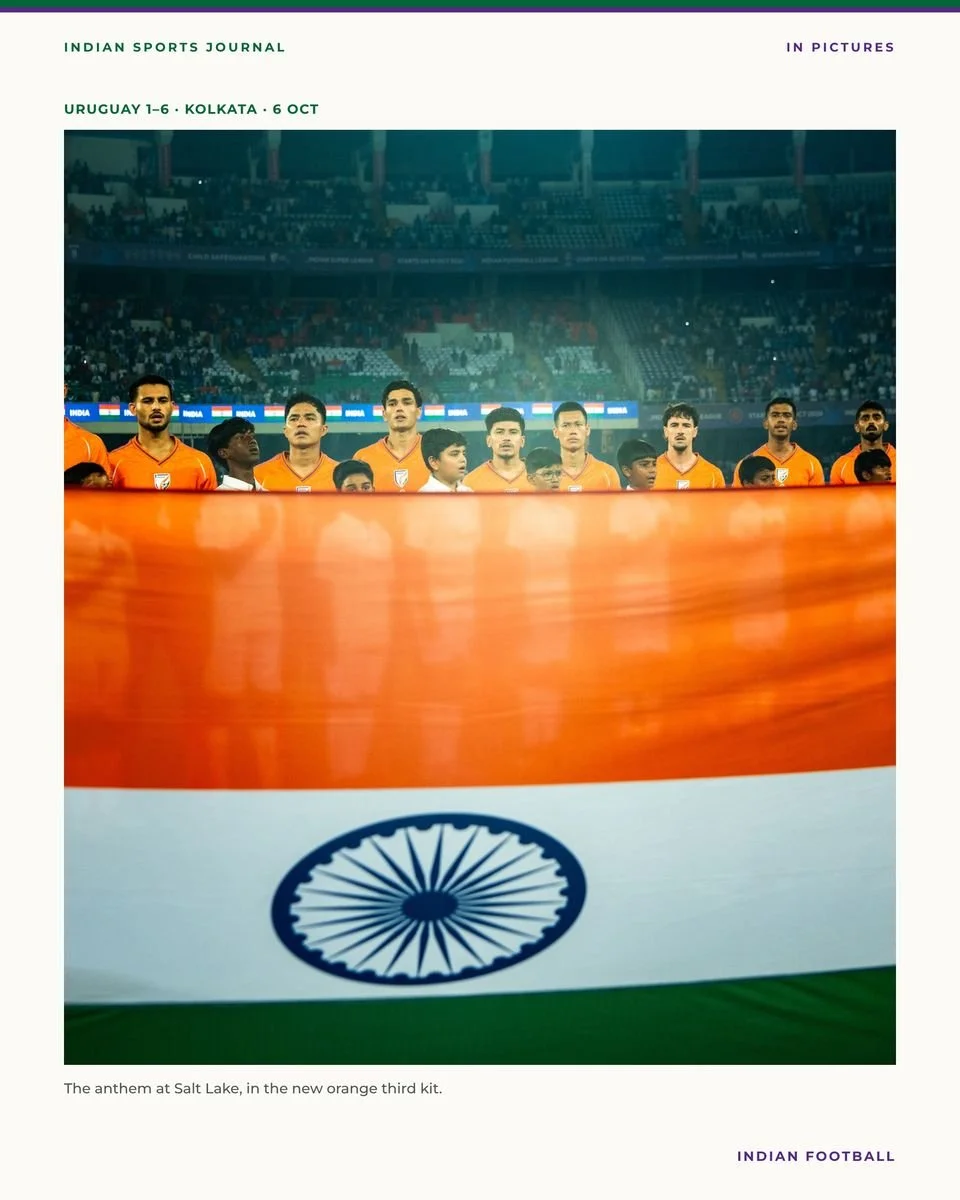
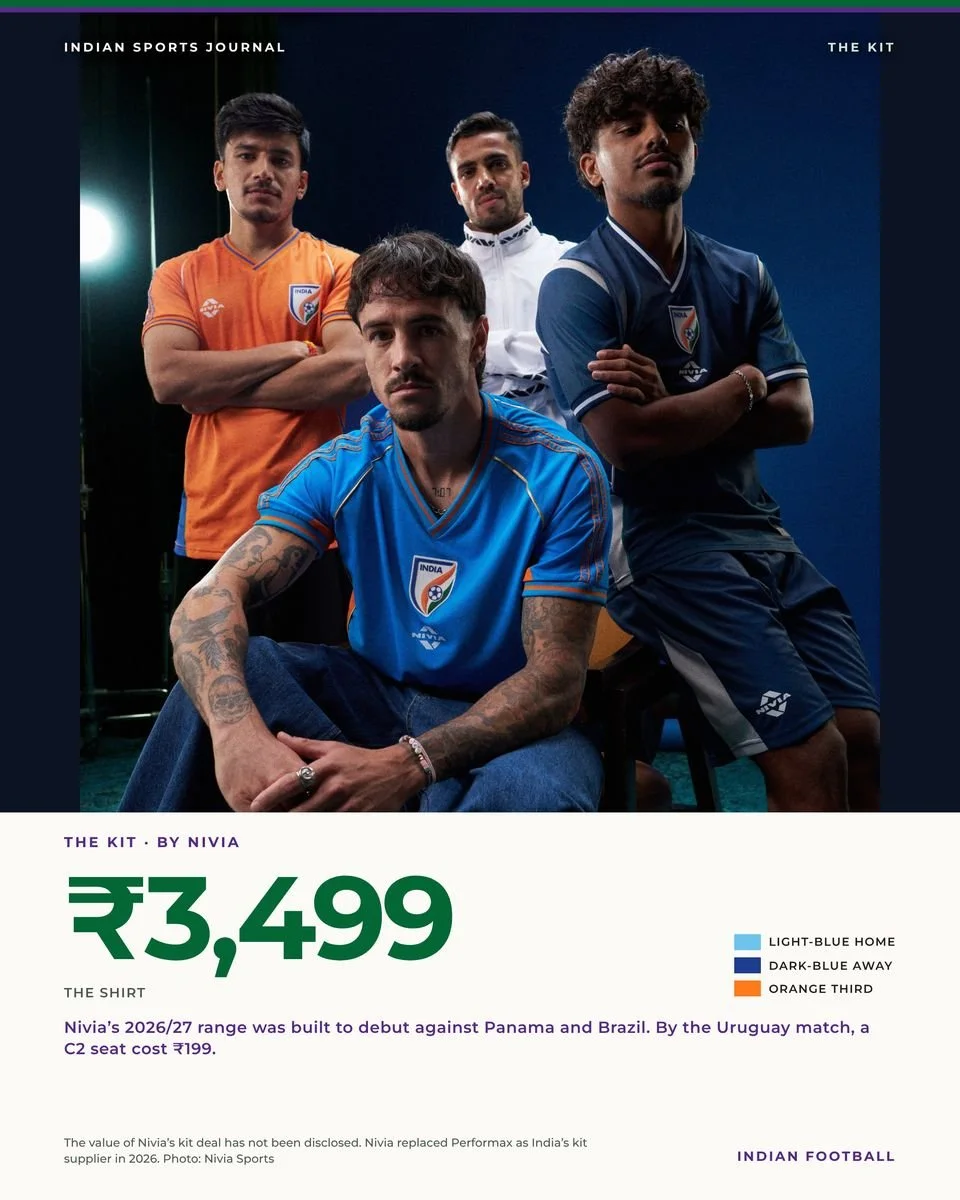
The window was also a shop front. Nivia, India’s kit supplier since Reliance’s Performax brand left earlier this year, has a new India shirt on sale at ₹3,499, reported on the eve of the Panama match, and revealed a 70-foot jersey on Instagram hours before Uruguay, when India played in orange. One shirt costs more than 17 of the cut-price C2 seats for Uruguay. No value for Nivia’s deal has been published.
The league
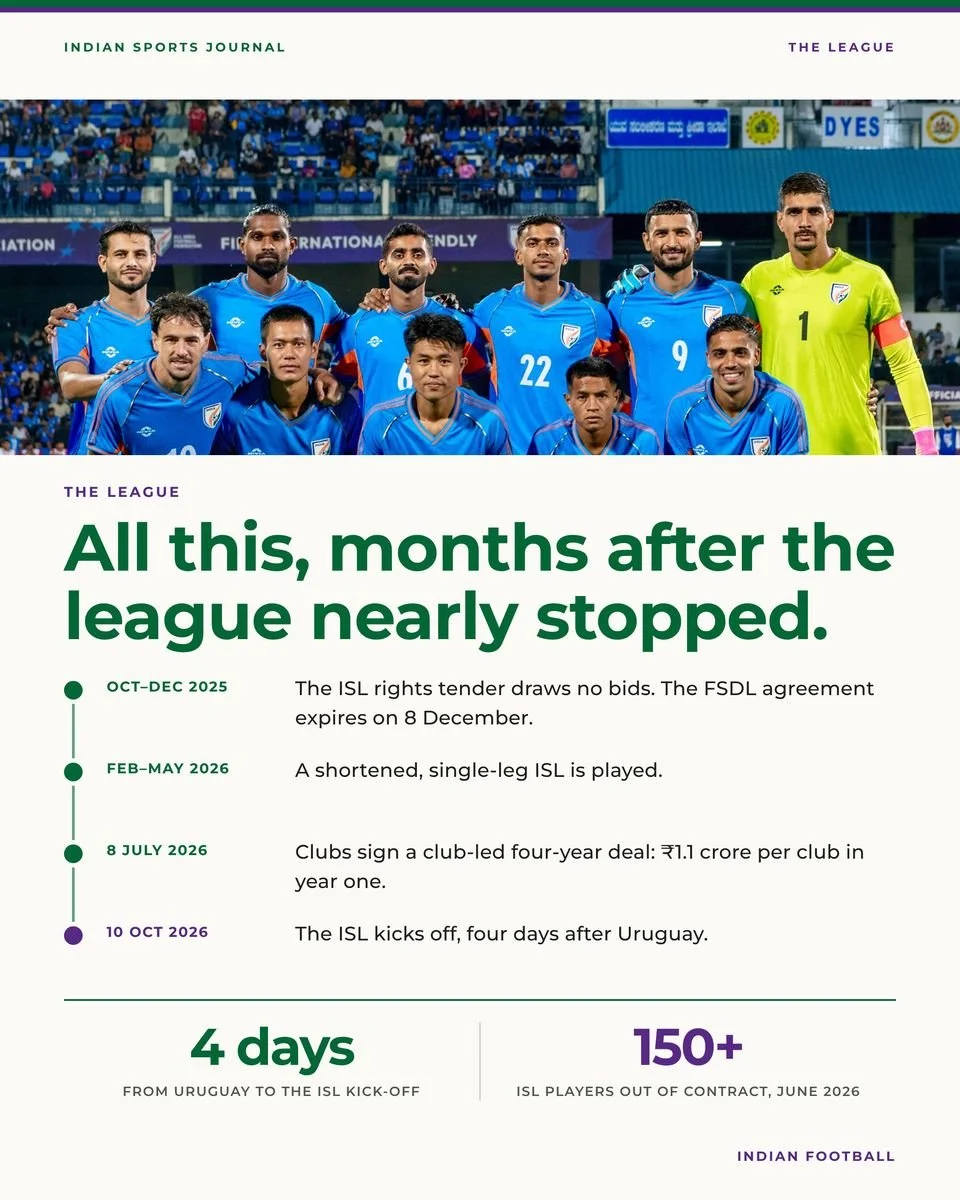
The matches filled a gap the league had left. The ISL’s 2025–26 season was put on hold in July 2025. In November the AIFF’s tender for the league’s commercial rights drew no bids, and on 8 December the 15-year, ₹700 crore master rights agreement with Football Sports Development Ltd expired. A shortened season of 13 rounds began in February and finished in May. When contracts ran out on 31 May, nearly 150 ISL players were left without one, Onmanorama reported.
On 8 July the AIFF and the clubs announced a club-led model for an initial four years. Each club pays the federation ₹1.10 crore for 2026–27, in two instalments of ₹55 lakh. Jamshedpur FC, owned by Tata Steel, did not pay the first and withdrew; Churchill Brothers agreed to take over its licence for ₹100. Diamond Harbour, the I-League champions, missed the deadline for the second and will not play. The season starts tonight with 13 clubs, paying the AIFF ₹14.3 crore between them.
The federation’s case is that the matches were an investment in players who had never faced a team of Brazil’s standing, a chance that India’s ranking would not otherwise buy. The arithmetic above is the case against.
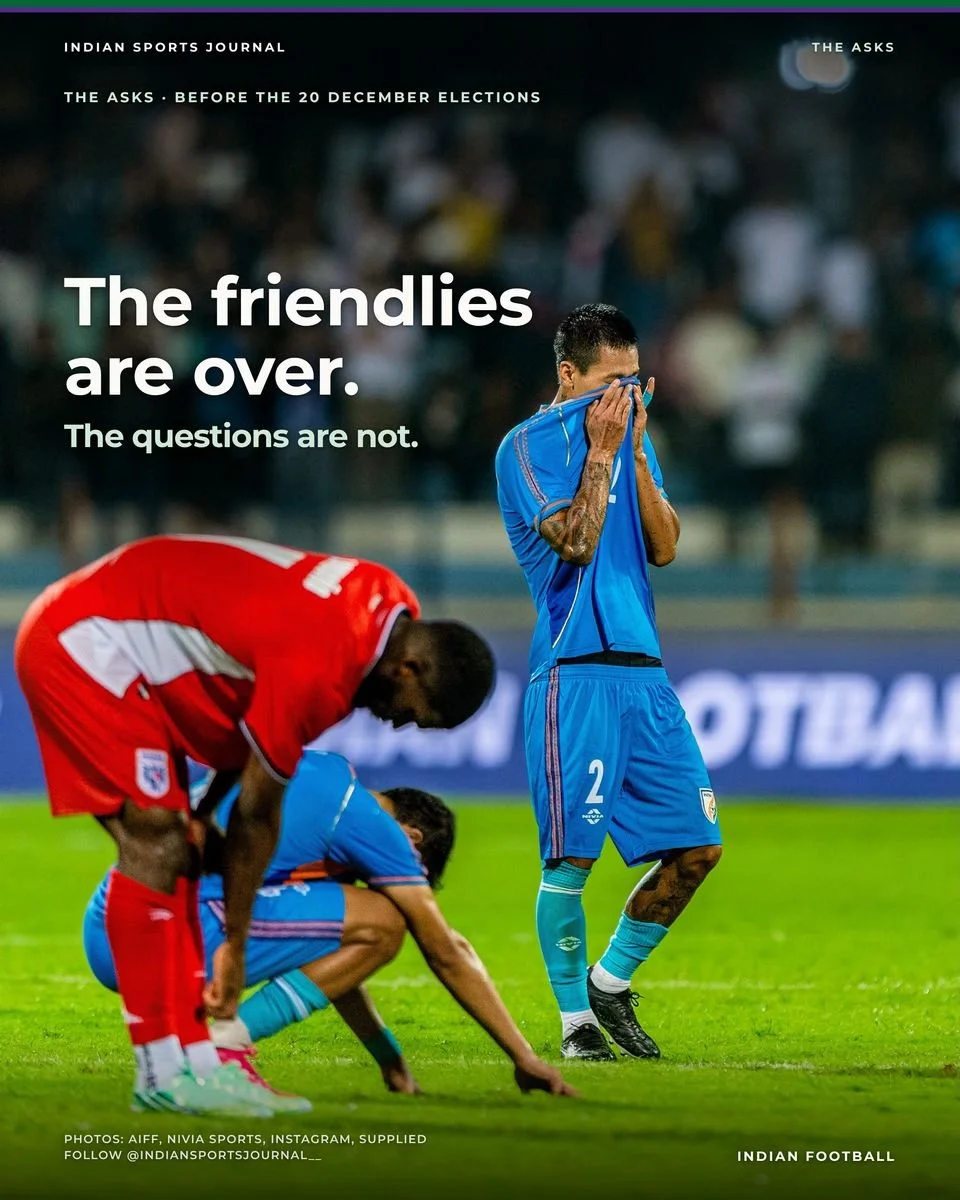
Chaubey’s executive committee began a four-year term in September 2022. On 4 October, the day after Brazil, the AIFF general body extended it to 30 December and set elections for 20 December. India will have played Maldives and Pakistan in Dhaka by then. Whether the federation will also have said what Panama, Brazil and Uruguay cost, and whose money paid for them, is the question the friendlies leave behind.
Sourcing. Matches: Khel Now, Onmanorama and myKhel (Panama, 25–26 September); beIN Sports, Reuters via The Star, BeSoccer (possession and shots) and Khel Now (Brazil, 3–4 October); Outlook, t2, Gulf News, myKhel and Vavel (Uruguay, 6 October); RSSSF (1982 Nehru Cup, India 1–3 Uruguay, Bhattacharya 35); Concacaf (Panama at the World Cup); beIN Sports and Inside World Football (Brazil v Norway); beIN Sports and The Star (Forlán’s appointment); t2 and the AIFF (Brazil fifth, highest-ranked opponent since 1993); AIFF match reports (Brazil, Lino 90+4; Uruguay, attendance 37,307). Money: Mint as carried by Gulf News, National Herald and Democrata; The Week (10 October); National Herald (8 October); Khel Now (3 September, AIFF bank balances and income and expenditure); Inside World Football (5 October); Outlook and PTI (7 August, the advance); AIFF statement (19 August); BPCL press release (5 October); Khel Now and bdnews24 (Adhikari’s passes). Crowds and tickets: PTI via ThePrint (3 and 6 October), Outlook (6 October), Khel Now (Panama pricing), Onmanorama (3 September), AIFF via myKhel, bdnews24 (5 October, the C2 cut). ASEAN Cup: AIFF executive committee release (6 August), The Week and National Herald (13 August), PTI via DT Next (Bhutia, 14 August), Wikipedia (SAFF draw and rankings). League: Tribune and Khel Now (tender, November 2025), Khel Now (fees, Churchill, Diamond Harbour), Outlook (13 clubs, 10 October start), Onmanorama (players out of contract), Fox Mandal (8 July announcement). Quotes: Chaubey to PTI (7 August) and ANI (7 October); Forlán via National Herald (5 October); Satyanarayan via Khel Now and The Week; Adhikari via Khel Now; IFA official via PTI.
Corrections to the carousel. Slide 11: the Telegraph column (Brazil ~₹45 cr, Uruguay ~₹18 cr, all in ~₹85 cr) and “The AIFF calls the Telegraph’s figure incorrect” — no such Telegraph report found; the AIFF’s 19 August statement condemned “unverified figures” on its finances without naming a publication or a number, per the AIFF. ₹85 crore is used here as the midpoint of the ₹80–90 crore reported range. Slide 11 also credits all four lines to Mint: the Mint figures traceable are the ₹35–40 cr Brazil fee, a ~₹50 cr Brazil budget and a ~₹6 cr Brazil charter; Uruguay ₹12.5 cr, Panama ₹5.5 cr and ₹80–90 cr appear unattributed in the reports carrying Mint’s numbers, and the ₹9.5 cr charter total matches The Week’s ₹6 cr + ₹3 cr + ₹50 lakh. Slides 10 and 12: “will not be paid from the federation’s coffers” is given as a quote; no published source carries those words — the National Herald (8 October) quotes Chaubey’s assurance to working-committee members that losses “would not be taken out of the AIFF coffers”, Inside World Football paraphrases it, and the finance-committee point is Inside World Football’s paraphrase. Slides 13 and 15: “About 16,500 paid” and the Sportstar attribution for ~40,000 free passes — not found; Inside World Football reports about 40,000 complimentary passes, and PTI says 51,402 was announced after passes were handed out during the match. Slide 14: the Mohun Bagan (90 of 6,000) and East Bengal (400 of 4,000) figures were PTI’s for the Brazil match on 3 October, not Uruguay, per PTI via ThePrint. Slide 15: 17 May 2026 derby, 62,201 — not found in any report (the ISL’s report says only “packed”); left out. 29 October 2022 derby, 62,543 — 62,542 per ISL attendance records (The Bridge gives both). Slide 16: “all 14 ISL clubs”, ₹15.4 cr, 5.5 years — the 2026–27 ISL has 13 clubs, ₹14.3 cr a year, so ₹85 crore is about 5.9 seasons, per Khel Now and Outlook. Slide 4: “the highest-ranked side India have ever played” — since FIFA rankings began in 1993, per t2. Slide 19: “150+ ISL players out of contract” — “nearly 150”, per Onmanorama (2 June); “clubs sign” on 8 July — the framework was announced that day, per Fox Mandal; the four-year term is confirmed by Khel Now.
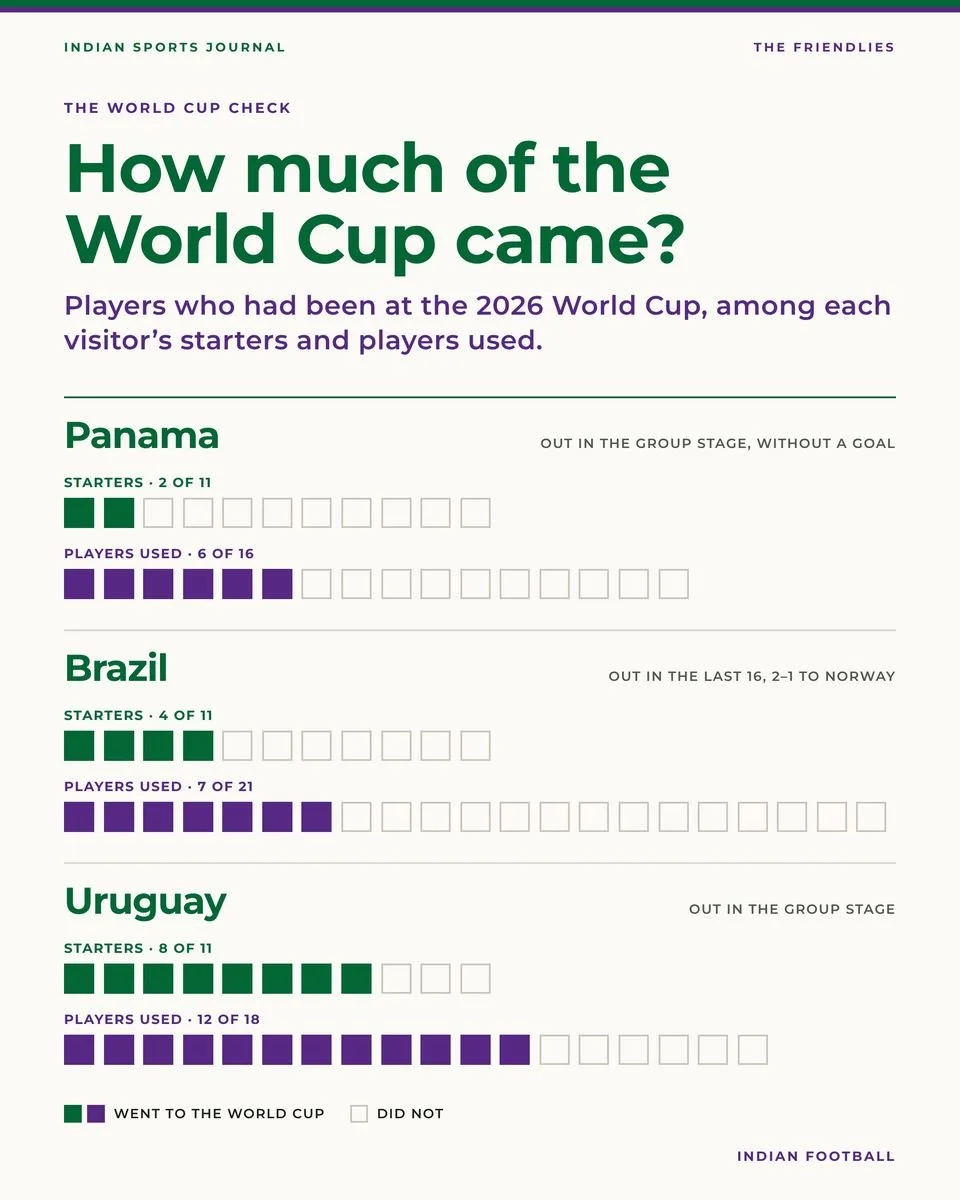
Flag. ISJ’s own research chat for this carousel did not surface in past-conversation search. Slide 18’s reason for the ASEAN Cup withdrawal (“FIFA would not accept a B team”) rests on unnamed sources in The Week; the AIFF’s stated reason was the clash. Slide 7’s counts of World Cup players among the visitors’ starters and players used are ISJ’s own tally and were not re-checked for this article; Reuters reports only that Brazil made eight changes from the Australia match. Slide 16’s “two clubs asked for more time” — Jamshedpur sought an extension and withdrew; Diamond Harbour missed the second-instalment deadline; whether a second club formally asked for time is not confirmed. Slide 17’s “built to debut against Panama and Brazil”: Nivia’s first India shirt was unveiled on 27 May for the Unity Cup (Khel Now); the ₹3,499 range was reported on 24 September (Indian Retailer). Conflicts: Valencia’s equaliser 68 minutes (Onmanorama, myKhel) or 66 (Khel Now); Núñez’s penalty 11 (Outlook, myKhel) or 12 (t2, Vavel); the lightning stoppage “more than 30 minutes” (Gulf News), 30 (t2), 34 (Outlook), about 35 (myKhel), about 20 (ANI); Salt Lake capacity 68,000 (PTI, Indian Express) or about 85,000 (Outlook); Brazil’s fee ₹35–40 cr (Mint) or ₹40–50 cr (The Week); total ₹70–90 cr, with Khel Now citing ~₹90 cr and Bhutia ₹50–70 cr for Brazil alone. The 2022 derby comparison is a league match, not an international.
Fact-check, 29 October. Adhikari’s offer is dated Saturday 3 October by bdnews24, citing The Indian Express, so the copy says “the weekend of the Brazil match”; the passes were collected on 5 October. Khel Now’s pre-match price list for Panama gave a ₹499 lowest tier; its post-match report gives ₹849 as the starting price, which the copy follows as Khel Now’s figure. Salt Lake capacity is also given as 65,000 (AFP via Khaleej Times). The AIFF announced on 11 July two friendlies in New Zealand on 12 and 15 November, which clash with the SAFF Championship’s knockout rounds (semi-finals 14 November, final 17 November); Khel Now reported on 26 September, citing The Times of India, that India were likely to send an under-23 or reserve side to Dhaka. Resting on the outlets named: The Week’s figures; Gulf News on executive-committee approvals; Inside World Football (40,000 passes, finance committee); PTI via ThePrint (gate figures, the IFA official, Satyanarayan and Chaubey quotes); Khel Now’s 3 September balances, ₹85.47 crore and confidentiality clause; Bhutia’s quotes; Chaubey to ANI; BPCL’s announcement; the Nivia details; the 62,542 derby crowd and its ranking; Bielsa’s exit; the ASEAN Cup draw; the ISL fee, instalments, Churchill’s ₹100 and Diamond Harbour.
Photographs. As printed on the slides: Photo: AIFF (slide 10); Photo: Nivia Sports (slide 17); Photos: AIFF, Nivia Sports, Instagram, supplied (slide 20).