He Delivered Milk. Then He Ended a 64-Year Wait.
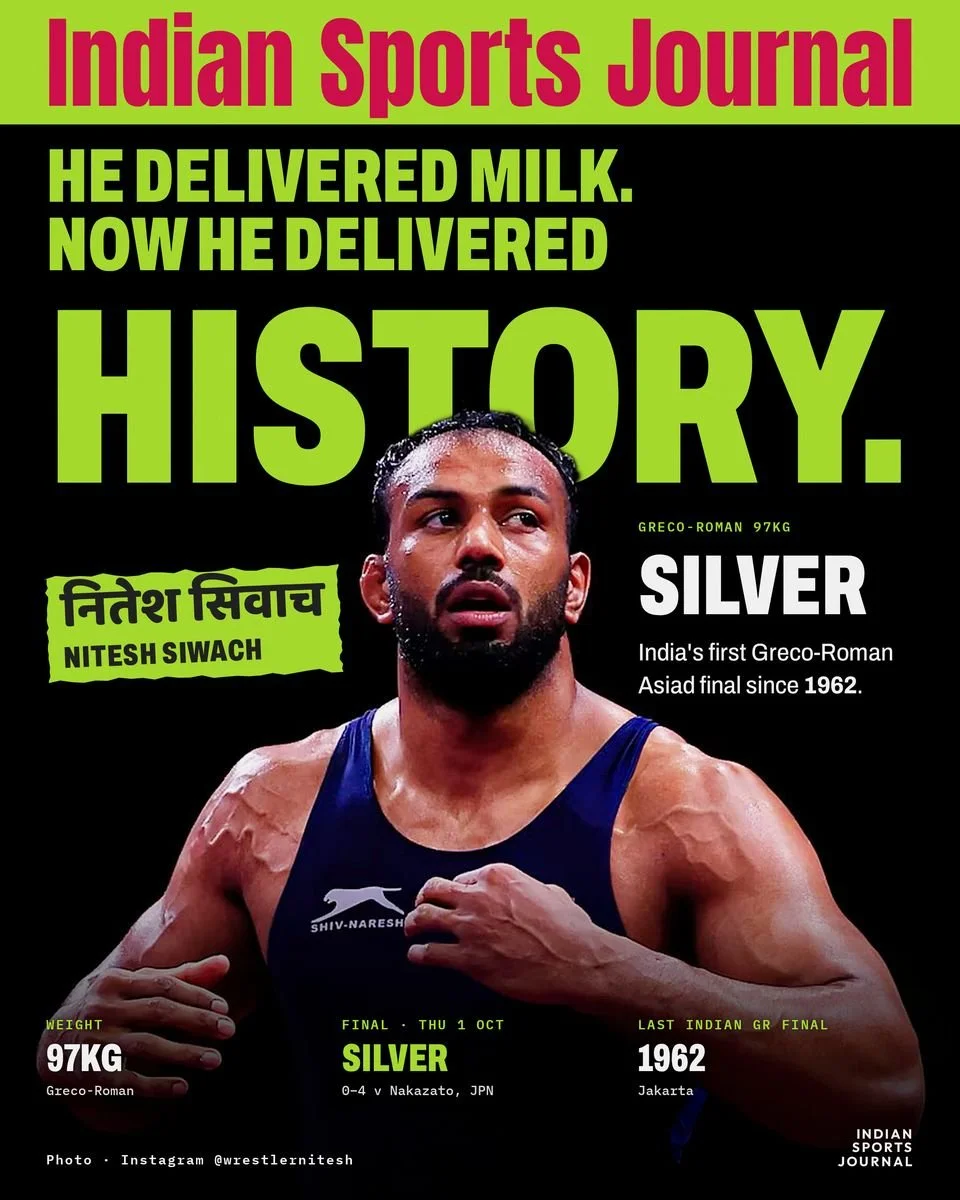
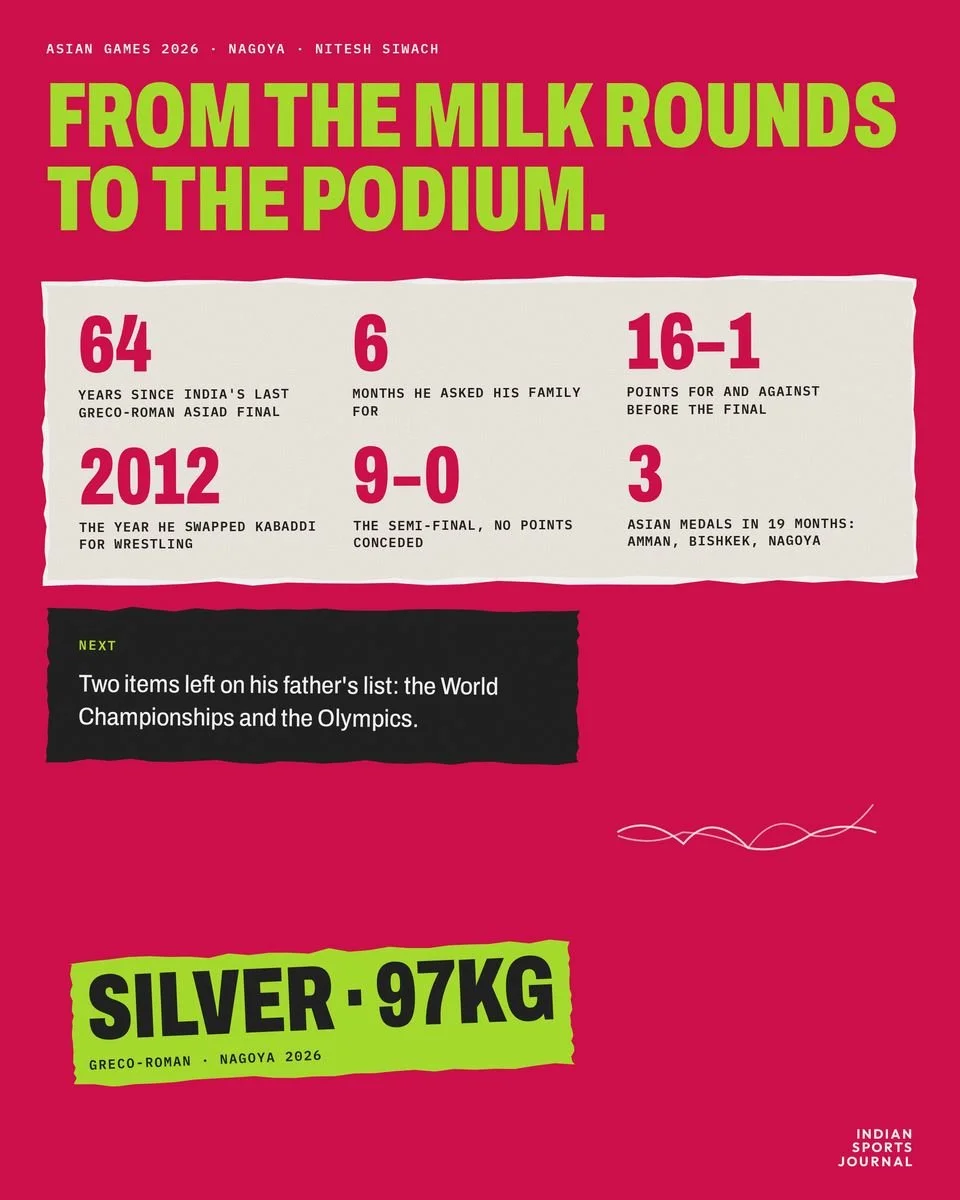
Nitesh Siwach lost the Greco-Roman 97kg final 4–0 to Japan’s Yuri Nakazato in Nagoya on Thursday. His silver is India’s first in the style at an Asian Games since Jakarta 1962, won by a 23-year-old who once spent close to two years off the mat, out on his father’s milk round.

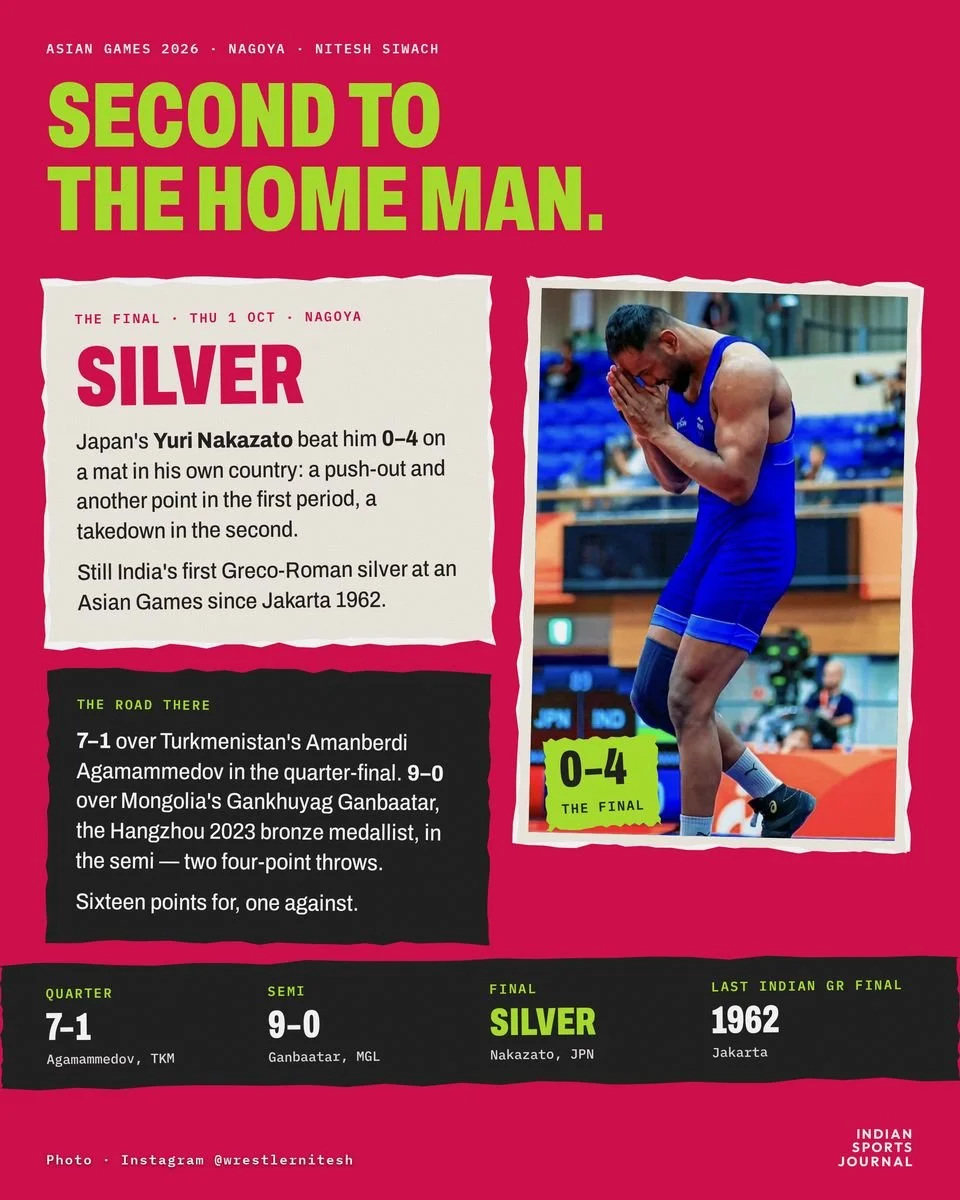
Nitesh Siwach lost the last bout of his first Asian Games and still went further than any Indian Greco-Roman wrestler in 64 years. Japan’s Yuri Nakazato beat him 4–0 in the 97kg final in Nagoya on Thursday: a push-out and a passivity point in the first period, a takedown in the second, and nothing on the board for the Indian. The silver is India’s first in Greco-Roman at an Asian Games since Jakarta in 1962.
The road to the final was close to flawless. Nitesh had a bye into the quarter-finals, beat Turkmenistan’s Amanberdi Agamammedov 7–1, and then stopped Mongolia’s Gankhuyag Ganbaatar 9–0 inside the first period of the semi-final with two four-point throws from par terre, the ground position in which one wrestler starts on hands and knees. Sixteen points for and one against, before the final.
That a silver counts as history says as much about Indian wrestling as about Nitesh. India is a wrestling power in one style. All eight of its Olympic wrestling medals, from KD Jadhav’s bronze in 1952 to Aman Sehrawat’s in Paris, came in freestyle. Its only senior world medal in Greco-Roman is Sandeep Tulsi Yadav’s bronze from 2013. And between Jakarta and Nagoya, its Greco-Roman wrestlers won five Asian Games medals, every one of them bronze.
Nitesh is not a one-week story either. Nagoya is his third continental medal since March 2025, after a bronze at the Asian Championships in Amman and a silver at the Asian Championships in Bishkek in April. The man who beat him at both of those, Iran’s Paris Olympic champion Mohammadhadi Saravi, was not Iran’s entry at 97kg in Nagoya. The man who beat him on Thursday was wrestling at home.
Four points in Nagoya
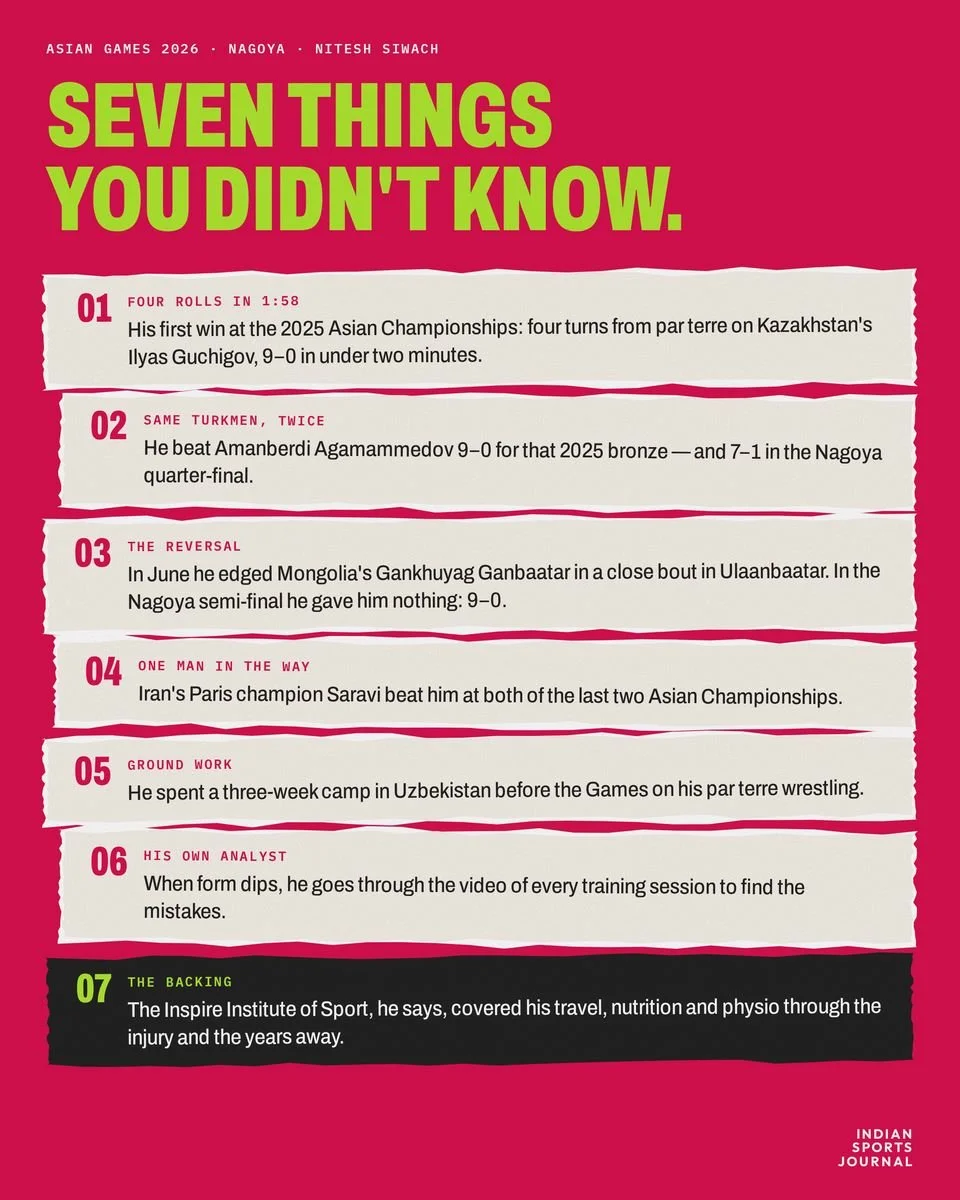
The quarter-final was a rematch. Nitesh had beaten Agamammedov 9–0 for bronze at the 2025 Asian Championships. In Nagoya the Turkmen took a point off him and lost 7–1.
The semi-final was the cleaner statement. Ganbaatar is an unusual opponent: a Mongolian who wrestles both styles, he won bronze at 97kg in freestyle at Hangzhou 2023 and has added Greco-Roman since, taking bronze in that style at the Ulaanbaatar Open in 2025 and again in June this year, when Nitesh beat him 4–1 on the way to the title. On Thursday there was nothing close about it. According to PTI, Nitesh scored two four-point throws from par terre and finished the bout by technical superiority in the first three-minute period.
Nakazato came through the other half of the draw, beating Kazakhstan’s Islam Yevloyev 10–0 in the quarter-finals and Iran’s Mehdi Balihamzehdeh 5–4 in the semi-finals. He knew the level. At the 2025 Asian Championships in Amman, the event at which Nitesh won his bronze, Nakazato reached the final and lost it to Saravi.
PTI’s account of the final has Nitesh reaching for a two-on-one grip from the start and Nakazato giving him nothing to work with. The Japanese scored first with a push-out. Nitesh was then called for passivity and put down in par terre, where he defended well enough that Nakazato could not lock a gut-wrench. It was 2–0 at the break. In the second period Nakazato pushed him off balance and turned it into a takedown for 4–0, and with a minute left, needing to attack, Nitesh could not find a way through. Ganbaatar and Balihamzehdeh took the bronze medals.
“No one from my weight category had ever won a medal here before, so there was a lot of pressure,” Nitesh said afterwards, according to Khel Now. The record says otherwise, and the man who disproves it is the reason the 64-year line exists at all.
| Round | Opponent | Score |
|---|---|---|
| Pre-QF | ByeDrawn straight into the quarter-finals | — |
| QF | Amanberdi Agamammedov, TurkmenistanBeaten 9–0 by Nitesh for Asian Championships bronze in 2025 | 7–1 |
| SF | Gankhuyag Ganbaatar, MongoliaTwo four-point throws from par terre; over in the first period | 9–0 |
| Final | Yuri Nakazato, JapanPeriod 1: push-out, then a passivity point (0–2). Period 2: takedown (0–4) | 0–4 |
The last time was Jakarta
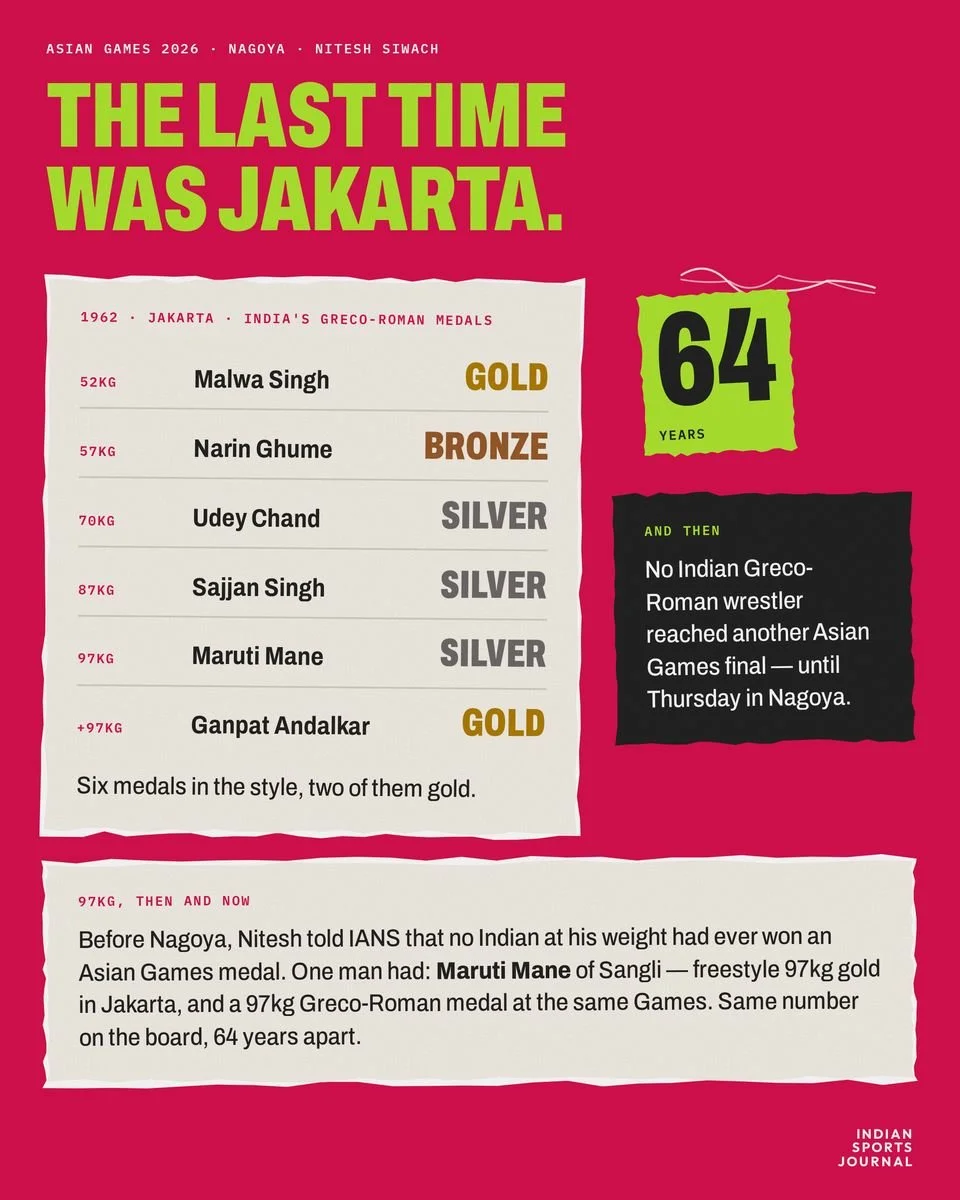
Greco-Roman first appeared at the Asian Games in Jakarta in 1962, after two freestyle-only editions, and India had its best Games in the style that year. Malwa Singh won gold at 52kg and Ganpat Andalkar at heavyweight, over 97kg. Udey Chand (70kg) and Sajjan Singh (87kg) took silver, and Narin Ghume bronze at 57kg. At 97kg, the same number Nitesh wrestles at now, Maruti Mane of Sangli won a silver that the results list as shared with Japan’s Haruo Takagi. Mane also won the freestyle 97kg gold at the same Games.
So when Nitesh told IANS before the Games that “nobody in my weight category has done well at the Games before,” and said after the final that nobody at his weight had won a medal, Mane was one exception. Sukhchain Singh Cheema’s 1974 bronze at 100kg, the class from which today’s 97kg descends, is arguably another. ISJ’s carousel made the same point about Mane.
Then the style left the programme. There was no Greco-Roman at the 1966, 1970, 1978 or 1982 Games. It returned in Tehran in 1974 and has been a fixture only since Seoul in 1986. India’s Greco-Roman medals in the six decades between Jakarta and Nagoya: Sukhchain Singh Cheema’s bronze at 100kg in 1974, Vinayak Dalvi’s at 55kg in Doha in 2006, two at Guangzhou in 2010 for Ravinder Singh (60kg) and Sunil Kumar Rana (66kg), and Sunil Kumar’s at 87kg in Hangzhou. Sunil Kumar won a second straight 87kg bronze in Nagoya on Wednesday, the day before Nitesh’s final.
Even the wire services were unsure of that history this week. PTI’s report of the semi-final said no Indian had ever won a Greco-Roman gold at the Asian Games and that India had four Greco-Roman bronze medals in all. PTI’s report of the final named Malwa Singh and Andalkar as the 1962 champions. IANS and Outlook called Andalkar the first and only Indian champion in the style, which leaves out Malwa Singh. ISJ’s count, from the Games results, is below.
Waist up, no legs
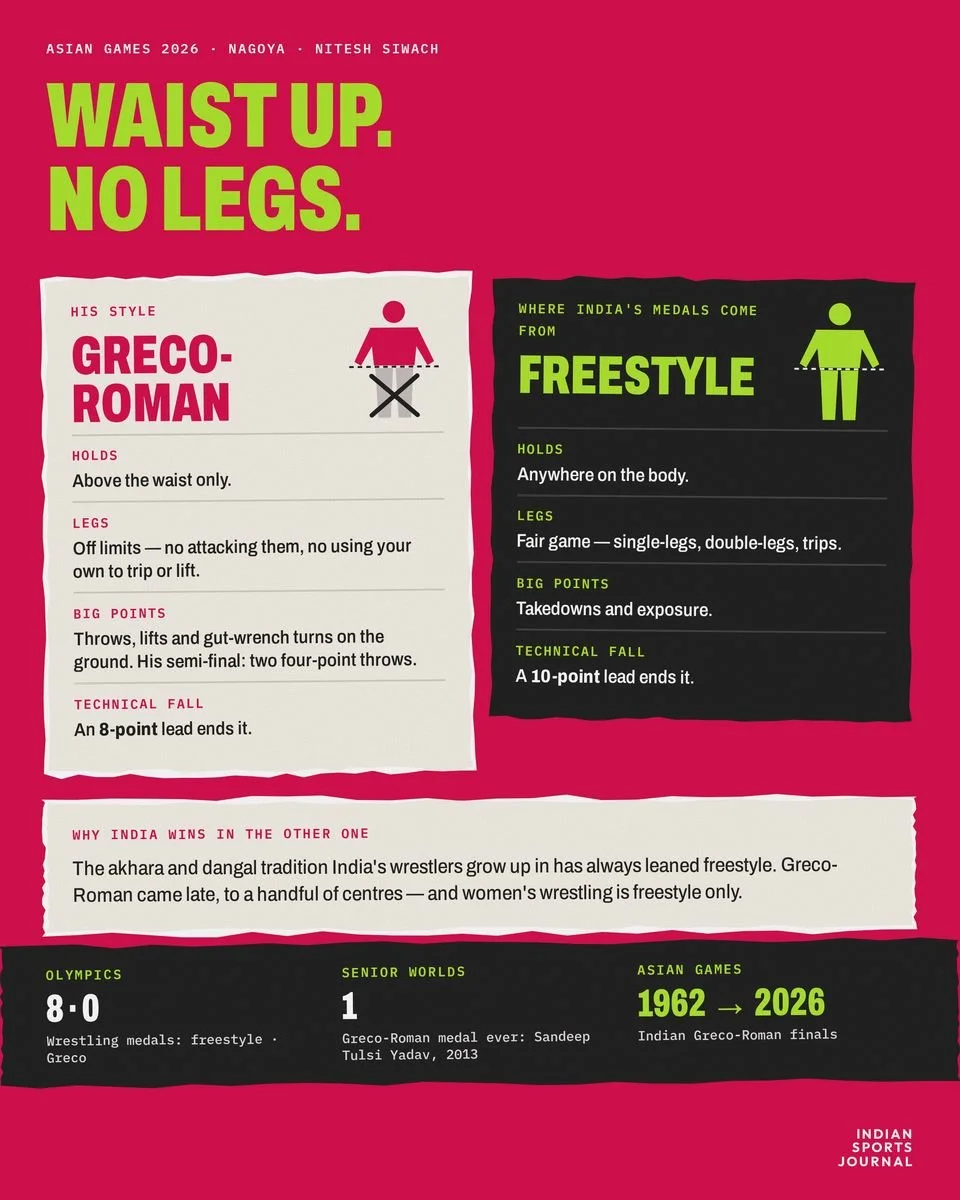
The rules explain part of the imbalance. In Greco-Roman a wrestler may hold only above the waist: no attacks on the legs, and no using his own legs to trip or lift. The big scores come from throws, lifts and turns on the ground, the gut-wrenches and rolls from par terre. A bout ends on an eight-point lead rather than freestyle’s ten. Nitesh’s semi-final was the style in miniature: both of his four-pointers came from the ground.
Most Indian wrestlers come up through akharas and the dangal circuit, where, as a 2019 analysis by The Bridge put it, training is built on freestyle. The same piece described Greco-Roman as a late arrival in India, confined to a few Sports Authority of India centres and some schools and universities, with far fewer coaches than freestyle and no place in the Pro Wrestling League that had raised freestyle’s profile. Women’s wrestling is contested only in freestyle, so India’s women’s programme never touches the style at all.
That leaves Greco-Roman with a thin top end and few reference points. A young Indian freestyler can look at Sushil Kumar, Bajrang Punia or Aman Sehrawat. A young Greco-Roman wrestler has Sandeep Tulsi Yadav’s 66kg world bronze in Budapest, now 13 years old, and, as of Thursday, Nitesh.
Two years on the milk rounds
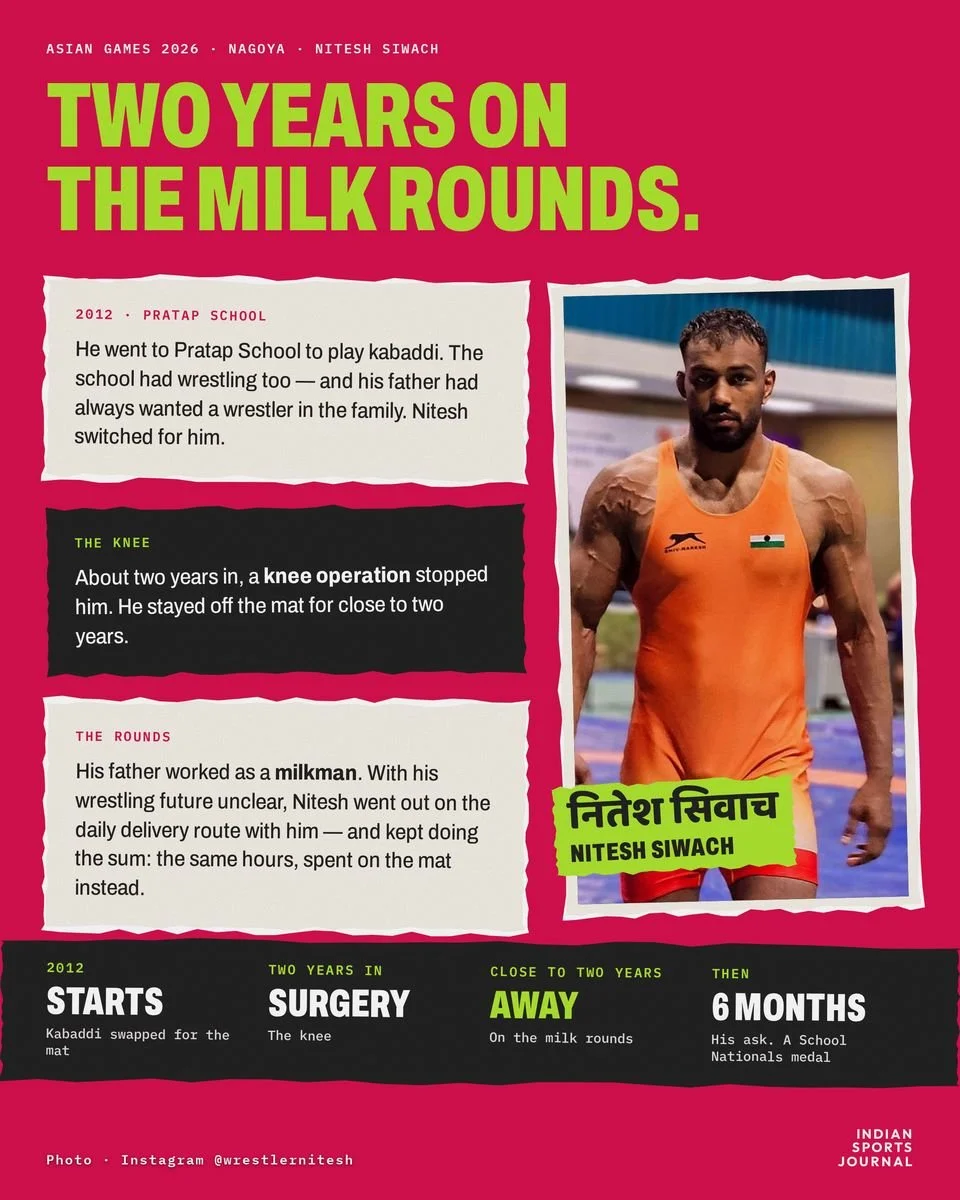
Nitesh is 23 and from Jagsi, a village in Haryana. In 2012 he went to Pratap School to play kabaddi, which he enjoyed. The school also had wrestling, and his father, Anand, had long wanted a wrestler in the family. “My father always had this dream that I should become a wrestler,” he told IANS in September. He switched.
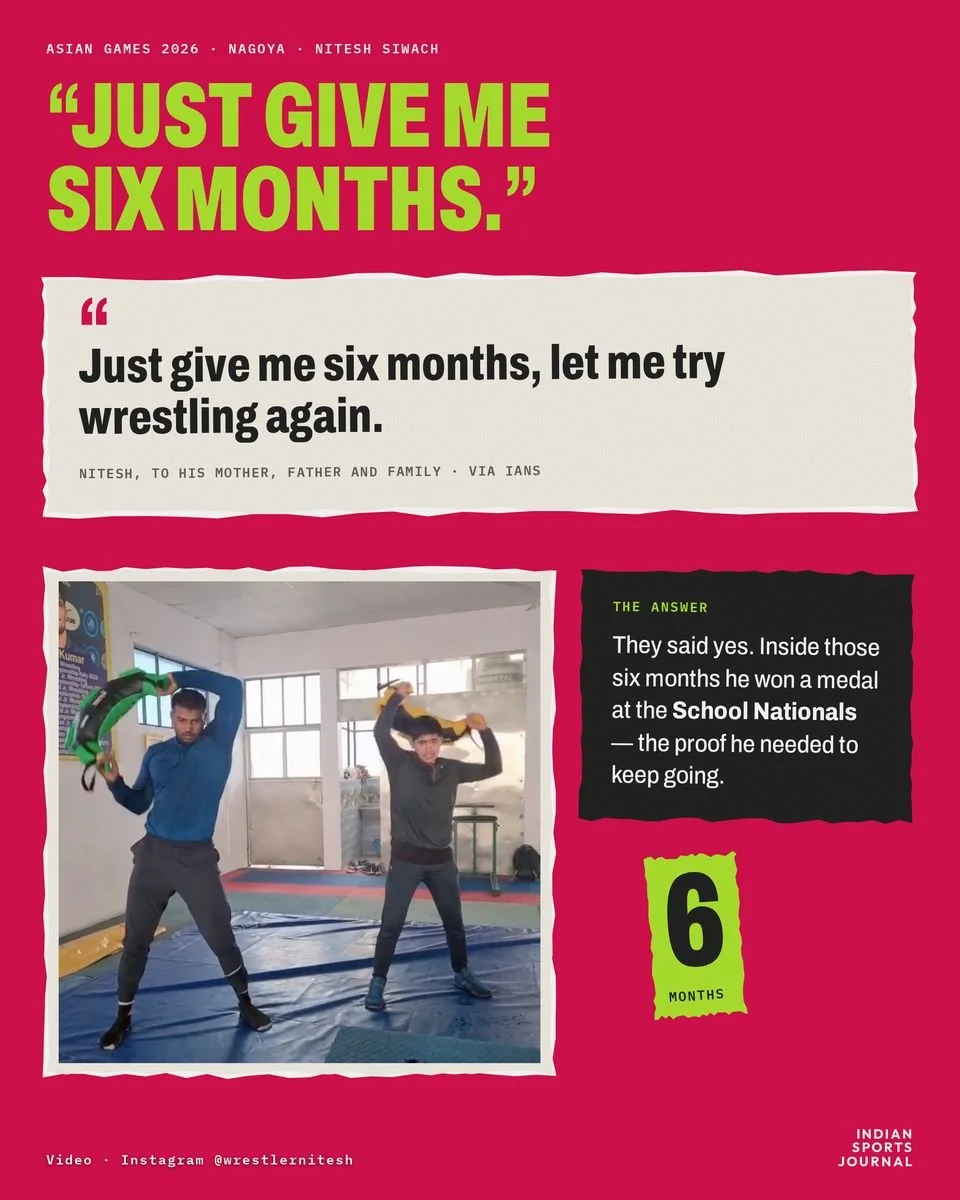
About two years in, a knee operation stopped him, and he stayed away from the sport for close to two years. His father was a milkman, and Nitesh went with him on the daily delivery rounds. Then he went to his family with a request, as he told it to IANS:
“Just give me six months, let me try wrestling again.”
They agreed. Inside those six months he won a medal at the School Nationals. He has been wrestling since.
One step up a year
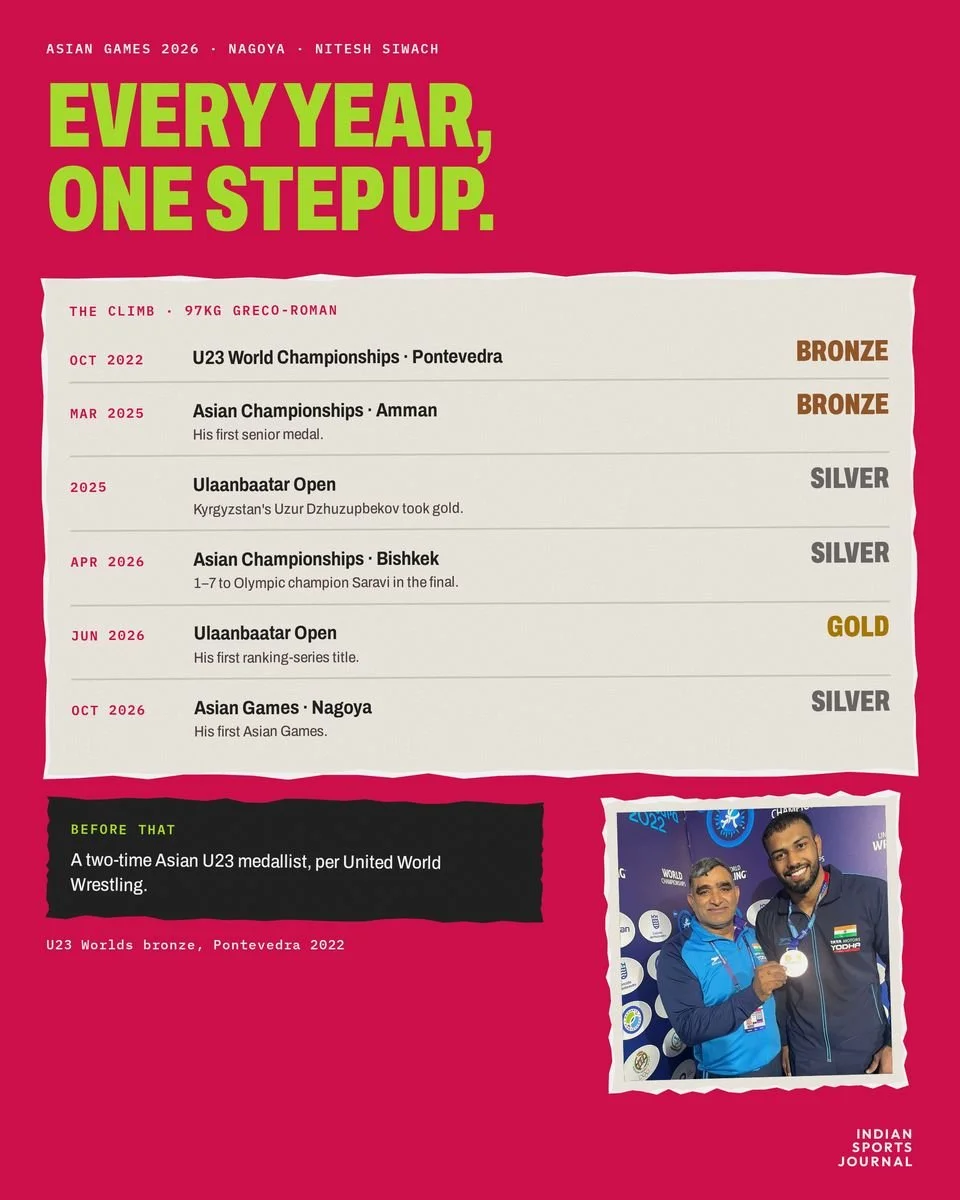
The international record starts at under-23 level. United World Wrestling describes him as a two-time Asian U23 medallist and a bronze medallist at the 2022 U23 World Championships, held in Pontevedra, Spain. The senior climb since has gone a rung at a time.
| Date | Event | Result |
|---|---|---|
| Oct 2022 | U23 World Championships, PontevedraAlso a two-time Asian U23 medallist, per UWW | Bronze |
| Mar 2025 | Asian Championships, AmmanFirst senior medal; lost 0–9 to Saravi in the semi-final | Bronze |
| May 2025 | Ulaanbaatar Open (ranking series)Final lost to Uzur Dzhuzupbekov, Kyrgyzstan | Silver |
| Sep 2025 | World ChampionshipsOut in the repechage, 4–5 to Giorgi Melia, Georgia | — |
| Apr 2026 | Asian Championships, BishkekFinal lost 1–7 to Saravi, the Olympic champion | Silver |
| Jun 2026 | Ulaanbaatar Open (ranking series)First ranking-series title; 13–9 over Nurassyl Amanaly, Kazakhstan | Gold |
| Oct 2026 | Asian Games, NagoyaFirst Asian Games; 0–4 to Yuri Nakazato, Japan, in the final | Silver |
His first senior medal came in Amman in March 2025. He opened by rolling Kazakhstan’s Ilyas Guchigov four times from par terre for a 9–0 win in 1:58, UWW reported, then ran into Saravi, in his first competition since winning Olympic gold in Paris, who beat him by technical superiority on the way to the title. Nitesh beat Agamammedov 9–0 for bronze. Two months later he lost the Ulaanbaatar Open final to Kyrgyzstan’s Uzur Dzhuzupbekov. At the World Championships that September he reached the repechage and lost there 4–5 to Georgia’s Giorgi Melia, according to The Bridge.
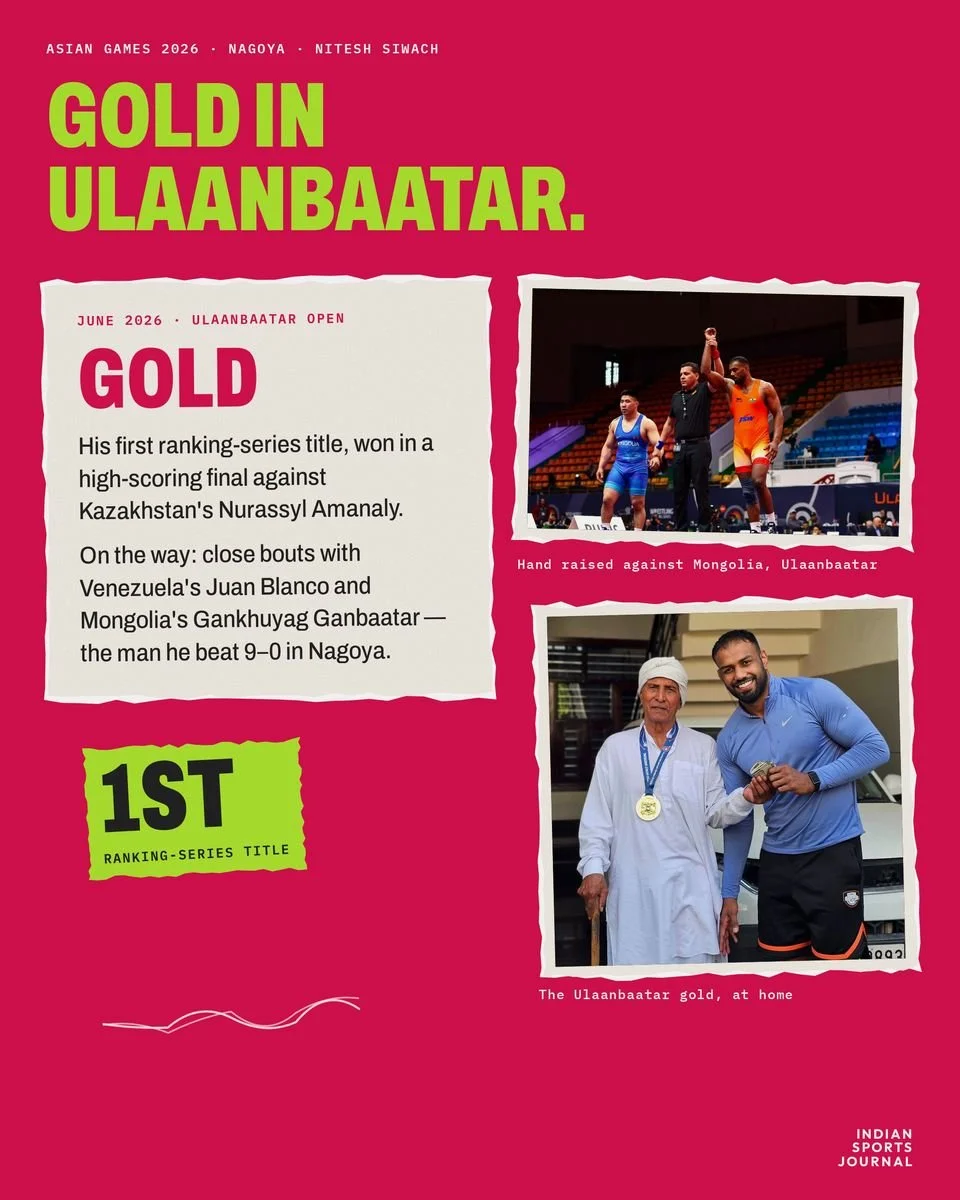
In Bishkek in April he won two bouts by technical superiority to reach the Asian final, where Saravi, the defending champion, beat him 7–1. In June he went back to Ulaanbaatar and won his first ranking-series title: 3–1 over Venezuela’s Juan Diaz, 4–1 over Ganbaatar, then 13–9 over Kazakhstan’s Nurassyl Amanaly in a final he trailed 9–5, after a four-point throw, with about two minutes left. Amanaly gave away three step-outs and a point for fleeing to bring it level, and Nitesh finished it with a takedown and a turn, UWW reported.
The backing behind the climb is private. Nitesh has the support of the Inspire Institute of Sport, the JSW Group’s high-performance centre at Vijayanagar in Karnataka, which he told IANS has covered his travel, nutrition and physiotherapy. “Whatever I have needed, they have made sure it is taken care of,” he said. Before the Games he spent three weeks at a camp in Uzbekistan and, by his own account, worked specifically on his ground wrestling, the par terre game that won him his semi-final. When his form dips, he goes back to the footage of his bouts and training sessions. “I sit and watch my own videos, to see where I am weak,” he said.
His father’s list
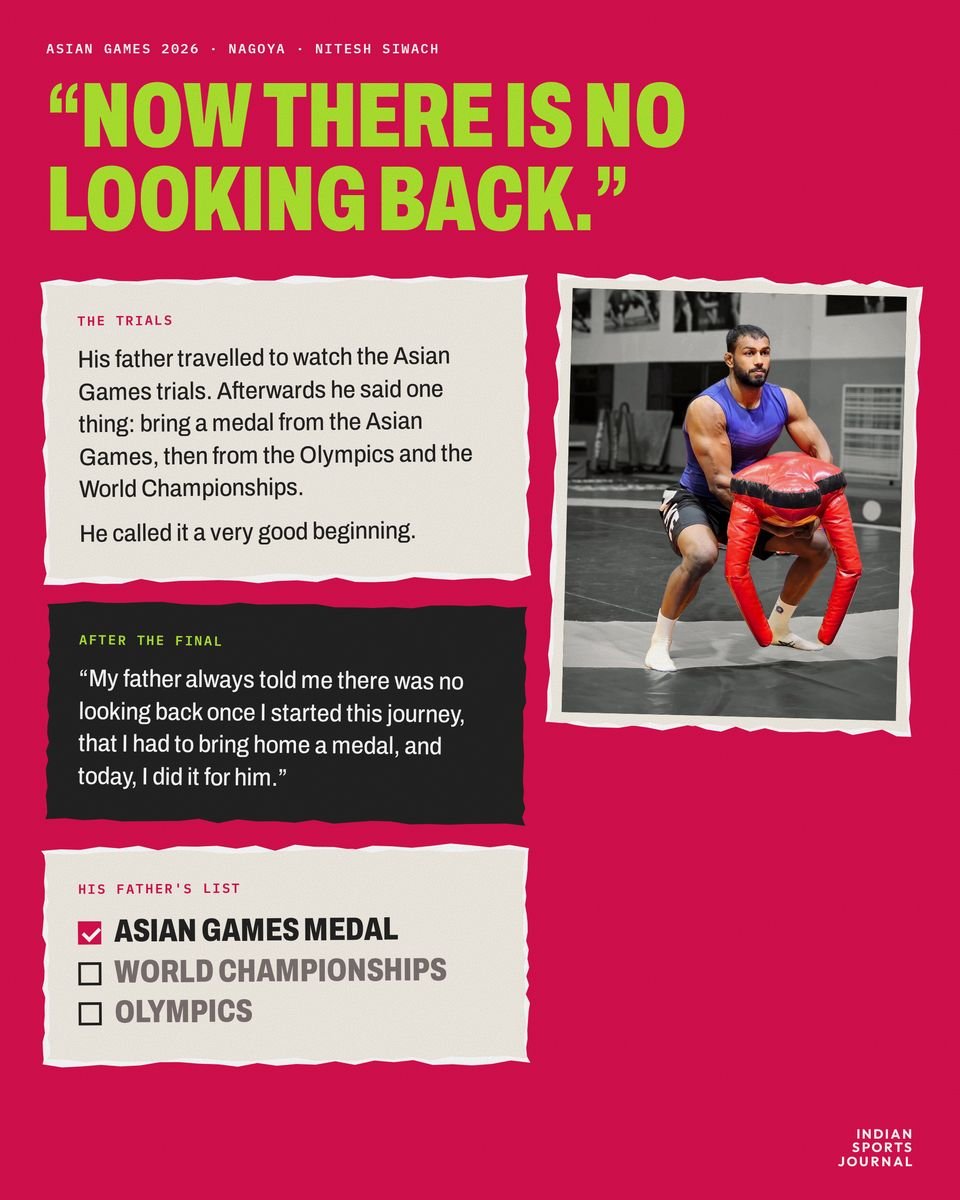
His father travelled to watch the Asian Games trials. Afterwards, Nitesh told IANS, he set out the order: there was no looking back now, a medal at the Asian Games first, then the Olympics and the World Championships. “This is a very good beginning for you,” he told his son.
On Thursday the first item was ticked. “My father always told me there was no looking back once I started this journey,” Nitesh said after the final, according to Khel Now, and said the medal was for him.
The other two are harder, and the obstacles have names. Saravi has beaten him at two straight Asian Championships, 0–9 and 1–7, and holds the Olympic title at 97kg. Nakazato has now beaten him once. The World Championships come next on the calendar, and Nitesh’s last one ended in a one-point repechage defeat.
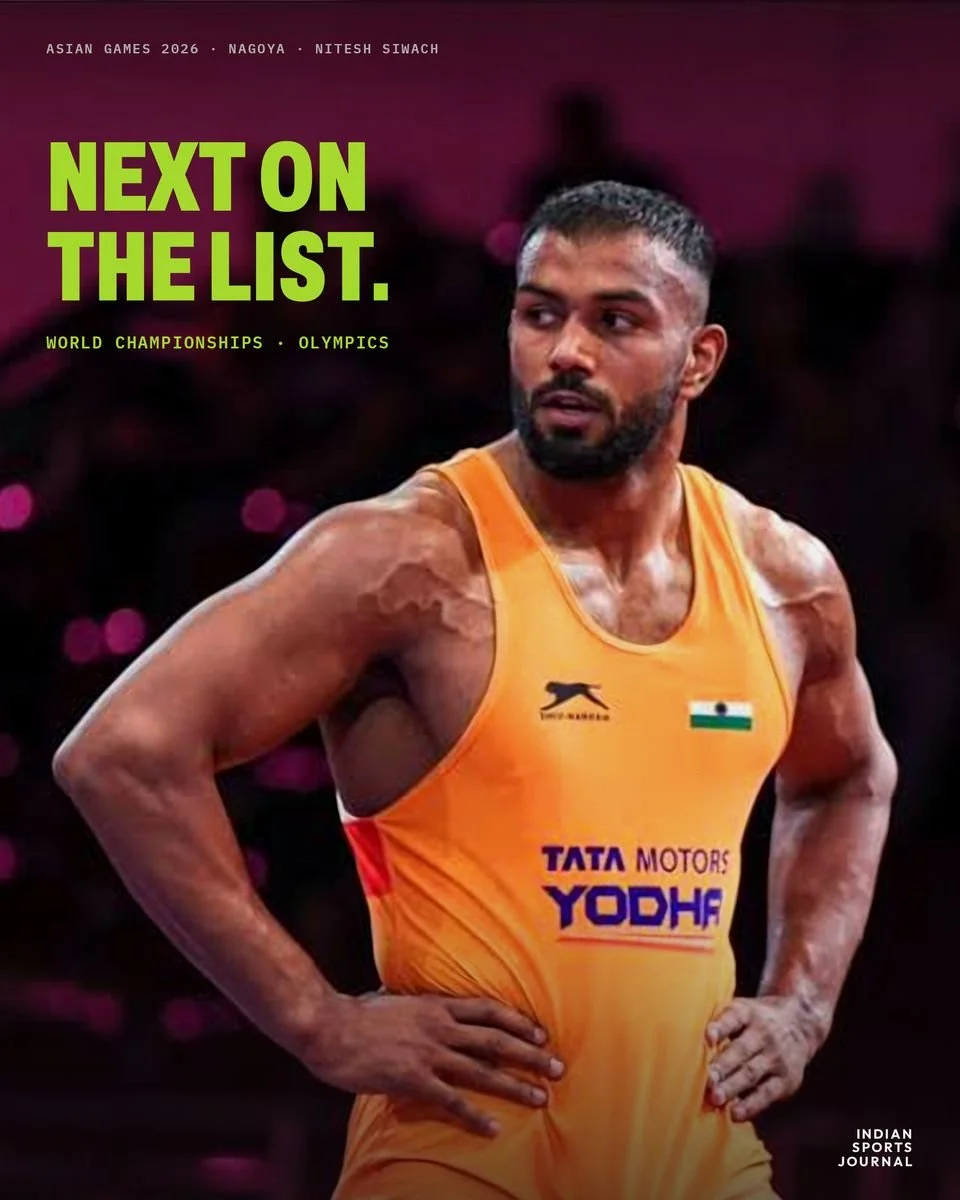
He has spent four years showing what one step up a year looks like. The list asks for two more, and the next one is a world medal no Indian Greco-Roman wrestler has won since 2013.
At the World Championships in Astana, Kazakhstan, Nitesh was seeded sixth at 97kg but lost his opening bout on 25 October to Germany’s Anton Vieweg, 1–1 on criteria, according to United World Wrestling’s official bracket. Vieweg went out 5–0 to Saravi in the quarter-finals, so there was no repechage. Saravi finished with bronze. India’s count of senior world medals in Greco-Roman stays at one.
Sourcing. Built from ISJ’s carousel; the IANS interview of 9 September 2026 (IANS Live, Telangana Today); ANI via Gulf News and Asianet; PTI via DT Next and ThePrint; Outlook, Khel Now, MyKhel and UNI on the Nagoya bouts; United World Wrestling’s live reports from the 2025 Asian Championships and the 2025 and 2026 Ulaanbaatar Opens; The Bridge, The Tribune, Sportskeeda, Wion and the Wrestling Federation of India on Amman 2025, Bishkek 2026 and the 2025 World Championships; The Bridge (2019) on Greco-Roman in India; Asian Games results for every edition from 1954 to 2023, as compiled on Wikipedia from the FILA/UWW database; PTI (2018) on the launch of the Inspire Institute of Sport; UWW’s official bracket for the 2026 World Championships.
Corrections to the carousel. Slide 2: Ganbaatar’s Hangzhou 2023 bronze was in freestyle 97kg, not Greco-Roman, per the Hangzhou results; he won Greco-Roman bronze in Nagoya. Slide 3: the pre-Games IANS quote was “nobody in my weight category has done well at the Games before”; the “never won a medal” wording comes from his remarks after the final (Khel Now, MyKhel). The point the slide makes about Maruti Mane stands; his 1962 Greco-Roman silver is recorded as shared with Japan’s Haruo Takagi. Slide 5: the line that he “kept doing the sum: the same hours, spent on the mat instead” is not in the IANS or ANI interviews and is not carried. Slide 8: the Venezuelan beaten at the 2026 Ulaanbaatar Open is “Juan Diaz” in UWW’s report and “Juan Blanco” in The Bridge’s; this page uses UWW’s. Slide 9, item 07: that IIS supported him “through the injury and the years away” could not be confirmed. IANS uses the phrase but gives no start date for the support; the Inspire Institute of Sport opened in August 2018 (PTI), and the IANS timeline puts the knee operation about two years after he began in 2012. Not carried as fact. Slide 10: the full post-final quote (“My father always told me there was no looking back once I started this journey, that I had to bring home a medal, and today, I did it for him”) appears verbatim in Khel Now’s report of 1 October; the slide is correct. The page quotes the first clause and paraphrases the rest.
Flag. History: PTI’s semi-final report says no Indian has won an Asian Games Greco-Roman gold and counts four Greco-Roman bronze medals in all; PTI’s final report, Khel Now and others name the 1962 champions; IANS (via Telangana Today) and Outlook call Andalkar the “first and only” champion, leaving out Malwa Singh. The 1962 and 1974 results rest on the FILA/UWW database as compiled on Wikipedia, which also shows Mane’s 97kg Greco-Roman silver as shared. Fact-check (28 October): Olympedia independently lists Malwa Singh’s 1962 Greco-Roman 52kg gold and Greco-Roman silvers for Udey Chand (70kg), Sajjan Singh (87kg) and Mane (97kg, shown as second, not shared), so PTI’s semi-final count and the IANS/Outlook “first and only” line are both wrong, and no Indian won a Greco-Roman medal better than bronze between 1962 and 2026 (Wikipedia medallist tables, 1966–2023). The 64-year headline stands as a first Greco-Roman silver since 1962. The final: PTI has a push-out followed by a passivity point; ANI has Nitesh conceding 0–2 on the passivity call alone. Age: 23 per IANS, UNI and Wion; The Bridge (April 2026) and UWW’s athlete profile give 24. Nakazato’s quarter-final and semi-final scores rest on results listings (Wikipedia, Katadata) rather than match reports. Since publication: Wikipedia’s bracket gives Vieweg an 8–0 win; UWW’s official bracket gives 1–1 on criteria, which this page uses.