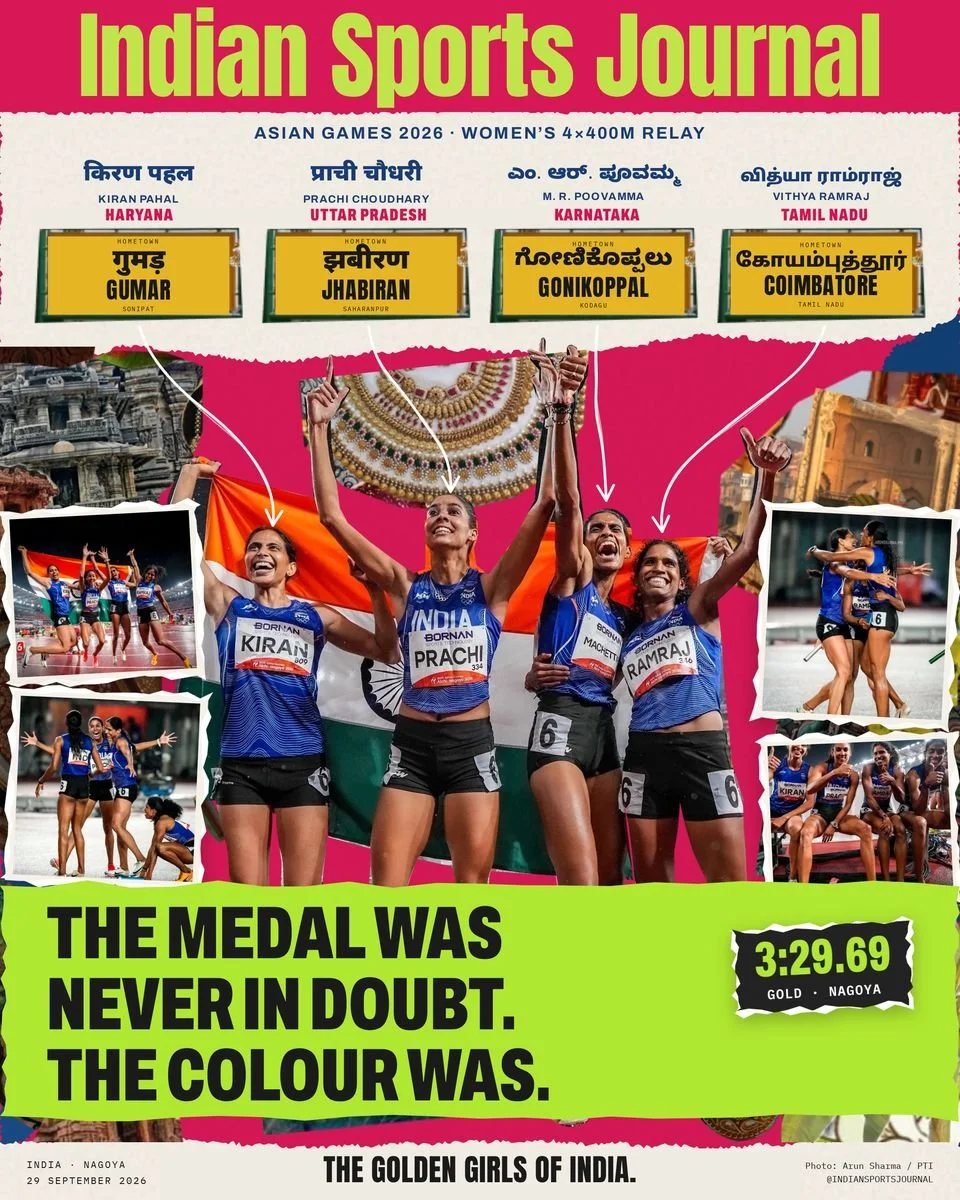
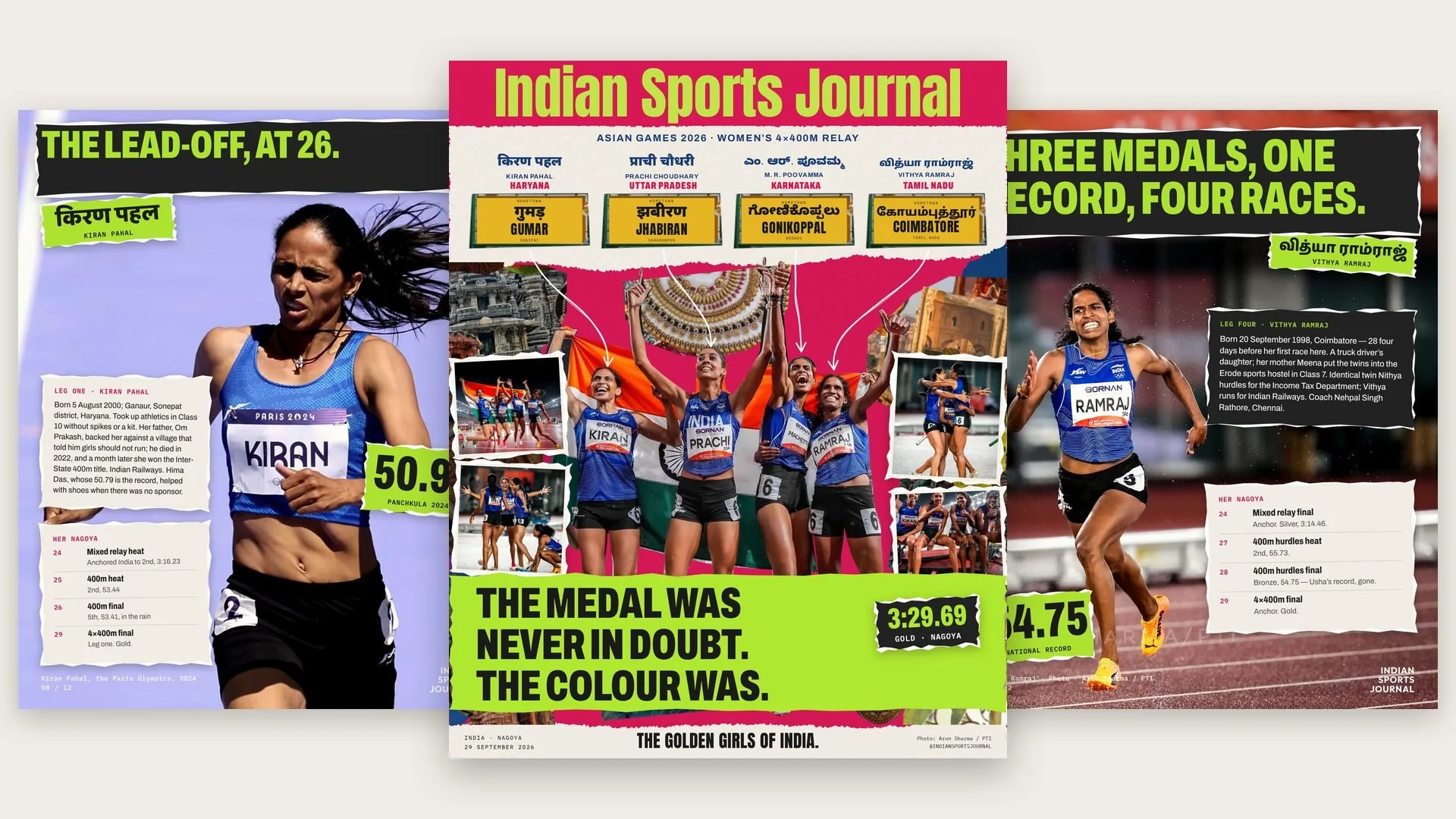
The Medal Was Never in Doubt. The Colour Was.
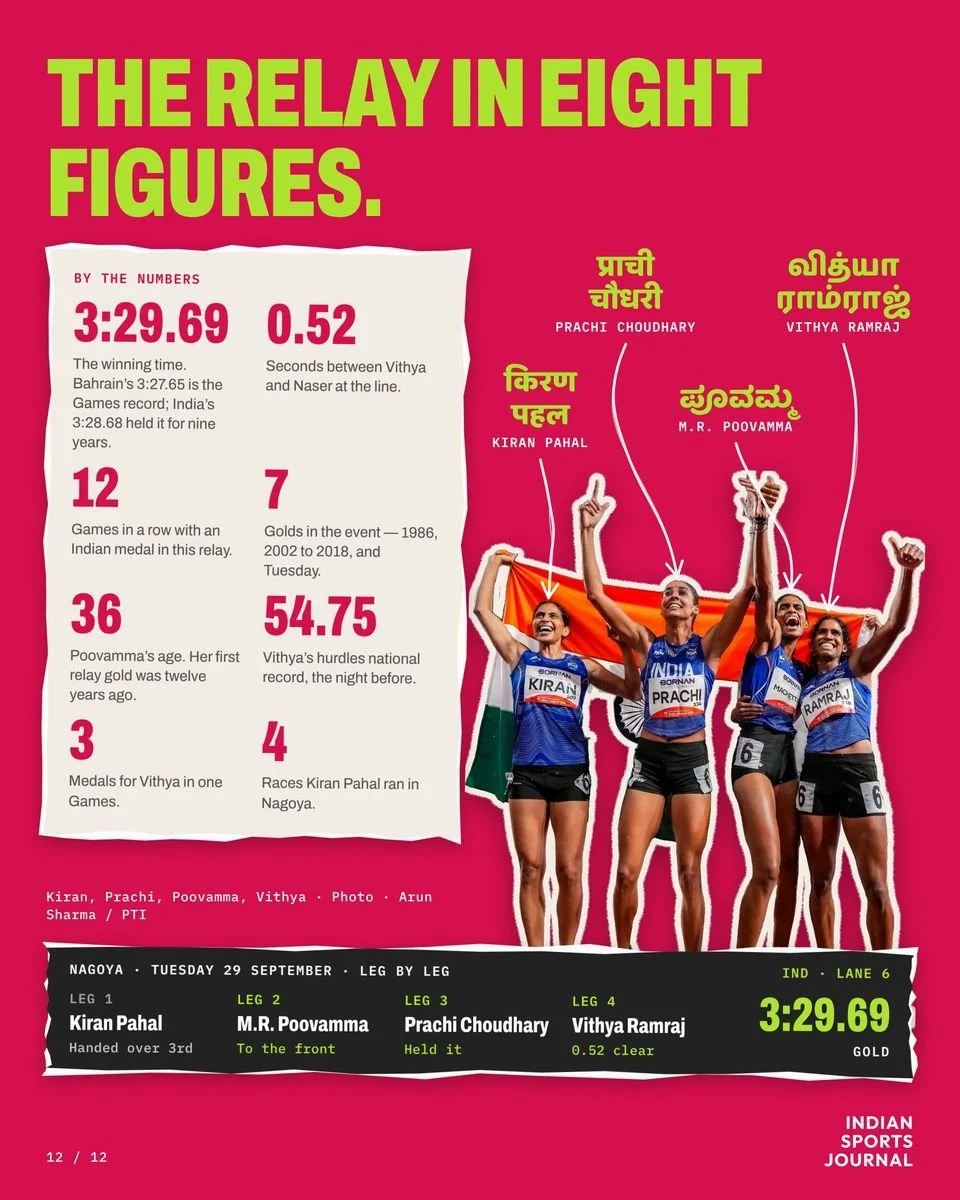
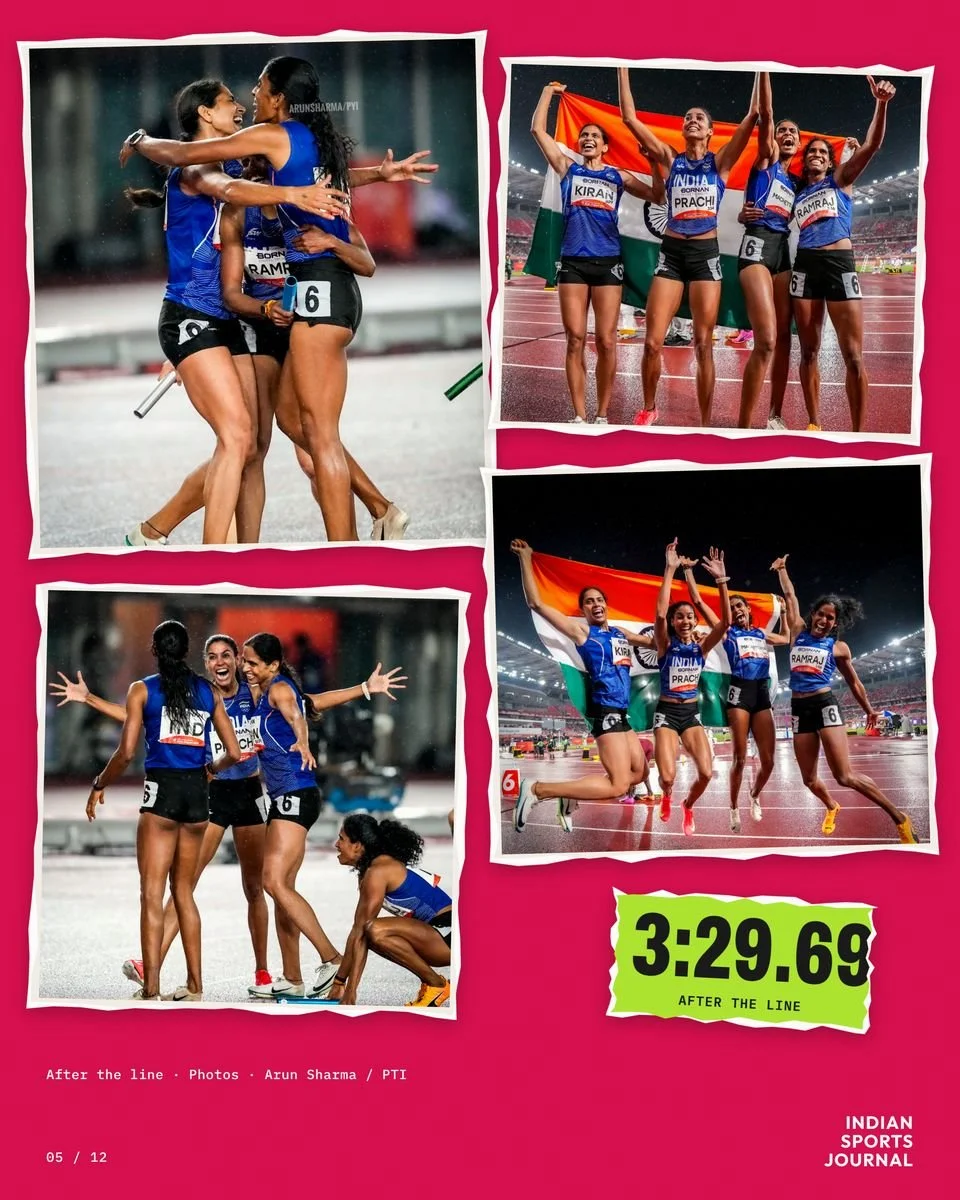
Kiran Pahal, M.R. Poovamma, Prachi Choudhary and Vithya Ramraj won the women’s 4x400m relay in 3:29.69, 0.52 seconds clear of Salwa Eid Naser’s Bahrain. It is India’s first athletics gold in Nagoya, and the title Bahrain took from them in Hangzhou is back.
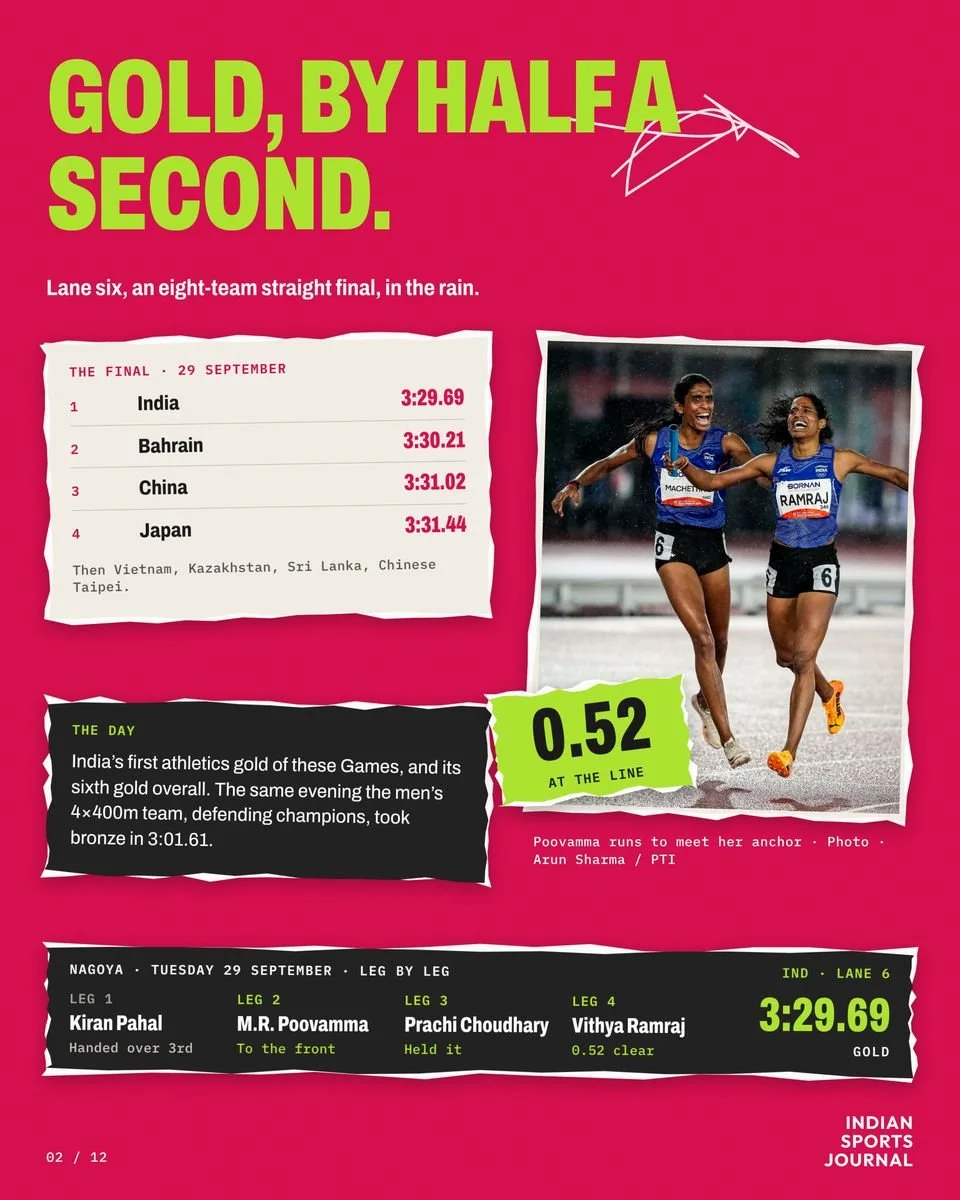
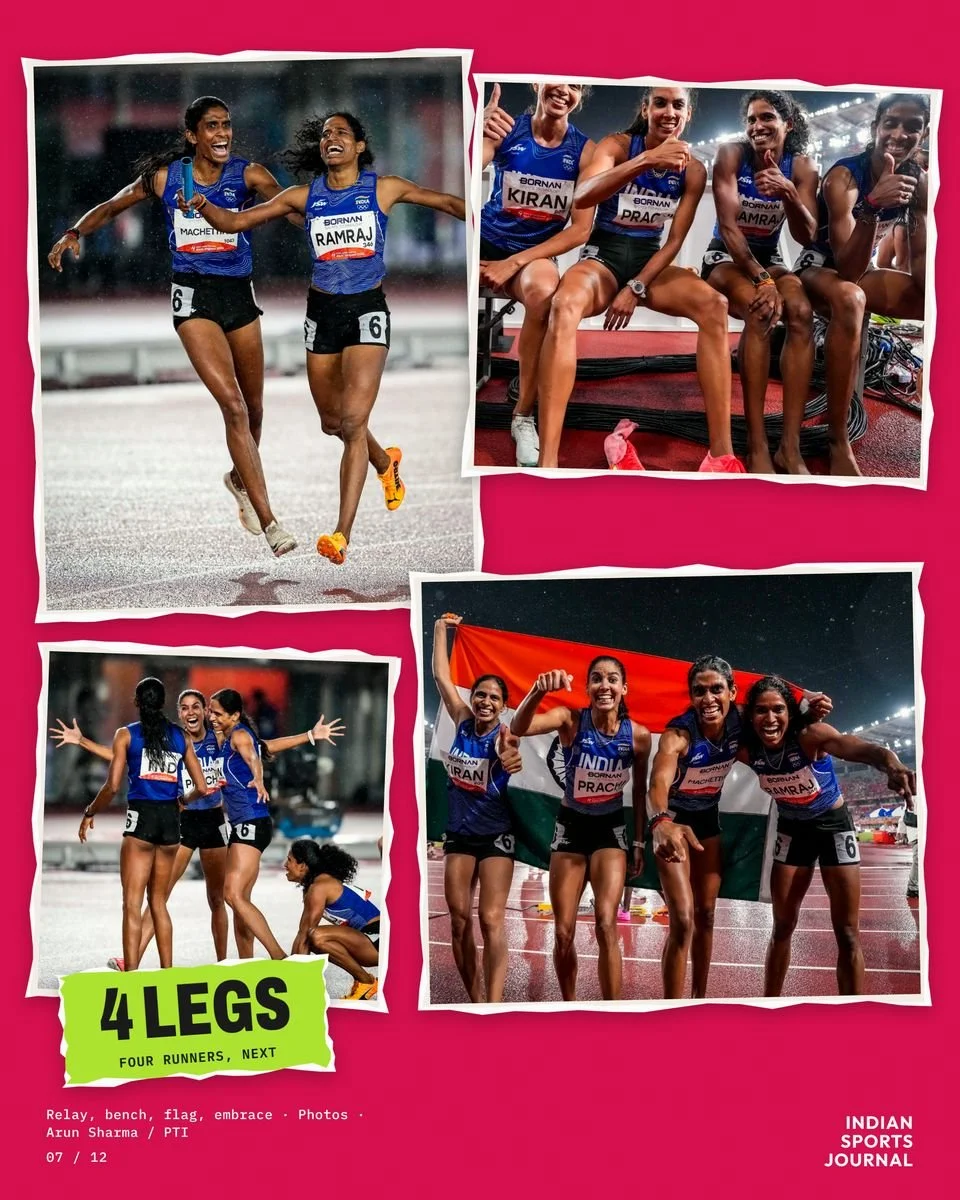
India’s women won the 4x400m relay at the Asian Games in Nagoya on Tuesday in 3 minutes 29.69 seconds. Kiran Pahal ran the first leg, M.R. Poovamma the second and Prachi Choudhary the third, and Vithya Ramraj brought the baton home 0.52 seconds ahead of Bahrain, whose last runner was Salwa Eid Naser, the Asian record holder at 400m. China were third in 3:31.02, Japan fourth in 3:31.44.
It is India’s first gold in athletics at these Games and its sixth overall, the second of the day after Neeru Dhanda’s in the women’s trap. Until the relay, as National Herald’s report of the race noted, the track and field team had been in danger of leaving an Asian Games without an athletics gold for the first time since Hiroshima in 1994. The same evening the men’s 4x400m team, the defending champions, took bronze in 3:01.61 behind Japan and Qatar.
No event in Indian athletics is more dependable than this one. India have won a medal in the women’s 4x400m at every Asian Games since 1982, twelve in a row, and Tuesday’s was the seventh gold. But dependable had stopped meaning gold. A run of five straight titles ended in Hangzhou in 2023, where Bahrain, with Naser on the last leg, beat India by 0.20 seconds in a Games record. In Nagoya the podium was close to a given; the step was not. It was settled by four runners who each arrived with a race already in their legs or a gap in their careers: a lead-off on her fourth race in six days, a 36-year-old back from a doping ban, a third-leg runner three days after her first individual Asian Games medal, and an anchor who had broken P.T. Usha’s 42-year-old national record the day before.
| Pos | Team | Time |
|---|---|---|
| 1 | IndiaKiran Pahal, M.R. Poovamma, Prachi Choudhary, Vithya Ramraj · lane six | 3:29.69 |
| 2 | BahrainAnchor: Salwa Eid Naser · 0.52 behind | 3:30.21 |
| 3 | ChinaAnchor: Zuo Siyu · 1.33 behind | 3:31.02 |
| 4 | Japan1.75 behind | 3:31.44 |
| 5–9: Vietnam, Kazakhstan, Sri Lanka, Chinese Taipei, Hong Kong | ||
Half a second, leg by leg
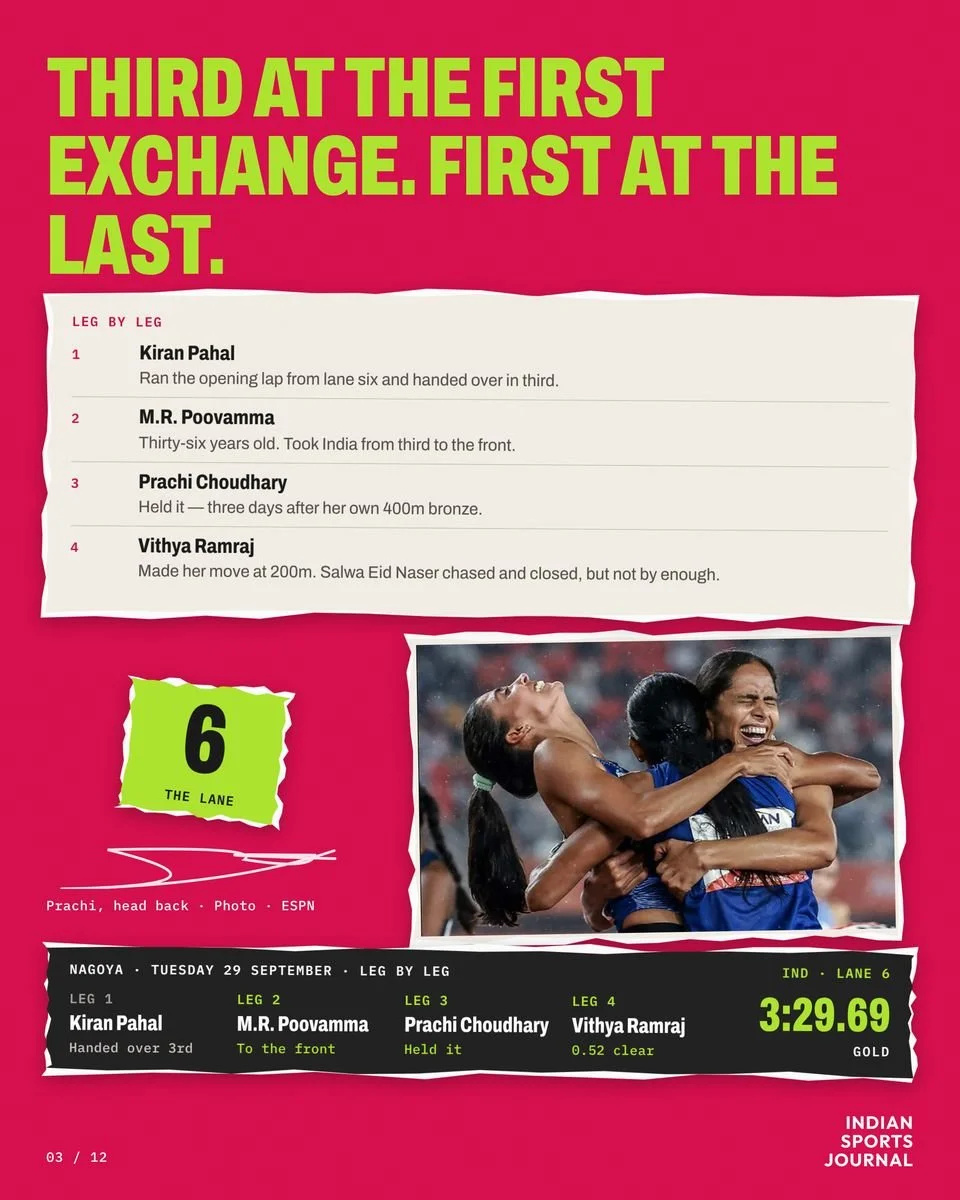
Some of the race is settled. Pahal started India from lane six and handed over in third; every report that gives her position agrees on that. Ramraj made the decisive move in the second half of the anchor leg (around the 200m mark in Sportstar, Morung Express and NewsBytes, in the final 200m in ThePrint) and India finished 0.52 seconds clear. What happened in between depends on which account you read.
PTI’s report, carried by National Herald, has Poovamma taking India into the lead on the second leg and Choudhary keeping them there. Sportstar’s Jonathan Selvaraj, reporting from the stadium, has it differently: Poovamma, fourth when the lanes merged, passed Japan and Bahrain to hand over with only China ahead; Choudhary held second behind China’s Zhou Li and saw off a charge from Bahrain’s Zainab Fyofuoba, who faded; and Naser took Bahrain’s baton in last place, a little over five seconds after Ramraj had hers. ThePrint, Hindustan Times and Morung Express also have Ramraj setting off behind the leader, China’s Zuo Siyu, which sits more easily with Sportstar’s version than with a front-running one. ISJ found no published splits that settle it.
Ramraj’s own account points the same way. “I was a bit confused around the 300m mark,” she told ThePrint. “Do I overtake her now, or do I wait and keep chasing her?” She went. Naser came through to second and cut into India’s lead, but not by enough. Ramraj had been given the leg on trust, she said: “They have trusted me as the anchor runner. I had to live up to it, right?”
| Leg | Runner · what was reported | Status |
|---|---|---|
| 1 | Kiran PahalOpened from lane six; handed over in third. | Agreed |
| 2 | M.R. PoovammaTook India into the lead (PTI) or to second, behind China (Sportstar). | Differs |
| 3 | Prachi ChoudharyKept India ahead (PTI) or held second, behind China (Sportstar). | Differs |
| 4 | Vithya RamrajMoved in the second half of the leg; passed China’s Zuo Siyu (Sportstar, ThePrint); held off Naser by 0.52. | Agreed |
Naser, for the third time
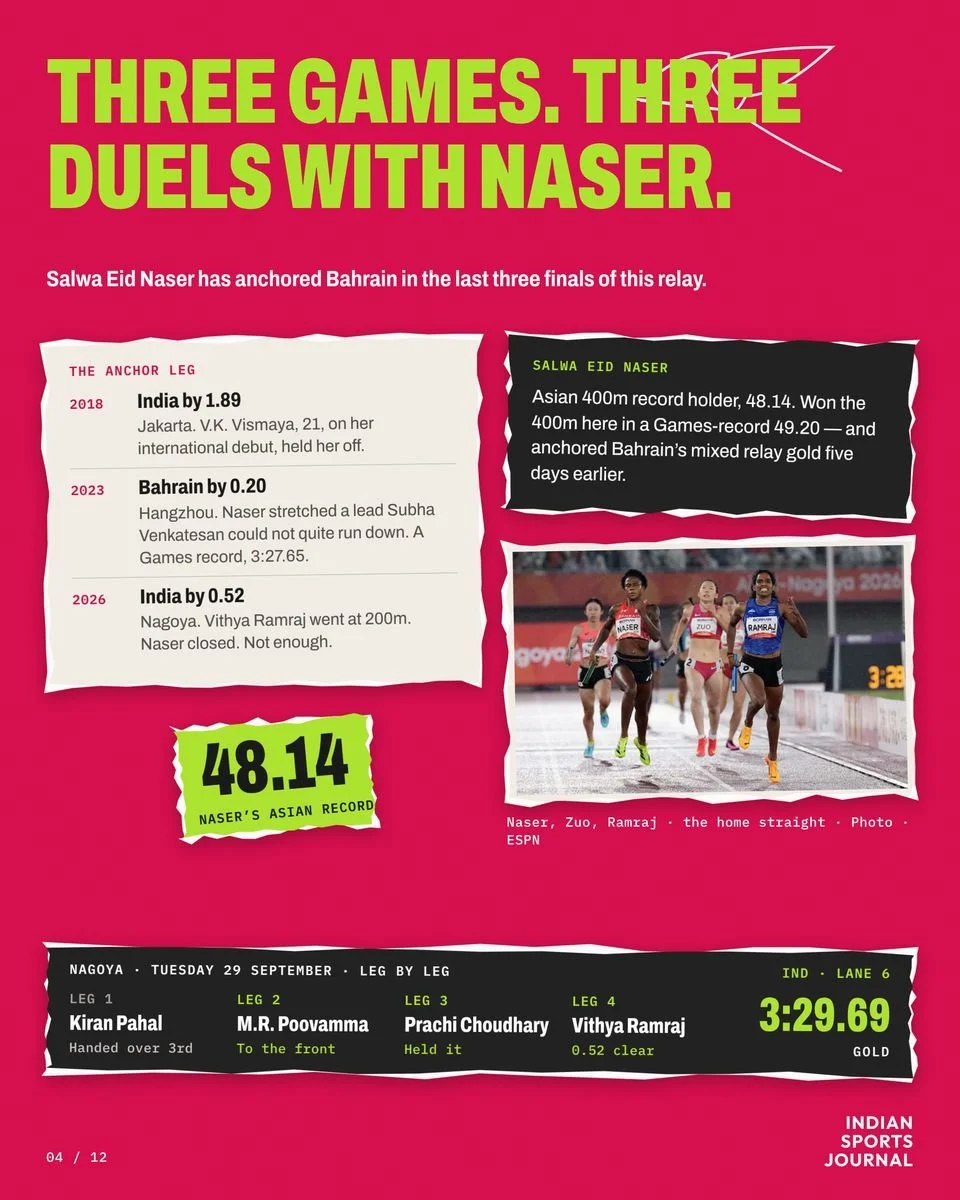
Naser is the reason Bahrain arrive at every Asian Games final in this event as the team to beat. Born in Nigeria and running for Bahrain since 2014, she won the 2019 world title in 48.14, still the Asian record, and took Olympic silver in Paris in 2024. In Nagoya she won the individual 400m on Saturday in 49.20, a Games record, by 3.18 seconds. Two days before that she anchored Bahrain’s mixed 4x400m team to gold in an Asian Games record of 3:12.87, with Ramraj anchoring India to silver in 3:14.46.
Tuesday was her third women’s relay final against India, and all three have turned on the woman asked to deal with her. In Jakarta in 2018 India’s coach, Galina Bukharina, gave the anchor to V.K. Vismaya, 21 and running her first international race, rather than to Hima Das. “Hima wanted to run the anchor. But I said no,” Bukharina told ESPN. Vismaya held Naser off and India won by 1.89 seconds. In Hangzhou in 2023 it went the other way: Bahrain 3:27.65, a Games record, India 3:27.85 with Subha Venkatesan on the last leg. The record Bahrain broke was India’s own 3:28.68 from Incheon, which had stood for nine years.
Twelve Games, twelve medals
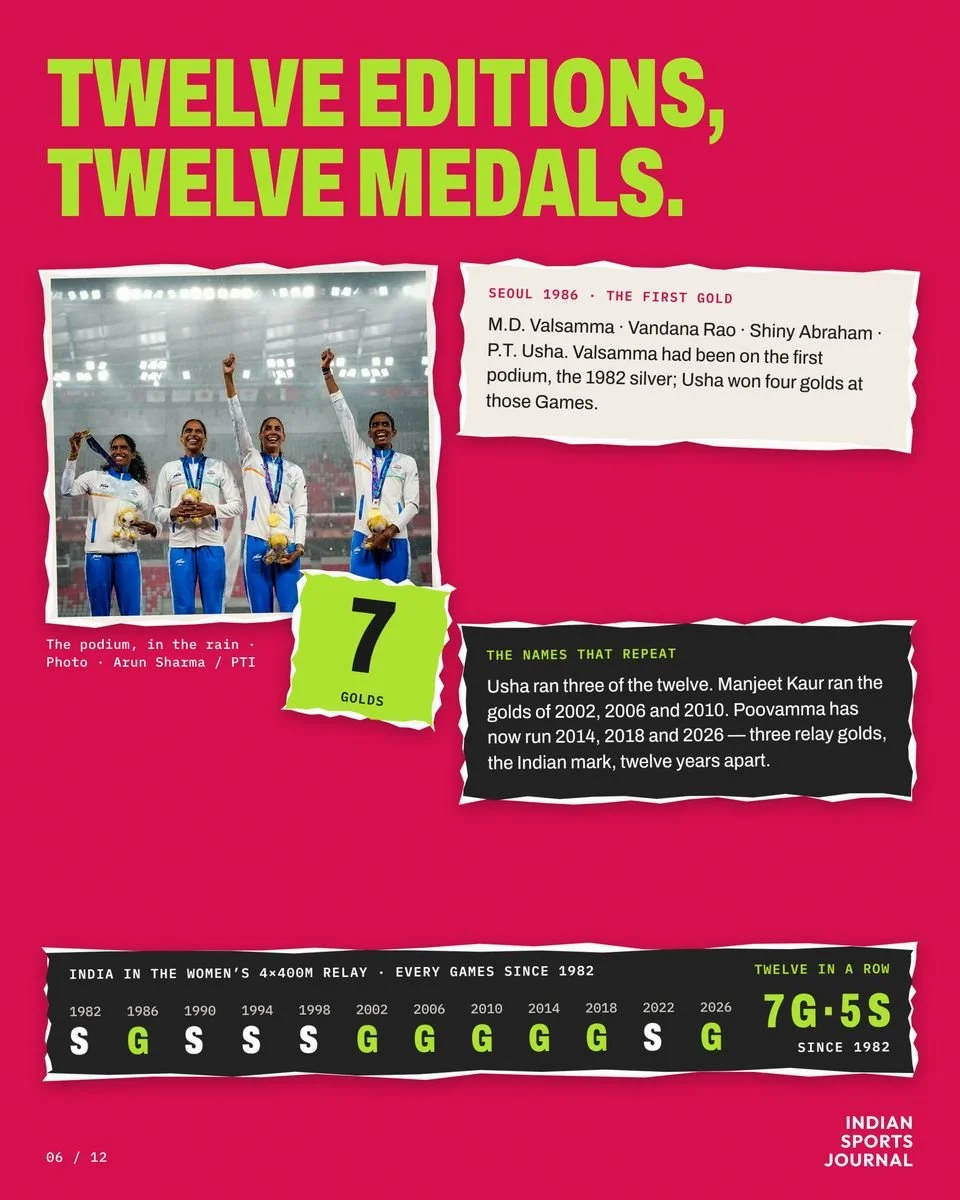
The women’s 4x400m has been on the Asian Games programme since 1974, and India did not reach the podium in its first two editions. The streak began in New Delhi in 1982 with a silver behind Japan, run by Rita Sen, Hamida Banu, M.D. Valsamma and Padmini Thomas. Four years later in Seoul, Valsamma, Vandana Rao, Shiny Abraham and P.T. Usha won the first gold, in a Games record 3:34.58. It was one of Usha’s four golds at those Games, with the 200m, the 400m and the 400m hurdles.
Then came a long stretch in second place. China won in 1990, 1994 and 1998, the last of them by 0.17 seconds in Bangkok. Usha ran three of India’s twelve medal-winning finals: 1986, 1990 and 1994. From Busan in 2002 to Jakarta in 2018 India won five in a row, three of them with Manjeet Kaur (2002, 2006, 2010), and the 2010 and 2014 teams each lowered the Games record, to 3:29.02 and then 3:28.68. India’s fastest time in an Asian Games final remains the Hangzhou silver, 3:27.85.
Poovamma’s gold on Tuesday was her third in the event, after Incheon 2014 and Jakarta 2018, twelve years after the first. It equals Manjeet Kaur’s three, the most by any Indian in these finals.
The lead-off and the one who was there in 2014
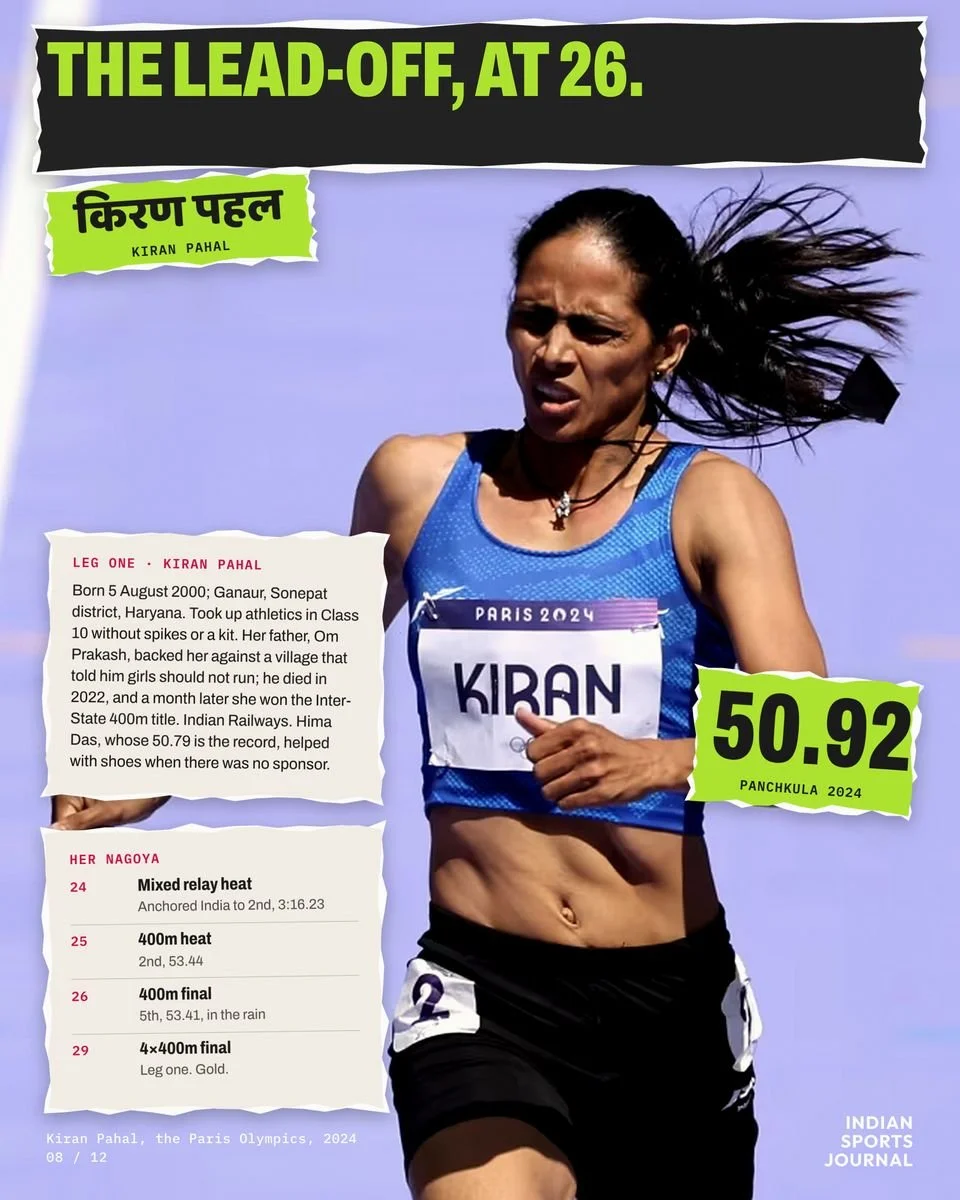
Pahal is 26, from Sonipat district in Haryana, and a clerk with Indian Railways. She took up athletics around Class 10 without the money for running shoes or a kit, The Bridge reported in 2022, and her father, Om Prakash, a clerk at the tehsil court, backed her when neighbours told him girls should not play sport. He died in May 2022 after a long lung illness. A month later she won the 400m at the National Inter-State Championships in 52.47. “He was the one behind my taking up to athletics, but he is no more,” she said then. Hima Das, whose 50.79 from 2018 is still the national record, looked out for her when they were in camp together; “she used to give me jerseys and shoes,” Pahal told The Bridge in 2024.
In June 2024, at the Inter-State Championships in Panchkula, she ran 50.92, inside the Olympic standard of 50.95, and went to Paris. In Nagoya she was the busiest of the four. On Thursday she anchored India’s mixed relay heat to second place in 3:16.23, which earned her a share of the silver. She ran the 400m heats on Friday and finished fifth in Saturday’s final in 53.41, in the rain. On Tuesday she ran the opening leg of the relay: four races in six days.
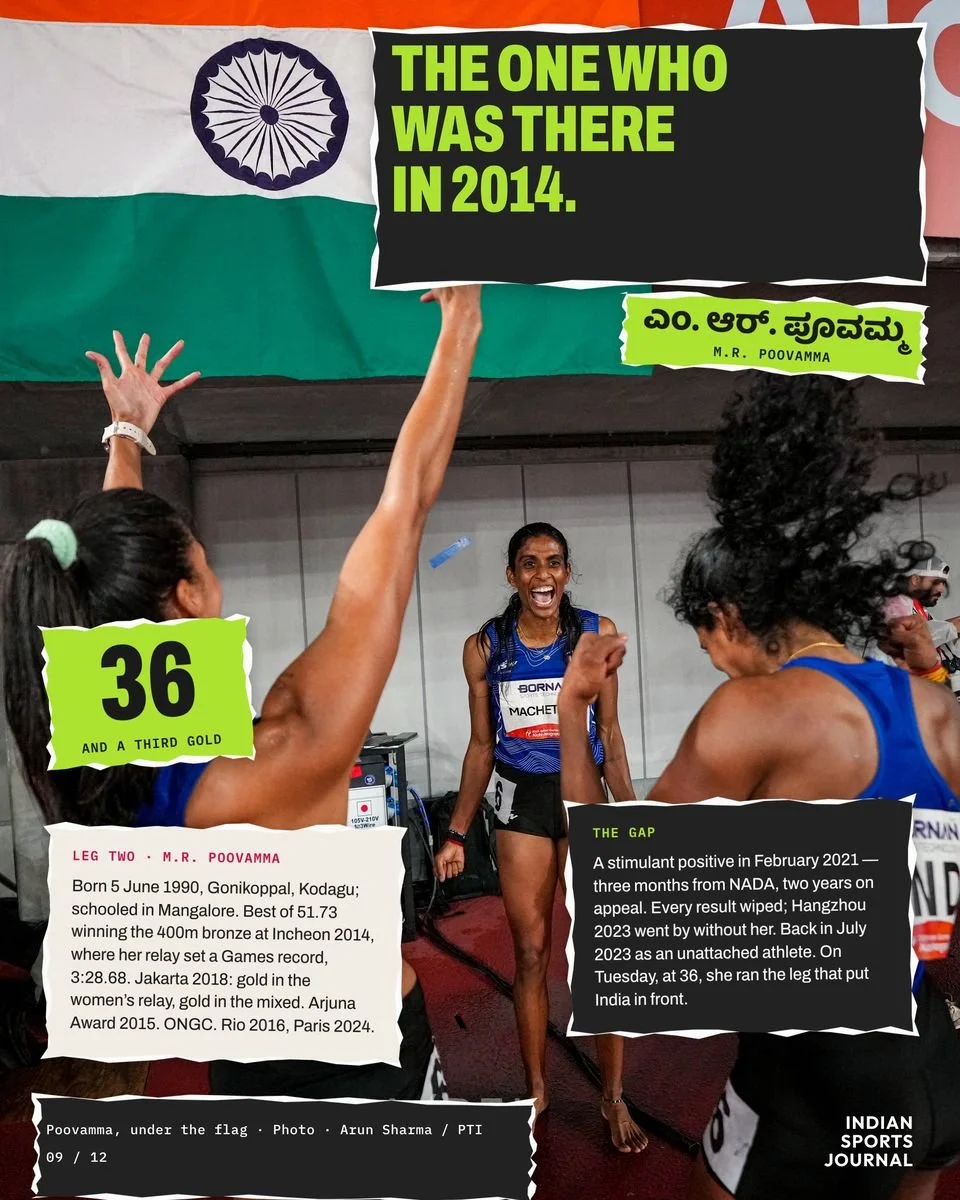
Poovamma was the only one of the four who had won this title before, and she had won it twice. Born on 5 June 1990 in Gonikoppal, in Karnataka’s Kodagu district, and schooled in Mangaluru, she runs for ONGC. At Incheon in 2014 she won the individual 400m bronze in 52.36 and anchored the relay to its Games record; the Arjuna Award followed in 2015. In Jakarta in 2018 she ran the second leg of the relay gold and was part of the mixed 4x400m team that finished second to Bahrain, a silver upgraded to gold in July 2020 after Bahrain were disqualified over Kemi Adekoya’s doping ban. She ran the relay at the Rio and Paris Olympics.
Then came the gap. At the Indian Grand Prix in Patiala on 18 February 2021 she tested positive for methylhexaneamine, a stimulant on the World Anti-Doping Agency’s prohibited list. NADA’s disciplinary panel gave her three months in June 2022; NADA appealed, and that September the appeal panel made it two years and annulled her results from the date of the test, Olympics.com reported. She was not in Hangzhou. She came back in late July 2023, running the Sri Lankan national championships in Colombo as an unattached athlete. In Nagoya, at 36, she ran the mixed relay heat and final on Thursday, for another silver, and the second leg on Tuesday. By ISJ’s count from the results, that is six Asian Games medals, four of them gold.
The third leg and the anchor
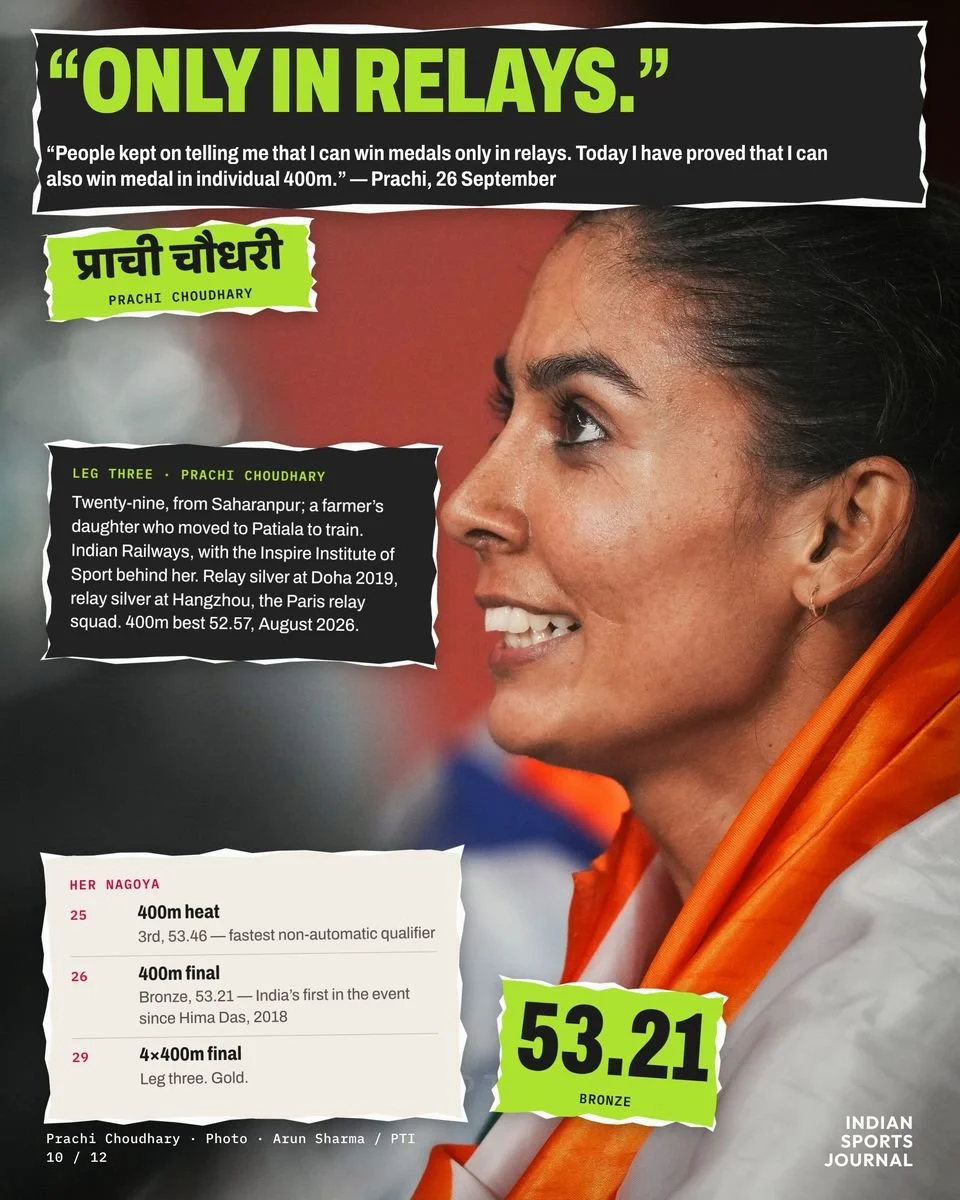
Choudhary, 29, from Saharanpur in Uttar Pradesh, had spent her senior career as a relay runner: silver in the 4x400m at the 2019 Asian Championships in Doha, silver in Hangzhou, a place in India’s relay squad for Paris. On Saturday, in the rain, she won the individual 400m bronze in 53.21, behind Naser and Iran’s Zahra Zarei Manoujan (52.38), having gone into the final with only the sixth-fastest personal best in the field, according to Outlook. Pahal was fifth. It was the first individual Asian Games 400m medal by an Indian woman since Hima Das’s silver in 2018, and she said it mattered “because people kept on telling me that I can win medals only in relays.” Three days later she ran the third leg.
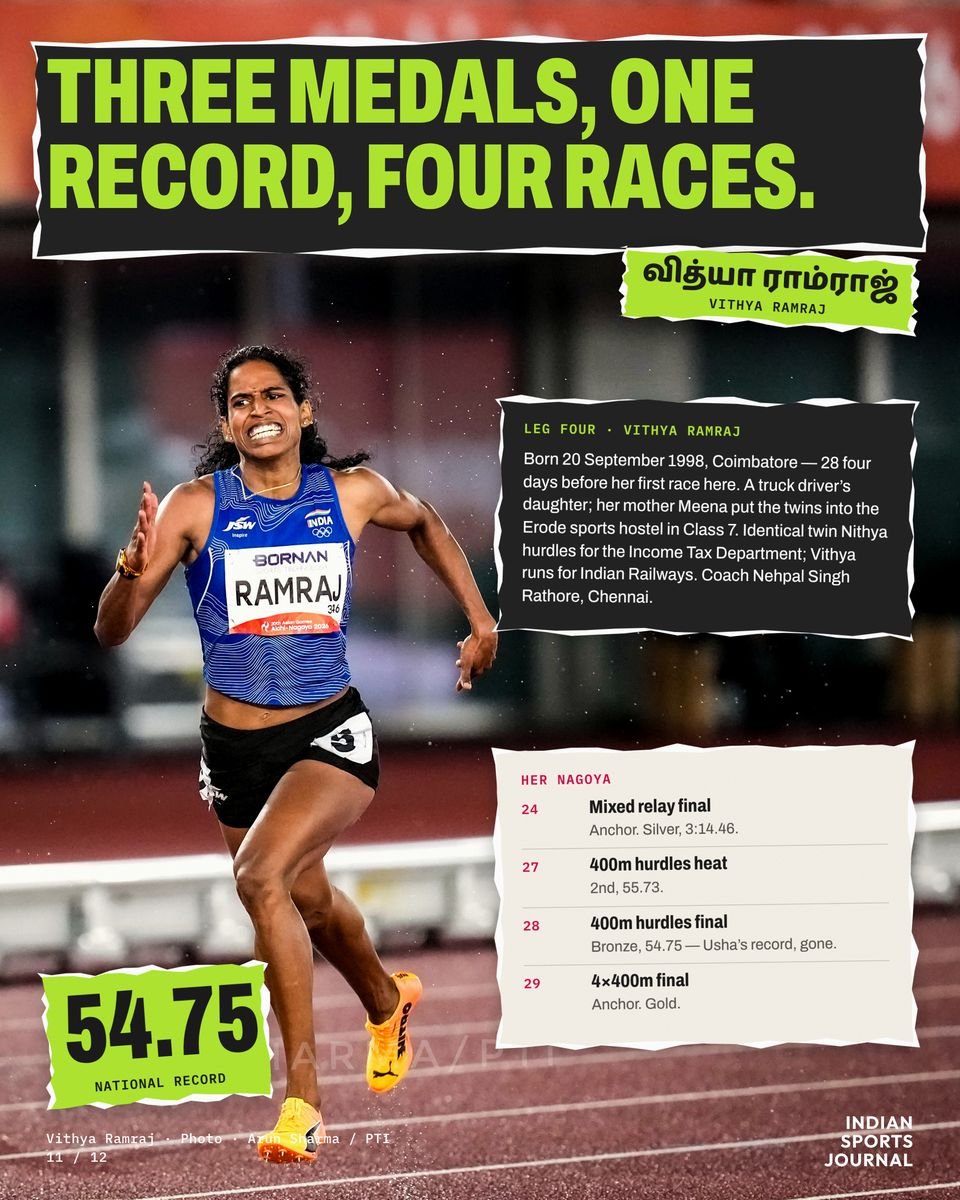
Ramraj is the subject of her own ISJ profile, so briefly: she was born in Coimbatore on 20 September 1998, a tempo driver’s daughter and an identical twin (her sister Nithya is also an athlete), and the twins went to a sports hostel in Erode from Class 7. She runs for Indian Railways and has trained under Nehpal Singh Rathore in Chennai since 2021. In Hangzhou she equalled Usha’s 400m hurdles record of 55.42, set at the 1984 Olympics. On Monday in Nagoya she broke it, running 54.75 for bronze behind the UAE’s Mariam Kareem, who won in a Games record 54.31, and Kazakhstan’s Adelina Zems. Tuesday was her fourth race in six days and her third medal of the Games. “This gold is my third medal here,” she said in remarks released through the Inspire Institute of Sport.
Twelve, and the next one
All four leave Nagoya with at least two medals. The title is India’s again, but the clock says how much further there is to go outside Asia. Bahrain’s 3:27.65 from Hangzhou is still the Games record, and in Paris two years ago an Indian quartet with Ramraj and Poovamma ran 3:32.51 and went out in the heats.
The streak itself has never depended on the same four women. It has run through Valsamma and Usha, through Manjeet Kaur, through Poovamma, and now through a lead-off from Sonipat and a hurdler from Coimbatore. The next Asian Games are in Doha in 2030. Poovamma will be 40. Naser will be 32.
The only one. The relay was India’s only athletics gold of the Nagoya Games. India finished the athletics programme with 24 medals (one gold, nine silver, 14 bronze), according to ThePrint, which named the quartet its newsmaker of the week.
Sourcing. Race and results: Aichi–Nagoya 2026 official results (women’s and mixed 4x400m relay finals; entry list for dates of birth), Sportstar (Jonathan Selvaraj’s race reconstruction, 29 September), PTI, Hindustan Times, Morung Express, National Herald, ThePrint (Triya Gulati’s newsmaker feature, and its PTI copy on the 400m), NewsBytes, Khel Now, Outlook, UNI, The Week, All India Radio and Asianet Newsable/ANI (Ramraj and Choudhary quotes). Mixed relay: Qatar Tribune, UNI, Khel Now, DD India (heat). Naser: Gulf Daily News, Wikipedia (career). Previous finals: Wikipedia results pages for 1974–2023, and ESPN (2018 anchor, Bukharina quote). Pahal: The Bridge (2022, 2024), The Tribune/PTI (2024), Wikipedia, MyKhel, GKToday. Poovamma: Wikipedia, Olympics.com (ban), circleofsport (return), The Tribune (2020 upgrade). Choudhary: Outlook, ThePrint/DT Next (PTI quote), Wikipedia. Ramraj: Wikipedia, Onmanorama.
Corrections to the carousel. Slide 9: “Best of 51.73 winning the 400m bronze at Incheon 2014” — she won that bronze in 52.36; 51.73 is her personal best, per the Incheon results and Wikipedia. Slide 10: the quote is trimmed without an ellipsis from “Today I have proved that I can also win medal in individual 400m also, that too in Asian Games” (PTI via DT Next). Slide 2: “an eight-team straight final” — nine teams ran the straight final (Hong Kong ninth, 3:43.86), per the official results, and the slide’s list of the also-rans omits Hong Kong; the rain is confirmed by Sportstar. Not verified, left out of the copy: the heat times on slide 8 (53.44) and slide 10 (53.46, “fastest non-automatic qualifier”); slide 10’s “farmer’s daughter who moved to Patiala” and “Indian Railways, with the Inspire Institute of Sport”; slide 4’s description of the 2023 anchor leg (result and anchors only, from the listed running order). Confirmed since the first draft: slide 11’s 55.73 heat on 27 September (official results); slide 11’s “mother Meena”, the Erode sports hostel and Nithya’s Income Tax Department job (PTI and Onmanorama, 2023); slide 10’s 52.57 (PTI calls it her personal and season’s best; Sportstar gives it as her August 2026 season’s best and her personal best as 52.40 from 2023); slide 1’s “Jhabiran”, Choudhary’s village in Saharanpur district (Sportstar).
Flag — the race. Slides 3 and 9 (and the leg-by-leg strip on slides 2, 3, 4 and 12) have India first after Poovamma and Choudhary. PTI (National Herald, DT Next) and Khel Now support that, and The Indian Express has Ramraj starting the last lap in the lead. Sportstar’s eyewitness reconstruction has India second behind China at both later changeovers and Ramraj taking the lead at about 200m; Hindustan Times (“When Vithya took charge, India were not in the lead”), ThePrint and Morung Express agree she set off behind. ThePrint’s “half a step behind Qatar” after leg two is an error: Qatar did not run the final (official results). Left open in the copy, which takes Sportstar’s detail where it gives it; ISJ’s Vithya Ramraj profile follows the same account. Slide 3’s title is given as “first at the finish” in the slide list. ThePrint’s newsmaker feature, quoted in the copy, was published on 3 October, after this piece’s dateline.
Flag — Poovamma’s medals. ThePrint gives “two golds, two silvers and a bronze from earlier editions” plus this gold; Sportstar gives her four Asian Games medals before Nagoya, which matches ISJ’s count from the results: 2014 relay gold and 400m bronze; 2018 relay gold and mixed relay gold (upgraded from silver in 2020); 2026 mixed relay silver and relay gold. Her ban’s start date is disputed: circleofsport reports the disciplinary order was dated 16 June 2022, while NADA appears to have counted the two years from the February 2021 sample.
Flag — Pahal’s home. The Tribune (2024) places her in Ganaur, Sonepat district; GKToday names Gumad village, Sonipat (the cover sign reads Gumar); Wikipedia gives her birthplace as Rohtak, where she trains; Sportstar says Ghummad village, Sonepat district. The copy says Sonipat district. Her father, Om Prakash, is a tehsil-court clerk in The Bridge (2022) and a farmer in Sportstar (2026).
Flag — the anchors. Naser’s anchor leg is confirmed by ESPN for 2018 and by the official results for 2026 (and for the mixed final); for 2023 it rests on the running order listed in the results. China’s anchor, Zuo Siyu, is confirmed by the official results.